

Why Zero-Party Data Is Now the Foundation of Ecommerce Customer Retention
 Anamika Kalwan
The third-party data era is over. Most DTC brands already know this. What fewer have figured out is what to replace it with and how to connect that replacement to a retention program that actually compounds.
Zero-party data is the answer. Not because it's a trend, but because it's the only data type that survives every privacy update, every inbox algorithm change, and every platform policy shift. Customers tell you what they want, you use it to send them things they care about, and retention follows.
In 2026, the brands building this infrastructure are pulling ahead. The ones still waiting to get around to it are leaking customers to competitors who already did.
What the data environment actually looks like now
Third-party cookies are largely gone. Meta's ad signal is still fractured from the iOS 14.5 fallout. Even first-party behavioral data, browse history, on-site clicks, and purchase patterns only tell you what someone did, not why they did it or what they want next.
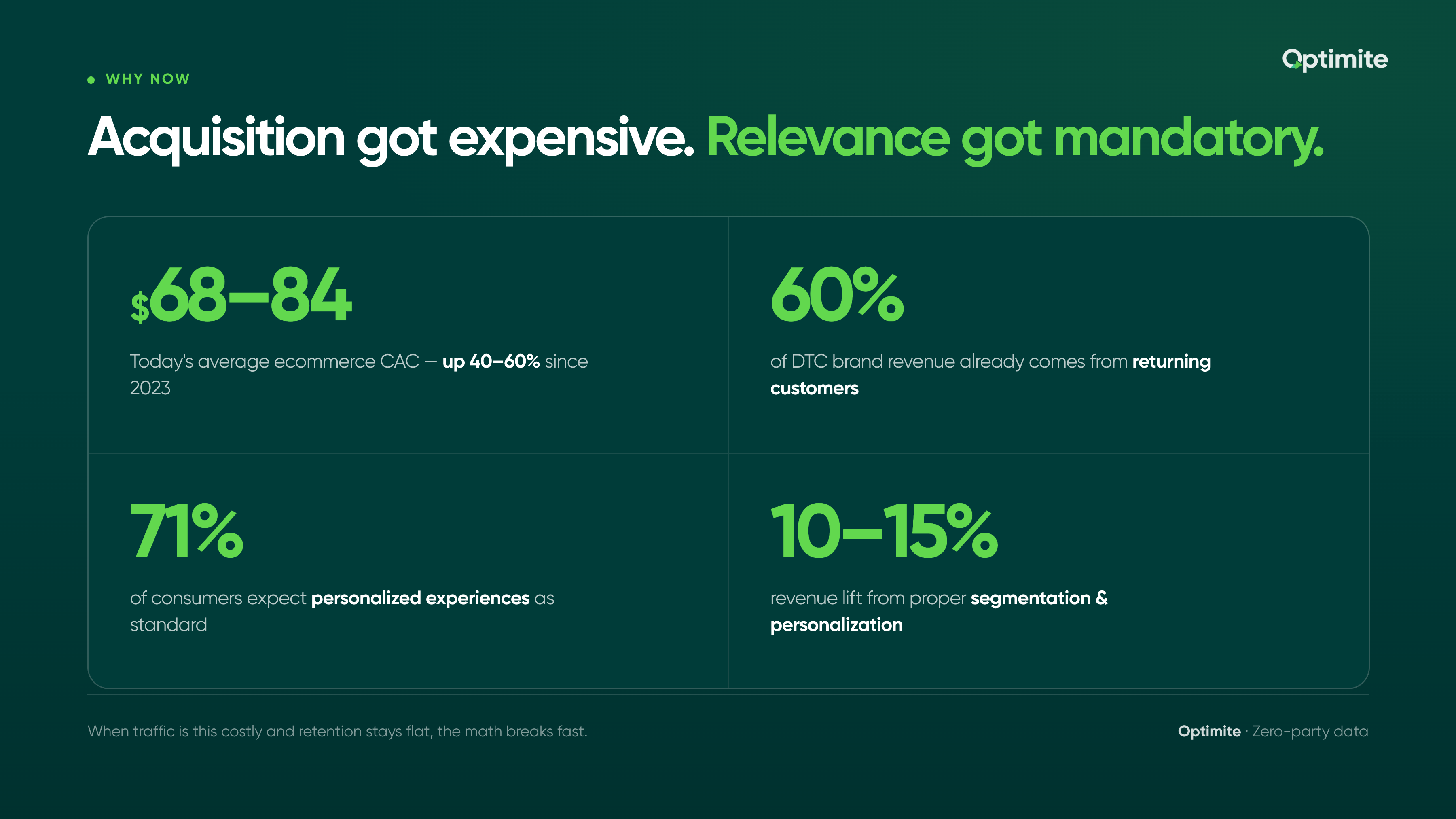
The result is a personalization problem. 71% of consumers now expect personalized experiences as standard. But the data infrastructure most brands are running on can't actually deliver that. They're guessing — using lookalike audiences built on inferred signals, sending campaigns based on what customers bought once, and calling it segmentation.
The economics are getting worse too. E-commerce customer acquisition costs increased 40-60% from 2023 to 2025, now averaging $68-$84. When paid acquisition is that expensive and retention rates stay flat, the math breaks fast. 60% of DTC brand revenue already comes from returning customers. You can't afford to keep losing them to irrelevance.
Bain & Company data shows that increasing customer retention by just 5% can grow profits by 25-95%. The brands doing this in 2026 aren't spending more on acquisition. They're building better data relationships with the customers they already have.
Zero-party data fixes the signal problem at the root. It's information customers give you directly and intentionally: their skin type, their goals, their preferred communication frequency, how they use your product. Unlike behavioral data, it doesn't need to be inferred or modeled. The customer told you. That's as accurate as data gets.
The three collection points most brands skip
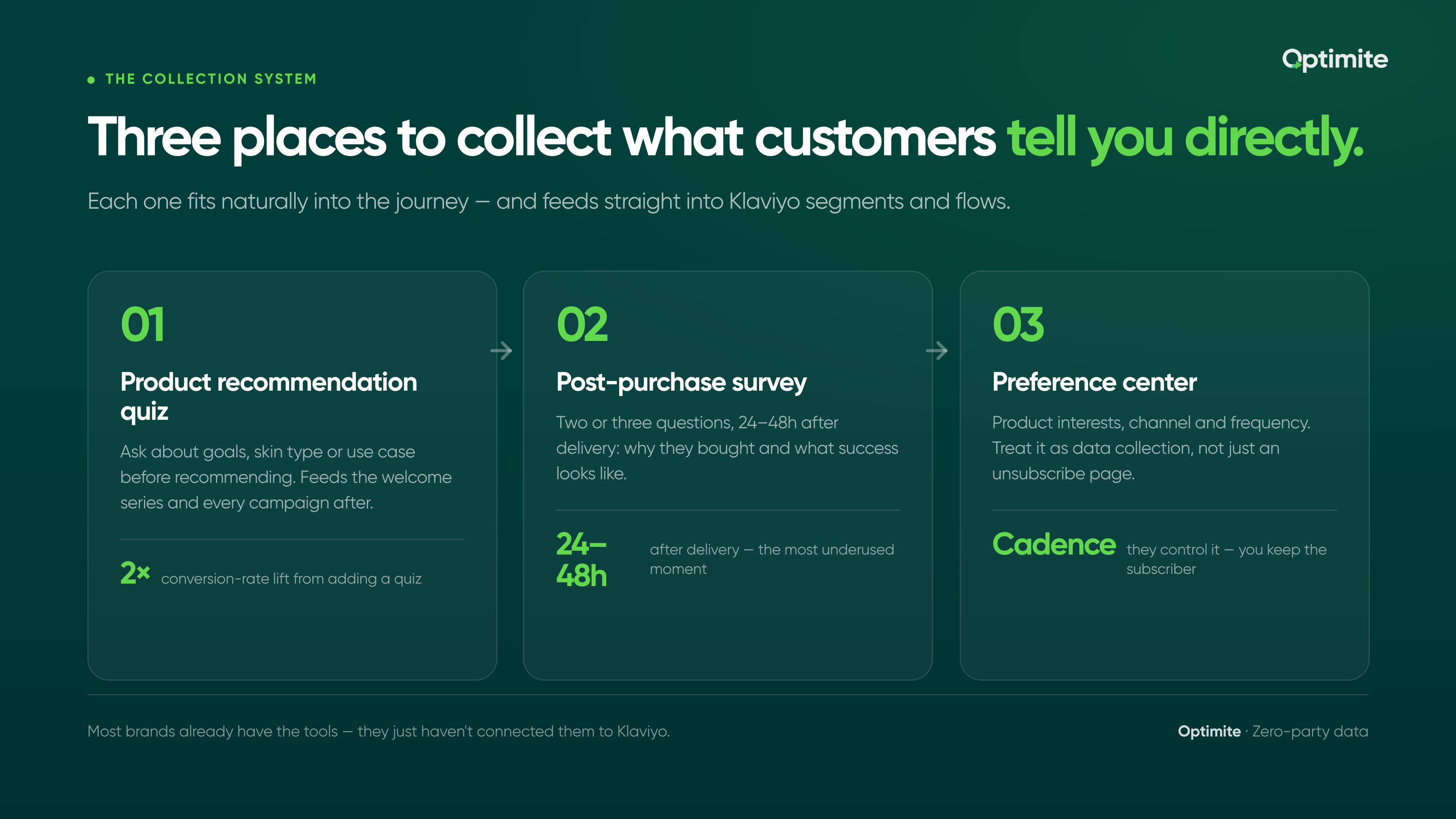
Zero-party data collection sounds like a big lift. In practice, there are three places it fits naturally into the customer journey that most brands either haven't built or have underinvested in.
1. The product recommendation quiz
Product recommendation quizzes have emerged as the single most effective zero-party data collection mechanism in e-commerce. A wellness brand asking about health goals before recommending a supplement stack. A beauty brand asking about skin type and concerns before surfacing a routine. A home brand asking about living situation and aesthetic before recommending a collection.
The quiz does two jobs at once: it collects structured data that feeds directly into Klaviyo segmentation, and it creates a better first impression than any generic homepage. One DTC brand saw a 2x conversion rate lift from adding a quiz to their customer journey. The data that flows out of it powers the welcome series, the first post-purchase recommendation, and every subsequent campaign that references what the customer actually wants.
2. The post-purchase survey
Most brands send an order confirmation and nothing else. A two or three-question post-purchase survey sent within 24-48 hours of delivery is one of the most underused data collection moments in e-commerce.
Questions like "What made you choose us?" and "What are you hoping this product does for you?" tell you exactly why someone bought and what they're measuring success against. For a food and beverage brand, that's the difference between sending a generic replenishment email and sending one that references the specific goal the customer told you they were working toward. The open rate difference is not small.
3. The preference center
Preference centers let customers control their communication preferences, which fosters trust and improves retention. Most brands treat the preference center as an unsubscribe alternative. The brands using it well are treating it as a data collection moment, asking about product interests, communication frequency, channel preference (email vs. SMS), and life stage.
Rather than losing a subscriber tired of irrelevant emails, a preference center gives them control over their experience. In return, you get the data needed to make every future interaction relevant.
How to actually use this data in Klaviyo
Collecting zero-party data is the easy part. The harder part is making sure it flows into Klaviyo in a way that changes what you send and when.
Here's what that looks like in practice:
- Quiz responses as profile properties. Tool answers skin type, health goal, usage frequency, and aesthetic preference should be written directly to Klaviyo profile properties via your quiz platform (Octane AI, Typeform, Jebbit). These properties then become segment conditions, flow triggers, and personalization variables in email copy.
- Survey data informing flow logic. If a post-purchase survey tells you a customer bought for a specific use case, the next email they receive should reference it. A conditional split in your post-purchase flow can branch by stated goal, sending a different email sequence to someone who bought a protein supplement to lose weight versus someone building muscle. Same product, completely different message.
- Preference center data controlling send cadence. If a customer tells you they only want emails once a week, honor that and tag them accordingly. The brands sending four emails a week to subscribers who asked for one are not winning on retention; they're burning list health.
Map every quiz question to a specific Klaviyo profile property before you launch the quiz. If you can't answer "how does this response change what we send this person?" for each question, cut the question. Data you collect but don't use is just list hygiene debt.
Across the 500+ brands we've worked with as a retention marketing agency, the brands getting the most out of zero-party data share one trait: they built the data architecture before building the quiz. The collection tool is almost irrelevant. What matters is that the data lands in the right place and triggers the right thing.
The segmentation shift this makes possible
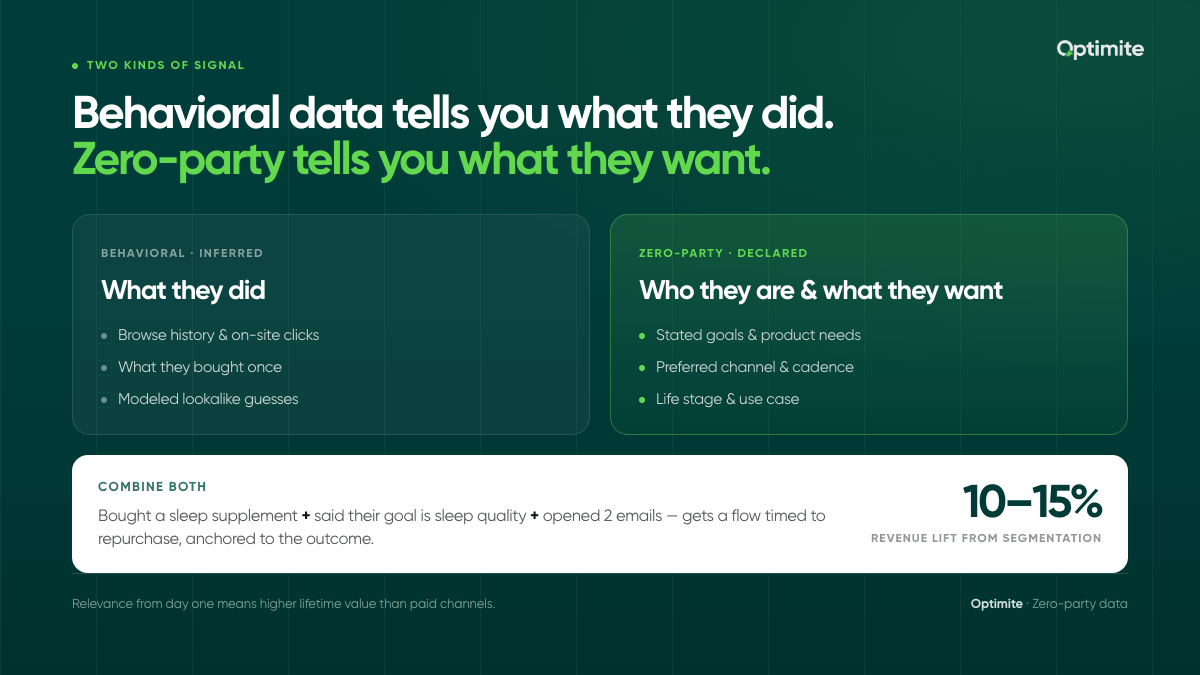
Standard Klaviyo segmentation engaged 60 days, purchased twice, added to cart but didn't buy is behavioral. It tells you what someone did. Zero-party data tells you who they are and what they want. Combine both, and the segmentation becomes genuinely specific.
A wellness brand we work with built segments that cross behavioral data with quiz responses: customers who purchased a sleep supplement, who stated their goal was sleep quality, and who have opened at least two emails in the last 30 days. That segment gets a flow timed to the repurchase window with copy anchored to sleep quality outcomes, not product features. Customers acquired through a zero-party data interaction generate significantly higher lifetime value compared to those acquired through standard paid channels, because the relationship starts with relevance.
The same logic applies to campaigns. Blanket sends to your full list treats a first-time buyer and a five-time loyal customer identically. When you layer in stated preferences and goals:
- A beauty customer who said they're focused on anti-aging gets different product recommendations than one who said they're managing acne
- A fashion customer who selected "minimalist" in their style quiz doesn't get the maximalist new-arrivals email
- A food and beverage customer who bought for meal prep sees a different recipe campaign than someone who bought for on-the-go snacking
Brands using proper segmentation strategies see 10-15% revenue lifts from personalization. That's not a rounding error for a brand doing $3M-$10M in revenue.
Don't launch a quiz, collect 5,000 responses, and leave the data sitting in a spreadsheet. This happens more often than it should. If your quiz tool doesn't have a direct integration with Klaviyo, build the Zapier or native API connection before you turn the quiz on. Retroactively backfilling profile data is messy and often incomplete.
What this means for list growth
Zero-party data doesn't just improve what you send; it changes how you grow your list. A quiz-based pop-up consistently outperforms a standard discount pop-up on opt-in quality, not always on volume, but on the value of who opts in.
A "What's your skin type?" quiz pop-up on a beauty brand's homepage collects an email and a profile property in the same interaction. The subscriber gets a personalized product recommendation immediately. You get an email address attached to real preference data. Compare that to a "10% off your first order" pop-up, which collects an email address and nothing else.
The list growth payoff compounds over time. A list built on preference data generates better open rates, better click rates, and lower unsubscribe rates than one built on discount incentives alone. Deliverability improves as a result. So does every revenue-per-send metric.
One retail brand summarized its value exchange in 15 words on signup and lifted email capture rate by 22%. The data they collected in that interaction powered segmentation that changed their entire campaign strategy.
The brands that do this now will be harder to compete with later
Zero-party data compounds. A brand that starts collecting structured preference data in 2026 will have 12-18 months of profile enrichment by the time its competitors get started. The lifecycle flows they build on top of it will be more personalized, the segments sharper, the campaigns better-targeted.
Every day spent chasing diminishing third-party signals is a day you could have spent building an owned data asset that grows in value over time.
The retention infrastructure for a DTC brand doing $2M-$15M is not as complicated as it sounds. You need three things: a structured way to collect what customers tell you, a Klaviyo setup that uses that data in flows and segments, and a campaign cadence that reflects it. The quiz, the post-purchase survey, and the preference center get you there. Most brands already have the tools. They just haven't connected them.
If your retention program is running on behavioral data alone, you're leaving a significant segment of personalization potential untouched. The customers on your list will tell you what they want. You just have to ask.
Want to know where your retention program has gaps? Book a free retention call and we'll show you exactly where zero-party data can change your numbers.
Keep reading.
All posts
What to Do With First-Time BFCM Buyers Before They Go Cold
Shrestha Ghosal · Jun 16, 2026

5 Signs Your Post-Purchase Flow Is Leaving Repeat Revenue on the Table
Shrestha Ghosal · Jun 10, 2026

What Buyer's Anxiety Is Costing Your Retention Rate
Shrestha Ghosal · Jun 8, 2026