

What Buyer's Anxiety Is Costing Your Retention Rate
Most repeat purchase problems don't start at the win-back stage. They start in the 48 hours after the first order.
 Shrestha Ghosal
Most repeat purchase problems are diagnosed in the wrong place. Brands look at their win-back flow, adjust the discount, and rethink the subject line. They test send times. They A/B the CTA. The repeat purchase rate barely moves.
The real problem is often much earlier. It happens in the 24 to 72 hours after the first order ships, when a customer who was excited to buy starts quietly second-guessing themselves. This is buyer's anxiety, and if your post-purchase email flow doesn't address it directly, you're losing repeat buyers before they've even received their first order.
This post covers what buyer's anxiety actually is, how to spot it in your retention data, and what a flow built to counter it looks like in practice.
What buyer's anxiety actually is
Buyer's anxiety is the uncomfortable mental conflict a customer feels after placing an order. It's sometimes called buyer's remorse, but that framing is slightly off. Remorse suggests they regret the purchase outright. Buyer's anxiety is subtler. The customer wanted the product. They bought it. But now two competing feelings are pulling in opposite directions: the excitement that drove the purchase and the second-guessing that follows it.
This happens because buying something triggers a conflict between two things the brain holds at the same time:
- The desire that drove the purchase (I want this, I need this, this is the right choice)
- The uncertainty that follows it (Was this worth it? Did I choose the right brand? What if it doesn't work?)
A customer who just spent £65 on a supplement they've never tried, or $120 on skincare from a brand they discovered on Instagram, will almost always experience some version of this. The product hasn't arrived yet. They can't validate the decision.
According to research published in the Journal of Consumer Research, this kind of post-purchase second-guessing is strongest for high-involvement purchases, first-time buyers with a new brand, products where results take time to appear, and categories where social proof matters (wellness, beauty, fitness). These are exactly the categories where most DTC brands operate.
How it shows up in your retention data
You won't see "buyer's anxiety" as a metric in Klaviyo. But the fingerprints are there if you know what to look for.
The clearest signal is a gap between first-purchase conversion rate and second-purchase rate that's larger than your vertical benchmark. If 35% of your customers buy once and fewer than 15% buy again within 90 days, something is breaking in that first post-purchase window. In wellness and beauty, a healthy second-purchase rate within 90 days sits between 25 and 35%. Anything significantly below that deserves scrutiny.
Other signals to check:
- High unsubscribe rates on post-purchase emails, particularly in the first 7 days
- Low open rates on emails sent 48 to 72 hours after purchase
- Elevated refund or return rates on first orders compared to repeat orders
- Customer support volume spiking in the days after delivery
- Low click rates on product education emails despite strong open rates
None of these individually confirms buyer's anxiety is the issue. But if you're seeing two or three of them together in the days right after purchase, your customer retention problem may have more to do with the post-purchase experience than with your win-back or re-engagement strategy.
The 48-hour window most brands miss
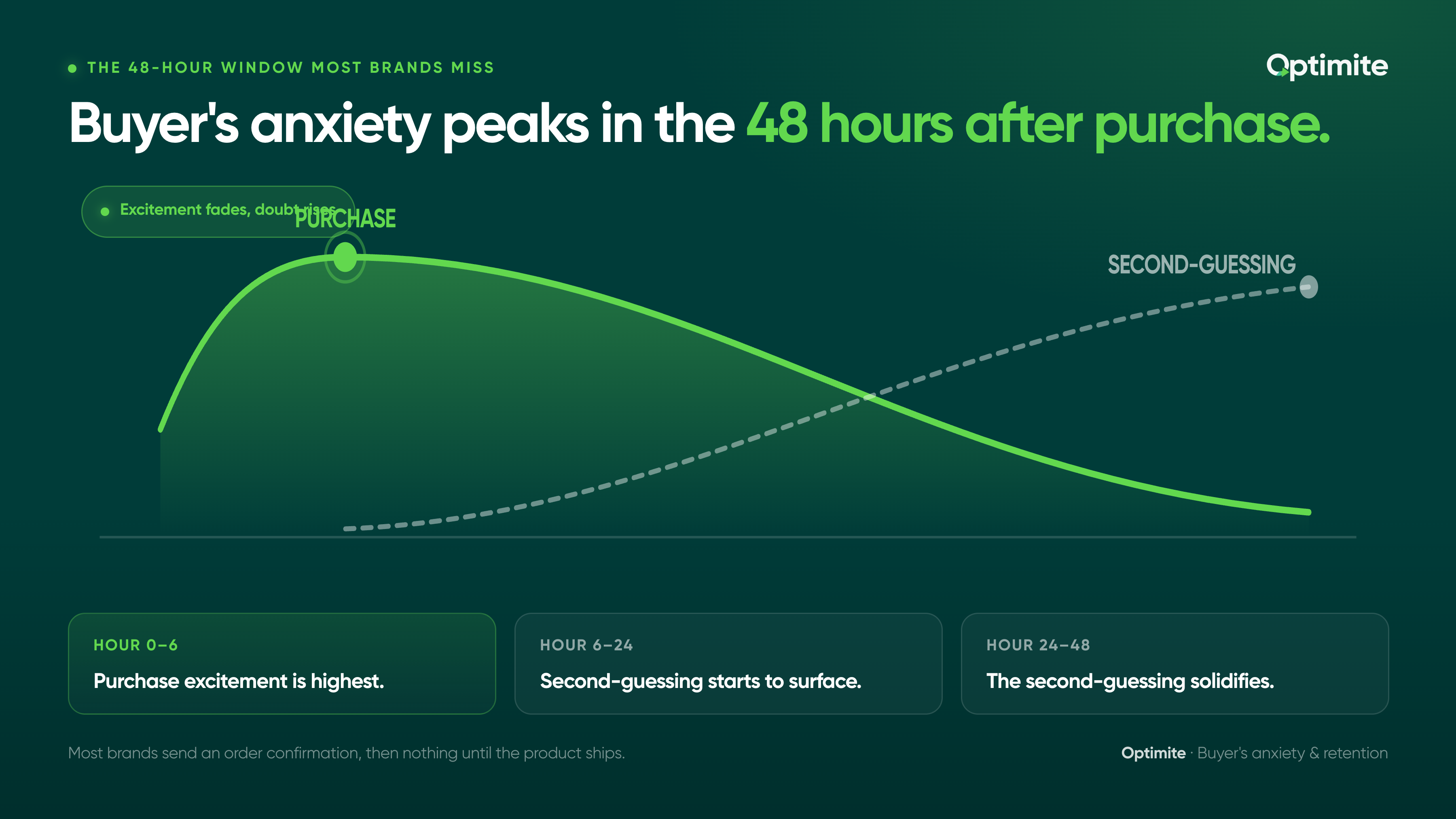
The window that matters most is the 48 hours after an order is placed, before the product arrives. This is when buyer's anxiety peaks. The customer has committed to the purchase but hasn't yet received the payoff. They're in a kind of psychological limbo.
Most brands send an order confirmation (automated by Shopify) and then nothing until the product ships. That silence makes the second-guessing worse. The 48 hours after purchase is when your brand should be most present, not quiet.
What's happening in a customer's head during that window:
- Hour 0-6: Purchase excitement is highest. They may browse your site again, check their email for the confirmation, or tell someone about the purchase.
- Hour 6-24: Second-guessing starts to surface. They may Google the brand, look for reviews, and check Reddit. If they don't find reassurance, the anxiety compounds.
- Hour 24-48: If nothing from you has reinforced the decision, the second-guessing solidifies. By the time the product arrives, they've already mentally downgraded their expectations.
The brands that win at customer retention in wellness, beauty, and fashion understand this window intuitively. They don't wait for delivery to start the relationship. They fill the silence with content that does one job: confirm that the customer made a good decision.
What an anxiety-aware post-purchase flow looks like
A standard Klaviyo post-purchase flow typically looks like this: order confirmation (handled by Shopify), shipping notification, delivery confirmation, review request 7-10 days later. That's a fulfilment flow, not a retention flow. It does nothing to address how a customer is feeling.
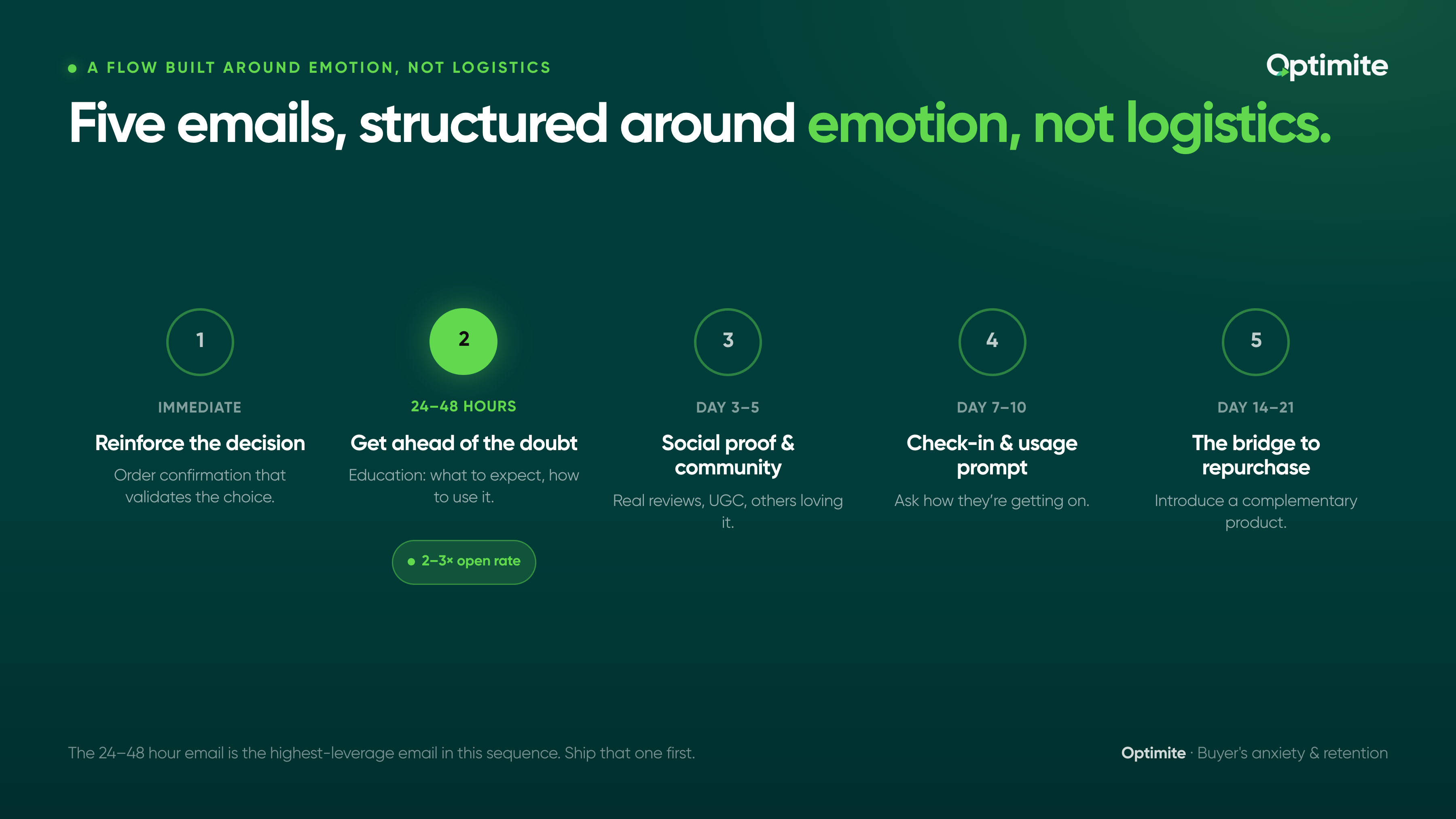
A flow built around buyer's anxiety is structured around emotion, not logistics. Here's how the sequence changes:
- Immediate: Order confirmation with reinforcement, not just a receipt. A short line that validates the decision: "You picked well. Here's why this works."
- 24-48 hours: An email that gets ahead of the second-guessing. Education about the product, what to expect, how to use it correctly, and what success looks like in the first 30 days. No upsell here.
- Day 3-5 (around delivery): Social proof and community. Real reviews, UGC, or a "others are loving this" moment that anchors the customer in a shared experience.
- Day 7-10: Check-in and usage prompt. Ask how they're getting on. For supplements and skincare especially, this email catches people before they've formed a habit and gently pushes them toward consistent use.
- Day 14-21: The bridge to repurchase. By now, they've used the product. If the earlier emails have done their job, this is the right moment to introduce a complementary product or subscription option.
The 24-48 hour email is the highest-leverage email in this sequence. Across the post-purchase flows we've built for 500+ brands, this email, when written around education rather than promotion, consistently produces open rates 2-3x higher than the review request. Ship that one first if you're rebuilding.
The emails that fix it and what most brands send instead
The difference between an anxiety-aware email and a standard post-purchase email comes down to the job the email is trying to do.
Most brands send emails that serve the brand's interests: leave a review, refer a friend, here's 10% off your next order. Those emails arrive before the customer has fully committed to the product. They ask for something before they've delivered value.
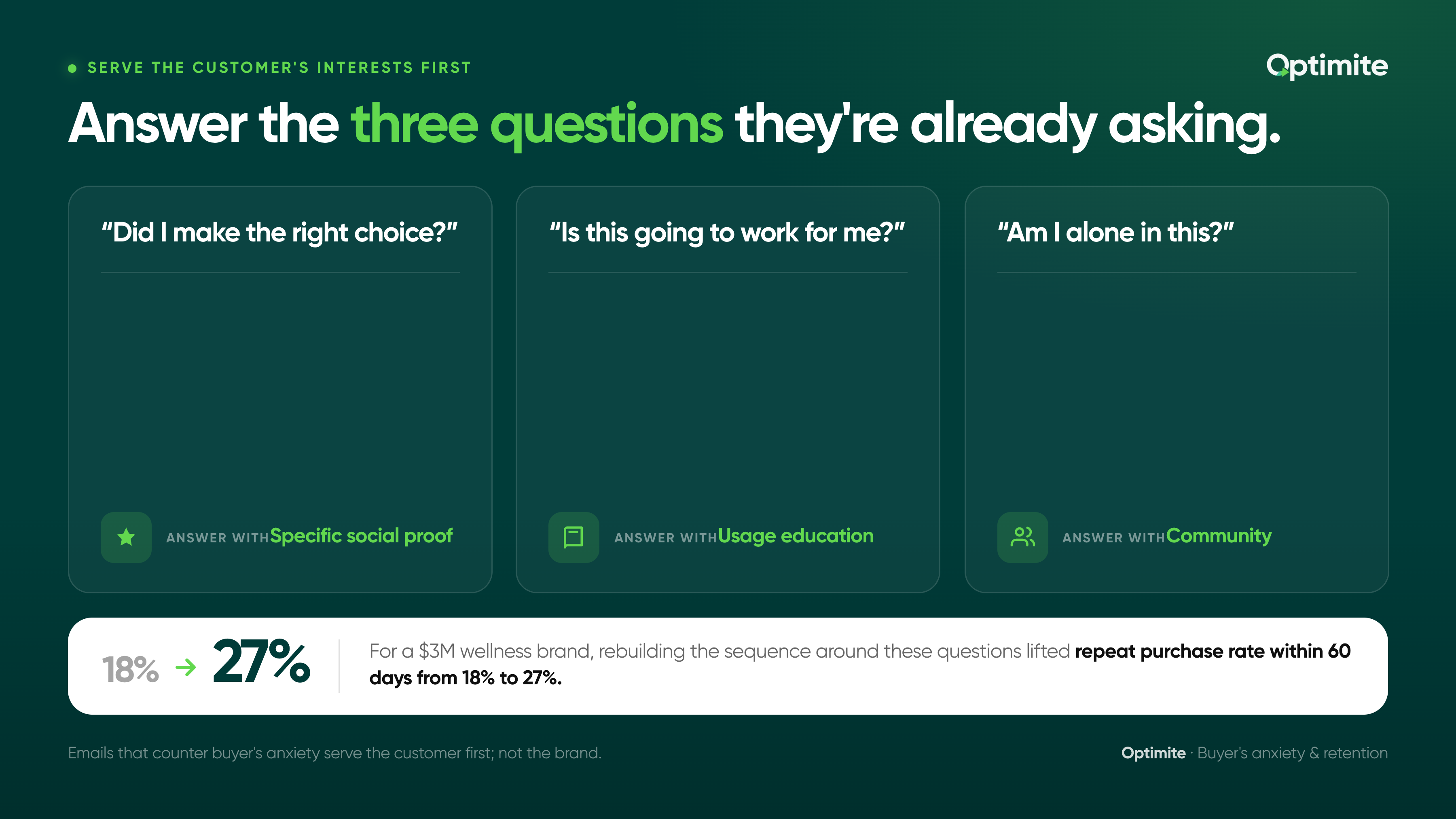
Emails that counter buyer's anxiety serve the customer's interests first. They answer the questions the customer is already asking:
- "Did I make the right choice?" Answer with specific social proof: real reviews, before/after, numbers where you have them.
- "Is this going to work for me?" Answer with usage education: how to use the product, what results to expect and when, common mistakes to avoid.
- "Am I alone in this?" Answer with community: other customers' experiences, UGC, the brand story in a way that the customer can see themselves in.
For a wellness brand doing $3M in annual revenue, we rebuilt the post-purchase sequence around these three questions. The 24-hour email became a straight education piece: what the supplement does, how long until you notice it, what to pair it with. No CTA beyond "reply if you have questions." Repeat purchase rate within 60 days increased from 18% to 27%.
That's not a small number. On a $3M brand with a 40% gross margin, closing a 9-point gap in repeat purchase rate is worth six figures annually. The email itself took two hours to write.
How to know if buyer's anxiety is your problem
Before rebuilding anything, run a quick check on your current post-purchase window. You need three things from your analytics:
- Your 60-day second-purchase rate for first-time buyers. If you don't have this segmented out, build it in Klaviyo now. It's the most important retention metric you're probably not tracking at this level of specificity.
- Your open and click rates on every email sent in the first 7 days post-purchase. Low opens on day 1-2 suggests the email isn't resonating. Low clicks on day 3-5 suggests the content isn't connecting.
- Your refund and return rate split by new vs. returning customers. If first-time buyers return at a notably higher rate than repeat buyers, buyer's anxiety is almost certainly a factor.
This applies across verticals but the timelines vary. For fashion brands with a 45-day repurchase window, the anxiety window is shorter and the social proof angle matters more. For supplement brands where results take 30-60 days to appear, the education sequence needs to run longer and explicitly set expectations about timeline. For CBD and wellness, regulatory constraints shape what you can say, but the emotional structure of the sequence is the same.
If your second-purchase rate is below benchmark and your post-purchase emails aren't addressing buyer's anxiety directly, that's your starting point. Not the win-back flow. Not the campaigns. The 48-hour email that most brands haven't shipped yet.
The e-commerce lifecycle marketing stack only compounds when the foundation is solid. A customer who converts once and feels good about it is five times easier to retain than a customer you have to win back. Fix the first window, and the rest of the retention system gets easier.
Want to know what your post-purchase flow is actually costing you? We work with DTC brands every week to find and fix exactly these gaps. If your second-purchase rate is below 25%, there's almost always something fixable in the first 7 days. Book a free call to find out where yours is leaking.
Keep reading.
All posts
What to Do With First-Time BFCM Buyers Before They Go Cold
Shrestha Ghosal · Jun 16, 2026

5 Signs Your Post-Purchase Flow Is Leaving Repeat Revenue on the Table
Shrestha Ghosal · Jun 10, 2026

8 Psychology Principles That Drive Ecommerce Customer Retention
Anamika Kalwan · Jun 5, 2026