

8 Psychology Principles That Drive Ecommerce Customer Retention
 Anamika Kalwan
8 min read By Anamika Kalwan
Here's something I see constantly. A brand sets up their flows, builds out a discount ladder, sends campaigns every two weeks, and then wonders why their repeat purchase rate is stuck at 18%.
The problem usually has nothing to do with the platform or the send frequency. Most brands treat ecommerce customer retention like a logistics problem. Get the right offer to the right person at the right time and the second order follows. Sometimes that works. Mostly it doesn't.
The brands generating 30-35% of their revenue from email have figured out something worth paying attention to: customers don't come back because of your discount code. They come back because of how your brand made them feel.
That feeling has real psychology behind it. Once you understand these principles, you stop guessing at what to send and start building a retention marketing strategy that works with how the human brain actually makes decisions.
Here are 8 principles worth actually knowing, and what each one means for your programme.
The Endowment Effect: they're already attached the moment they buy
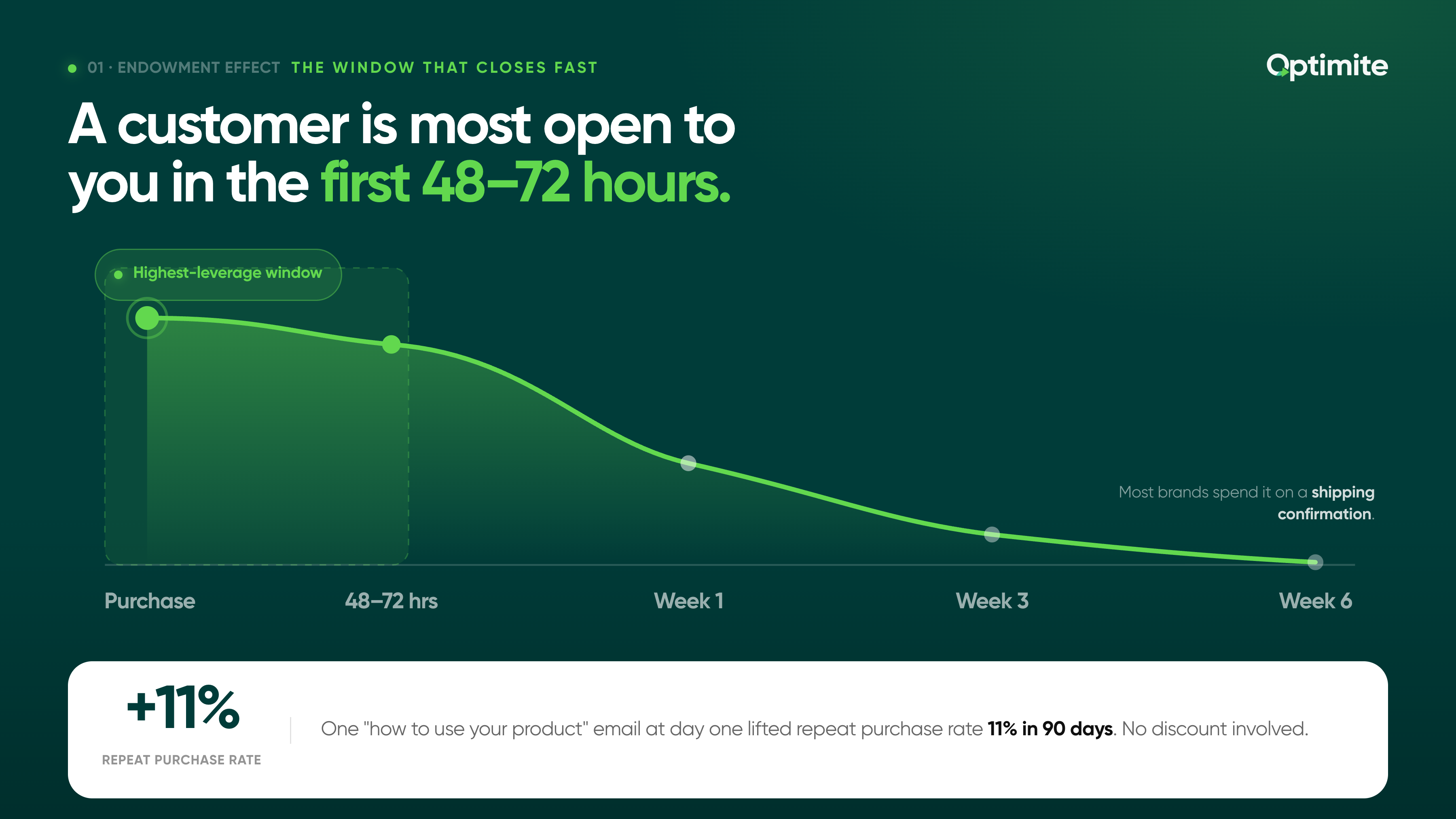
The second someone places an order, something shifts. They start valuing what they own more than they did before they owned it. Psychologists call this the Endowment Effect, and it has a very direct implication for ecommerce customer retention.
That customer who just bought from you? They're more open to your brand right now than they'll ever be again. The first 48-72 hours after purchase is the highest-leverage window in the entire lifecycle. Most brands waste it on a shipping confirmation.
What to do with it instead:
- Send an email at the 24-hour mark that helps them get value from what they just bought
- Reinforce the decision with content, not another offer
- Make them feel good about what they own before you ask for anything else
A wellness brand we work with added a single "how to use your product" email at day one. Repeat purchase rate lifted 11% in 90 days. No discount involved. The post-purchase email flow is the single highest-leverage moment in the customer lifecycle and most brands treat it like an afterthought.
Variable reward loops: why predictable discounts stop working over time
Think about why people scroll Instagram more than they check their email. Instagram is unpredictable. You don't know if the next post will be interesting or not. That uncertainty is the point. It's a variable reward loop, and it keeps people coming back.
Most loyalty programmes do the exact opposite. Buy five times, get 10% off. Every time. No surprise, no delight, just a transaction with extra steps. This is one of the most common patterns I see when auditing brands who wonder why their repeat purchase rate has plateaued.
The brands doing this well mix it up deliberately:
- Surprise gift-with-purchase emails that go out with no pattern customers can predict
- Random "just because" offers sent to high-value segments mid-month
- Exclusive early access that drops without warning
B.F. Skinner's research on variable reinforcement schedules showed that unpredictable rewards produce stronger, more persistent behaviour than fixed ones. That applies directly to how customers engage with your email flows. The unpredictability is the strategy.
The Peak-End Rule: customers only remember two moments from every experience
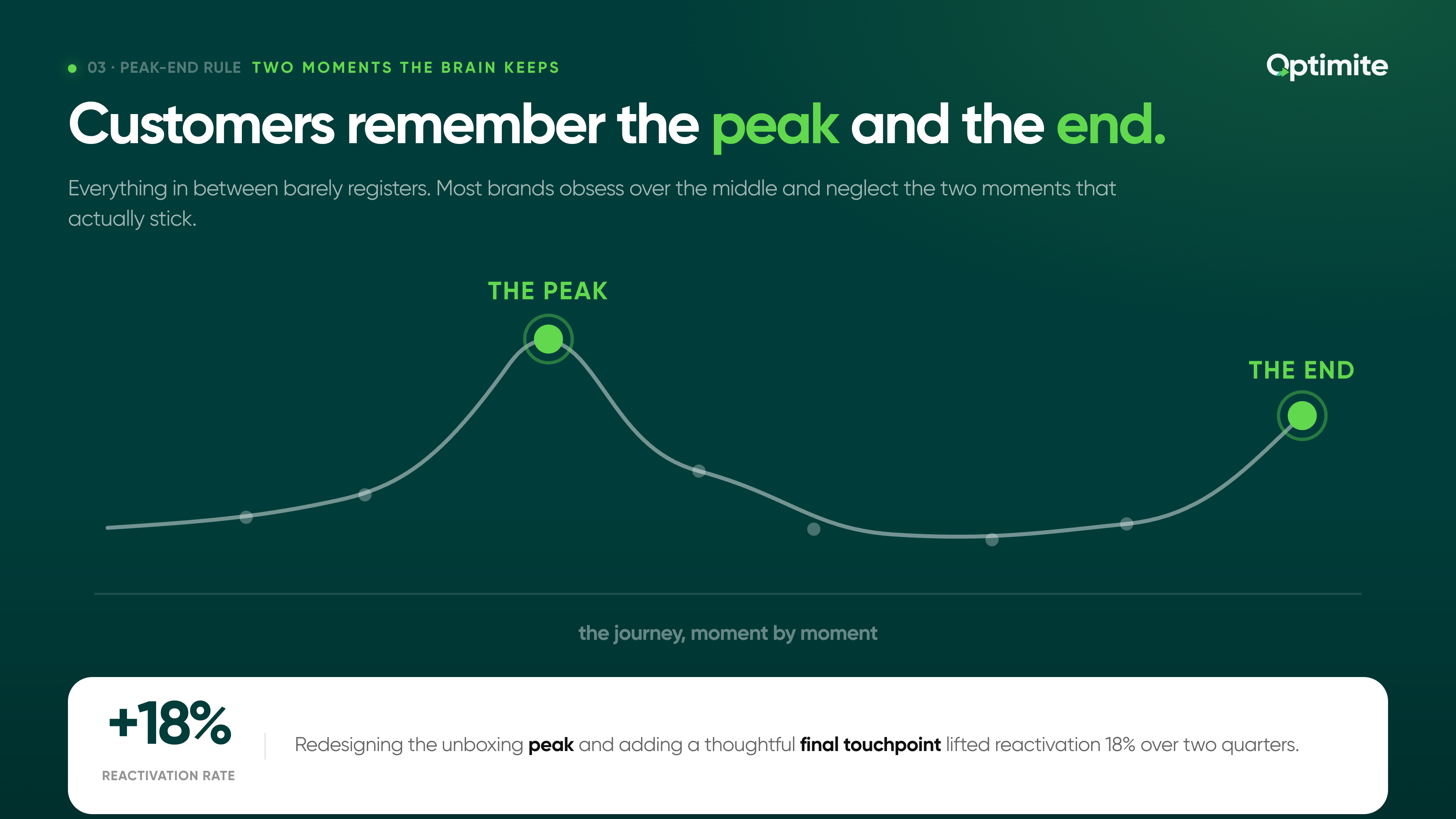
Nobel Prize-winning psychologist Daniel Kahneman found that people judge an experience almost entirely on two things: the peak moment and the ending. Everything in between barely registers.
I think about this every time I audit a brand's customer journey. They've obsessed over the middle, the nurture emails, the campaign cadence, the segmentation logic, and completely neglected the two moments the brain actually holds onto.
Ask yourself honestly:
- What is the most emotionally charged moment of buying from your brand?
- What is the last thing a customer experiences before they go quiet?
If the peak is a forgettable brown box and the ending is a generic "we miss you" email three months later, you haven't given the brain anything to remember.
A fashion brand we work with redesigned their unboxing experience and added a thoughtful final touchpoint before the win-back window. Reactivation rate on that segment improved 18% over two quarters. That's the Peak-End Rule doing its job.
Post-purchase cognitive dissonance: the doubt that kills the second order
Almost every customer goes through this. The order goes through, the money leaves the account, and a small voice says: "Did I actually need that?"
That's cognitive dissonance. And for brands trying to increase repeat purchase rate in ecommerce, it's a direct threat because most brands leave customers alone with that doubt.
A purely transactional post-purchase sequence (order confirmed, shipped, delivered) does nothing to resolve the anxiety a customer feels after spending. By the time your replenishment email arrives six weeks later, they've already half-talked themselves out of buying again.
The fix is straightforward:
- Reinforce the decision with social proof. "You're in good company, over 12,000 customers bought this in the last 30 days."
- Set expectations for results. "Here's what to expect in your first week."
- Normalise the repurchase before it's needed. "Most of our customers reorder around week 6. Here's why."
The goal is simple. Make customers feel smart for buying, not anxious about it.
The Zeigarnik Effect: "almost there" drives more action than "you've earned it"
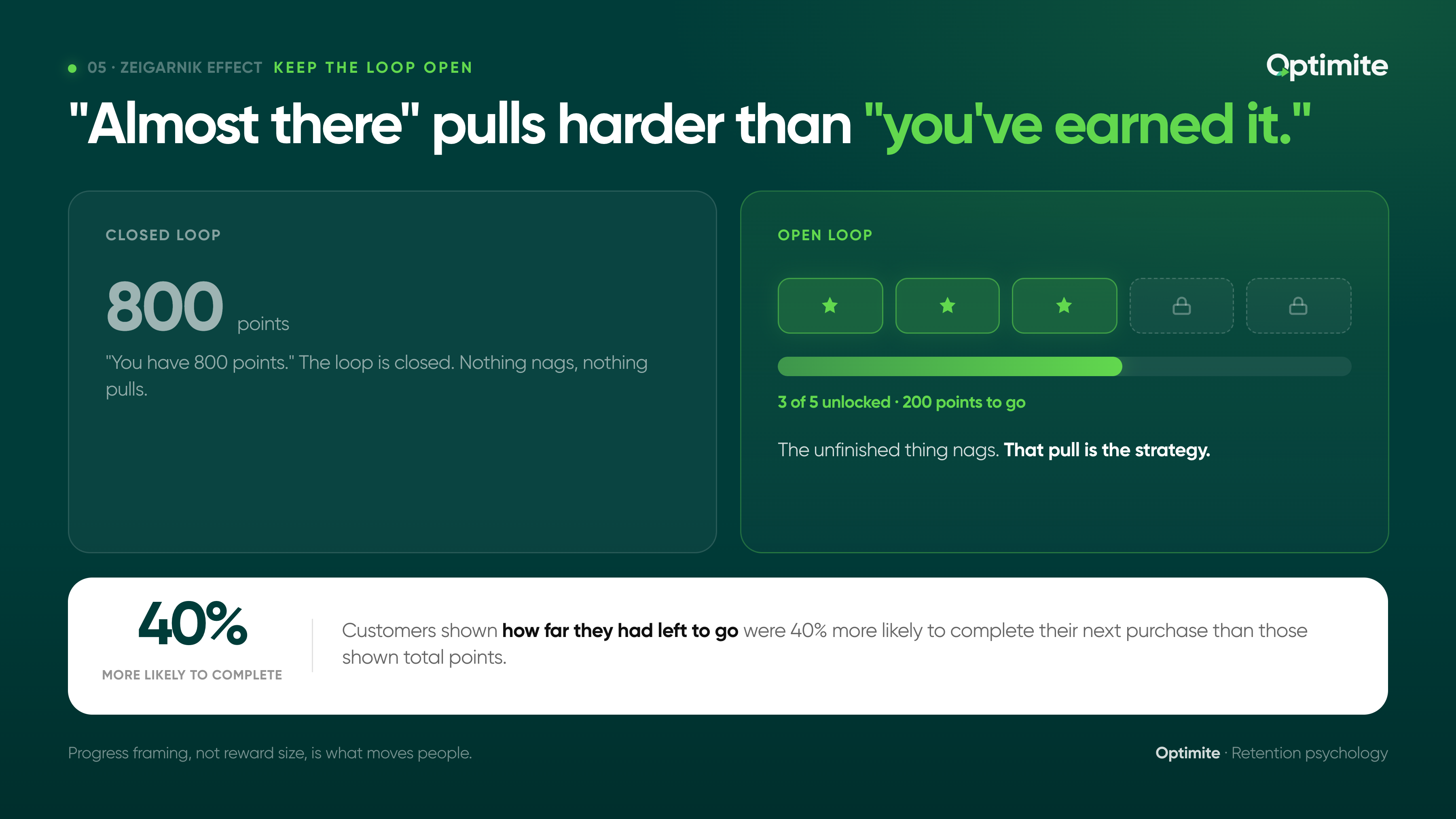
In the 1920s, psychologist Bluma Zeigarnik noticed that waiters could remember unpaid orders in detail but forgot them the moment the bill was settled. The brain keeps an open loop for unfinished things. That loop nags. It pulls.
Most loyalty programmes use this backwards. "You have 800 points" closes the loop. "You're 200 points away from your next reward" keeps it open. One drives action. The other doesn't.
Research published in the Journal of Consumer Research found that customers shown how far they still had to go in a loyalty programme were 40% more likely to complete their next purchase than customers shown their total accumulated points. Progress framing, not reward size, is what moves people.
This shows up across ecommerce lifecycle marketing more broadly:
- "You've unlocked 3 of 5 rewards" pulls harder than "You've earned a reward"
- Progress bars in emails, even simple ones, outperform static point balances consistently
- "Your VIP tier expires in 12 days" hits differently than "You're a VIP member"
Social Identity Theory: customers buy who a product makes them, not just what it does
Henri Tajfel's Social Identity Theory says people define part of who they are through the groups they belong to. Applied to ecommerce customer retention: your customers aren't just buying a product. They're buying membership in something that reflects who they are or who they want to be.
A customer buying from a sustainable skincare brand isn't just buying moisturiser. They're signalling something about their values. A customer buying from a premium fitness supplement brand is buying an identity as someone serious about their health.
The brands that understand this build retention around identity reinforcement, not product reminders:
- "You've been part of our community for 6 months" lands differently than "You haven't ordered in 6 months"
- User-generated content in flows showing people like them using the product reinforces belonging
- Content that celebrates who the buyer is outperforms product-push emails on engagement every time
This is especially relevant in wellness, beauty, and fitness verticals, where identity sits at the centre of the purchase decision. If your lifecycle flows don't reflect that, you're treating an identity purchase like a commodity purchase.
The Mere Exposure Effect: showing up consistently is a retention strategy on its own
Robert Zajonc's research showed something counterintuitive: we develop a preference for things simply because we've been exposed to them repeatedly. No pitch. No offer. Just presence.
This is what a consistent email cadence actually does for your brand over time. Every send, even the ones with low click rates, is building a familiarity baseline that directly supports customer lifetime value in ecommerce. Customers who see your brand in the inbox regularly are more likely to think of you when the repurchase moment comes, even if they didn't click the last four emails.
What this looks like practically:
- Going quiet for 60 days and blasting a discount does less than staying present at lower intensity throughout the same period
- A bi-weekly value email, tips, content, community updates, keeps the familiarity loop running between purchase cycles
- Deliverability matters here. An email landing in spam does nothing for familiarity and damages your sender reputation over time
Most brands only email when they have something to sell. The brands with strong customer lifetime value email when they have something worth reading. Customers feel the difference even when they can't articulate it.
Loss aversion: the most powerful lever in retention, used backwards by most brands
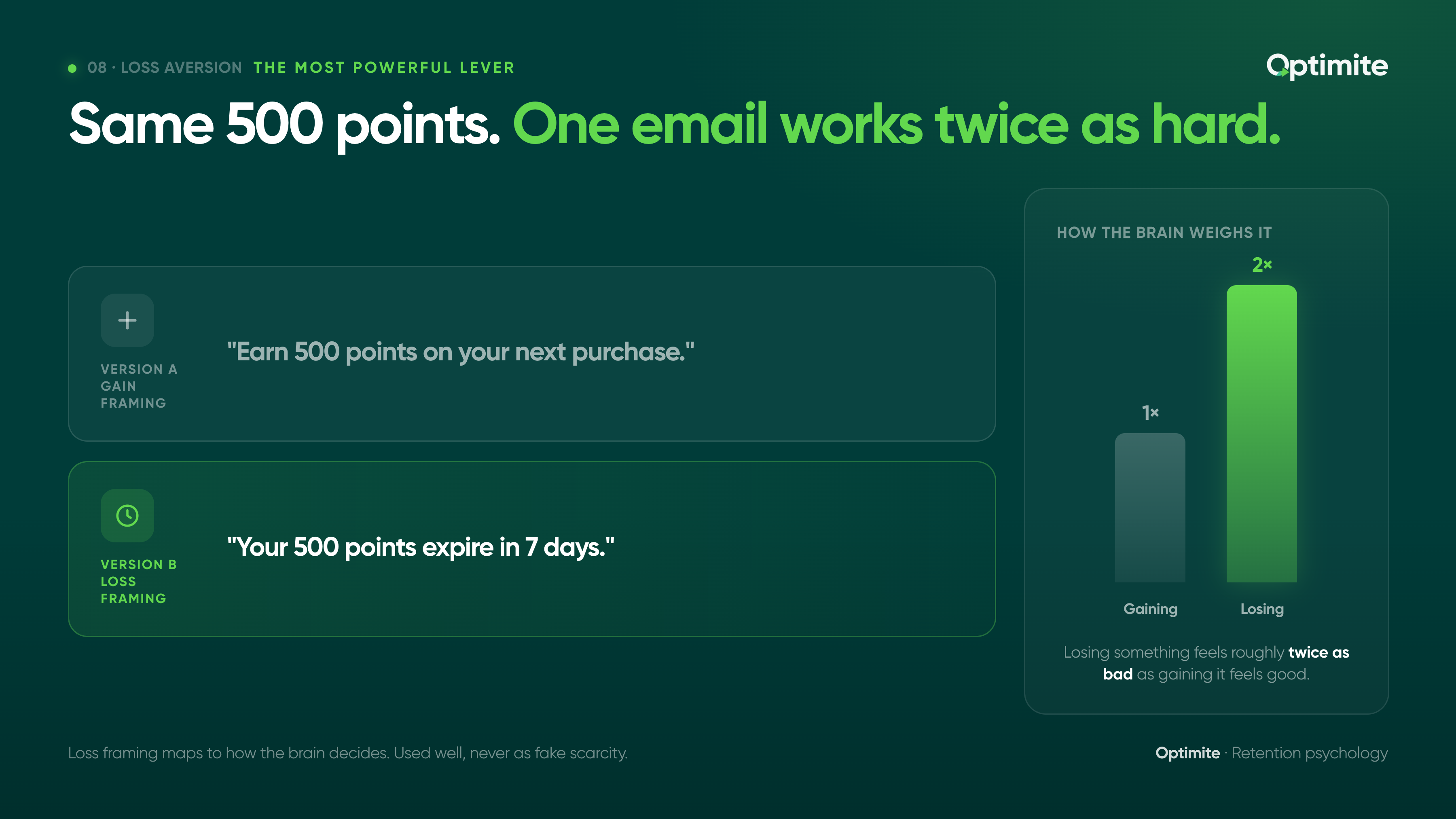
Kahneman and Tversky's research showed that losing something feels roughly twice as bad as gaining the same thing feels good. Loss aversion is one of the most replicated findings in behavioural economics, and ecommerce brands consistently apply it the wrong way round.
Compare these two emails:
Version A: "Earn 500 points on your next purchase." Version B: "Your 500 points expire in 7 days."
Version B works harder. Not because it's manipulative, but because it maps to how the brain actually weighs decisions. Gain framing is weak. Loss framing activates something deeper.
Used well in your retention marketing strategy, loss aversion looks like:
- Expiring points reminders timed to the natural repurchase window
- "Your VIP status drops in 14 days" emails sent to at-risk high-value customers
- Lapsing tier notifications with a clear, easy path to maintain status
Used badly, it looks like fake countdown timers and manufactured scarcity. Customers notice. And once trust goes, it rarely comes back.
What a psychologically-sound retention programme actually looks like
None of this requires a new platform or a bigger team. It requires a different lens on what you're building and why.
After working on ecommerce customer retention across 500+ brands in wellness, beauty, fashion, and food and beverage, the pattern is consistent. The brands with the strongest numbers have lifecycle flows built around how customers feel at each stage, not just what they might buy next.
That means a post-purchase email flow that kills doubt before it grows. A loyalty programme framed around progress and loss, not just accumulation. An email cadence that values familiarity as much as conversion. And personalisation that makes customers feel known, not tracked.
If you want to see where your current programme sits against these benchmarks, our free retention audit will give you a clear picture of the gaps.
Keep reading.
All posts
What to Do With First-Time BFCM Buyers Before They Go Cold
Shrestha Ghosal · Jun 16, 2026

5 Signs Your Post-Purchase Flow Is Leaving Repeat Revenue on the Table
Shrestha Ghosal · Jun 10, 2026

What Buyer's Anxiety Is Costing Your Retention Rate
Shrestha Ghosal · Jun 8, 2026