

5 Signs Your Post-Purchase Flow Is Leaving Repeat Revenue on the Table
The structural gaps in most DTC post-purchase sequences and what to do about each one
 Shrestha Ghosal
The post-purchase flow is the most underbuilt sequence in most DTC email programmes. Brands spend months refining their welcome series and cart abandonment flow, then ship a two-email post-purchase sequence, call it done, and move on.
The irony is that post-purchase emails have some of the highest open rates of any automated sequence. Customers just bought something. They're engaged, they're paying attention, and they're in the highest-trust moment of the customer relationship. That window is short, and most brands use it only to confirm the order and ask for a review.
If your post-purchase flow ends before the customer's second purchase decision is made, you're leaving repeat revenue on the table every single day. Here are five signs that's exactly what's happening.
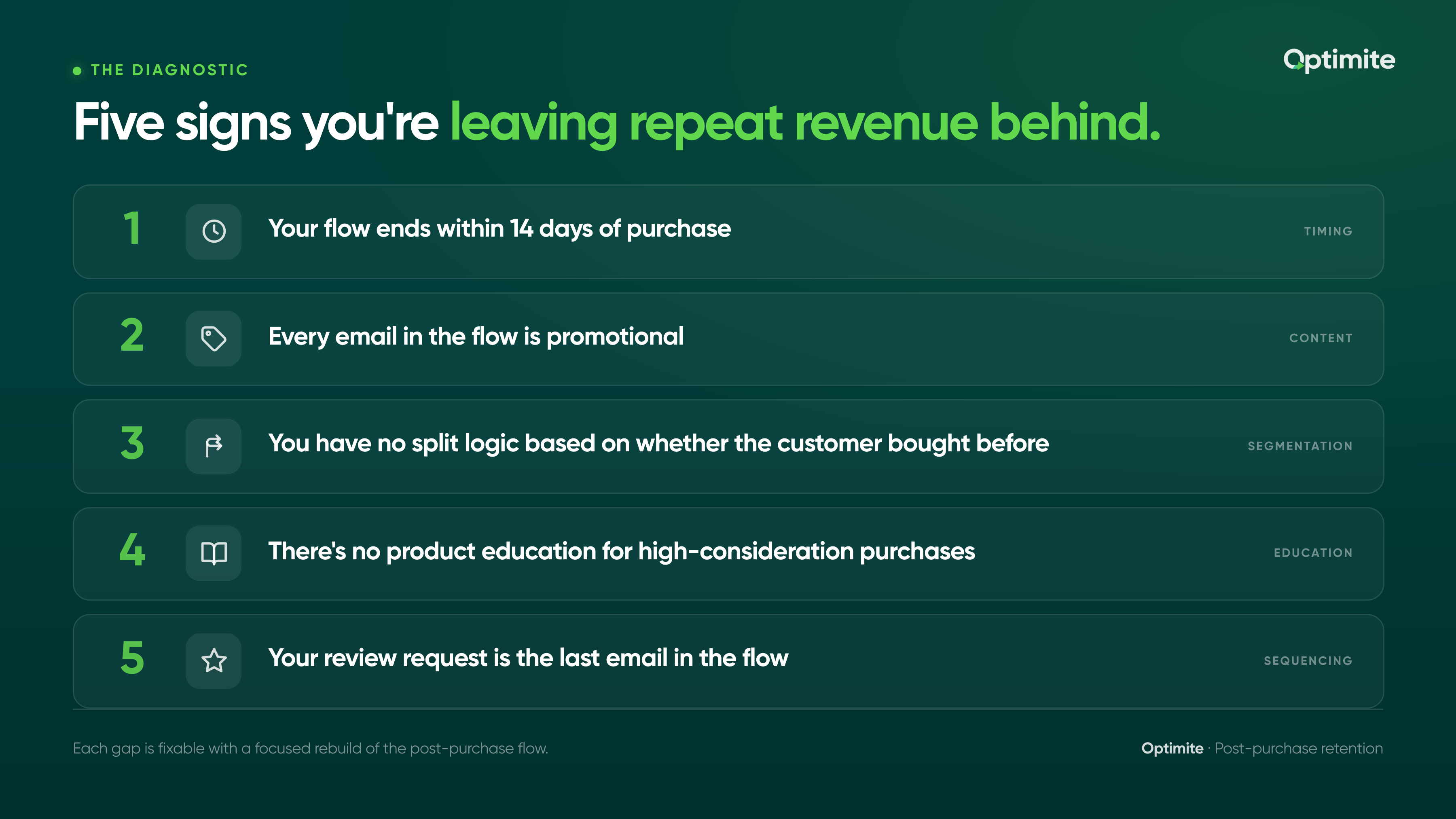
Your flow ends within 14 days of purchase
The most common post-purchase flow structure I see in DTC accounts: an order confirmation, a shipping update, and a review request. All three land within the first 7 to 10 days. Then silence.
The problem is timing. Most customers don't make a second purchase decision in the first two weeks. They're still using the product, forming an opinion, and deciding whether the brand is worth coming back to. A flow that goes quiet at day 10 abandons the customer at exactly the moment the relationship is still being formed.
A well-built post-purchase flow extends to at least 45 to 60 days for most DTC categories, and longer for consumables where the repurchase window is predictable. The emails after day 14 don't need to be promotional. Educational content, usage tips, community proof, and social content all keep the brand present without pushing for a sale before the customer is ready.
For consumable products like supplements, skincare, or coffee, build your post-purchase flow timeline around the product's actual consumption window. A 30-serving product should have a replenishment email from days 25 to 28, not a generic 30-day trigger that ignores how the customer uses it.
Every email in the flow is promotional
A post-purchase flow that leads with discounts and cross-sell offers from email one is solving the wrong problem. The customer just bought. What they need in the first two to three weeks is confidence that they made a good decision, not another reason to spend money.
The brands with the strongest post-purchase retention rates use the early emails to build value, not extract it:
- Usage guidance that helps the customer get more from what they bought
- Expectation-setting content that explains what to expect and when, particularly important for wellness and beauty products where results take time
- Community proof from customers at a similar stage, reinforcing that the purchase was the right call
- Brand story content that deepens the emotional connection before the commercial ask comes
The cross-sell and upsell emails belong in the flow. But they perform significantly better when they come after the customer has been given a reason to trust the brand. A cross-sell email at day 30 to a customer who has received genuine value in the first four weeks converts at a higher rate than the same email sent at day 7 to a customer who has received nothing but promotions.
You have no split logic based on whether the customer bought before
A first-time buyer and a returning customer who just made their third purchase have completely different needs from a post-purchase flow. Sending them the same sequence is one of the most common structural gaps in DTC retention programmes.
A first-time buyer needs:
- Brand introduction and story
- Product education and usage guidance
- Social proof that reassures them the purchase was the right decision
- A gentle path toward a second purchase once trust is established
A returning customer needs:
- Acknowledgement that they're back, ideally by name and with reference to their history
- A loyalty or VIP signal if they've crossed a purchase frequency threshold
- Cross-sell or complementary product recommendations based on what they've bought before
- Less education, more reward
Klaviyo makes this split straightforward. A conditional branch at the start of the flow checks whether the customer has placed more than one order. First-time buyers go left. Returning customers go right. The two sequences can share some emails, but the opening two or three sends should be completely different.
Repeat customers spend 67% more than first-time buyers on average, according to Bain and Company. Building a post-purchase flow that treats returning customers differently from first-time buyers is one of the highest-leverage segmentation decisions in a DTC retention programme.
There's no product education for high-consideration purchases
For brands in wellness, beauty, fitness, or any category where results depend on consistent usage over time, the post-purchase flow has a specific job beyond confirmation and review collection: keeping the customer using the product long enough to see results.
Customers who don't see results churn. And in most cases, they churn not because the product doesn't work, but because they stopped using it before it had time to work. A supplement that takes 8 weeks to show meaningful effects will lose a significant portion of its customer base in weeks 3 and 4 if the brand hasn't set expectations correctly.
A product education sequence inside the post-purchase flow:
- Sets accurate expectations about the timeline in the first email after delivery
- Sends a milestone email on day 14 acknowledging where the customer is in their journey
- Provides usage tips that increase the likelihood of consistent use
- Shares social proof from customers who are 30, 60, and 90 days in
This sequence reduces early churn by keeping the customer engaged during the window when most drop-off happens. The brands that build it see measurably better 90-day retention rates. The ones that don't are losing customers during the most critical phase of the relationship.
Your review request is the last email in the flow
The review request is a legitimate and valuable email. It should be in the post-purchase flow. The problem is when it's positioned as the final communication, as if the brand's only remaining interest in the customer is getting a five-star rating.
What comes after the review request matters more than the review request itself. The customer has just been asked to reflect on their experience with the product. That reflection, positive or negative, creates a moment of heightened engagement that most brands walk away from immediately.
A customer who just left a positive review is in exactly the right mindset for a cross-sell or a loyalty programme invitation. A customer who left a mixed review is signalling a problem that a proactive follow-up could address before they decide not to come back.
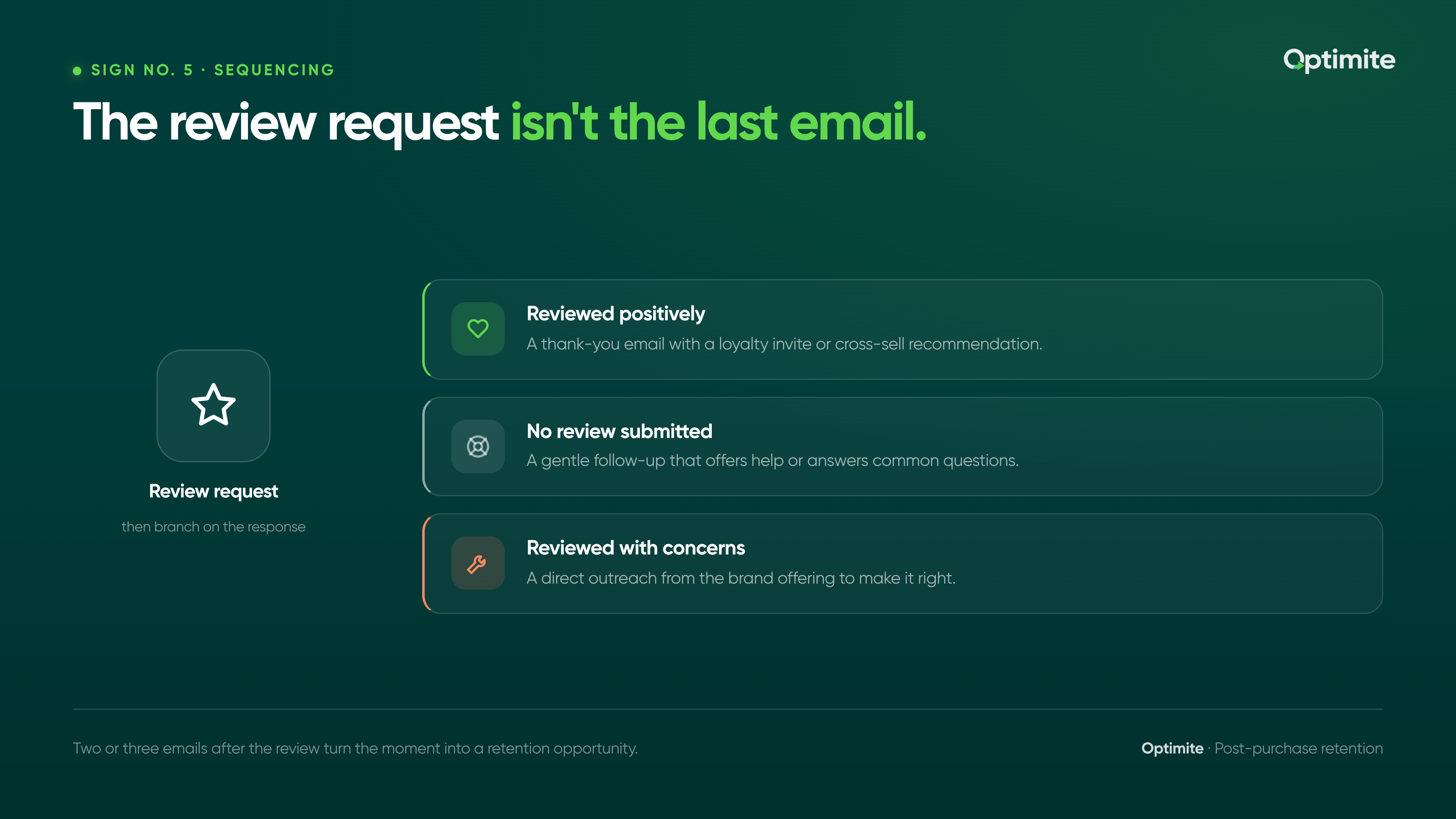
Building two or three emails after the review request, triggered differently based on whether a review was submitted, turns the review moment into a retention opportunity rather than a dead end:
- Reviewed positively: a thank-you email with a loyalty invite or cross-sell recommendation
- No review submitted: a gentle follow-up that offers help or answers common questions
- Reviewed with concerns: a direct outreach from the brand offering to make it right
This logic takes a few hours to build in Klaviyo and changes the trajectory of the customer relationship for a meaningful percentage of buyers.
Don't wait for a negative review to surface a problem. If your post-purchase flow includes product education and usage guidance from the start, you reduce the likelihood of a customer reaching the review stage with unresolved issues. Prevention is significantly cheaper than recovery.
A post-purchase flow that ends too early, leads with discounts, treats every customer the same, skips product education, and closes with the review request is leaving repeat revenue behind every single month. Each of these gaps is fixable with a focused rebuild, and the compounding effect of getting post-purchase right shows up quickly in repeat purchase rate and customer lifetime value. If you want to understand what your post-purchase flow is currently worth and what it should be generating, book a free call with us and we'll walk through it together.
Keep reading.
All posts
What to Do With First-Time BFCM Buyers Before They Go Cold
Shrestha Ghosal · Jun 16, 2026

What Buyer's Anxiety Is Costing Your Retention Rate
Shrestha Ghosal · Jun 8, 2026

8 Psychology Principles That Drive Ecommerce Customer Retention
Anamika Kalwan · Jun 5, 2026