

What to Do With First-Time BFCM Buyers Before They Go Cold
 Shrestha Ghosal
Every year, brands spend more to acquire customers during BFCM than at any other point in the calendar. The traffic is real, the volume is real, and the new customer numbers look great in a post-weekend Slack update. Then January arrives, and most of those buyers have gone quiet.
This is not a BFCM problem. It's a post-BFCM problem, and it's almost entirely a retention problem. The window between a customer's first Black Friday purchase and their second order is the most important stretch in their entire lifecycle with your brand. Most brands waste it.
Here's how not to.
Why BFCM buyers are a different cohort
Not all new customers are created equal. Someone who discovers your brand in March, pays full price, and buys again in May is a very different profile from someone who clicked a Black Friday ad, used a 30% off code, and bought a single item.
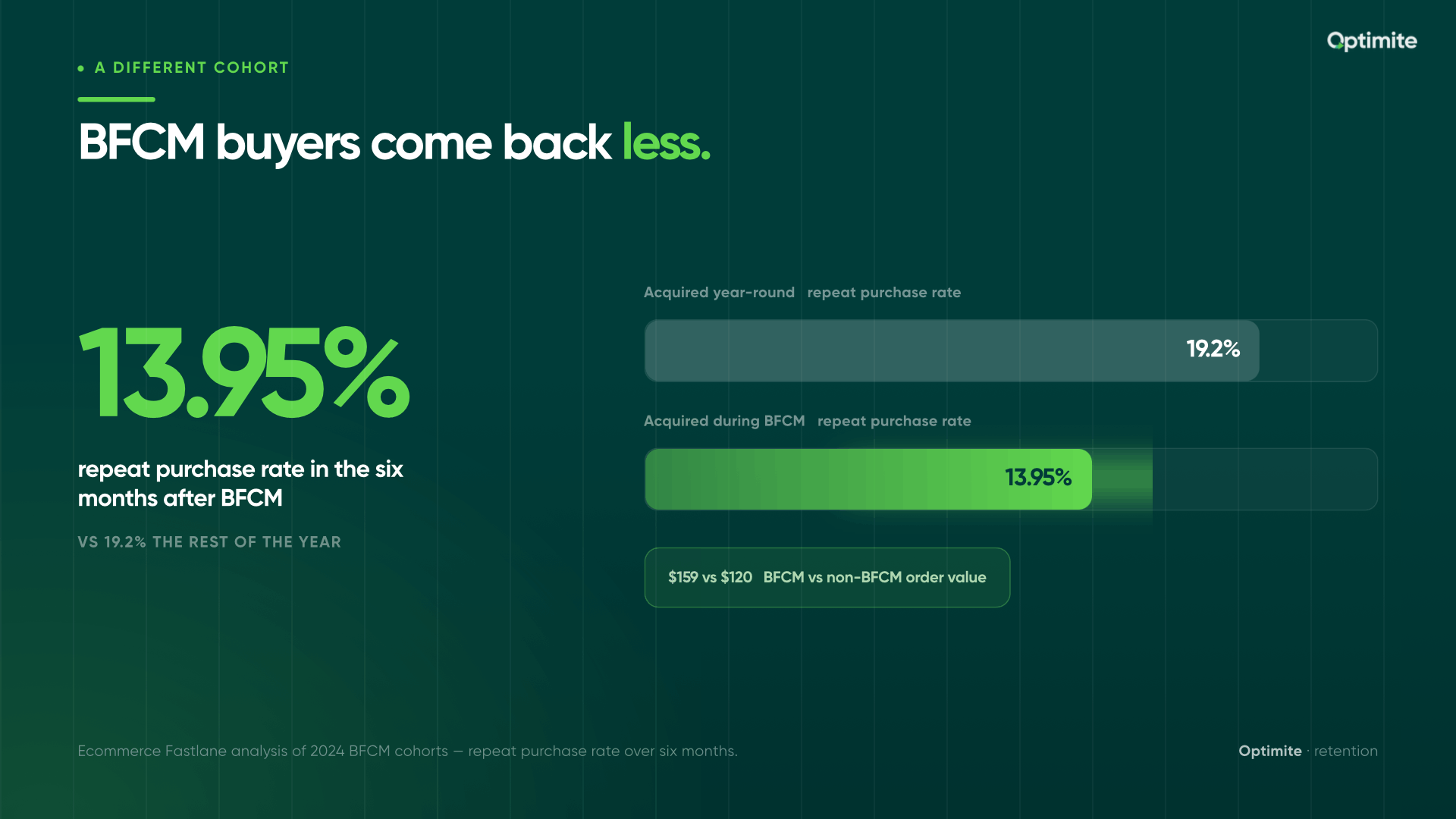
The data backs this up. According to Ecommerce Fastlane's analysis of 2024 BFCM cohorts, first-time buyers acquired during BFCM had a repeat purchase rate of 13.95% in the following six months, compared to 19.2% for customers acquired at other times of the year. That's a gap of roughly 30%.
What's driving that gap:
- A significant share of BFCM buyers are discount-motivated. They were not looking for your brand specifically; they were looking for a deal.
- A portion of BFCM buyers are gift purchasers. They will never use the product themselves, which means post-purchase educational content will not resonate.
- BFCM buyers often have lower brand familiarity at the point of purchase, which means trust is lower and the activation window is shorter.
None of this means the cohort is not worth retaining. The same data shows BFCM buyers had a higher average order value at acquisition ($159 vs $120 for non-BFCM buyers), which means there's real LTV available if you can get the second purchase.
The challenge is that you have a shorter, more contested window to do it.
The 60-day window you're probably underusing
George Rodríguez of A-Game Digital, quoted in Klaviyo's strategy content, puts it well: "You haven't really converted them to a customer until they've bought for the second time. The first time they transacted with you, it might be because of a particular offer or a product."
That framing is useful. Treat every BFCM first-time buyer as a lead who has raised their hand, not a customer you've already won.
Customers who place a second order within 60 days of their first are three times more likely to become long-term customers than those who take 120 days or more. For BFCM buyers, this window is even more critical because their baseline repeat rate is lower than the year-round average.
The 60-day post-BFCM window runs through late January. That is a period when most brands go quiet. After the December holiday campaign push ends, sending volume drops, flows revert to default timing, and those new buyers drift away without a structured reason to come back.
Brands that win Q1 repeat revenue from BFCM cohorts do not do anything complicated. They do one thing: they keep showing up with relevant, well-timed messages while everyone else has stopped.
How to segment the BFCM cohort before you contact them
Before you send a single post-BFCM email, spend 30 minutes in Klaviyo splitting your new buyers into groups. The content that works for one group will actively put off another.
Three segments to build immediately after BFCM:
- First-time BFCM buyers, by product category (skincare, supplements, apparel, equipment). You'll cross-sell within and across categories based on this.
- First-time BFCM buyers, high AOV (above your average order value). These buyers signalled intent and financial willingness at acquisition. They are your highest-priority retention targets.
- First-time BFCM buyers, single-unit or low AOV. Higher probability of being gift purchasers or one-time deal seekers. They need a different nurture path, not the same flow at a lower frequency.
One further split worth making: buyers who engaged with your post-purchase emails in the first 7 days (opened, clicked) versus those who did not. The engaged group needs acceleration toward a second purchase. The unengaged group needs re-entry content first: brand story, social proof, reasons to care beyond the original discount.
Don't put BFCM buyers into your standard new-customer welcome flow and call it done. A welcome series written for full-price, non-seasonal buyers will miss the context that BFCM buyers have. They came in on a deal; they may not know the brand well, and they're about to be contacted by every other brand they bought from that same weekend.
What to send in the first 30 days
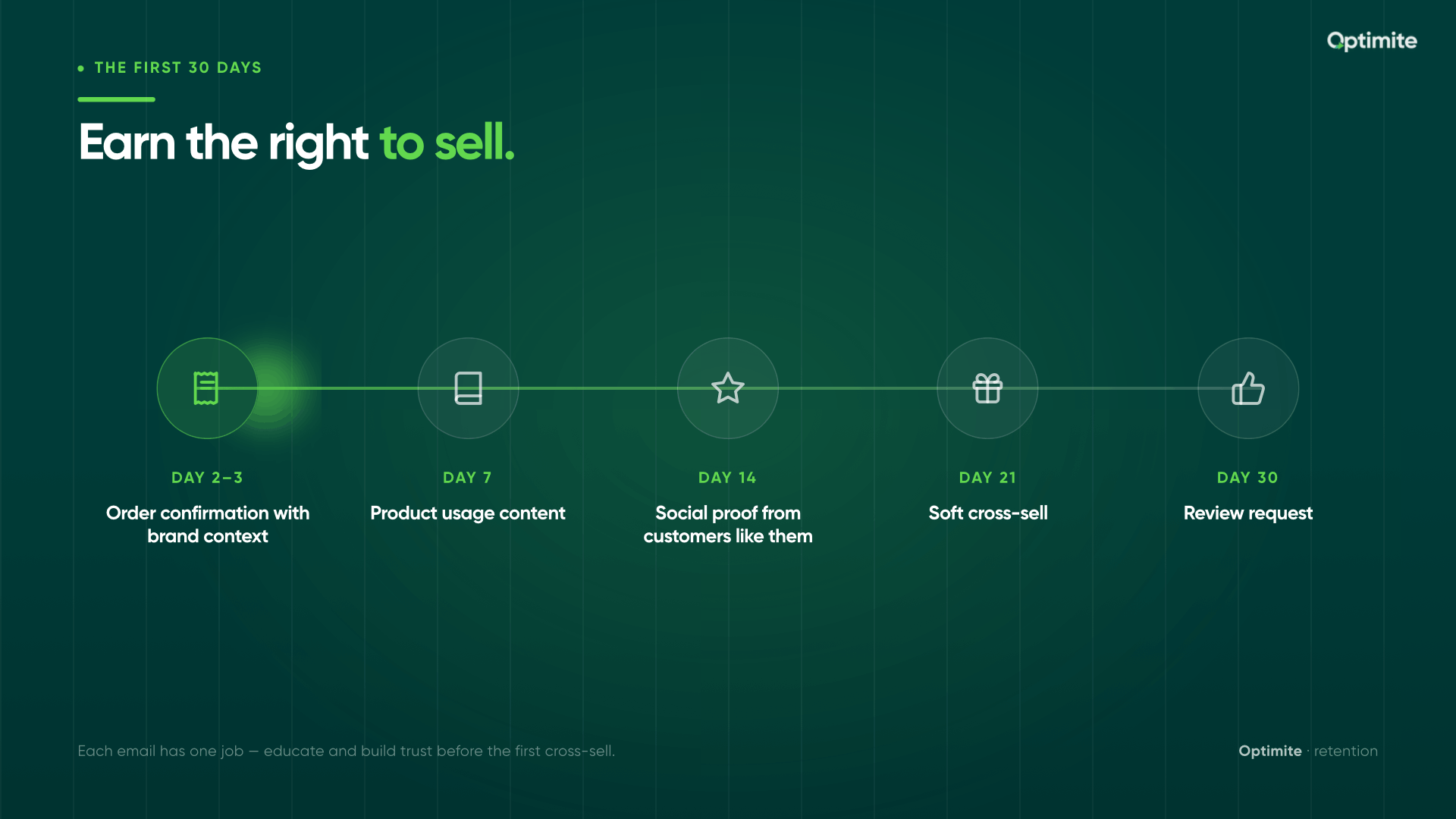
The goal in the first 30 days is not to sell. It's to earn the right to sell.
BFCM buyers who receive educational, value-adding content in the first few weeks after purchase are far more likely to open your next campaign than those who receive a discount-first re-engagement email. The discount trained them to buy at a price point you can't sustain year-round. Brand content trains them to buy because they trust you.
A structure that works across wellness, beauty, and fashion brands:
- Day 2-3: Order confirmation with brand context. Not just transactional. A short note about who you are, what you stand for, and why the product they bought matters. Keep it to 3-4 sentences.
- Day 7: Product usage content. How to get the most from what they bought. For consumables, this is usage guidance and expected results. For apparel, care instructions and styling ideas. For equipment, a quick-start guide.
- Day 14: Social proof from customers like them. UGC, reviews, a short before-and-after if the product category supports it. The goal is to reinforce that they made a good decision and surface other products in context.
- Day 21: Soft cross-sell. One product recommendation based on what they bought. Not a sale announcement. A specific, curated suggestion with a reason behind it.
- Day 30: Review request. By now, they've had time to form an opinion. Ask for it.
Each email should have one job. Not two, not three. Brands that try to fit a loyalty pitch, a product recommendation, and a review request into a single email get none of those things done well.
Where SMS fits in the post-BFCM sequence
SMS during BFCM is a growth channel for acquisition. In the weeks after, it becomes a retention channel, and the two require different approaches.
During the peak, brands pairing email and SMS together saw a 30% lift in conversions compared to email alone, according to the Ecom Department's 2025 BFCM analysis. After the peak, the channel's job shifts. It's no longer about urgency and volume. It's about precision.
Specific places SMS earns its place in the post-BFCM sequence:
- Delivery confirmation. A short SMS when the order arrives. "Your [product] is here. Let us know if you need anything." Low friction, high goodwill.
- Replenishment prompt for consumables. If the product runs out in 30 days (supplements, skincare, food), an SMS nudge at days 25-28 outperforms email on open rate and speed of action.
- Follow-up on unopened emails. If your day-21 cross-sell email was not opened within 48 hours, a short SMS follow-up with the same product recommendation can recover the conversion.
Keep SMS content for this cohort short and single-purpose. The discount window is closed. Sending SMS with "20% off, today only" in January trains BFCM buyers to wait for the next sale rather than buy at full price. Resist it.
The metric that tells you if it's working
Open rates, click rates, and campaign revenue are all useful, but none of them tells you whether your BFCM retention work is actually moving the needle.
The only number that matters in the 90 days post-BFCM is second-purchase rate within 90 days.
Pull your BFCM cohort in Klaviyo. Filter to first-time buyers acquired in the Black Friday to Cyber Monday window. Then check: what percentage of them placed a second order within 90 days? That number is your baseline. Do it again next year. The difference is the impact of your retention programme.
Tag your BFCM first-time buyers as a Klaviyo segment the week after the sale ends. Label it clearly, for example, "BFCM New Buyers." You'll use this segment for post-BFCM flows, Q1 campaign targeting, and cohort analysis in January. Brands that don't tag this group immediately lose the ability to measure it cleanly later.
A 90-day second-purchase rate above 20% for a BFCM cohort is a strong result given the baseline repeat rate of sub-14%. Across the brands we work with, well-structured post-BFCM lifecycle flows consistently push this metric 8-12 percentage points above the untreated baseline. That's the difference between a cohort that generates LTV and one that generates a single discounted order.
What good looks like in practice
A beauty brand in the US doing around $4M in annual revenue came to us after BFCM 2023 with a familiar problem. They'd acquired 1,800 new customers over the sale weekend, their best BFCM performance to date. By February, fewer than 11% had placed a second order.
The post-purchase flow they had was their standard new-customer series: a thank-you email, a generic brand intro, a discount code for the next purchase. Nothing was wrong with it, but nothing in it was built for the specific context of a BFCM buyer.
For 2024, we built a separate BFCM new-buyer flow: product education at day 7, social proof at day 14, a curated cross-sell at day 21. We added an SMS delivery confirmation and a replenishment SMS at day 28 for their top-selling consumable SKU.
The 90-day second-purchase rate from their BFCM 2024 cohort came in at 19.4%. For a cohort of 2,100 new buyers at that AOV, it represented a material shift in Q1 revenue that came entirely from buyers they already had.
Start before next November
BFCM acquisition costs are not going down. The brands that build sustainable businesses out of peak season are the ones that treat BFCM as the beginning of a customer relationship, not the end of a campaign.
The infrastructure for that is not complicated: a dedicated post-purchase flow for the BFCM cohort, proper segmentation, a clear SMS sequencing plan, and a 90-day second-purchase rate to measure against.
If your post-BFCM sequence is still the same flow you use the rest of the year, that's the gap to close before next November. Start with the segmentation, and the rest follows. If you want us to map out what that looks like for your brand, book a free call with Optimite.
Keep reading.
All posts
5 Signs Your Post-Purchase Flow Is Leaving Repeat Revenue on the Table
Shrestha Ghosal · Jun 10, 2026

What Buyer's Anxiety Is Costing Your Retention Rate
Shrestha Ghosal · Jun 8, 2026

8 Psychology Principles That Drive Ecommerce Customer Retention
Anamika Kalwan · Jun 5, 2026