

Why Your Klaviyo Account is Probably Overpaying
You're paying for Klaviyo features you don't use, contacts that don't engage, and sends that don't convert. Here's how to see it and fix it.
 Arpit Mehar

You're paying for Klaviyo. $1,500 per month. $2,000. $3,000. Maybe more.
You probably don't know if you're overpaying.
Most brands aren't. They're just paying what Klaviyo charges based on their contact count and send volume. They assume that's the going rate. So they pay it.
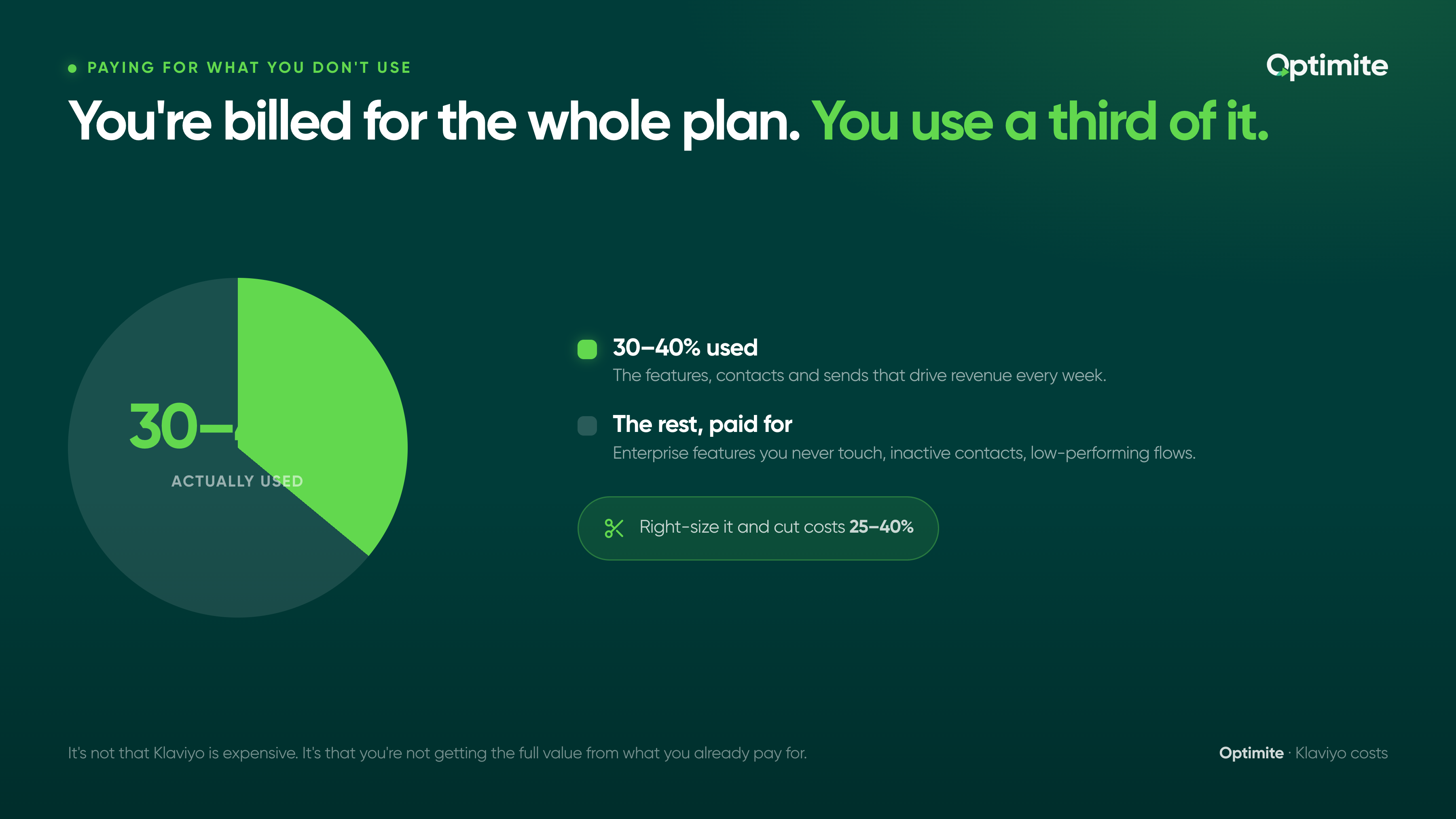
Here's the reality: most Klaviyo accounts are paying 40-60% more than they need to. Not because Klaviyo's pricing is unfair. But because brands are using 30-40% of what they're paying for.
This post walks through where the overpaying happens. How much is it actually costing you? And how to fix it without switching platforms.
The cost reality
Let's start with numbers.
Average Klaviyo spend across ecommerce brands doing $1M-$30M in revenue: $1,800 per month.
Average email revenue generated from Klaviyo: $18,000 per month.
That's $0.10 per dollar of email revenue. Sounds reasonable.
But half the brands we audit are spending $0.25-0.35 per dollar of email revenue. Same platform. Same contact count. Different efficiency.
The difference isn't Klaviyo's fault. It's account bloat.
Where the overpaying happens
Most overpaying doesn't come from choosing the wrong plan. It comes from using the wrong features or not optimizing what you're paying for.
Overpay pattern 1: Paying for enterprise features on a mid-market budget.
You're on the $3K/month Klaviyo plan because you needed advanced segmentation. You set it up once. You use it. But you're also paying for predictive analytics, advanced reporting, API rate limits, and custom integrations. Features you've never touched.
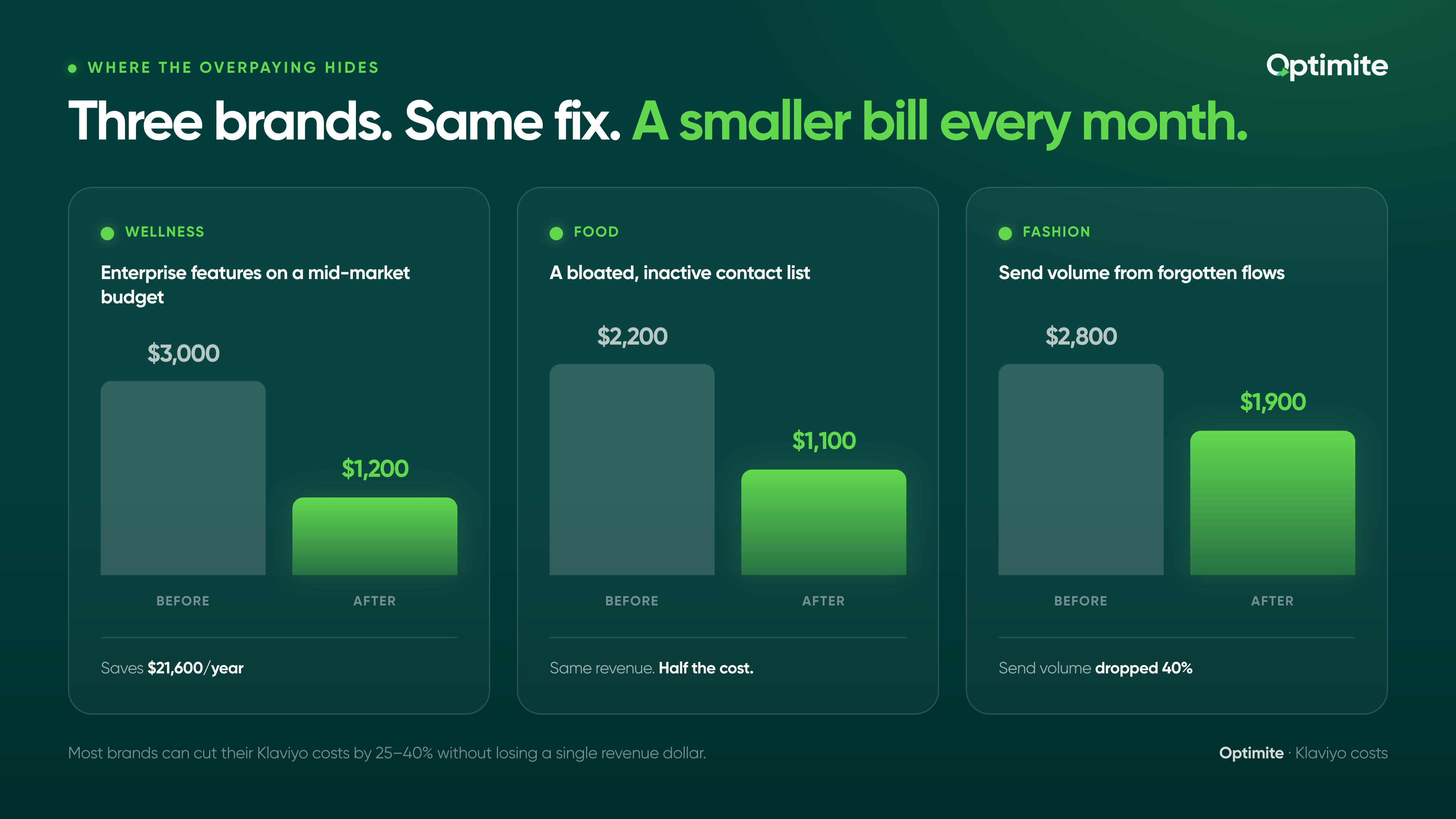
A wellness brand we audited was on a $3K/month plan. They were using basic list segmentation and standard reporting. They weren't using 60% of what they were paying for. We moved them to a $1,200/month plan with the same core features they actually used. They saved $21,600 per year by simply not paying for enterprise features they didn't need.
The signal: Do an inventory of the features you're using. Not the features you think you might use. The ones you actually use every week. If you're using under 40% of your plan, you're likely on the wrong tier.
Overpay pattern 2: Bloated contact lists.
Your Klaviyo contact count is 50,000. But 30% of them are inactive. They haven't opened an email in six months. They're bounced addresses. They're unengaged from day one.
Klaviyo charges by contact count. So you're paying for 15,000 contacts that generate zero revenue.
A food brand had 80,000 contacts but only 22,000 were active. They were paying $2,200/month. We cleaned their list. Removed bounced emails, suppressed inactive subscribers, deleted duplicates. Contact count dropped to 38,000. Their bill dropped to $1,100/month. Same revenue. Half the cost.
The signal: Run a list health audit. How many of your contacts have opened an email in the last 90 days? If it's under 70%, you have bloat. Clean it.
Removing inactive contacts doesn't hurt revenue. It helps it. Cleaner lists mean better deliverability, better metrics, lower costs.
Overpay pattern 3: Not optimizing email volume.
Klaviyo charges on a hybrid model: contact count plus send volume. More sends = higher costs.
If you're sending five emails per week per subscriber, you're in the high-volume tier. If you're sending one email per week, you're in the low-volume tier.
Most brands don't realize their send volume is the lever. They think contact count is the only variable.
A fashion brand was sending eight emails per week. Their Klaviyo bill reflected high-volume pricing. We audited their sends. Three were low-performing automations they'd built once and forgotten about. Two were abandoned flows that weren't converting. We killed those five low-performers. Send volume dropped 40%. Their bill dropped from $2,800/month to $1,900/month without losing a single revenue dollar.
The signal: Audit your active flows and campaigns. Are all of them converting? If you're not sure which flows you should have built in the first place, check out 7 Klaviyo flows every D2C brand should build in year one. If a flow has been live for six months and converting under 1%, kill it. You're paying send volume costs for revenue you're not generating.
The real cost calculation
Here's how to calculate whether you're overpaying.
Step 1: Calculate your Klaviyo spend for the last 12 months. Total annual cost divided by 12 = monthly average.
Step 2: Calculate your email revenue for the last 12 months. How much revenue came from email campaigns and flows? Total annual email revenue divided by 12 = monthly average.
Step 3: Divide monthly Klaviyo cost by monthly email revenue.
Example 1: Brand spending $2,000/month on Klaviyo, generating $25,000/month in email revenue. Cost per revenue dollar: $2,000 ÷ $25,000 = $0.08. Efficient.
Example 2: Brand spending $3,000/month on Klaviyo, generating $15,000/month in email revenue. Cost per revenue dollar: $3,000 ÷ $15,000 = $0.20. Overpaying.
Example 3: Brand spending $1,500/month on Klaviyo, generating $12,000/month in email revenue. Cost per revenue dollar: $1,500 ÷ $12,000 = $0.125. Reasonable.
Benchmark: Top-quartile brands spend $0.08-0.12 per revenue dollar. Most brands spend $0.15-0.25. Brands spending over $0.30 are either overpaying or not generating enough email revenue (different problem).
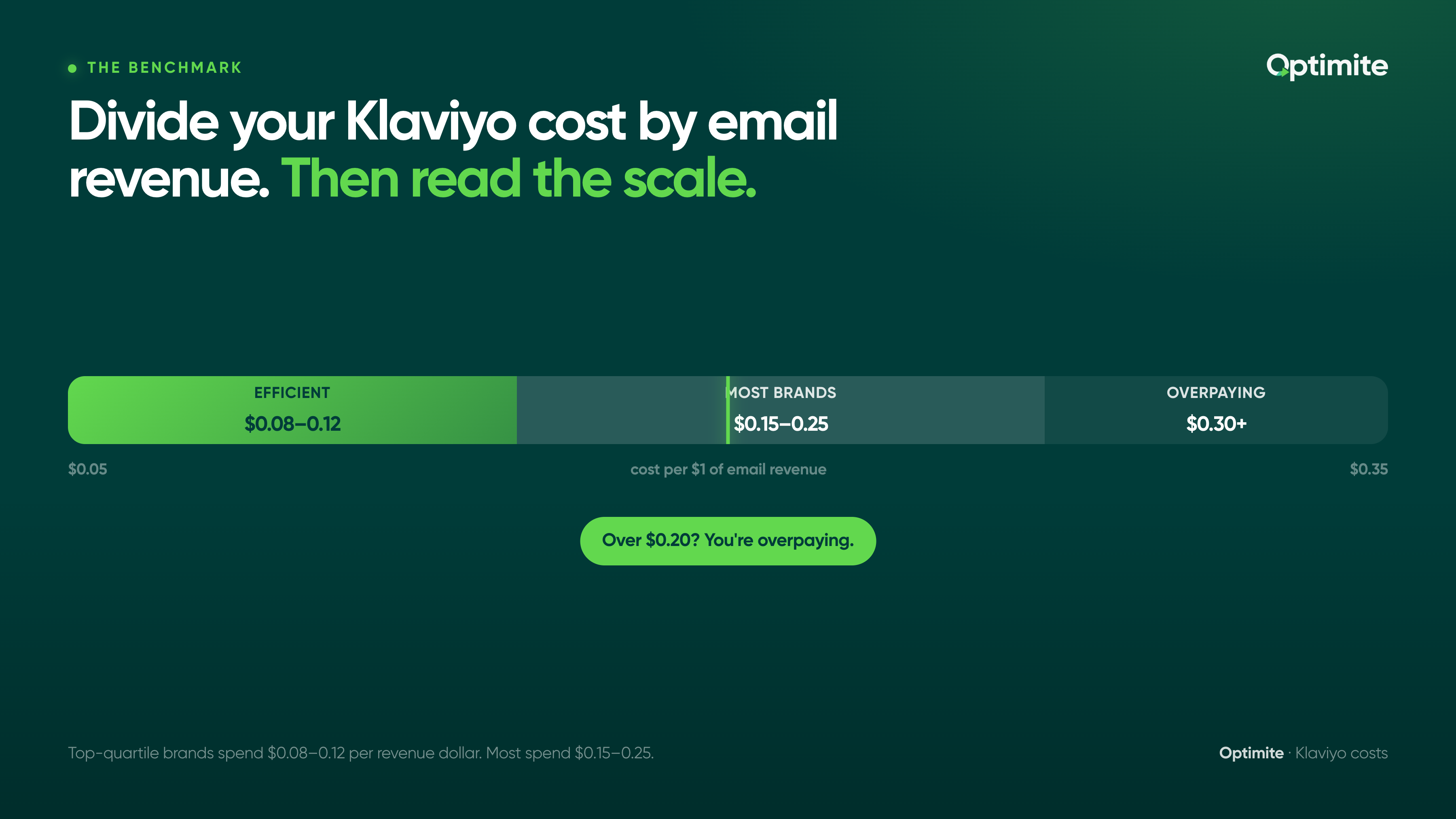
If you're over $0.20, you're overpaying. Fix it through the three patterns above: right-size your plan, clean your list, optimize your send volume.
Don't confuse overpaying with Klaviyo being expensive. Klaviyo's pricing is fair for what it delivers. Overpaying means you're not getting the full value from what you're already paying for.
The hidden costs
Klaviyo's listed price is just the starting point. There are hidden costs that add up fast.
SMS add-ons: You're paying Klaviyo email pricing. Then you add SMS. SMS is separate. Suddenly your bill is 30-40% higher. Not because SMS is expensive. But because you're paying two bills instead of one.
Integrations and app marketplace: You want to connect Slack, Zapier, your CRM, your analytics tool. Some are built-in. Some cost extra through the Klaviyo app marketplace. If you're using five integrations at $50-100 per month each, that's another $3,000-6,000 per year.
Agencies or internal consulting: You're paying Klaviyo but not using it optimally. So you hire an agency to build flows or a consultant to optimize. That's 100+ hours per year at $150-200/hour. $15,000-20,000 extra.
Lost revenue from poor flows: Your welcome flow converts at 8% instead of the 20% it could. Your post-purchase flow converts at 12% instead of 28%. Over a year, the gap between good flows and great flows is $50,000-100,000 in lost revenue. That's the biggest hidden cost.
A supplement brand calculated their total Klaviyo ecosystem cost: $2,000/month Klaviyo + $400/month SMS + $300/month integrations + $2,000/month agency help = $4,700/month. Their email revenue was $20,000/month. Cost per revenue dollar: $0.235. Overpaying.
When we optimized their flows in-house and killed the agency dependency, total cost dropped to $2,600/month. Cost per revenue dollar: $0.13. Efficient.
The optimization checklist
Before you accept your next Klaviyo bill, run through this checklist.
-
Calculate your cost per revenue dollar. If it's over $0.20, you're a candidate for optimization.
-
Inventory your Klaviyo plan features. Are you using 60%+ of them? If not, talk to Klaviyo about right-sizing.
-
Clean your contact list. Remove bounces, suppress inactive subscribers, delete duplicates. Remove anyone who hasn't engaged in 180 days.
-
Audit your active flows and campaigns. Kill anything converting under 1%. You're paying send costs for zero revenue.
-
Count your email sends per week per subscriber. If it's over five, investigate. Are all those sends necessary?
-
Review your integrations. Are you paying for tools you're not using? Consolidate where possible.
-
Evaluate your agency dependency. If you're paying an agency $2K+/month to manage Klaviyo, learn it yourself. Most teams can manage Klaviyo in 5-10 hours per week once set up.
-
Calculate your new projected annual cost. Compare to today. If there's a gap, that's your overpaying amount.
Overpaying for Klaviyo isn't about Klaviyo being expensive. It's about not extracting the full value from what you're paying for.
Most brands can cut their Klaviyo costs by 25-40% without losing a single revenue dollar. Not by switching platforms. But by using what they're paying for more efficiently.
Start with your cost per revenue dollar. If it's over $0.20, you have opportunity. Work through the checklist. You'll find it.
Want a professional audit of your Klaviyo account to identify your specific overpaying opportunities? Let's talk. We audit Klaviyo accounts for ecommerce brands and typically identify $10,000-30,000 in annual savings within the first review. See how we've helped brands across wellness, fashion, food, and beauty optimize their Klaviyo spend and improve their email ROI.


