

Klaviyo Social Marketing Is Live. Here's Where to Start
Klaviyo Social Marketing became available to all users on June 30, 2026. Here's what it actually does, how it connects to your retention programme, and what to set up first.
 Arpit Mehar
8 min read
For most DTC brands, Instagram and email live in separate worlds. Someone finds you on Instagram, follows you, comments on three posts, tags your product in a photo, and DMs you a question. None of that makes it into Klaviyo. In Klaviyo, they might not even exist yet. Or they're a single-purchase profile with no social context attached.
Meanwhile, your retention programme is making decisions based on incomplete data. You know what they bought. You have no idea how engaged they are with your brand outside the inbox.
Klaviyo Social Marketing is their answer to that. It went live for all users on June 30, 2026, and for the first time, what happens on Instagram can feed directly into your flows, your segments, and your retention programme. Here's what to know.
What it actually is
Klaviyo Social Marketing is not a social scheduling tool. You can't use it to plan or publish content. That's not what it's for.
What it does is pull social engagement signals into the Klaviyo CRM. Comments, DMs, tags, mentions, and UGC posts become events on the customer profile, sitting alongside purchase history, email engagement, browse behaviour, and SMS activity. For the first time, the customer who found you on Instagram and the customer who bought from your Shopify store can be the same unified record.
There are three things the product does in practice:
First, it grows your email, SMS, and WhatsApp lists directly from Instagram without any paid media. Second, it enriches customer profiles with social engagement data that can trigger flows and build segments. Third, it surfaces a content library of UGC and owned posts so you can identify top-performing content and the customers championing your brand most actively.
On pricing: Social Auto-replies (the list growth feature) are free on every Klaviyo account. Custom social events that trigger flows and feed segments, such as Posted UGC, Social Comment, and Social DM, require the paid version of Social Marketing. Worth knowing before you start planning flows that depend on those events.
Social Auto-replies: the list growth engine
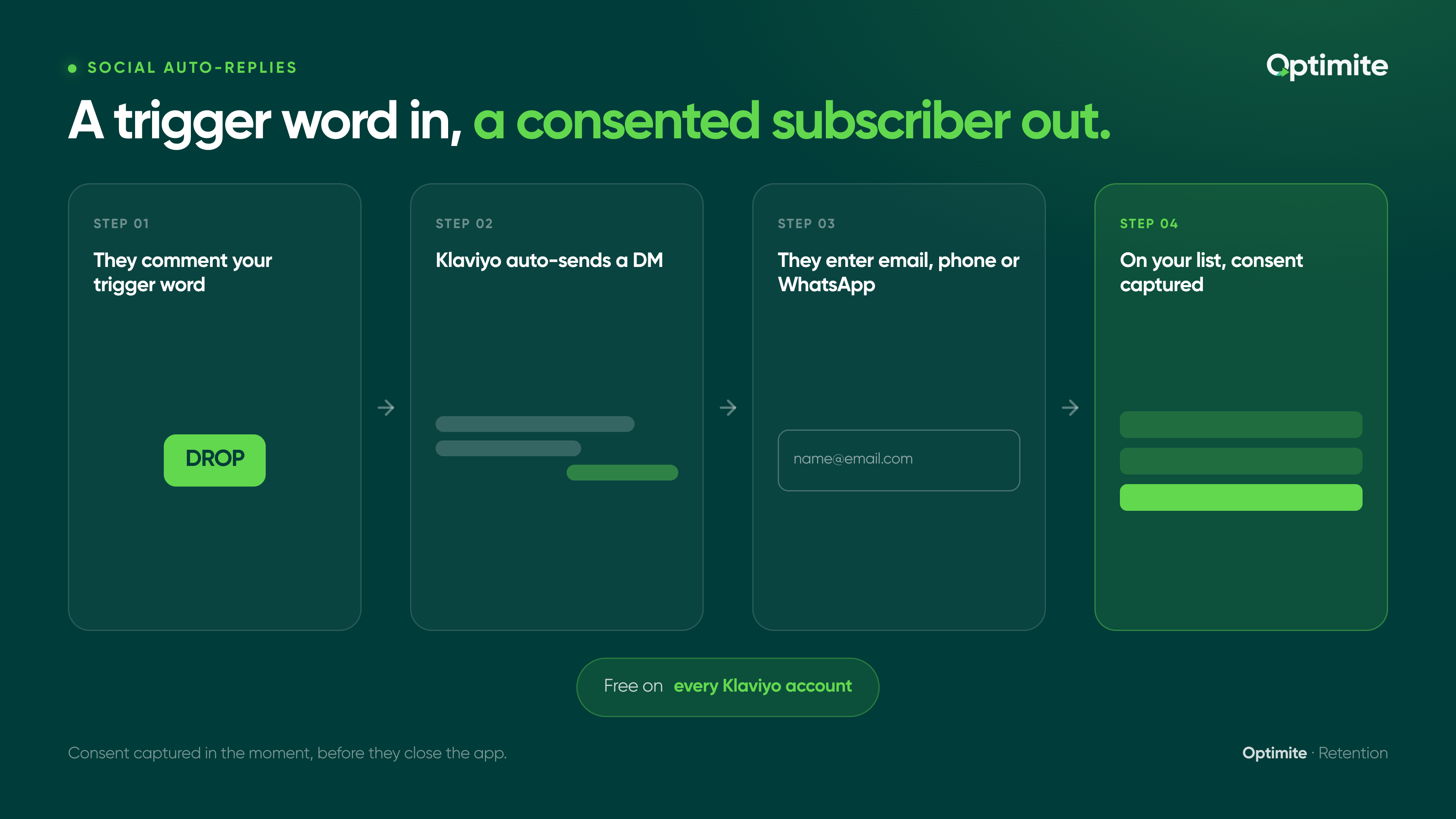
This is the feature to set up first regardless of what tier you're on. It's free, it's practical, and it starts producing results from day one.
Here's how it works. You set a trigger word on an Instagram post or story. When someone comments that word or sends a DM containing it, Klaviyo automatically sends them a DM with an opt-in prompt. They enter their email, phone number, or WhatsApp, and they're on your list with consent captured in the moment, before they close the app and forget about you.
The use cases that work best: giveaways (comment a word to enter, collect email as part of entry), early access campaigns (comment to get the link before anyone else), and evergreen always-on campaigns linked from your Instagram bio.
Why this matters for retention specifically: the cost per subscriber from social auto-replies is significantly lower than paid acquisition. A customer who opts in via an Instagram DM after engaging with your content is more qualified than someone who clicked a paid ad. They already know the brand. They've seen the product in context. The welcome flow they enter should reflect that.
Kulani Kinis, an Australian swimwear brand, grew their ambassador programme to more than 130,000 members and collected over 4,800 tagged UGC posts in a year as an early adopter. That's not a list-building anomaly. That's what happens when you stop letting Instagram engagement evaporate.
Set up one evergreen Social Auto-reply campaign tied to your Instagram bio this week. A simple always-on opt-in that runs whether or not you're actively posting. Then layer trigger-word campaigns on top of your next giveaway or product launch. The evergreen campaign builds the baseline. The campaigns accelerate it.
Social signals inside the CRM
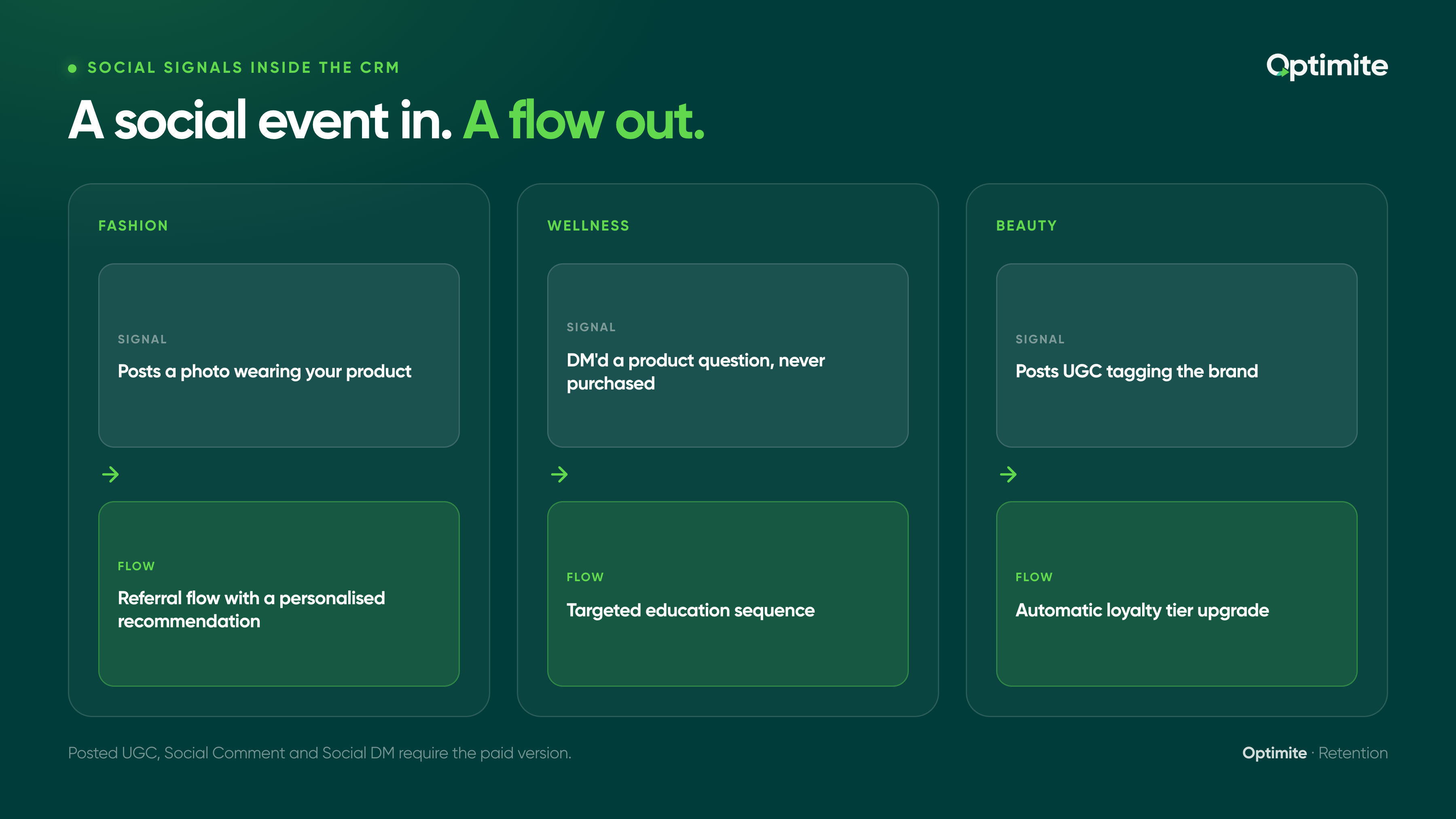
Once you're on the paid tier, social interactions become events on the Klaviyo customer profile. This is where the retention value compounds.
Every comment, DM, story mention, tag, and UGC post gets logged against the customer record. That means you can build segments on social behaviour the same way you build segments on purchase behaviour. And you can trigger flows from social events the same way you trigger flows from browse or cart events.
The practical applications across verticals:
A fashion brand can trigger a referral flow the moment a customer posts a photo wearing their product. Instead of a generic post-purchase sequence, the customer who tagged the brand gets a thank-you, a referral incentive, and a personalised product recommendation based on what they posted. That sequence converts at a higher rate because the trigger is specific.
A wellness brand can identify customers who DM'd a product question but never purchased. That's a high-intent signal. Route them into a targeted education sequence that addresses the specific concern behind the question, whether it's ingredients, dosage, or compatibility with other supplements. Generic browse abandonment wouldn't have caught this. Social event data does.
A beauty brand can automatically trigger a loyalty tier upgrade the moment a customer posts UGC tagging the brand. Most loyalty programmes upgrade on purchase frequency alone. Adding social engagement as a criteria rewards the customers who are genuinely advocating for the brand, not just buying from it.
Posted UGC, Social Comment, and Social DM become Klaviyo events in the same system as Placed Order, Viewed Product, and Clicked Email. Once they're events, they can feed advanced segmentation and trigger any flow in your programme. The infrastructure is already there. Social Marketing adds new inputs to it.
The social content library
The third piece of Klaviyo Social Marketing is less about automation and more about visibility.
The social content library pulls all owned posts, UGC, creator content, and engagement data into one place inside Klaviyo. You can sort by top-performing content, engagement rate, follower count of the poster, and reach. The result is a clear view of what's resonating and who's driving it.
For retention this matters in two ways.
The first is audience identification. Sort your UGC contributors by follower count and post frequency. The customers who have posted five times and have 20,000 followers are a different kind of asset than the customers who bought twice and went quiet. Pull the top 50 into a segment. Trigger a VIP or ambassador flow. Give them early access, exclusive product previews, or a higher loyalty tier. These are the customers most likely to bring in new customers through organic reach. Treating them differently is not a nice-to-have.
The second is content reuse. A customer's photo of your product in a real-world context performs better in email than studio photography. The social content library tells you which UGC pieces are actually resonating. Pull the top-performing ones into your welcome flow, your post-purchase emails, and your campaigns. Dynamic email content that pulls in recent top-performing Instagram posts creates a visual connection between where the customer found you and where you reach them in the inbox.
What this changes in your existing flows
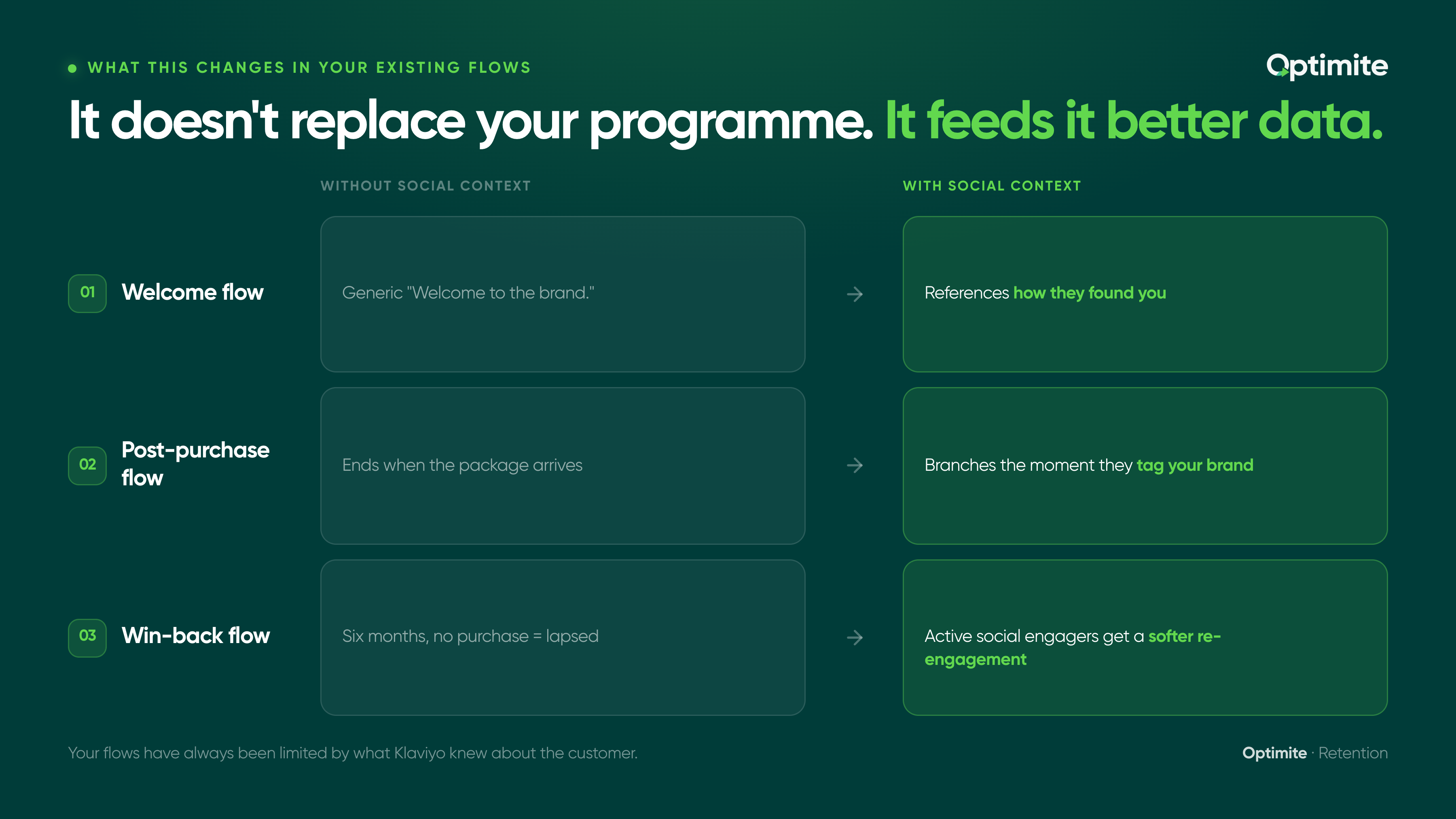
Klaviyo Social Marketing doesn't replace your current retention programme. It feeds it with better data. But a few flows are worth revisiting now that social context is available.
Welcome flow: If someone opted in via an Instagram DM, your welcome flow should know that. Not a generic "Welcome to the brand." Something that references how they found you. "You followed us on Instagram for a while before signing up" is a different opening than the standard intro email. It acknowledges the relationship that already existed before the first email.
Post-purchase flow: Most post-purchase flows ignore what happens after the package arrives. If a customer tags your brand in a post after receiving their order, that's the signal to branch the flow. Trigger a thank-you, request a review, or offer a referral incentive at the moment they're most likely to say yes. Most brands miss this entirely because they have no visibility into when a customer posts.
Win-back flow: A customer who hasn't purchased in six months looks lapsed in Klaviyo. But if they've been commenting on your Instagram posts every week, they're not lapsed. They're still engaged. They just haven't bought again yet. Social Marketing surfaces this distinction. Pull active social engagers out of your win-back suppression and into a softer re-engagement sequence that acknowledges their continued interest rather than treating them as lost.
This is the real value of connecting social to CRM. Your flows have always been limited by what Klaviyo knew about the customer. Now Klaviyo knows more.
Before building flows that trigger on social events (Posted UGC, Social Comment, Social DM), confirm you're on the paid tier of Klaviyo Social Marketing. These events are not available on the free version. The seven core flows every D2C brand should have still run without social data. Social events extend them, they don't replace them.
Where to start
In priority order:
- Connect your Instagram Business account to Klaviyo. This is the prerequisite for everything else.
- Set up one evergreen Social Auto-reply campaign. Always-on, tied to your Instagram bio or a pinned post. This starts building your list from social immediately.
- Run a trigger-word campaign on your next Instagram post or giveaway. One keyword, one DM sequence, one opt-in flow.
- Check your subscriber growth report after 30 days. Compare cost per subscriber from social vs. your other list-building sources.
- If the free tier is producing results, move to paid. Unlock social events, build the segments, extend your flows.
The order matters. Don't spend time planning social-triggered flows before you've confirmed Social Auto-replies are working and producing quality subscribers. Start with list growth. Measure it. Then layer complexity.
The bigger picture
For six years and across 500+ brands, the pattern has been consistent: the retention programme only knows what happened inside the CRM. Purchase history. Email opens. Browse events. That was always an incomplete picture, because the customer's relationship with the brand was never limited to those channels.
Social has always been where DTC brands build the emotional part of the customer relationship. It's where they discover products, follow along, advocate, and engage between purchases. It's just never fed into the retention programme in a meaningful way.
Klaviyo Social Marketing changes that. The customer who found you on Instagram, bought once, tagged three photos, and DMs occasionally is now a fully visible profile in Klaviyo. Your flows can respond to the whole relationship, not just the transaction history.
The brands that connect this to their retention programme in the next 90 days will have a compounding advantage: better list growth, richer segments, and flows that respond to real customer behaviour rather than just purchase events.
Want help connecting Klaviyo Social Marketing to your existing retention programme or building out the flows that use social event data? Book a free retention call. We work with brands across wellness, beauty, fashion, and food and beverage to build retention systems that use every signal available.


