

Klaviyo vs. Mailchimp vs. Omnisend: The Real Difference for Retention
Which email platform drives repeat purchase? The answer depends on your stage, budget, and what you're willing to invest.
 Arpit Mehar
Which email platform actually drives retention? The answer depends on what you're willing to invest, what you need to build, and how serious you are about repeat purchase metrics. Most D2C brands choose based on price or brand reputation. They choose wrong. Here's the real difference.
You're evaluating email platforms. You've got three finalists. Mailchimp is cheap. Omnisend is in the middle. Klaviyo is the one everyone talks about. You need to pick. You're not sure what you're actually comparing.
This post breaks down what each platform does, where they actually differ on retention, and which one makes sense for your stage. We work with D2C brands using all three. We've seen the outcomes. The data is clear. But the platform choice matters less than what you do once you're in it.
Why the comparison matters for retention
Here's the thing: these three platforms are solving different problems.
Mailchimp solves the "I need email" problem. It's cheap. It works. Millions of brands use it.
Omnisend solves the "I need email plus SMS plus a little bit of automation" problem. It's more features than Mailchimp but not overwhelming.
Klaviyo solves the "I need email, SMS, segmentation, and automation built specifically for repeat purchase" problem. It's expensive. It's powerful. It's built for retention.
If you're comparing them on price alone, Mailchimp wins. If you're comparing them on features, Klaviyo wins. If you're comparing them on what drives actual repeat purchase rate, it depends on your stage.
Mailchimp: The free-tier option
Mailchimp is free up to 500 contacts. That's why millions of brands start there. It's accessible. It works. You can build basic email campaigns and automation.
Here's what Mailchimp does well: it's simple. You don't need training. You don't need a technical person. You can build a basic welcome flow and send campaigns.
Here's where Mailchimp falls short for retention: segmentation is clunky. Automation is limited. Integration with Shopify exists but it's not seamless. You don't get rich customer data. You can't personalize at scale. You can't do advanced SMS plus email sequencing.
A wellness brand we know started with Mailchimp. Free plan. They got their first 200 customers. They built a welcome flow. Then they wanted to segment customers by product type (subscription vs. supplement). Mailchimp's segmentation is basic. They spent four hours trying to build segments that should have taken 20 minutes. They moved to Klaviyo.
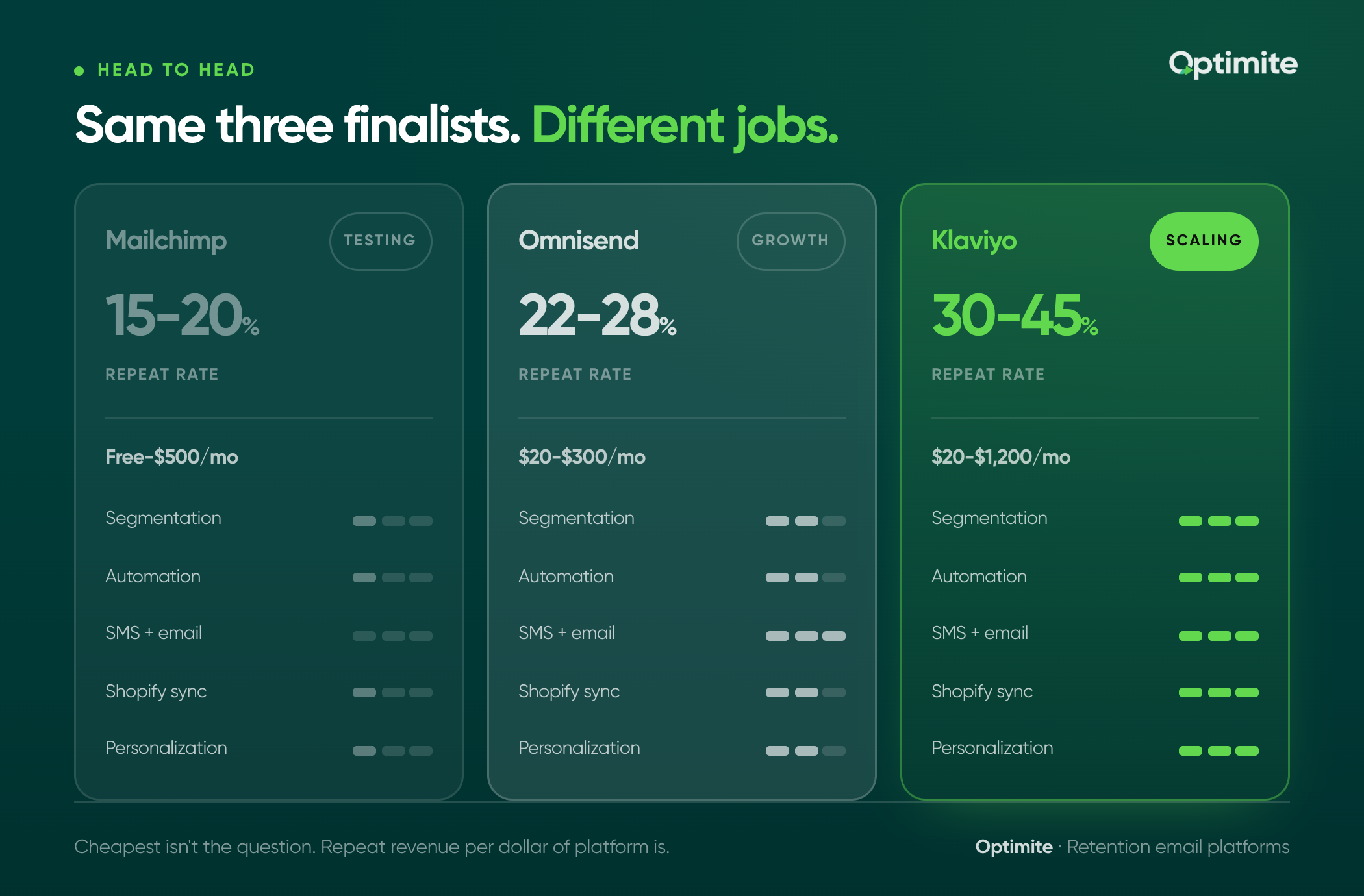
Mailchimp pricing: free up to 500 contacts, then $20-$500+ per month depending on list size.
Mailchimp repeat purchase impact: 15-20% for most brands because segmentation and personalization are limited.
Use Mailchimp if you're under 500 contacts and learning. Move on once you get serious about retention.
Omnisend: The middle ground
Omnisend sits between Mailchimp and Klaviyo. More features than Mailchimp. Less expensive than Klaviyo. Good for brands who want SMS plus email without the Klaviyo price tag.
Here's what Omnisend does well: it's affordable. SMS and email together. Decent automation. Good for basic retention workflows. Growing brands love it because they're not paying Klaviyo prices but they're getting SMS capability.
Here's where Omnisend falls short for retention: segmentation is better than Mailchimp but still not as powerful as Klaviyo. Automation is solid but limited compared to Klaviyo. Integration with Shopify is good but not native. You lose some of the advanced personalization and dynamic content capabilities.
A fashion brand we know used Omnisend for 18 months. They built SMS and email flows. Repeat rate was 24%. Then they moved to Klaviyo. Same flows, same strategy, better segmentation and personalization. Repeat rate went to 31%. The difference was platform capability, not strategy.
Omnisend pricing: $20-$300+ per month depending on contacts and SMS volume.
Omnisend repeat purchase impact: 22-28% for most brands because automation and segmentation are solid but not best-in-class.
Klaviyo: The retention specialist
Klaviyo is built for repeat purchase. Not just email. Not just SMS. The whole system is designed around repeat purchase metrics.
Here's what Klaviyo does well: native Shopify integration that syncs all your customer data automatically. Powerful segmentation that lets you segment by purchase history, product type, customer value, behavior. Advanced automation that handles complex workflows. SMS and email sequencing together. Dynamic content that personalizes emails based on customer data. Testing built in. Reporting that shows repeat purchase impact, not just open rates.
Here's the trade-off: Klaviyo is expensive. $20-$1,200+ per month depending on contacts. It requires more setup. You need someone who knows what they're doing or you'll waste the platform's capabilities.
A food brand we work with moved to Klaviyo at $3M revenue. They built segmentation by product type. They created separate post-purchase flows for meal kits vs. sauces. They set up SMS for urgency moments. Repeat rate went from 26% to 41% in six months because Klaviyo let them build a system that Omnisend couldn't support.
Klaviyo pricing: $20-$1,200+ per month depending on list size and SMS volume.
Klaviyo repeat purchase impact: 30-45% for most brands because segmentation, personalization, and automation are best-in-class.
Klaviyo is only worth it if you're going to use it properly. If you're just sending broadcast emails, you're wasting money. You need someone who understands retention strategy and knows how to build flows.
The real difference: segmentation and personalization
Here's where these platforms actually diverge for retention.
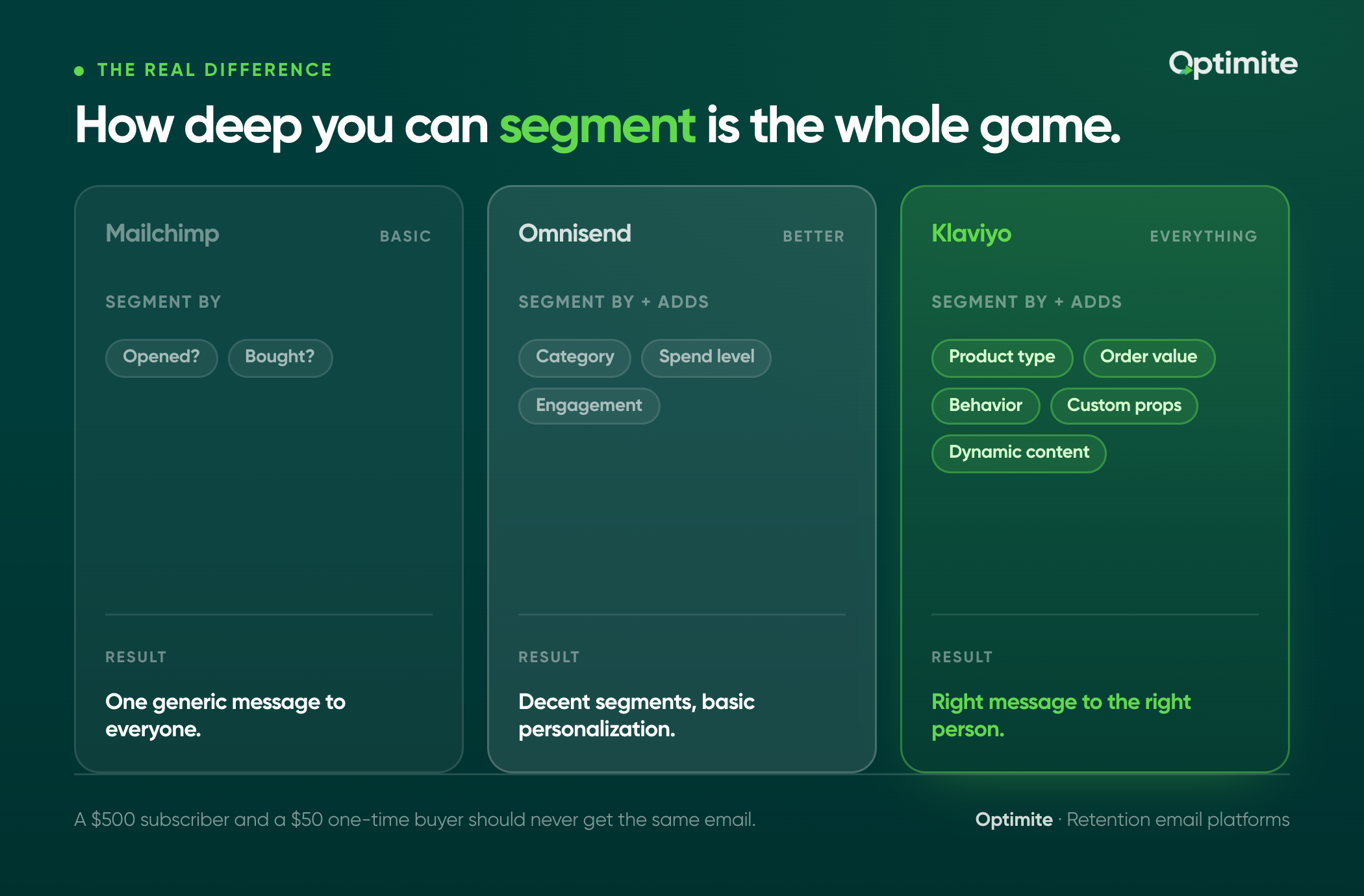
Mailchimp lets you segment by basic criteria: purchase history yes/no, email opened yes/no. That's it. You can't segment by product type, purchase frequency, customer value, or behavior patterns. Your retention messaging is generic because you can't get specific about who you're talking to.
Omnisend lets you segment by more criteria: purchase history, product category, spending level, engagement. Better than Mailchimp. But still limited. You can't build complex rules. You can't personalize dynamic content based on multiple data points. Your segmentation is decent but your personalization is basic.
Klaviyo lets you segment by everything. Purchase history, product type, order value, engagement, custom properties. You can build complex rules. You can create dynamic content that changes based on customer data. A customer who bought a subscription sees different messaging than a customer who bought a one-time supplement. A customer who spent $500 total sees different offers than a customer who spent $50. Your segmentation is powerful. Your personalization is advanced.
This is why Klaviyo drives higher repeat rates. You're not sending the same message to everyone. You're sending the right message to the right person.
Pricing and ROI comparison
Mailchimp: $0-$500 per month. ROI: medium. You get what you pay for.
Omnisend: $20-$300 per month. ROI: good. Solid features at a fair price.
Klaviyo: $20-$1,200 per month. ROI: excellent if used properly, wasteful if not.
The question isn't "which is cheapest?" The question is "which drives the most repeat purchase revenue relative to cost?"
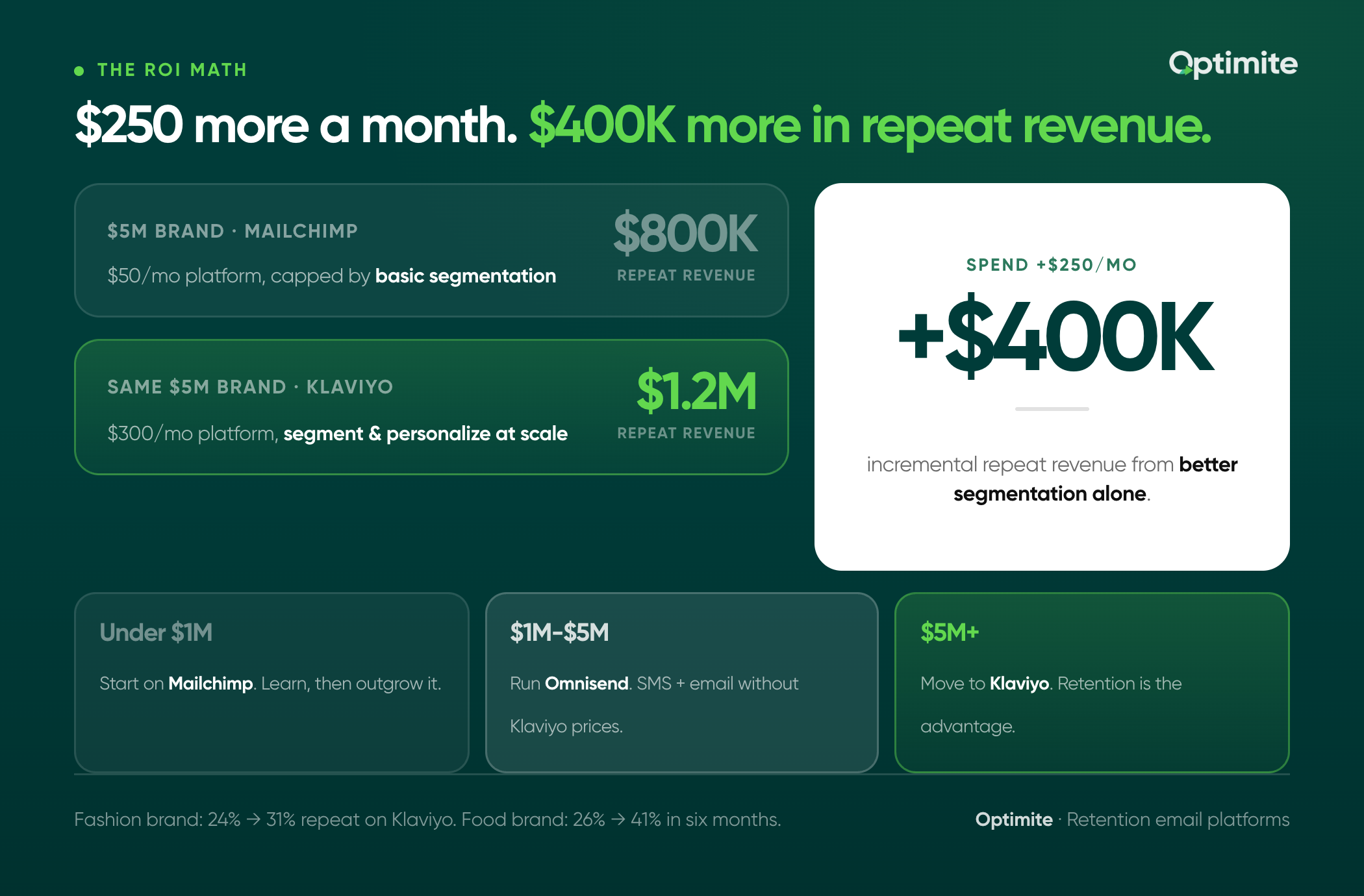
A $5M brand using Mailchimp at $50 per month sees $800K in repeat revenue. ROI looks good but it's actually constrained by platform limitations.
The same $5M brand using Klaviyo at $300 per month sees $1.2M in repeat revenue because they can segment and personalize better. The extra $250 per month in platform cost generated $400K in incremental repeat revenue.
That's the real comparison.
Which platform for which brand stage
If you're under $1M in revenue and you're testing your business model, start with Mailchimp. It's free. You'll learn. You'll outgrow it.
If you're between $1M and $5M and you need SMS plus email with decent automation, Omnisend works. You'll have solid repeat rate (22-28%) without paying Klaviyo prices. It's the right trade-off at your stage.
If you're above $5M or you're serious about retention as your competitive advantage, Klaviyo makes sense. The incremental repeat revenue pays for the incremental cost.
The platform matters, but your strategy matters more. A brand with a great retention strategy on Mailchimp will outperform a brand with a poor strategy on Klaviyo. That said, Klaviyo gives you more tools to execute a great strategy.
The email platform you choose matters for retention. But it matters less than what you do once you're in it.
Mailchimp works for testing. Omnisend works for growth. Klaviyo works for scaling retention. Pick the one that matches your stage and budget. Then build something thoughtful inside it.
If you're not sure which platform fits your needs or if you want help evaluating which makes sense for your specific business model, let's talk. We work with brands on all three platforms and we can help you evaluate the right choice for your situation. See how we've helped D2C brands across wellness, fashion, and food and beverage maximize retention revenue regardless of platform.


