

Top Mistakes To Avoid In Father’s Day Campaigns
The Father's Day email campaign mistakes that cost DTC brands revenue, list health, and long-term customer relationships
 Shrestha Ghosal
Running Father's Day campaigns across hundreds of e-commerce brands gives you a very clear view of what goes wrong. The mistakes aren't random. They cluster around the same decisions, made by well-intentioned teams under time pressure, that look reasonable in the planning stage and cost real revenue in execution.
This post is about what to stop doing. Because most Father's Day email campaign failures aren't caused by missing a tactic. They're caused by repeating patterns that erode list health, train customers to wait for discounts, and leave the post-gifting relationship completely unbuilt.
Here is what we consistently avoid when running Father's Day campaigns for the brands we work with.
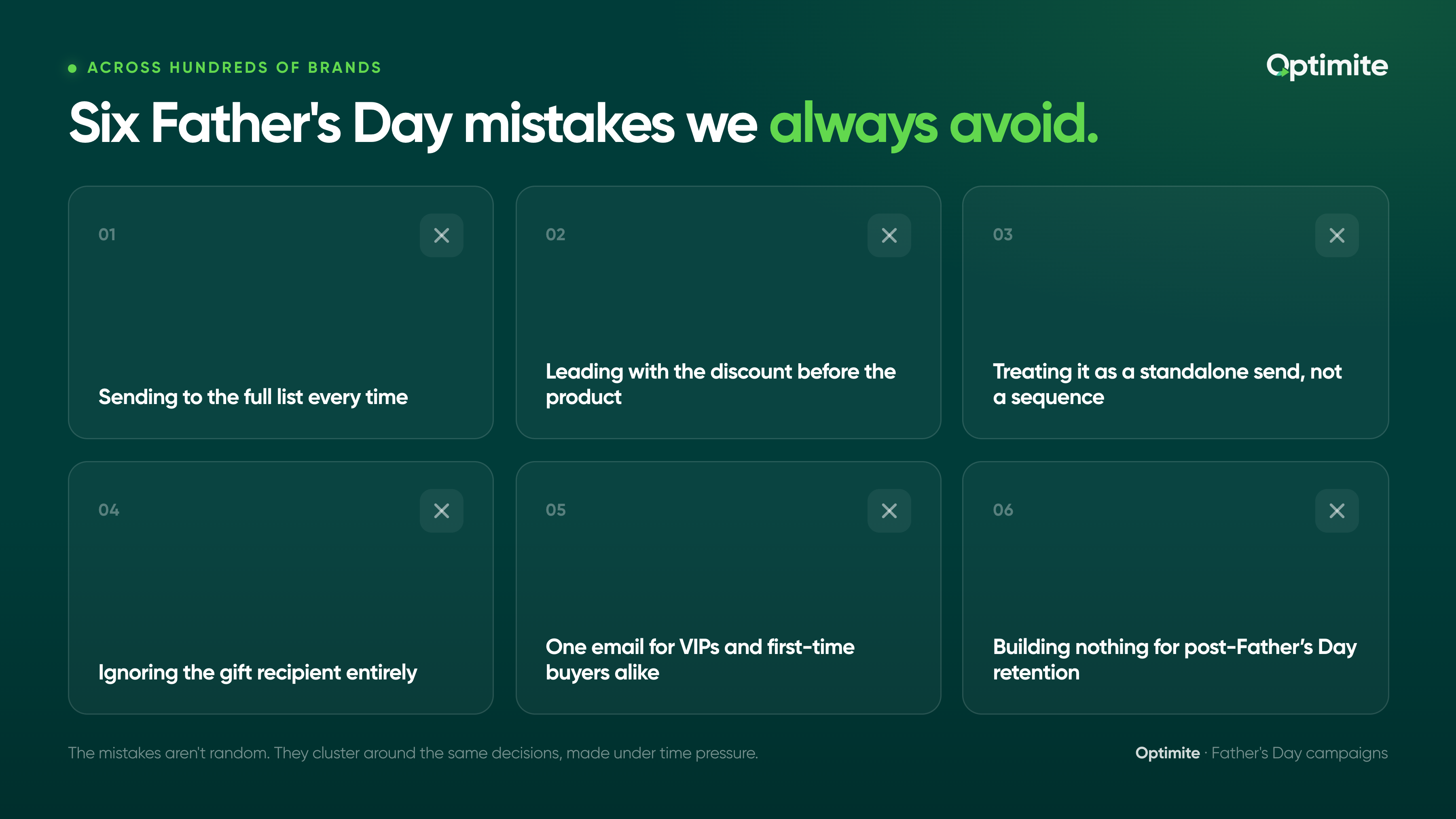
Sending to the full list every time
Father's Day campaigns have a clear audience: people who might buy a gift for their dad, their husband, their grandfather, or someone else in their life. That's a meaningful segment of most DTC lists. It's rarely the whole list.
Sending every Father's Day email to every subscriber is one of the fastest ways to generate unsubscribes and spike spam complaints during a peak sending window. Subscribers who have no reason to buy a Father's Day gift receive promotional emails that are simply irrelevant to them. A significant portion of them disengage or unsubscribe, which damages the sender's reputation, which you need for every campaign that follows.
What we do instead:
- Segment by past gifting behaviour. Customers who bought during last Father's Day, Mother's Day, or Christmas are the highest-intent audience.
- Suppress subscribers who haven't opened or clicked in 90 days before sending high-volume seasonal campaigns.
- Build a secondary sequence for the broader list with softer messaging rather than pushing the full gift guide to everyone.
Deliverability is infrastructure. A Father's Day campaign that damages the sender's reputation costs more than the revenue it generates if the next four weeks of sends land in spam as a result.
Never send a high-volume seasonal campaign to your full list without first suppressing unengaged subscribers. Klaviyo's deliverability data shows that sending to chronically unengaged contacts is one of the top causes of inbox placement decline. Suppress anyone with no opens or clicks in the last 90 days before the campaign goes out.
Leading with the discount before establishing the product
The default Father's Day campaign structure across most DTC brands is some version of: here's the discount, here's the product, here's the deadline. That structure converts in the short term. It creates a problem in the medium term.
Every time a brand leads with a discount, it trains a portion of its subscriber base to wait. The customers who would have bought at full price learn that patience gets rewarded. Over multiple seasonal campaigns, this behaviour compounds. The list becomes increasingly discount-dependent, and full-price conversion rates on non-promotional sends decline.
For Father's Day specifically, the gifting context gives brands a much stronger opening hook than a percentage off. The story of the product, why it makes a meaningful gift, what the person receiving it will actually experience, is more compelling than a discount code in the subject line. The discount, if one is part of the strategy, works better as a secondary element once the product desire has been established.
We consistently see better long-term retention metrics from brands that use Father's Day to introduce the product story first and offer second. The short-term conversion rate is sometimes slightly lower. The post-campaign repeat purchase rate is meaningfully higher.
Treating Father's Day as a standalone send rather than a sequence
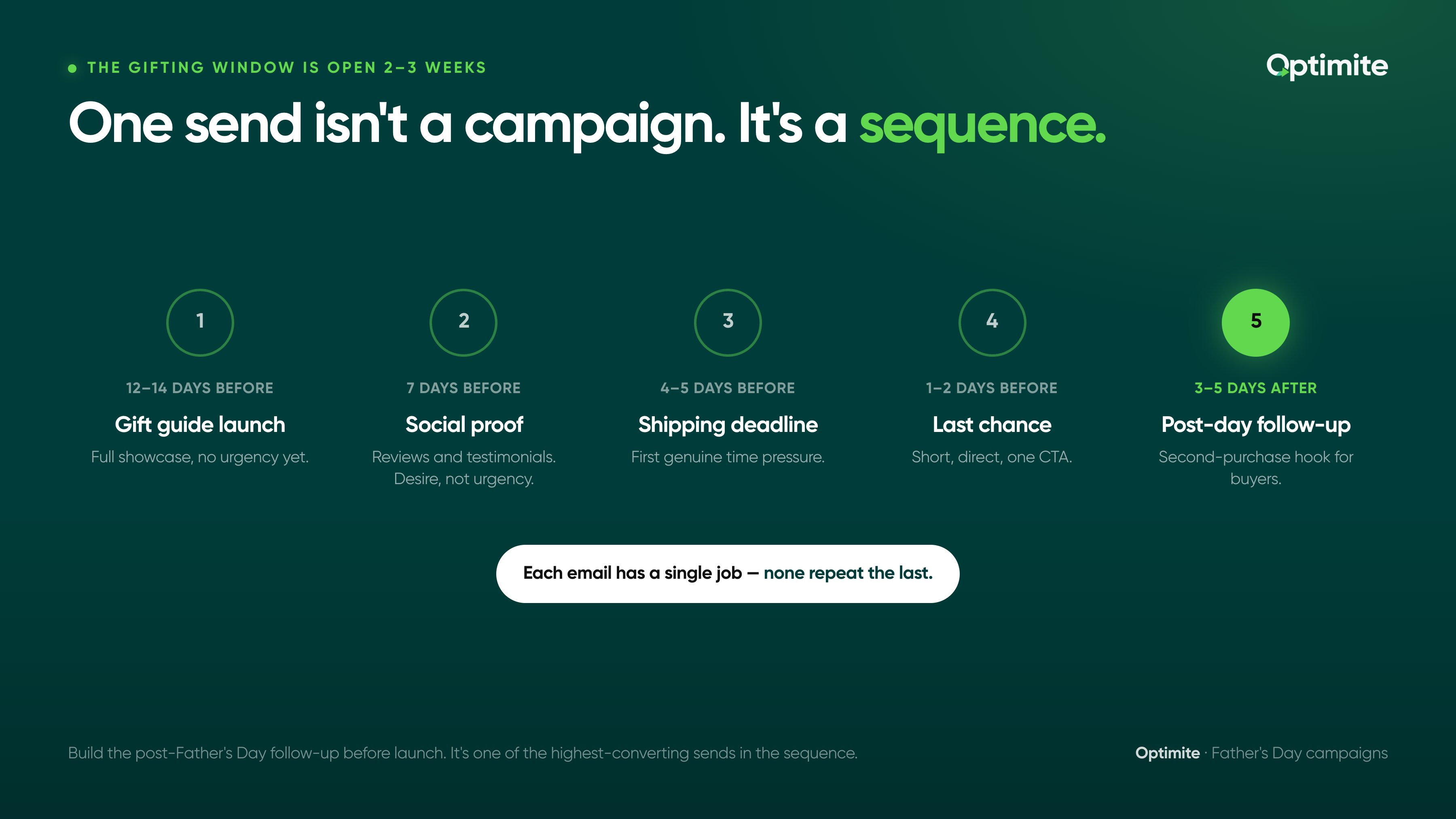
A single campaign email for Father's Day is a missed opportunity regardless of how well it performs. The gifting window is open for two to three weeks. Buyer consideration takes time. A single send gives subscribers one chance to see the campaign at the right moment, in the right context, with enough time to act.
The Father's Day campaign structure we build for most brands:
- Gift guide launch, 12 to 14 days before: Full product showcase, no urgency language yet. The goal is to plant the idea.
- Social proof send, 7 days before: Customer reviews, gift recipient testimonials, the "he's going to love this" angle. Desire, not urgency.
- Shipping deadline reminder, 4 to 5 days before: First introduction of genuine time pressure. Specific last-order dates for standard and express shipping.
- ** Last-chance send, 1 to 2 days before:** Short, direct, one CTA. For subscribers who haven't converted yet.
- Post-Father's Day follow-up, 3 to 5 days after: For buyers who converted, a second-purchase hook. For non-converters, a soft "still thinking of Dad?" angle if the product is relevant year-round.
Each email in this sequence has a single job. None of them repeats what the previous one said. The sequence feels like a coherent campaign rather than five versions of the same promotional email.
Build the post-Father's Day follow-up email before the campaign launches, not after. Most teams run out of time post-peak and skip the follow-up entirely. That email is one of the highest-converting sends in the sequence because it reaches buyers at peak product satisfaction and catches non-converters before they forget the brand entirely.
Ignoring the gift recipient entirely
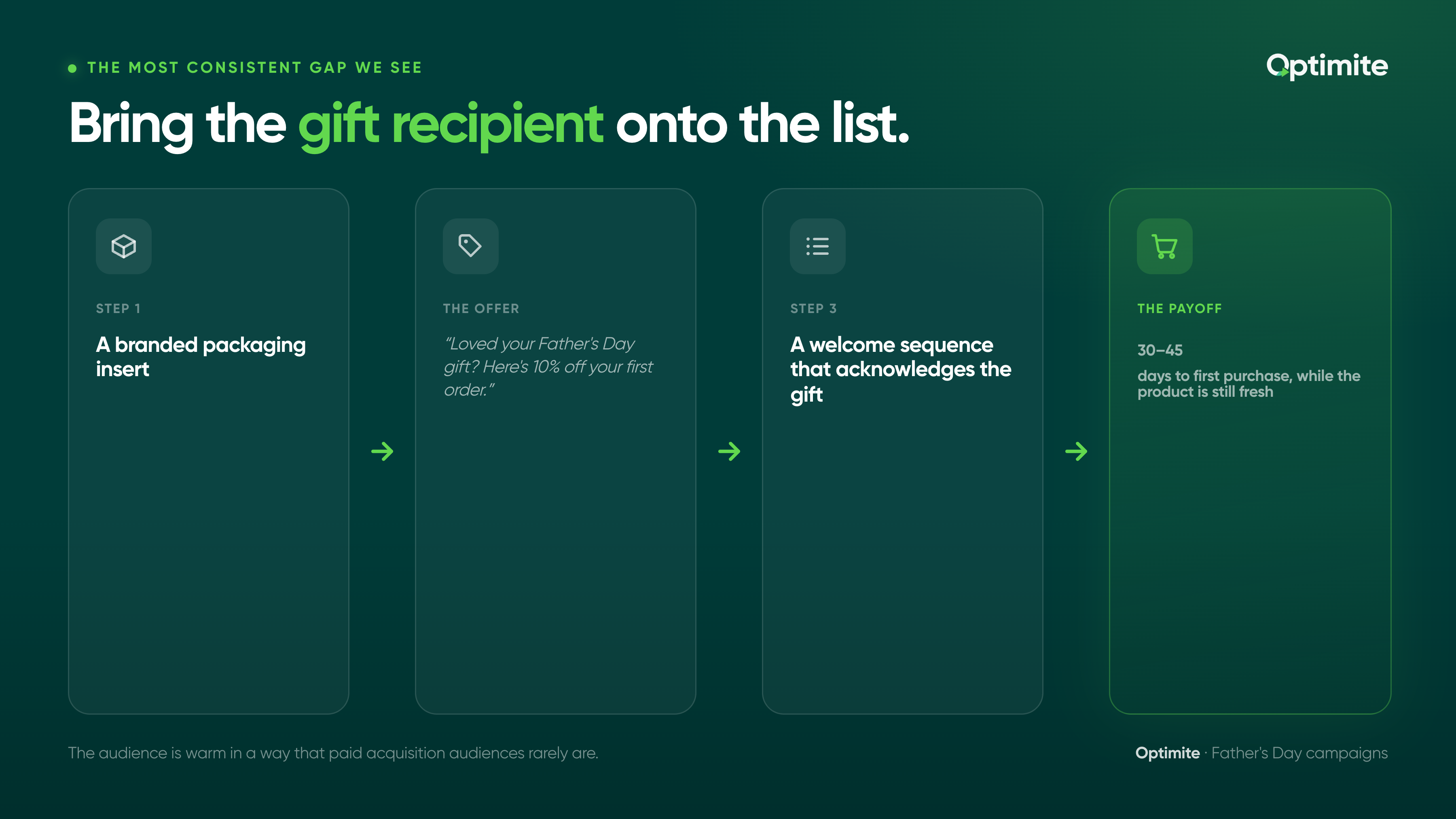
This is the most consistent gap we see in Father's Day retention strategy. The person who received the gift is not in the Klaviyo account. In most cases, no attempt is made to bring them in. The customer relationship ends with the gift buyer.
For brands in wellness, grooming, lifestyle, and food categories where the gift recipient becomes the end user of the product, this is a significant missed opportunity. A dad who received a grooming kit, used it for three weeks, and genuinely likes it is a warm potential customer. He just needs an on-ramp.
A branded insert in the delivery packaging with a specific offer for the recipient is one of the simplest and highest-leverage tactics in seasonal retention marketing. "Loved your Father's Day gift? Here's 10% off your first order," with a dedicated landing page, brings the recipient into the email list with context already established.
When the recipient opts in, they enter a welcome sequence that acknowledges the gift entry point. They've already had a positive brand experience. The welcome sequence doesn't need to work as hard to establish product desire because the product has already done that work.
Most brands that implement this for the first time are surprised by both the opt-in rate and the subsequent conversion rate. The audience is warm in a way that paid acquisition audiences rarely are.
Sending the same Father's Day campaign to VIP customers and first-time buyers
VIP customers, the segment who buy frequently and spends consistently, have a different relationship with the brand than someone on the list who has never purchased. Sending both audiences the same Father's Day email is a missed opportunity on both ends.
For VIP customers, the Father's Day campaign should:
- Land in their inbox before the general list, typically 48 to 72 hours earlier
- Offer access to a product, bundle, or configuration not available to the full list
- Acknowledge their loyalty directly in the copy, not in a generic way, but with a reference to their history with the brand
For subscribers who have never purchased, the Father's Day campaign is an acquisition opportunity. The messaging should work harder to introduce the brand and establish product credibility before asking for a sale.
The same email written to satisfy both audiences typically satisfies neither. The segmentation takes an hour to set up in Klaviyo. The revenue and retention impact lasts well beyond the Father's Day window.
VIP segmentation for seasonal campaigns doesn't need to be complex. A simple segment of customers who have made three or more purchases, or whose lifetime value sits above a defined threshold, is enough to start. The point is a different email with different access, not a completely separate campaign architecture.
Not building anything for post-Father's Day retention
This is the most expensive mistake on the list and the most common. The Father's Day campaign runs, the orders come in, and then the retention programme goes back to its standard cadence as if the peak never happened.
The gift buyers who purchased during Father's Day are a segment worth pursuing deliberately. They've demonstrated a willingness to spend on the brand. Many of them are gift buyers who will buy again before Christmas. A targeted post-Father's Day sequence that keeps the brand visible during the next gifting consideration window converts at a significantly higher rate than reaching those customers cold in November.
The lapsed customers who came back specifically for Father's Day and then went quiet are worth a dedicated win-back effort. They returned once. The right message at the right time can bring them back again.
And the gift recipients who opted in via the packaging insert are in a welcome sequence that should be built to convert them to a first purchase within 30 to 45 days while the product experience is still fresh.
None of this requires building a new campaign from scratch after Father's Day. It requires building the post-peak retention sequences before the campaign launches, so they trigger automatically when the conditions are met.
Father's Day is a reliable revenue spike for most DTC ecommerce brands. The brands that get the most from it aren't the ones with the biggest discounts or the most sends. They're the ones with a retention strategy that starts before the campaign goes out and runs for weeks after the occasion passes. If you want to build a Father's Day strategy that works this year and compounds over time, book a free call with us and we'll walk through exactly what to build for your brand.
Keep reading.
All posts
Mid-Year Review Email: The Campaign Type That Builds Trust Without Selling Anything
Shrestha Ghosal · Jun 18, 2026

How Small DTC Brands Can Run Meaningful Pride Month Campaigns on a Tight Send Cadence
Shrestha Ghosal · Jun 12, 2026

7 Father's Day Email Campaign Ideas That Drive Repeat Purchases, Not Just One-Off Gifts
Shrestha Ghosal · Jun 5, 2026