

Mid-Year Review Email: The Campaign Type That Builds Trust Without Selling Anything
The brands with the strongest retention programmes send emails that have nothing to do with a promotion. The mid-year review is one of them.
 Shrestha Ghosal
There's a category of email that doesn't get nearly enough attention: the one that asks for nothing.
No discount. No product push. No urgency countdown. Just a brand showing up to say: here's what we've been up to, here's what's coming, here's what you've been part of. Done well, this kind of email does more for long-term retention than most promotional campaigns ever will.
The mid-year review is one of the clearest examples. Sent in June or early July, it's a natural checkpoint in the calendar that most DTC brands walk straight past. The brands that don't walk past it tend to have stronger subscriber relationships, lower unsubscribe rates across their full send calendar, and higher engagement on the campaigns that come after it.
Why non-promotional emails matter for e-commerce customer retention
Retention programmes that only send when there's something to sell train customers to expect a transaction every time they open an email. That's a short-term pattern with long-term consequences. Over time, subscribers start to disengage unless there's a discount attached. Open rates drift down. Revenue per recipient follows.
Sending a different kind of email, with enough regularity that customers associate your brand with more than a sale, is what shifts that pattern. The relationship builds in the gaps between purchase moments.
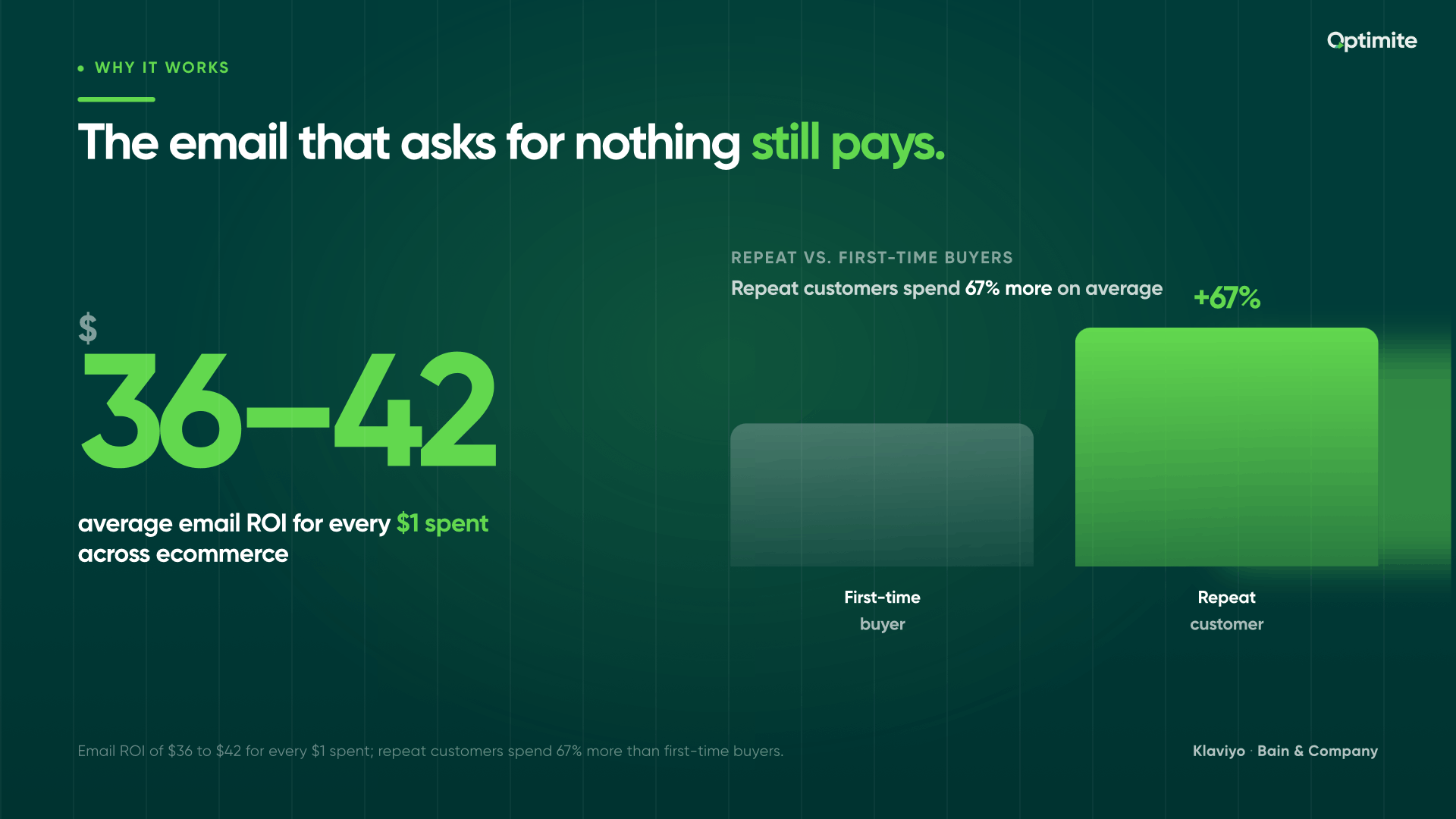
According to Klaviyo benchmarks, email drives an average ROI of $36 to $42 for every $1 spent across ecommerce. That ROI compounds fastest for brands where engagement stays high between purchase moments. Non-promotional emails, including review and update formats, are one of the clearest tools for keeping that engagement alive.
Bain & Company research shows repeat customers spend 67% more than first-time buyers on average. The brands that close that gap fastest are the ones that communicate consistently, not just transactionally.
Understanding why customers respond to this kind of communication comes down to behavioural psychology. The 8 psychology principles that drive ecommerce customer retention explain the mechanics behind why consistency and non-transactional touchpoints build stronger brand relationships over time.
What a mid-year review email actually contains
The format is flexible, but the best versions tend to share a few structural qualities.
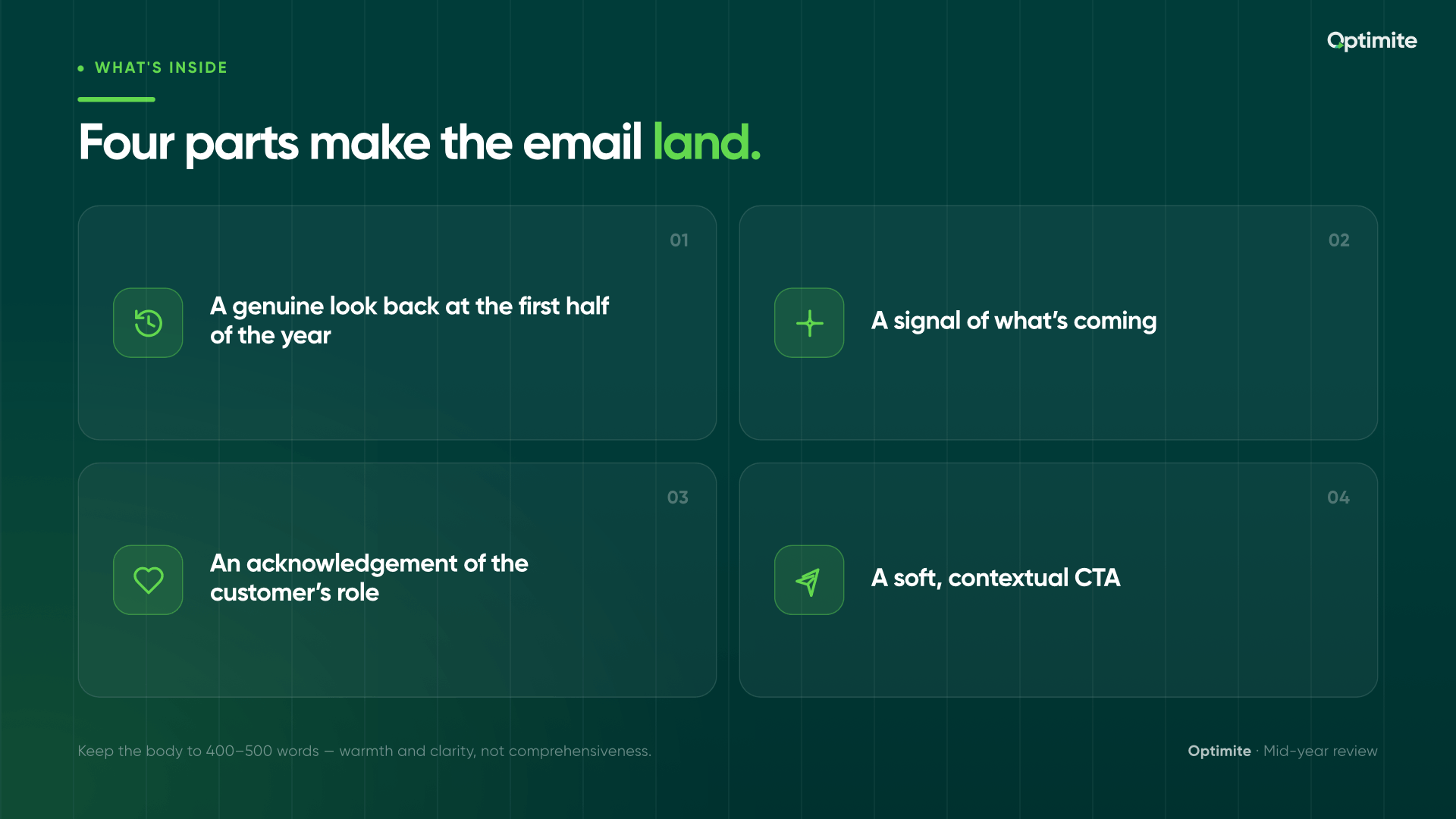
A genuine look back at the first half of the year. This isn't a highlight reel written by a PR team. It's honest: what launched, what sold out, what surprised you, what you learned. A wellness brand doing $4M might share that a new supplement formulation took three extra months because the first batch didn't meet their standards. That kind of honesty builds more trust than any launch announcement.
A signal of what's coming. Not a full reveal, but enough to create anticipation. A fashion brand might hint at a new category launching in Q3. A beauty brand might mention a restocked hero product that sold out in February. This section gives subscribers a reason to stay engaged without pitching them anything directly.
An acknowledgement of the customer's role. The best mid-year emails make the reader feel like a stakeholder. Language like "because of you, we were able to" or "the response from this community shaped what we built next" closes a loop between the brand's actions and the customer's participation. It's specific, and it's earned, not manufactured.
A soft, contextual CTA. This could be an invitation to reply with a question, a link to a content piece, or a quiet mention of what's available now. The CTA should feel like a natural next step, not the point of the whole email.
Keep the mid-year review email to 400-500 words in the body. The goal is warmth and clarity, not comprehensiveness. A long email signals that you have a lot to prove. A concise, confident one signals the opposite.
When to send it and who should receive it
Timing matters more than most brands realise with this format.
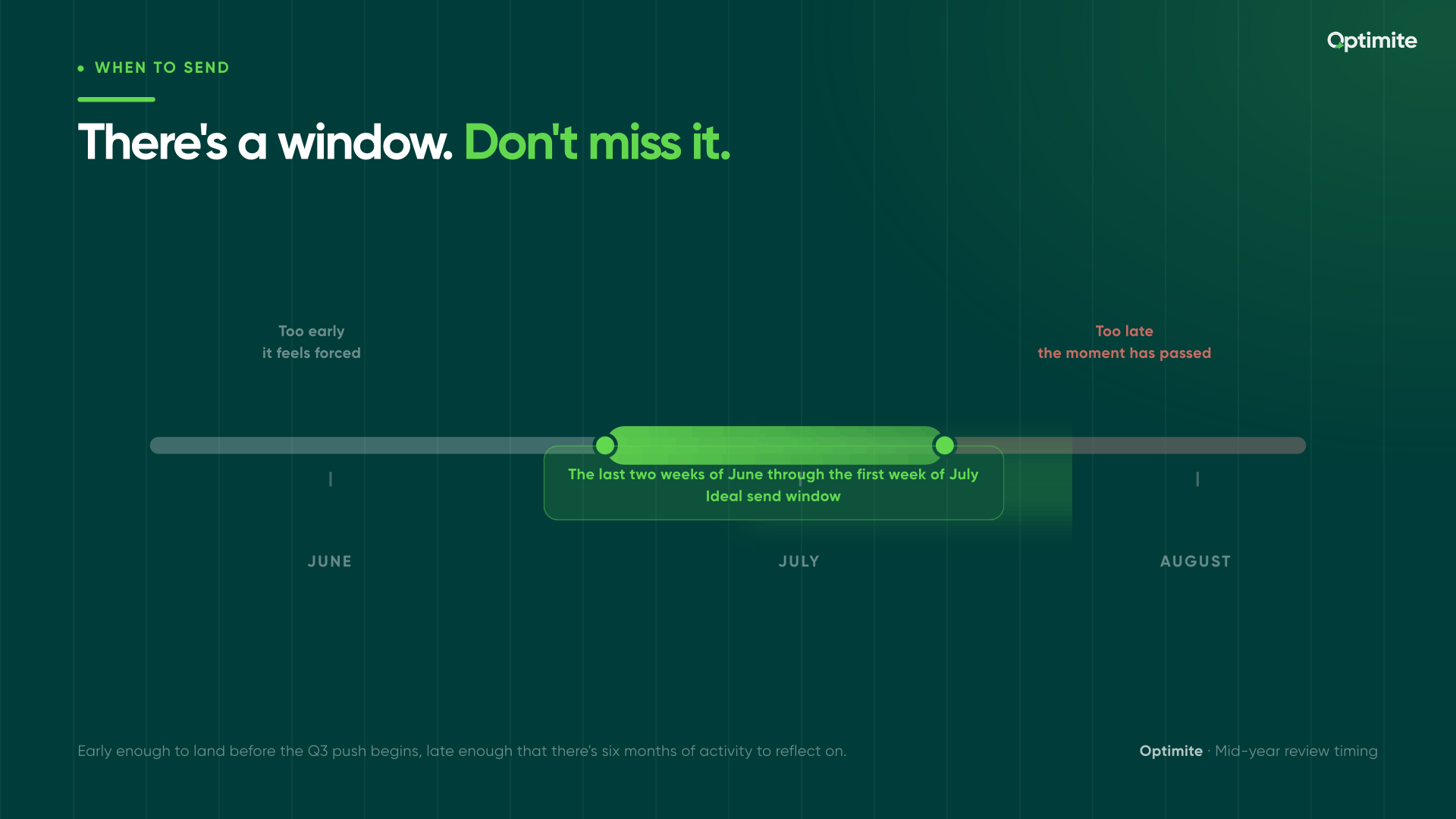
The ideal window is the last two weeks of June through the first week of July. Early enough to land before the Q3 push begins, late enough that there's actually six months of activity to reflect on. Send it too early, and it feels forced. Send it in August, and the moment has passed.
For the audience, the mid-year review works well across most of your list, but the segments that respond best tend to be:
- Subscribers who have been on the list for three or more months but haven't purchased recently
- One-time buyers who haven't returned in 60 to 90 days
- Active multi-buyers who engage with most sends
New subscribers who joined in the last 30 days don't have enough history with your brand for a review to land with weight. Either exclude them or write a slightly different version that frames the review as an introduction to who you are.
For one-time buyers sitting at 60-90 days, it helps to understand where they sit on the spectrum before deciding how to message them.
Don't send this email during a live sale or within 48 hours of a promotional campaign. If a subscriber opens a "we just want to say thank you" email and then immediately receives a 20% off push, the trust signal dissolves. Give the review email room to breathe in the calendar.
How this fits into a broader e-commerce email campaign strategy
The mid-year review works best as one of several non-promotional formats that run throughout the year alongside your lifecycle flows and campaign calendar. Before deciding where it sits, it helps to have your customer lifecycle mapped, so you know exactly which moments in the journey need a touchpoint like this.
Brands with strong retention programmes typically build a send calendar that includes:
- One or two value or educational sends per month alongside promotional campaigns
- Milestone emails tied to the brand's story: a founding anniversary, a product milestone, a community achievement
- Transparent update emails when something goes wrong or changes: a shipping delay, a reformulation, a price change
- Review or reflection emails at natural calendar moments, including mid-year and year-end
The mid-year review sits in this last category. Its job is to create a moment where the customer feels genuinely seen by the brand, separate from any commercial ask.
For wellness brands, this kind of email often references the customer's own journey: the seasons, the goals people set in January, the products that have been part of their routine. For beauty and fashion brands, it tends to be more product and community-focused: the launches, the reactions, the behind-the-scenes moments that subscribers were the first to hear about.
If your brand is in a vertical with longer repurchase windows, like home or CBD, the mid-year review carries even more weight. These are categories where customers might go 90 to 120 days between purchases. Keeping engagement alive through non-promotional content is what determines whether they come back to you or drift to a competitor.
The small details that determine whether it lands
The mid-year review is easy to write poorly. A few patterns reliably make it weaker:
-
Listing achievements without connecting them to the customer. "We launched four new products this year" is a press release. "The response to our March launch pushed us to build a second version faster than we'd planned" is a story with the customer inside it.
-
Making the subject line too broad. A subject line like "Our mid-year update" will get skimmed. "Six months in: here's what happened" or "What the first half of the year looked like" is more specific and more likely to get opened.
-
Overloading it with links. Every link in this email is a request for the reader's attention. One or two contextual links are enough. This email earns trust by giving, and every additional CTA shifts the balance back toward taking.
-
Skipping it because nothing major happened. Something always happened. A product that resonated more than expected. A community response that surprised the team. A decision that got reversed based on customer feedback. The story doesn't need to be dramatic to be worth telling.
The brands that send this kind of email consistently, year after year, build something that promotional campaigns alone can't: a subscriber base that opens out of genuine interest rather than just transactional intent. That's the foundation that makes every other campaign perform better.
If you want to build a send calendar that includes non-promotional formats alongside your core campaigns, book a free call with Optimite and we'll look at where these emails fit in your current programme.
Keep reading.
All posts
How Small DTC Brands Can Run Meaningful Pride Month Campaigns on a Tight Send Cadence
Shrestha Ghosal · Jun 12, 2026

Top Mistakes To Avoid In Father’s Day Campaigns
Shrestha Ghosal · Jun 8, 2026

7 Father's Day Email Campaign Ideas That Drive Repeat Purchases, Not Just One-Off Gifts
Shrestha Ghosal · Jun 5, 2026