

The Trust Gap in Wellness Retention: Why Your Customers Ghost After the First Purchase
 Shrestha Ghosal
Most Klaviyo accounts have flow performance reports, campaign revenue breakdowns, segment lists, customer profiles, and purchase histories. However, they're short on time to turn all of that into a decision.
A wellness customer who buys once and disappears is not an anomaly. It is the default outcome for most brands that have not built a retention system specifically for this category.
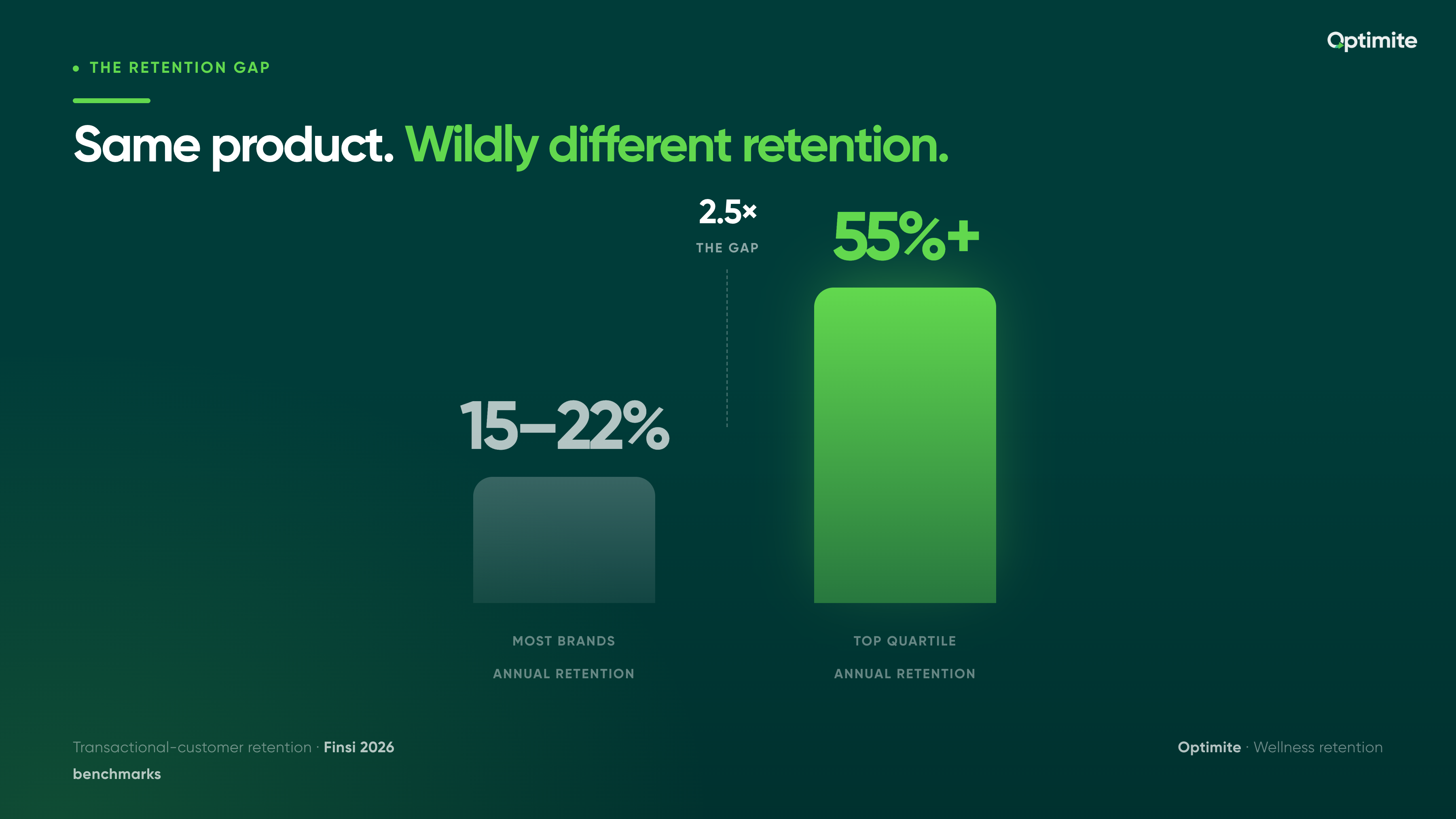
The average supplement brand sees somewhere between 15% and 22% annual retention among transactional customers, according to 2026 benchmarks from Finsi. The top quartile of supplement brands is hitting 55% and above. The difference is not the product. It is rarely the product. It is what happens in the 60 days after the first order.
Wellness customers ghost for a specific reason that most brands diagnose too late: they never fully trusted the purchase. The first order was optimistic. The post-purchase experience gave them nothing to hold onto. And by the time the bottle was half-empty, they had already started looking elsewhere.
This is the trust gap. And understanding it is the first step toward closing it.
Why wellness retention behaves differently from other categories
Supplement and wellness brands operate in a category where the purchase psychology is fundamentally different from fashion, beauty, or food. A customer buying a protein powder or a sleep supplement is not just buying a product. They are buying a belief that it will work for them personally.
That belief is fragile at the point of first purchase. The customer has taken a risk. They have spent money on something whose benefits are invisible in the short term, whose mechanism they may not fully understand, and whose results depend partly on their own behaviour. Compare that to a $60 pair of trainers. The trainers either fit or they don't. The judgment is instant.
With a 30-day supplement supply, the judgment is deferred. And in that window, three things typically happen:
- Doubt sets in, particularly around whether they're taking it correctly or consistently enough
- The brand goes quiet, because most post-purchase sequences are built on transaction logic, not trust-building logic
- The customer receives nothing that confirms their purchase was a good one
By day 20, the decision to reorder has already been made, one way or the other. Most brands don't realise this until the 90-day cohort data shows them who came back.
The critical retention window for supplement brands is days 15 to 45 after first purchase, according to Propel's 2026 lifecycle benchmarks. Brands that build education sequences into this window see significantly lower first-refill churn. The habit and the perceived benefit both get established here, or they don't get established at all.
The post-purchase silence problem
 The most common mistake wellness brands make in retention is treating the post-purchase flow as a transaction confirmation sequence. Order confirmed. Shipping update. Review request. That's the entire programme for most brands operating below $5M.
That sequence was designed for apparel. It does not work for wellness.
A customer who has just bought a collagen supplement and receives a review request on day 7 has not yet seen any results. Asking them to review a product they haven't had time to evaluate is not just ineffective; it is a trust signal in the wrong direction. It tells the customer the brand is extracting value from them rather than delivering it.
The post-purchase silence window, broadly defined as the period between the order confirmation and the next meaningful communication, is where most wellness brands lose customers they will never get back.
What that window should contain instead:
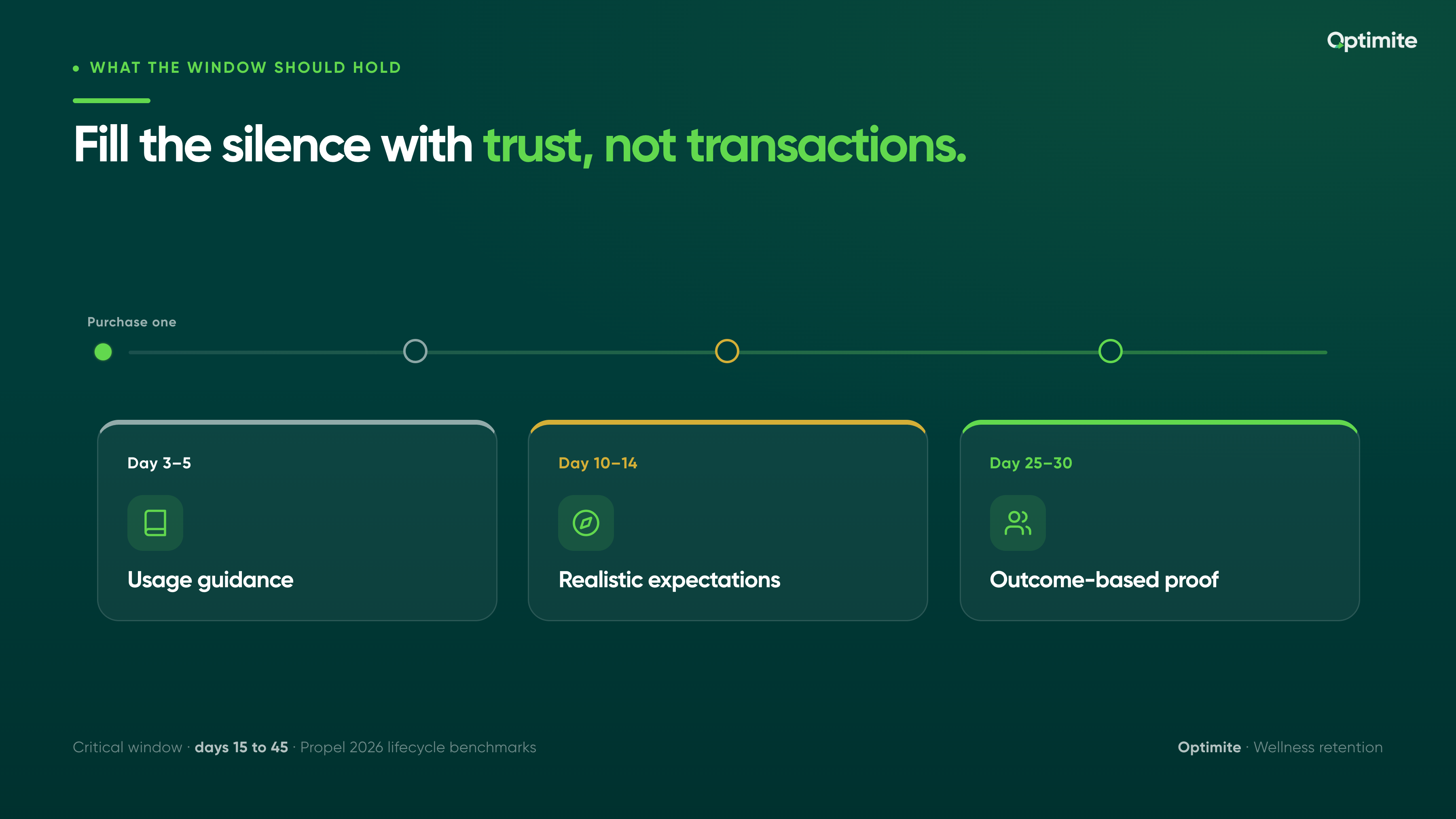
- Usage guidance sent on days 3 to 5. When to take the product, how to take it, and what to expect in the first two weeks. Not a brochure. A single, direct email written as if it came from someone who knows the product.
- A realistic expectation email at days 10 to 14. Wellness customers overestimate short-term results and underestimate what consistency actually delivers. An email that says "here's what week two typically looks like" reduces doubt and builds credibility simultaneously.
- Social proof that is outcome-based, not star-rating-based. Not "4.8 stars from 2,000 reviews." A real customer story about what changed after 30 days of consistent use. This is the kind of validation that makes a first-time buyer feel less alone in the process.
Build your day 3 to 5 usage email around a single question the customer is almost certainly asking at that point: "Am I taking this right?" Answer it plainly. Include dosage, timing, and one common mistake to avoid. This email consistently outperforms promotional content in open and click rates for supplement brands because it is genuinely useful rather than commercially motivated.
Discount-first retention is making the trust problem worse
Many wellness brands try to solve first-purchase churn with a discount offer on day 30. "20% off your next order" sent exactly when the first bottle is about to run out. The logic is sound. The execution often backfires.
Here is the problem: a discount offer sent to a customer who has not been educated, engaged, or supported in the preceding 30 days does not signal value. It signals desperation. For a customer who is already uncertain about whether the product worked, a discount can actually reinforce the doubt. If the brand needs to discount this heavily to get a reorder, they may wonder whether the product is worth the full price at all.
Wellness retention built on discount dependency also trains customers to wait. They learn quickly that if they don't reorder immediately, a better offer will appear. Your repurchase window gets artificially extended. Your margin gets compressed. And your list becomes full of customers who only buy on promotion.
The alternative is a retention sequence that makes the second purchase feel like a natural continuation rather than a transaction that needed an incentive. That requires communication during the first 30 days that builds enough perceived value that reordering feels obvious.
If your first reorder email is a discount, check what came before it. Most brands find the post-purchase sequence has four or fewer emails in the first 30 days, and none of them is educational. The discount is trying to compensate for trust that was never built. Fix the sequence first. The discount can come later, as a reward for loyal customers rather than a lever to rescue ambivalent ones.
What wellness customers actually need between purchase one and purchase two
The trust gap in wellness retention is not about email frequency. Brands that send three emails and brands that send twelve emails in the first 30 days can both lose the same customer if the content is wrong.
What the customer needs in the first-purchase window is specific:
Competence signals. Evidence that the brand knows what it's talking about. This looks like ingredient explanations, sourcing transparency, manufacturing standards, and third-party testing references. Not a wall of certifications, but one clear signal per communication that the brand is genuinely expert.
Consistency support. Most wellness products only work if the customer takes them consistently. Most customers don't. A retention sequence that helps someone build a habit around the product is delivering real value, and that value translates directly into reorder probability. Usage reminders, stacking tips, and habit-pairing suggestions are all underused by brands that are focused purely on the next transaction.
Community or social proof at the right moment. Not on day 7 when the customer has seen no results. On days 25 to 30, when they have had enough time to notice something and are ready to hear what others experienced. A testimonial from a customer who describes their 30-day journey lands very differently at that point than a generic five-star average.
The sequence structure that works for supplement and wellness brands is outcome-oriented rather than transactional. Every email should be asking: what does this customer need to feel confident and supported right now? The answer changes week by week, and the sequence should reflect that.
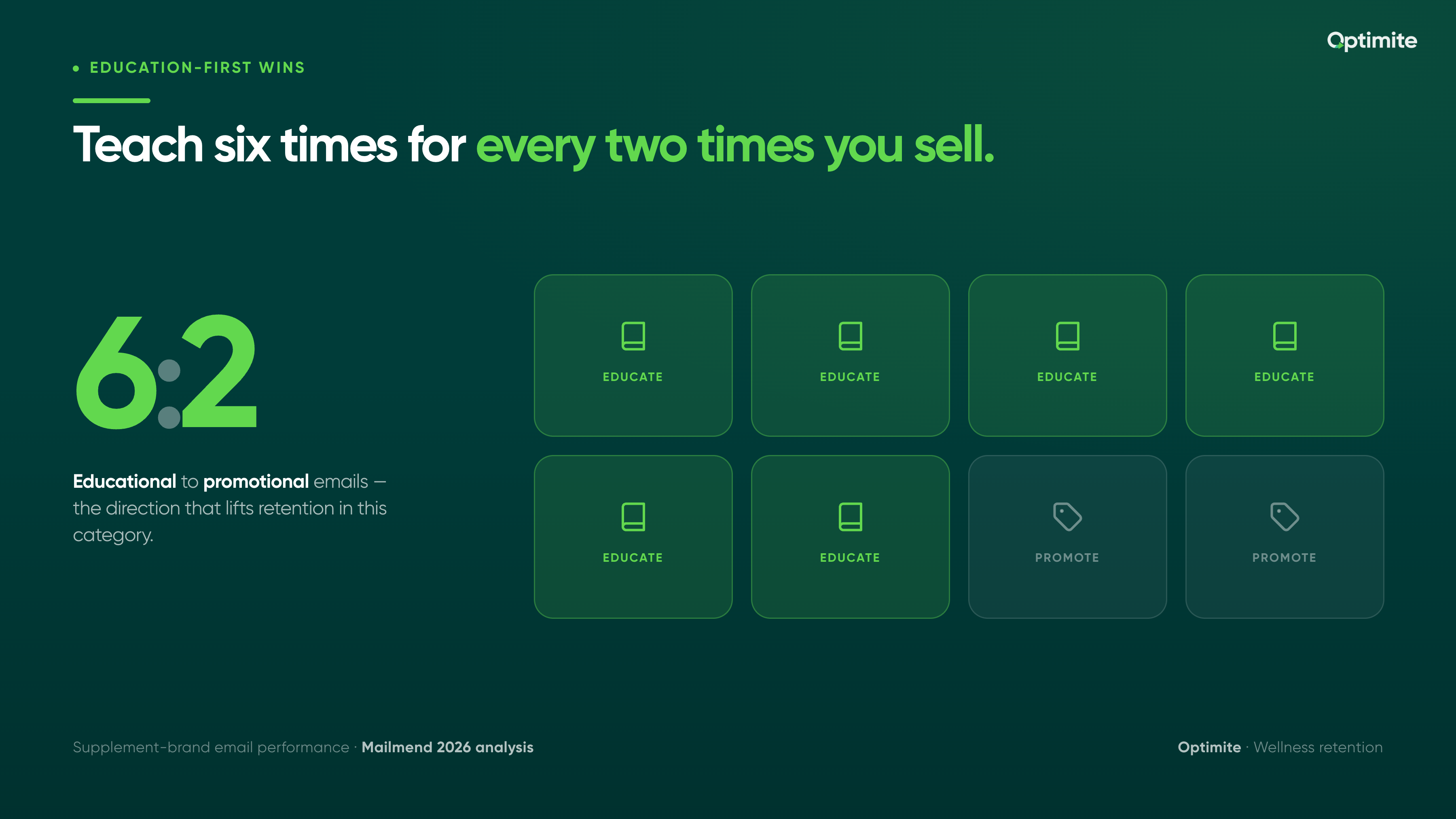
Wellness email programmes that maintain a ratio of approximately 6 educational emails to every 2 promotional emails see higher retention rates than those that flip the ratio, according to Mailmend's 2026 analysis of supplement brand email performance. The specific ratio matters less than the direction. Education-first programmes consistently outperform promotion-first ones in this category.
The repurchase window and why timing matters more than most brands realise
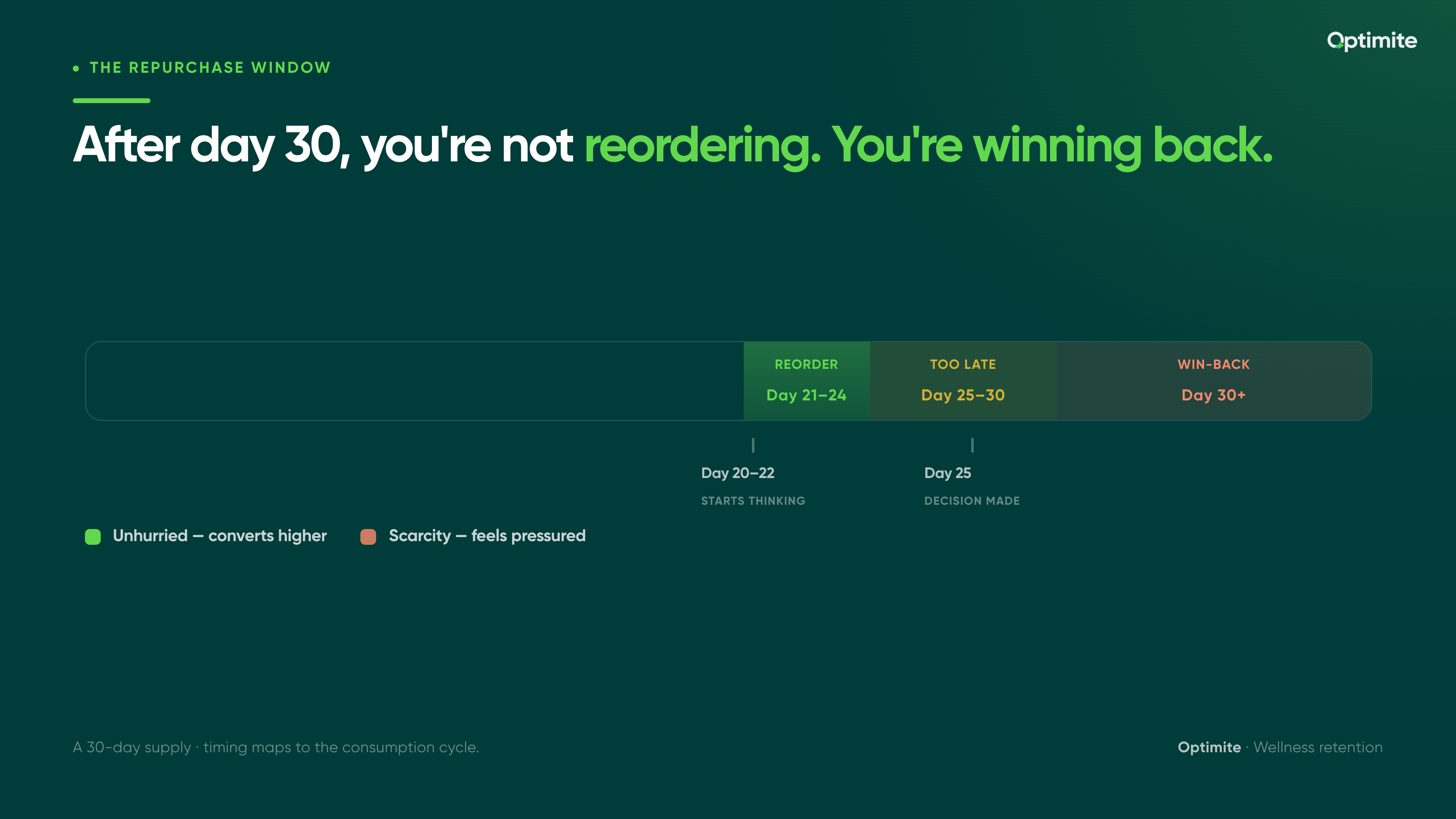
A 30-day supplement supply creates a natural repurchase window, but that window is not symmetric. The customer starts thinking about reordering around days 20 to 22, when they can see the end of the supply. The decision is effectively made by day 25. After day 30, you are no longer capturing a repurchase. You are running a win-back.
Most brands send their repurchase email on days 28 to 30. That is often two days too late for the undecided customers.
Reorder campaigns that arrive at days 21 to 24, when the customer has enough product left to feel unhurried, convert at a higher rate than those that arrive at the point of scarcity. Scarcity messaging feels pressured. A well-timed, educational email that says "you're coming up to the end of your first month, here's what customers who continue past 60 days typically notice" frames the reorder as a journey continuation, not a transaction.
For brands with multiple SKUs, this is also where the second-product introduction belongs. If a customer bought magnesium and you have a sleep formula that works well alongside it, day 21 is a better time to introduce it than day 45, when they are already considering whether to continue at all.
Building retention that closes the trust gap
Wellness retention that actually works looks less like a discount funnel and more like a support programme. The brands doing this well at $5M to $15M in revenue share have a few common patterns.
They treat the post-purchase email sequence as the product's onboarding experience. Every email earns the next open by delivering something useful. The review request doesn't come until day 45 at the earliest, after the customer has had real time to evaluate.
They segment by engagement, not just purchase date. A customer who opened the day 14 usage tips email is in a different position than one who didn't. The former gets a progression communication. The latter gets a re-engagement attempt before the repurchase window closes.
They build repurchase cadences that map to the actual consumption cycle, not to a generic 30-day rule. A 60-day supply needs different timing than a 30-day one. A customer who bought a bundle has a different reorder profile than one who bought a single product.
If your wellness brand is losing customers between purchase one and purchase two at a higher rate than you'd like, the gap is almost always in the post-purchase communication window. The acquisition was fine. The product is likely fine. The trust-building that should have happened in weeks two through four didn't happen, and by the time the reorder window opened, there was nothing to close it against.
We work with wellness, supplement, and health brands across Shopify and Klaviyo to build retention programmes that address exactly this problem. If you want us to take a look at where your lifecycle is losing customers, book a free call with us and we'll map your current sequence against benchmarks and tell you exactly what to fix first.
Keep reading.
All posts
8 Email Flows Built Specifically for Food and Beverage Brands on Shopify
Shrestha Ghosal · Jun 15, 2026

6 Segmentation Strategies That Work Specifically for Fashion E-commerce Buyers
Shrestha Ghosal · Jun 15, 2026

The CBD Brand Retention Problem Nobody Talks About Openly
Shrestha Ghosal · Jun 10, 2026