

8 Email Flows Built Specifically for Food and Beverage Brands on Shopify
Generic flows miss the category-specific logic that makes food and beverage retention work. Here are 8 built around consumption cycles, gifting, and repeat purchase timing.
 Shrestha Ghosal
Food and beverage brands on Shopify have a customer relationship that most generic flow templates are not built for: shorter repurchase windows, consumption-based timing, gifting behaviour, and a real opportunity to build habit and ritual around a product.
The standard flow stack: welcome, cart abandonment, post-purchase, win-back, works for almost every e-commerce category. But for food and beverage, the setup logic inside each flow needs to reflect how people actually buy and consume these products. A coffee brand needs a replenishment email timed to a 250g bag, not a ninety-day win-back window. A sauce brand needs post-purchase education, not just a review request.
According to Klaviyo's 2026 benchmarks, food and beverage brands have the highest placed order rate of any ecommerce category at 0.26%, more than double the rate for clothing and accessories. The category has purchase intent built in. The flows you set up determine how much of that intent you actually capture.
Here are eight flows built specifically for the category, with setup logic for each. 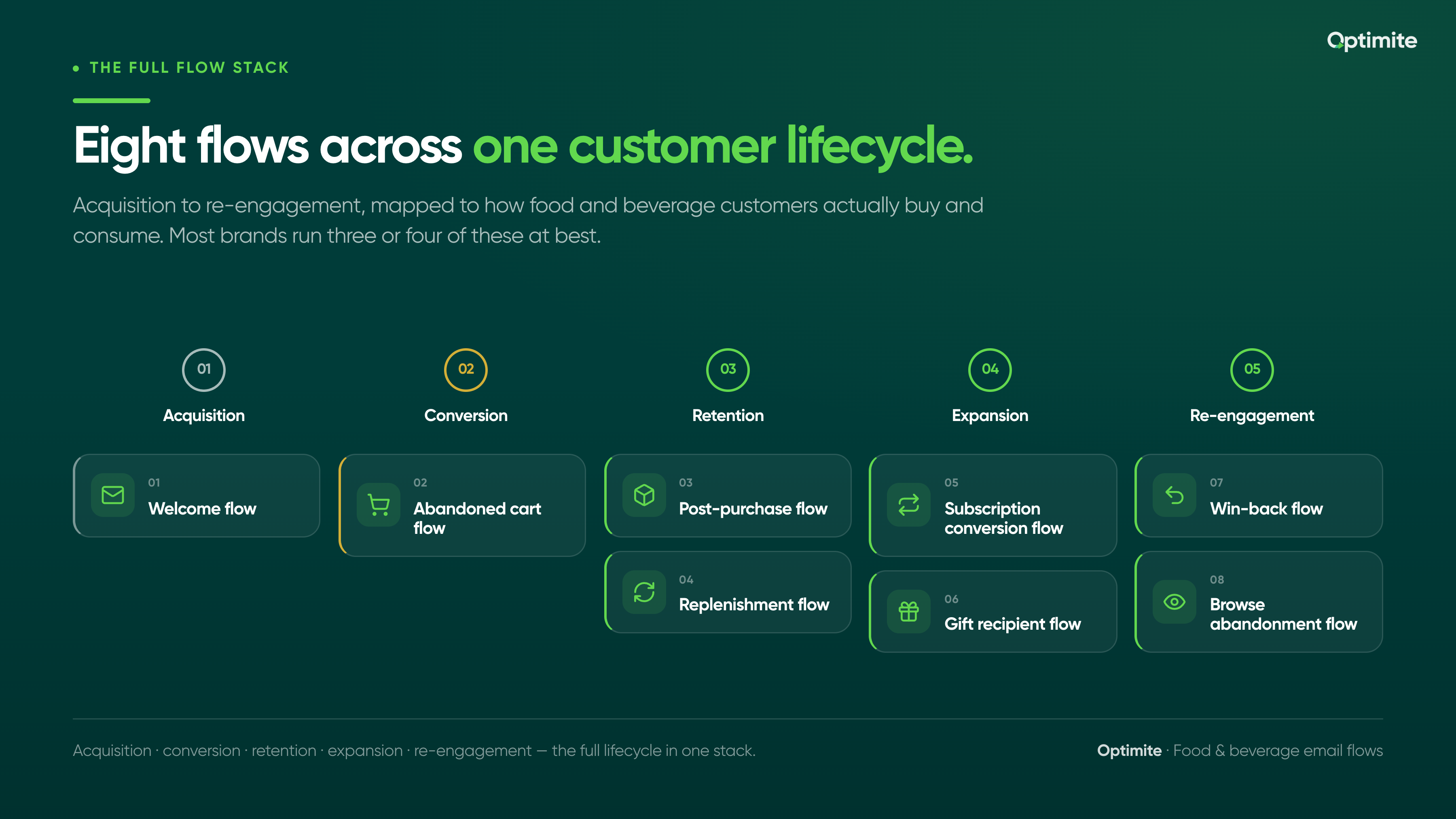
Welcome flow: Lead with the product story, not the discount
Food and beverage brands earn repeat purchases when customers understand what they are buying and why it is different. A welcome flow that goes straight to a discount skips the most important part of the conversion: trust.
Your welcome series should run four to five emails across ten to fourteen days. The first email confirms the signup and introduces the brand story: where the product comes from, how it is made, what makes it different from what they could pick up at a supermarket. The second email goes deeper into the product itself: origin, process, flavour profiles, use cases. The third email introduces social proof, ideally in the form of customer language that mirrors how buyers talk about the product in reviews. The fourth email handles the first-purchase offer.
For perishable or consumable products, include a freshness or production note early in the welcome series. Customers who understand the quality signal are more willing to pay full price on the first order and are more likely to become repeat buyers.
Brands that strip this down to a one-email welcome with a discount code are training their new subscribers to wait for offers rather than buy because they want the product.
Abandoned cart flow: Address the specific hesitation
Food and beverage cart abandonment is frequently not about price. It is about uncertainty: does this taste good, will I actually use it, is the shipping worth it for something I can buy elsewhere? Your abandoned cart flow needs to resolve those questions, not just remind the shopper that the cart exists.
The first email, sent one to two hours after abandonment, should be a simple cart reminder with strong imagery and a short line about what makes the product worth the purchase. The second email, sent twenty-four hours later, should lean on social proof, specifically reviews that speak to taste, texture, or experience. The third email, sent forty-eight to seventy-two hours later, can introduce an incentive if the brand's margin supports it.
According to Klaviyo's abandoned cart benchmark data, food and beverage leads all ecommerce categories with a 52.16% open rate on cart abandonment flows. The intent is there. Most brands are leaving it unresolved with a two-line reminder email.
Post-purchase flow: Teach them how to use the product
The post-purchase window is where food and beverage brands either build a loyal customer or lose them to one bad experience. If someone buys a specialty coffee and brews it wrong, they blame the product, not the grind size. If someone buys a sauce and does not know what to cook with it, the jar sits in the back of the cupboard.
Your post-purchase flow should include:
- A delivery confirmation email with a usage tip or recipe idea
- An education email on days three to five covering product preparation or best use cases
- A review request from days seven to ten, once the product has been used
- A cross-sell email at days fourteen to twenty-one introducing a complementary product
The goal of this sequence is to make sure the product experience lands well enough that the customer comes back.
Time your review request to product consumption, not delivery. A coffee brand should send the review request seven days post-delivery, not two. A wine brand should wait ten to fourteen days. Getting this timing wrong produces low response rates and rushed reviews that do not reflect the actual product experience.
Replenishment flow: Time it to consumption, not the calendar
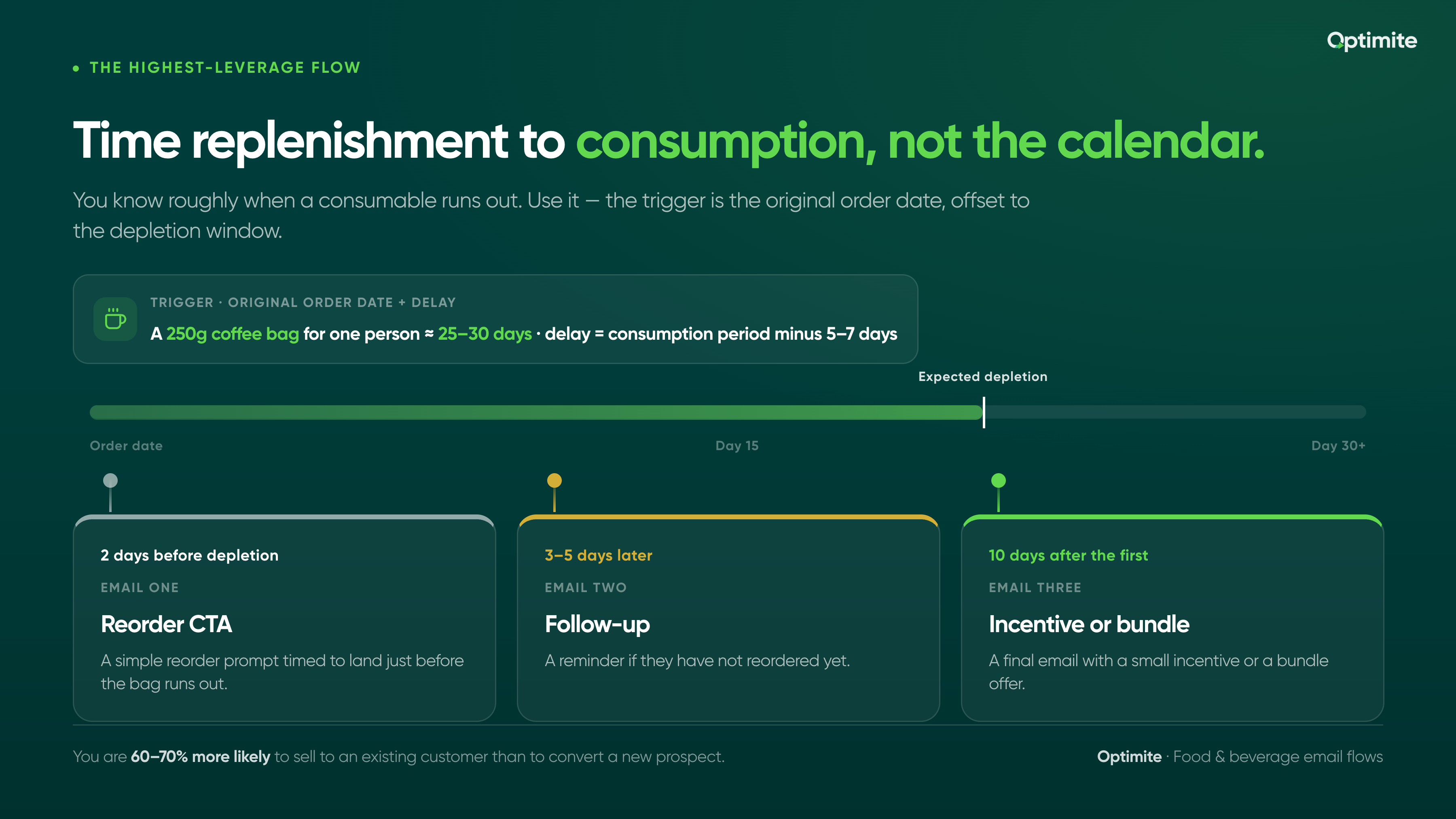
Replenishment is the highest-leverage flow a food and beverage brand can build. If you sell something consumable, coffee, protein powder, hot sauce, olive oil, or tea, you have a natural reason to contact the customer that is genuinely useful rather than promotional. You know approximately when they will run out. Use that.
The trigger in Klaviyo is the original order date, with a time delay set to the expected consumption period minus five to seven days. For a 250g coffee bag consumed by one person, that is roughly twenty-five to thirty days. For a 500g bag shared between two people, it is shorter.
Send the first replenishment email two days before the expected depletion date with a simple reorder CTA. If they do not reorder, send a follow-up three to five days later. If still no reorder, send a final email with a small incentive or a bundle offer ten days after the first.
According to research cited by LiveAgent, you are 60 to 70% more likely to sell to an existing customer than to convert a new prospect. A timed replenishment email is the most direct way to operationalize that fact.
Subscription conversion flow: Move repeat buyers off one-off orders
Some food and beverage brands have a subscription option, but do nothing to move repeat buyers onto it. If someone has placed two or more orders for the same product within sixty days, they are a subscription candidate. A dedicated flow triggered by the second purchase of the same SKU can meaningfully increase subscription conversion without relying on the product page alone.
The flow should run two to three emails:
- Triggered at second purchase: introduce the subscription option with a clear saving calculation
- Day seven post-second-purchase: a comparison email showing the total annual cost of one-off orders versus subscription
- Day fourteen: a final subscription offer with a small added incentive if appropriate
Most Shopify subscription tools (Recharge, Skio, Seal Subscriptions) integrate with Klaviyo and allow you to tag subscribers differently from one-off buyers. Set up this segmentation before building the flow so you can exclude existing subscribers from the sequence.
Gift recipient flow: Convert gifted buyers into direct customers
Food and beverage products are frequently gifted. A hamper, a specialty coffee subscription, and a bottle of olive oil as a housewarming gift. The person who receives it is a warm lead with no direct relationship with the brand. Most brands collect no data on gift recipients and do nothing with them.
If your Shopify store has a gift note field or a gift option at checkout, you can use that data to trigger a separate post-purchase flow for the gift buyer. Ask them to include the recipient's name. After delivery, send a short sequence to the purchaser asking them to share the brand with the recipient, with a first-purchase discount for the recipient attached.
If you have access to the recipient's email through gift registration or card redemption, build a gift recipient welcome flow that introduces the brand, explains the product, and offers a first-order incentive. This is one of the few acquisition flows that costs nothing in paid media.
Win-back flow: Use product depletion logic to re-engage lapsed buyers
Standard win-back flows are triggered at sixty or ninety days of inactivity. For food and beverage, that window may be too early or too late, depending on the product. A coffee brand should be concerned about forty days of inactivity. A wine brand may not need to worry until ninety days.
Set your win-back trigger based on your category's natural repurchase window rather than a generic timeline. Then build the sequence in three steps:
- Email one: a soft re-engagement with a reminder of what brought the customer to the brand in the first place
- Email two: a stronger incentive, ideally framed around a new product or seasonal release
- Email three: a last-chance offer with a clear expiry date
Do not suppress win-back from customers who are already in your replenishment flow. If someone is receiving a replenishment sequence and also enters a win-back sequence, they will receive conflicting messages. Use flow filters in Klaviyo to exclude anyone who has received a replenishment email in the last thirty days.
Food and beverage brands with natural repurchase cycles have a meaningful advantage in win-back because the reason to return is built into the product. Coffee runs out. Sauce gets used up. The win-back email just needs to show up at the right moment with the right prompt.
Browse abandonment flow: Capture high-intent browsers in a category-specific way
Food and beverage browse abandonment is underused. Most brands set up a generic browse abandonment flow with a single email and generic copy. The category offers more than that.
Someone browsing your coffee range is probably comparing roast profiles or grind options. Someone browsing your hot sauce collection is comparing heat levels. Your browse abandonment email should reflect what they were looking at and reduce the friction of that specific decision.
Set up collection-level browse abandonment in Klaviyo by filtering on the product category viewed. A browser of your espresso range gets a different email than a browser of your filter range. Include brief product comparison language, a best-seller callout, and a low-friction path back to purchase.
According to Klaviyo's 2026 benchmarks, flows generate nearly 41% of total email revenue from just 5.3% of total sends, with revenue per recipient nearly 18 times higher than campaigns. Browse abandonment is one of the flows most brands have set up generically and never optimized by category. For food and beverage specifically, that optimization gap is significant.
What this flow stack means for your email revenue
These eight flows cover the full lifecycle of a food and beverage customer on Shopify: acquisition through welcome, conversion through cart recovery, retention through post-purchase and replenishment, expansion through subscription conversion and gifting, and re-engagement through win-back and browse recovery.
Most food and beverage brands are running three or four of these at best, and usually not in a version built for the category. The gap between a generic flow setup and one built around consumption timing, product education, and gifting behaviour is where a meaningful share of email revenue is sitting.
If you want to see exactly which flows are missing from your Klaviyo account and what it is likely costing you in revenue, book a free call with the Optimite team. We will pull your Klaviyo data, map your current flow setup against the benchmarks for your category, and tell you precisely what to build first.
Keep reading.
All posts
6 Segmentation Strategies That Work Specifically for Fashion E-commerce Buyers
Shrestha Ghosal · Jun 15, 2026

The Trust Gap in Wellness Retention: Why Your Customers Ghost After the First Purchase
Shrestha Ghosal · Jun 12, 2026

The CBD Brand Retention Problem Nobody Talks About Openly
Shrestha Ghosal · Jun 10, 2026