

6 Segmentation Strategies That Work Specifically for Fashion E-commerce Buyers
Fashion buyers don't behave like supplement customers or home goods shoppers. Here is the segmentation logic that reflects how they actually buy.
 Shrestha Ghosal
Fashion e-commerce has a segmentation problem. Most brands running Klaviyo apply the same logic they'd use for any DTC product: purchase recency, email engagement, average order value. That logic isn't wrong. But it was built for products with predictable repurchase windows and category-consistent buying behaviour. Fashion doesn't work that way.
A customer who bought a winter coat in November isn't going to repurchase it in 30 days. A customer who buys three times a year during sale windows has a completely different retention profile from one who buys monthly at full price. A customer who clicked every email for six months and then went silent in February probably hasn't churned. February is just a slow month for fashion.
The segmentation strategies that work for fashion buyers account for these patterns. Here are six of them.
Seasonal engagement windows, not rolling 90-day engagement
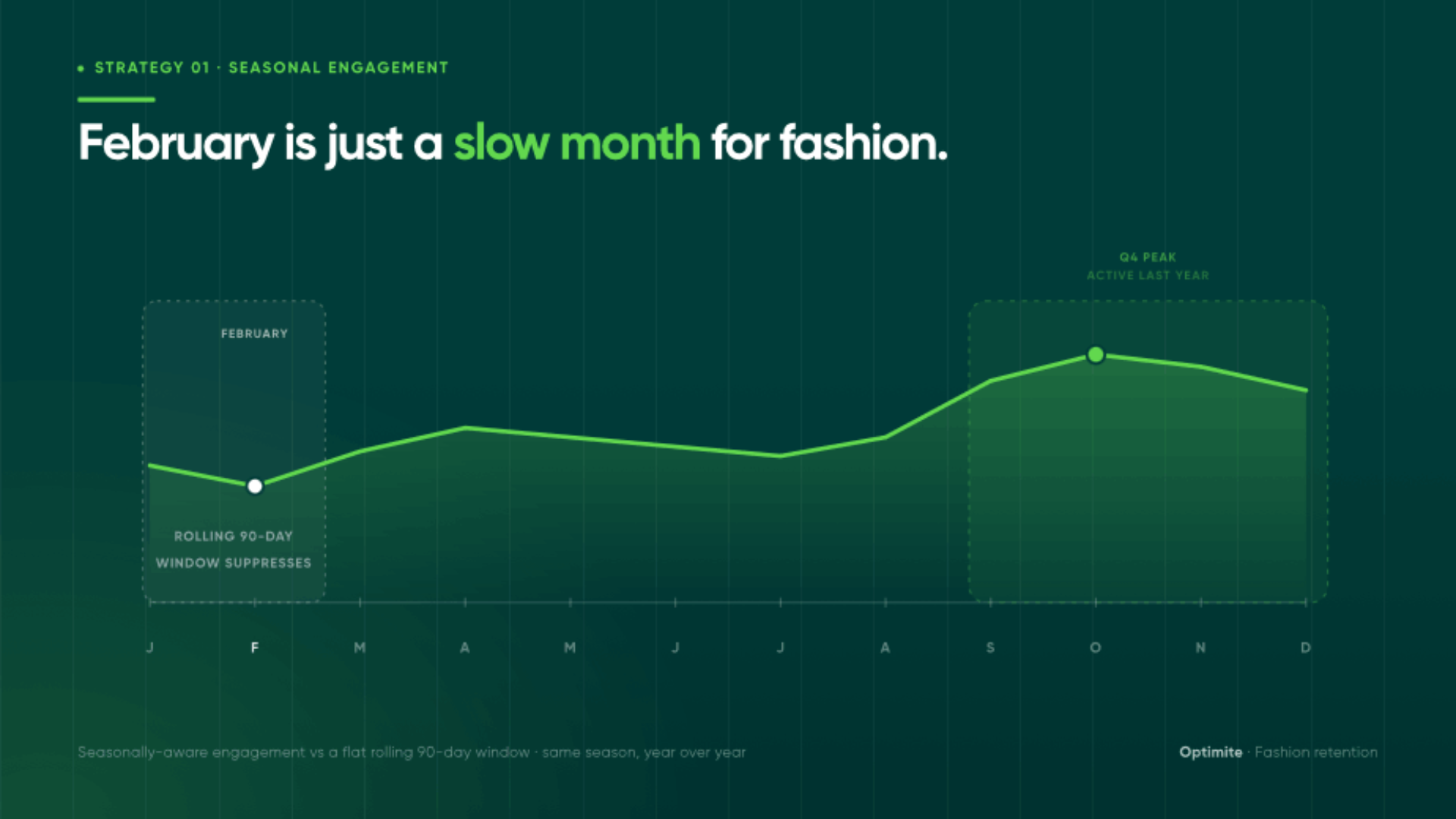
The standard engaged segment in Klaviyo is usually built on a rolling window: opened or clicked in the last 90 days. For fashion, that window creates a persistent problem. Engagement in fashion is inherently seasonal. A customer who opened 12 emails between September and December, bought twice, and then went quiet in January isn't unengaged. They're waiting for the season to be relevant again.
A rolling 90-day window in February will suppress that customer from key sends at exactly the moment you want them back. The better approach is a seasonally-aware engagement model that looks at behaviour in comparable periods year over year.
In practice, this means:
- Comparing engagement in the current season to the same season last year, not to the last 90 days as a flat window
- Suppressing customers from re-engagement flows if they were active in the prior year's equivalent window, even if the last 90 days are quiet
- Flagging customers who were active in Q4 of the previous year as a high-priority reactivation segment starting in September, not treating them as lapsed
For a fashion brand doing $5M in revenue, the difference between seasonally-aware segmentation and a flat rolling window can be significant in terms of how many valuable customers get incorrectly suppressed from key sends.
Purchase motivation segments by acquisition channel
Not all fashion buyers come in with the same intent, and the acquisition channel is one of the clearest proxies for purchase motivation at the point of entry.
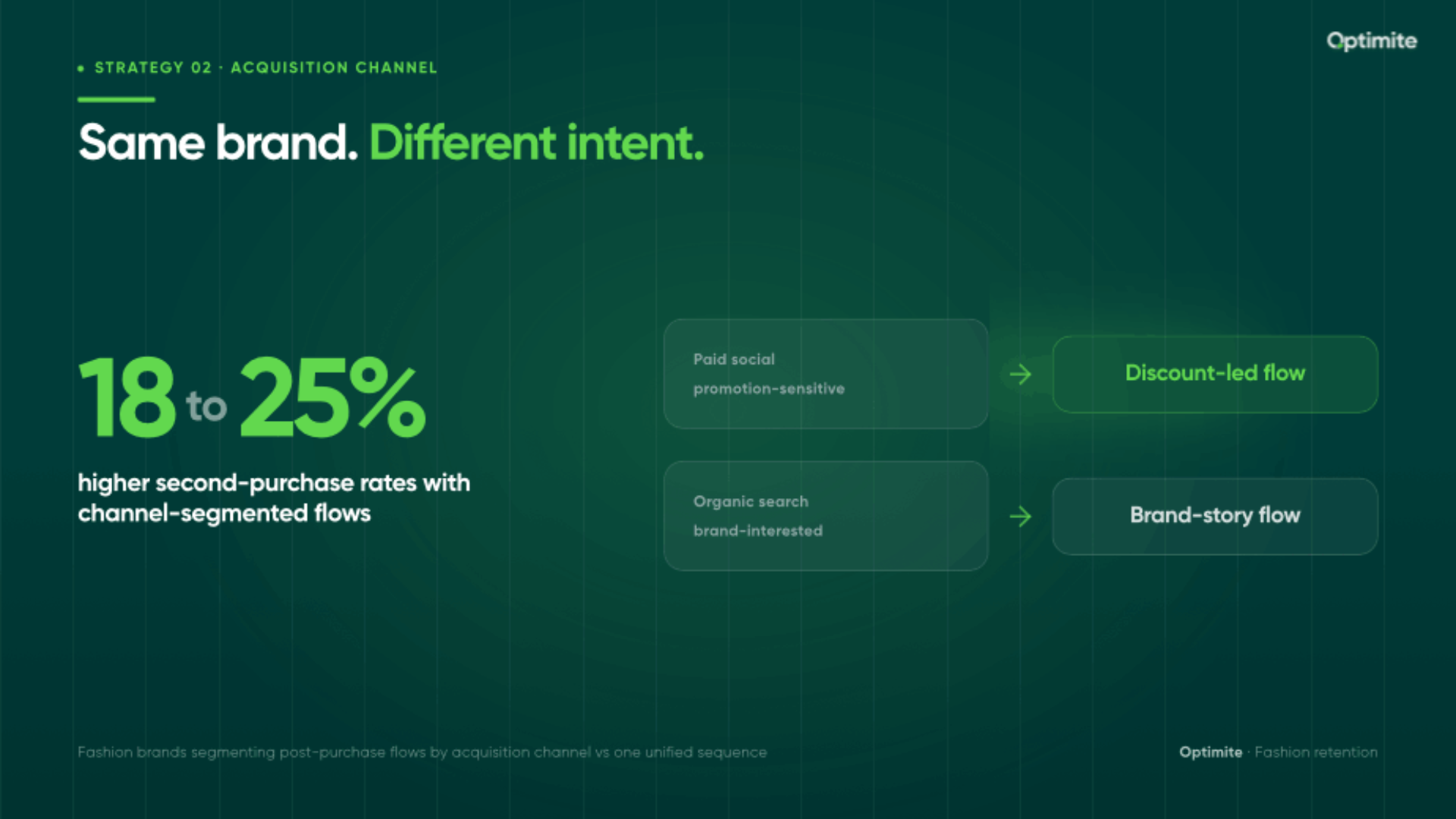
A customer who found your brand through a paid social ad featuring a specific product at a discounted price has a different retention profile from one who came in through organic search for a brand-name query. The first customer is promotion-sensitive. The second is brand-interested. Treating them identically from day one means either you're over-discounting to customers who would have bought at full price, or you're under-incentivising customers who need a reason to come back.
Fashion brands that segment post-purchase flows by acquisition channel report 18 to 25% higher second-purchase rates compared to brands running a single unified post-purchase sequence. The channel of entry predicts what the customer needs to hear next.
Building acquisition channel segments in Klaviyo requires clean UTM tracking at the point of opt-in and a flow structure that branches on that property. It's a setup investment, but one that pays back across every send that customer receives for the rest of their lifecycle.
Category affinity segments built on browse and purchase overlap
Fashion customers have preferences that go well beyond what they've bought. A customer who has purchased from the occasionwear category twice but has browsed casualwear repeatedly without buying is showing you a preference signal that their purchase history alone doesn't surface.
Category affinity segmentation combines browse behaviour with purchase history to build a richer picture of what a customer is actually interested in. For a fashion brand with five or six product categories, this creates meaningfully different send logic for each cohort.
The practical application:
- Customers with high browse-to-purchase conversion in one category get content and offers anchored to that category
- Customers who browse a category repeatedly without purchasing get a targeted conversion-focused send for that specific category, not a general newsletter
- Customers who have bought across multiple categories are flagged as high-value and moved into a loyalty or VIP segment regardless of recency
For fashion brands running on Klaviyo, category affinity data sits in the event stream already. The work is building the segment logic to surface it and the flows to act on it.
Style-based personalisation segments
This one takes more setup, but the payoff is proportional. Fashion customers respond to content that feels relevant to their specific aesthetic, not just their purchase history. A customer who consistently buys from a minimalist, neutral palette range doesn't want an email leading with bold prints, even if that product is on promotion.
Style-based segments can be built in a few ways depending on your product tagging structure in Shopify:
- Tag products with style attributes at the SKU level and use purchase history to assign customers to a primary style profile
- Use quiz or preference capture at the point of sign-up to assign a style segment from the start of the relationship
- Build inferred style segments from browse and purchase overlap across tagged product attributes
If you're not ready to build full style-based segmentation, start with one attribute: colour palette. Tag your products as neutral, bold, or patterned and build a basic segment split from there. It takes less than a day to set up and gives you immediate data on whether style-based personalisation moves your click-to-open rate.
Fashion brands that have built style segments report higher click-to-open rates across campaigns because the product imagery and copy in each send matches what the customer has already shown they respond to. The email feels curated rather than broadcast.
Price sensitivity segments based on full-price vs. sale purchase history
Every fashion brand has customers who only buy on sale. That's not a problem. But treating full-price buyers and sale buyers identically in your retention programme creates two problems: you train full-price buyers to wait for promotions, and you burn margin sending discounts to customers who were already planning to buy.
Price sensitivity segmentation splits your list based on the ratio of full-price to sale purchases in a customer's history. A customer who has bought four times, all at full price, belongs in a different send cadence than one who has bought four times, all during BFCM or end-of-season sale windows.
For the full-price segment, the retention strategy emphasises new arrivals, editorial content, early access, and brand story. Discounts are used sparingly, if at all. For the sale segment, the strategy acknowledges the motivation and works within it: preview content before sale windows, loyalty points that accumulate toward a reward, and a communication cadence that doesn't push full-price products as primary CTAs.
Mixing full-price and sale buyers in the same send cohort and leading with a discount trains your full-price customers to wait. Once that behaviour pattern is established, reversing it is genuinely difficult. Segment before you discount, not after the damage is done.
For a fashion brand doing $8M in revenue, the margin protection from running these two cohorts separately is often more significant than any direct revenue lift from better personalisation.
Post-purchase repurchase intent segments by product category lifetime
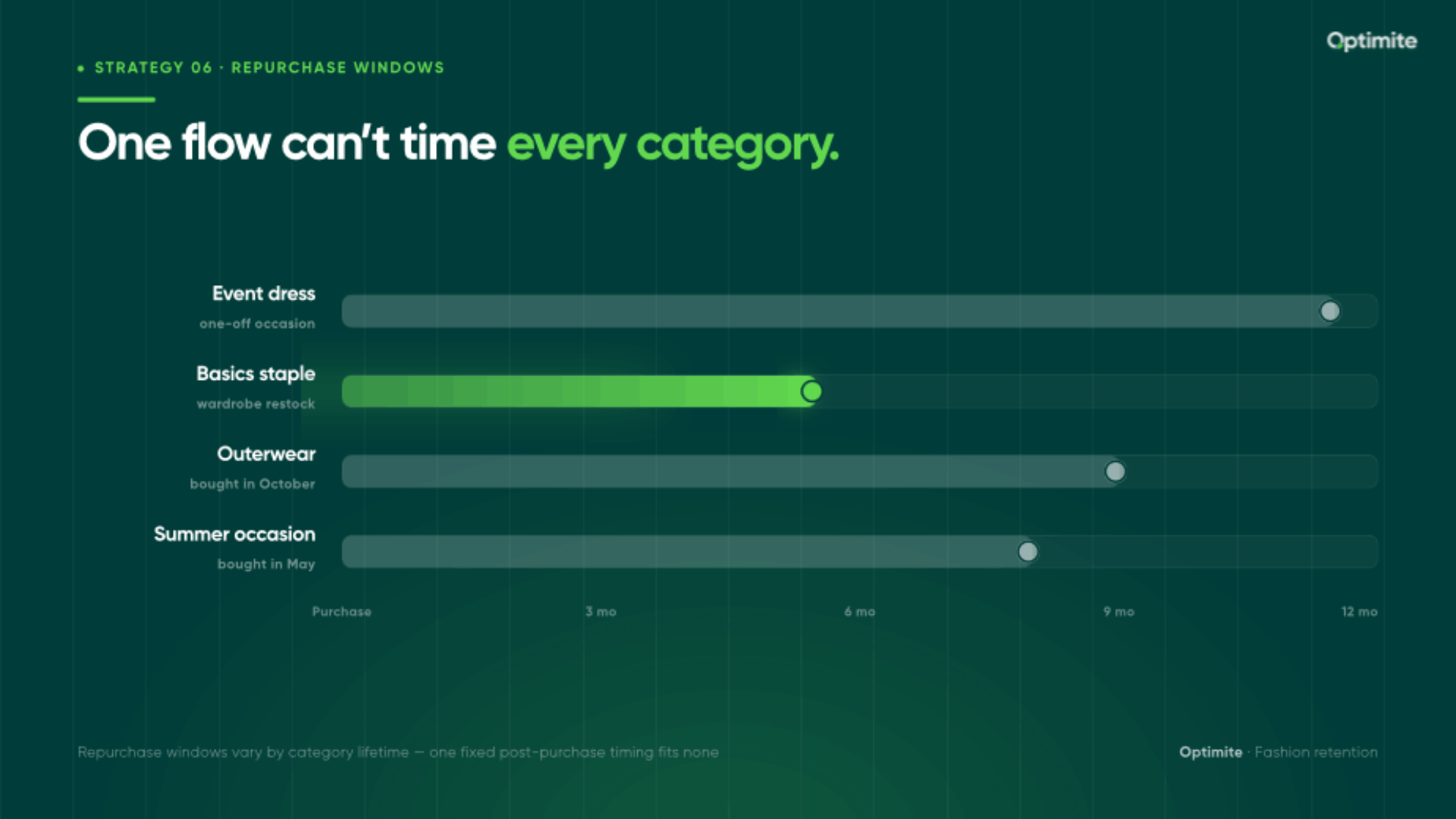
Fashion has a wide range of product lifecycle lengths, and that variation needs to sit inside your repurchase flow logic. A customer who bought a dress for a specific event has a different repurchase profile than one who bought a basic wardrobe staple. A customer who bought outerwear in October has a different repurchase window than one who bought summer occasion pieces in May.
The mistake most fashion brands make is setting a single post-purchase flow with fixed timing and applying it across the entire product catalogue. The timing works reasonably well for some categories and poorly for others, and the category mismatch often shows up as underwhelming repurchase flow revenue without a clear diagnosis.
Building post-purchase segmentation by product category requires:
- Mapping your product categories to realistic repurchase windows based on purchase data from your own account
- Building separate flow branches for categories with different repurchase timing, or using conditional splits within a unified flow
- Using browse behaviour in the post-purchase period as an intent signal to accelerate the repurchase send when a customer shows early interest
For fashion brands on Klaviyo with a reasonable product catalogue size, this is one of the higher-return segmentation improvements available. The infrastructure investment is moderate, and the revenue impact tends to show up within the first two repurchase cycles after the change.
Building these segments in practice
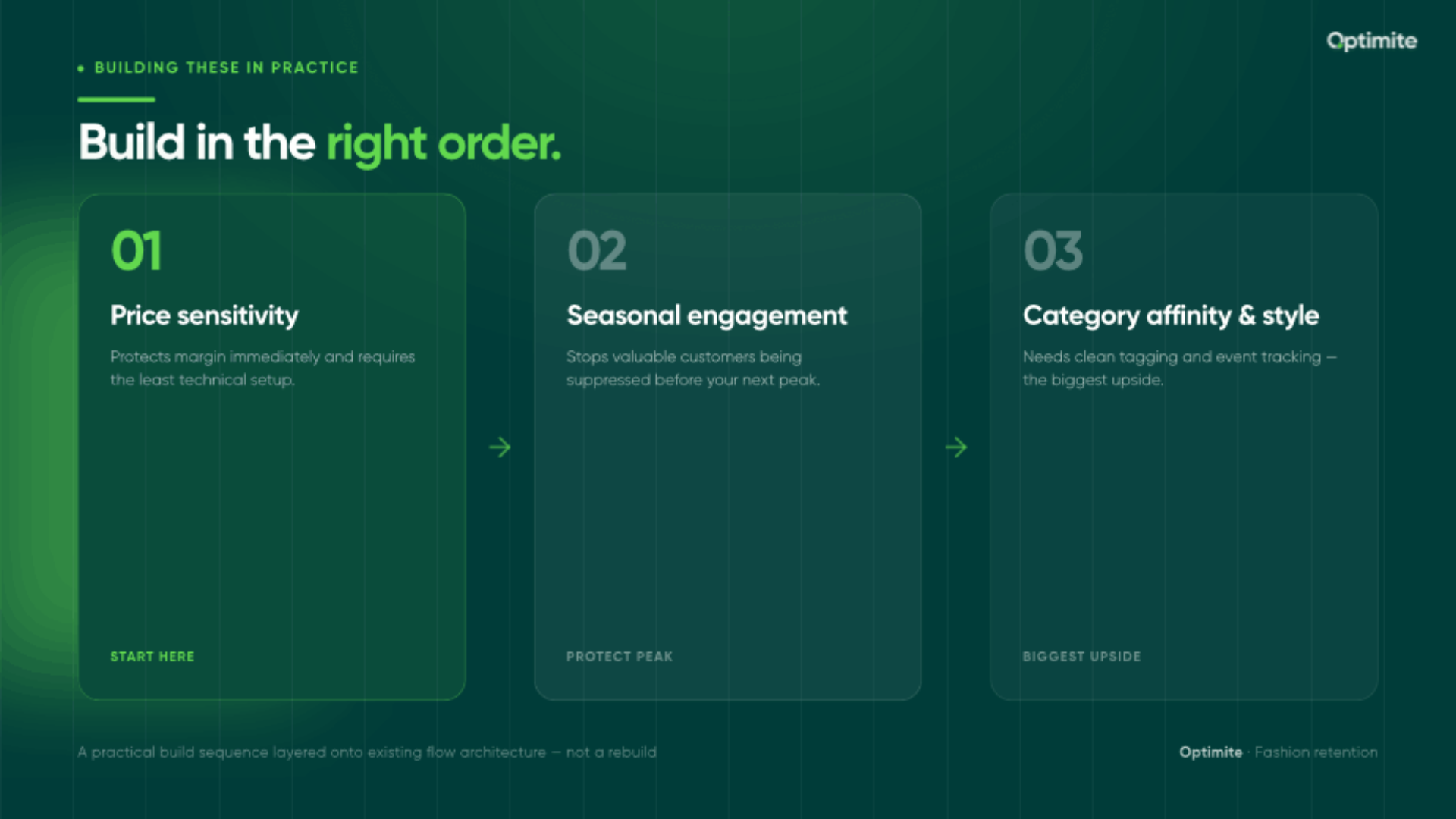
None of these six strategies requires a complete rebuild of your Klaviyo setup. Most can be layered onto existing flow architecture through conditional splits and updated segment definitions. The order in which you build them matters, though.
Start with price sensitivity segmentation, because it protects margin immediately and requires the least technical setup. Then move to seasonal engagement windows, which prevent you from incorrectly suppressing valuable customers during your next peak period. The more technically involved strategies, category affinity and style-based segments, deliver the biggest upside but need clean product tagging and event tracking to work properly.
The common thread across all six is that they treat fashion buyers as fashion buyers: seasonal, category-driven, style-motivated, and acquisition-aware. Generic segmentation logic applied to a fashion list will always underperform. These strategies close that gap.
If you want to understand which of these are the highest-priority builds for your current Klaviyo setup, book a free call with Optimite.
Keep reading.
All posts
8 Email Flows Built Specifically for Food and Beverage Brands on Shopify
Shrestha Ghosal · Jun 15, 2026

The Trust Gap in Wellness Retention: Why Your Customers Ghost After the First Purchase
Shrestha Ghosal · Jun 12, 2026

The CBD Brand Retention Problem Nobody Talks About Openly
Shrestha Ghosal · Jun 10, 2026