

The CBD Brand Retention Problem Nobody Talks About Openly
Why CBD ecommerce brands struggle with repeat purchase and what a retention programme built for the category actually requires
 Shrestha Ghosal
Most CBD brands talk openly about acquisition. Ad restrictions, platform bans, cost per click. The conversation about what happens after the first purchase is quieter, and the numbers behind it are worse than most founders want to admit.
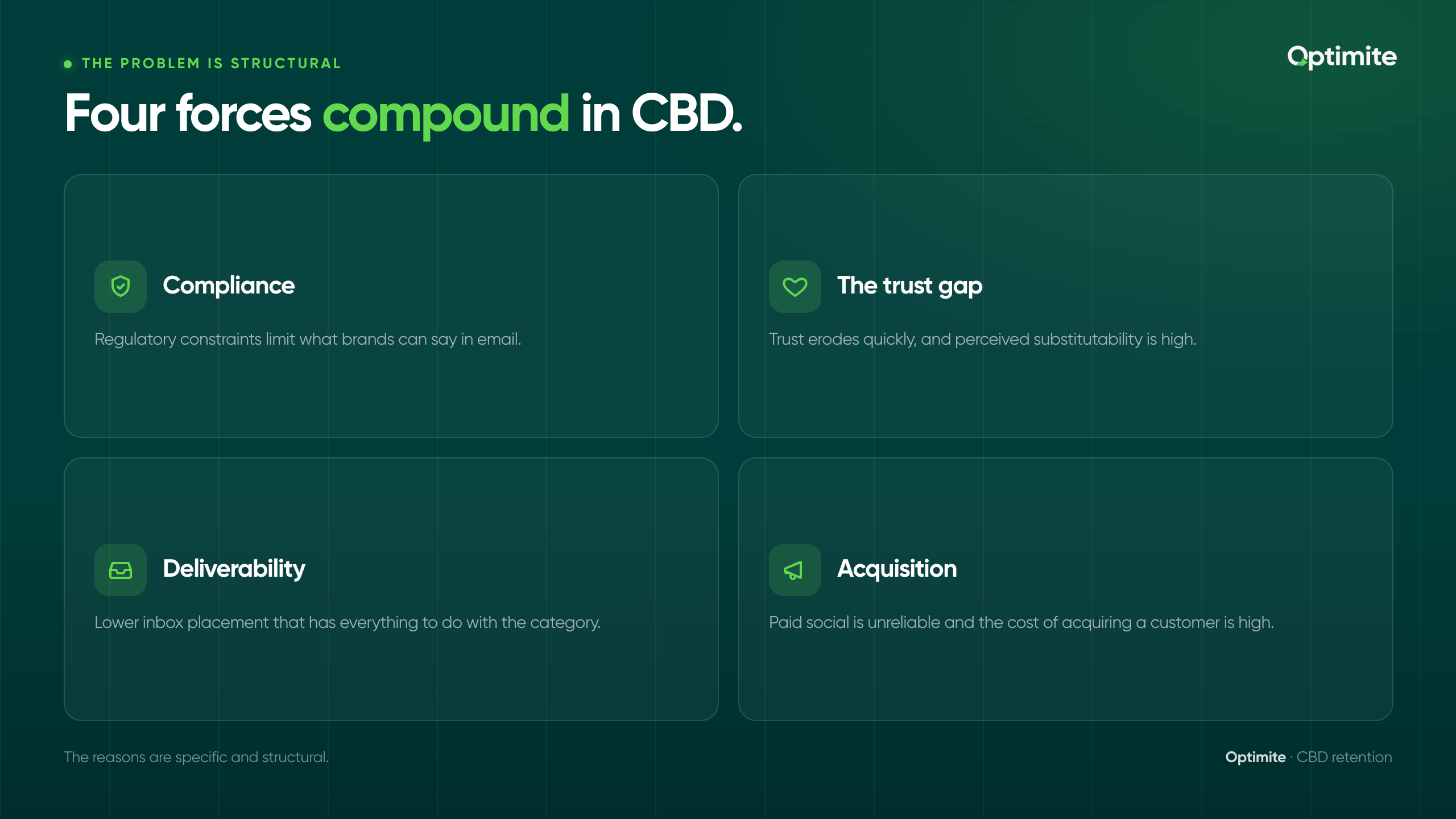
CBD has one of the most challenging retention profiles of any ecommerce category. The reasons are specific and structural. Regulatory constraints limit what brands can say in email. Platform restrictions have historically made paid retargeting unreliable. And the product itself, despite genuine efficacy for many customers, sits in a category where trust erodes quickly, and perceived substitutability is high.
The result is a customer base that churns faster than it should, a repeat purchase rate that underperforms comparable wellness categories, and a retention programme that most CBD brands have never fully built because the compliance requirements feel too complicated to navigate.
This is the CBD brand retention problem. Here is what it actually looks like, and what to do about it.
The compliance constraint shapes everything
In most e-commerce categories, retention marketers can say what they want about what a product does. In CBD, that freedom doesn't exist in the same way. The FDA's position on CBD health claims means that brands sending emails in the US need to be careful about how they describe product effects, benefits, and outcomes.
This creates a specific problem for post-purchase retention. The emails that typically perform best in wellness, the ones that set expectations, explain how the product works, and share results-based social proof, require language that CBD brands need to handle with care.
The practical constraints:
- Health claims like "reduces anxiety" or "improves sleep quality" are off-limits in most direct email copy
- Testimonials that reference specific conditions or symptoms carry compliance risk
- Even softly implied efficacy claims can create regulatory exposure depending on how they're written
Brands that respond to this by removing all educational content from their post-purchase flows end up with sequences that are purely transactional. Order confirmation. Shipping update. Review request. That structure doesn't build a relationship, and it doesn't drive repeat purchases.
Compliance constraints in CBD email marketing vary by market. US brands need to navigate FDA guidelines carefully. UK brands operate under MHRA rules, which have their own specific requirements around health claims. If you're sending to both markets from the same Klaviyo account, your flow copy needs to be segmented by market or written to the most conservative standard. Getting this wrong creates legal exposure that a higher repeat purchase rate doesn't offset.
The brands getting retention right in CBD have found a way to be educational without being clinical. They write about ritual, consistency, and lifestyle rather than conditions and symptoms. The copy talks about what the customer does with the product, the habit it becomes, the routine it supports, without making claims about what the product treats or cures. This approach is compliant, and it works better for retention than efficacy-focused copy anyway because it builds a behavioural connection rather than a transactional one.
The trust gap is wider in CBD than in most categories
Customers who buy CBD for the first time are taking a risk that customers in most other wellness categories aren't. The product is less regulated, the quality variance between brands is significant, and the information environment around CBD is still noisy enough that a new customer arrives with more uncertainty than confidence.
That uncertainty has a direct impact on repeat purchase behaviour. A customer who isn't sure whether the product is working or whether the quality they received is consistent has a low barrier to switching. A competitor with a lower price point or a more compelling first-email impression can pull that customer away before your brand has had a chance to establish any real loyalty.
The trust gap needs to be closed in the post-purchase sequence before the repurchase window opens. Specifically:
- Transparency content about sourcing, extraction method, and third-party testing. Customers who understand how a CBD product is made and can verify its quality are significantly more likely to come back.
- Consistency education that explains why regular use matters for CBD in a way that doesn't make a health claim. "Most of our customers find a consistent daily ritual makes the difference" is different from "CBD is most effective when taken daily for condition X."
- Community proof from customers who have made CBD a part of their routine, framed around habit and lifestyle rather than treatment outcome.
This content doesn't require a claims lawyer to review if it's written correctly. And it does the most important job in CBD retention: converting a first-time buyer who is uncertain into a customer who is confident enough in the product and the brand to come back.
Repeat purchase rate benchmarks and why CBD underperforms them
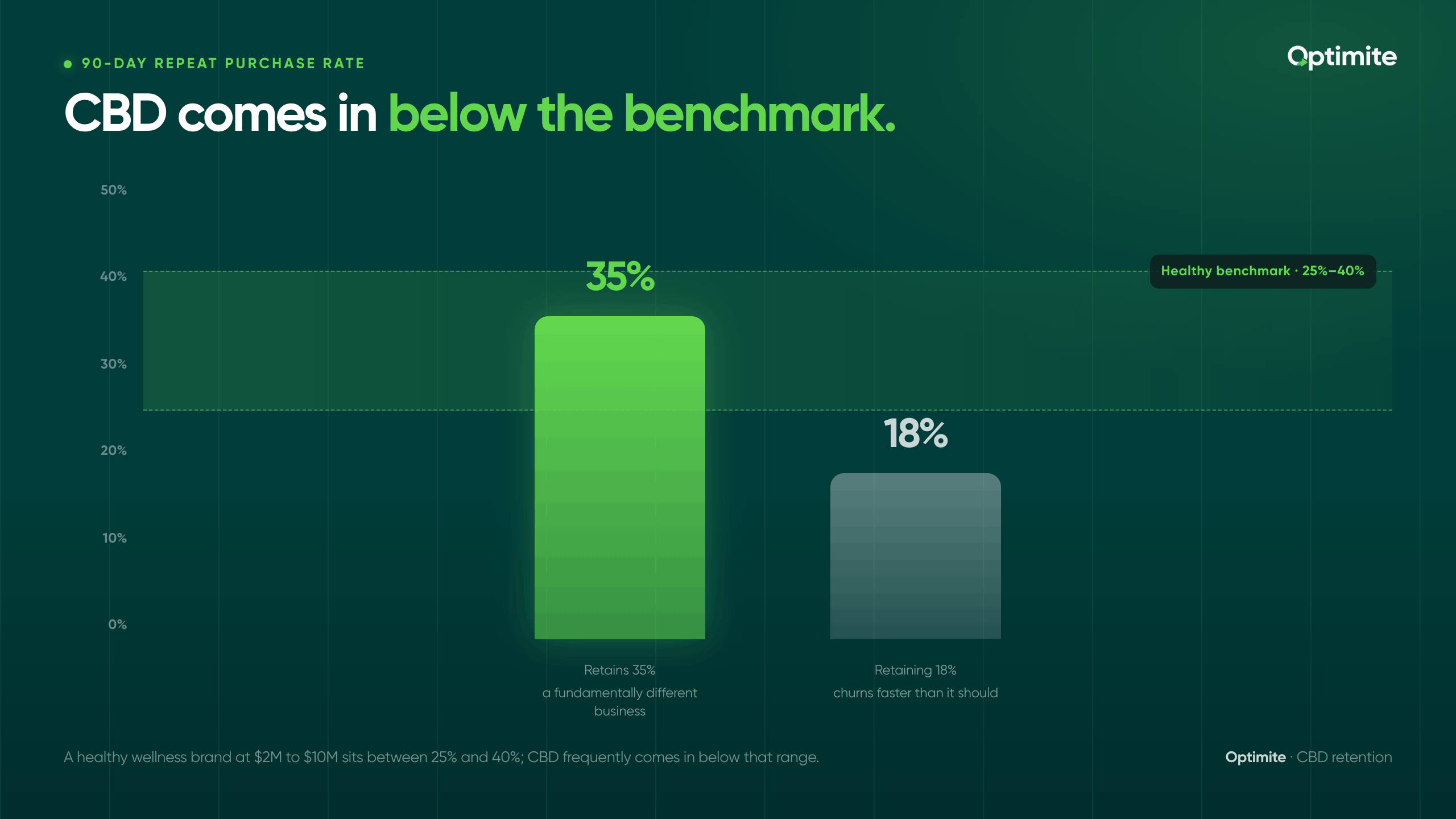
A healthy 90-day repeat purchase rate for a wellness brand doing $2M to $10M in revenue typically sits between 25% and 40%, depending on the product and price point. CBD brands at comparable revenue stages frequently come in below that range.
The reasons cluster around a few consistent patterns:
- Post-purchase flows that end too early, before the customer has completed one consumption cycle and formed a usage habit
- No replenishment trigger built around the actual product consumption window, so the reorder email arrives too late or not at all
- A welcome series that leads with acquisition offers rather than brand and product education, which trains the customer to wait for a discount before reordering
- No win-back flow, or a win-back flow triggered at 90 days when the customer has already found an alternative
For a consumable CBD product with a 30-serving count, the replenishment window typically falls between day 22 and day 28 for daily users. A flat 30-day replenishment trigger misses a meaningful portion of customers who run out before the email arrives. Brands that analyze their actual consumption patterns and build replenishment triggers around those windows consistently see higher replenishment conversion rates than those using calendar-based logic.
The fixes are not unique to CBD. They're the same infrastructure gaps that show up in wellness, beauty, and supplement brands across the board. What makes them more consequential in CBD is the acquisition constraint. When paid social is unreliable and the cost of acquiring a new customer is high, the economic pressure on retention is greater. A CBD brand that retains 35% of first-time buyers at 90 days has a fundamentally different business than one retaining 18%.
The deliverability problem that CBD brands rarely discuss
There is a specific deliverability risk in CBD email marketing that most brands don't talk about openly because acknowledging it means acknowledging they have a problem.
Certain email service providers and inbox providers apply additional scrutiny to sends from CBD brands, particularly those with CBD or cannabis-related terms in the sender domain, subject lines, or body copy. The result is lower inbox placement rates that have nothing to do with list health or engagement, and everything to do with the category.
The practical implications:
- Subject lines that include terms associated with CBD can trigger spam filters at certain inbox providers
- Sending domains that are closely associated with CBD products may face higher scrutiny from inbox placement algorithms
- List hygiene matters more in CBD than in most categories because a suppressed or disengaged list compounds the deliverability risk
The brands managing deliverability well in CBD have made a few consistent adjustments. They keep subject lines benefit-focused and lifestyle-oriented rather than product-label focused. They maintain aggressive list hygiene, suppressing unengaged subscribers on a shorter cycle than a comparable wellness brand might. And they monitor inbox placement rate, not just open rate, because open rate is an unreliable deliverability signal in any category and especially in CBD, where inbox placement variance is higher.
What a CBD retention programme actually needs to look like
Building retention infrastructure for a CBD brand requires the same foundations as any DTC retention programme, applied with more precision around compliance and trust-building.
The core flows that every CBD brand at $1M or above should have live:
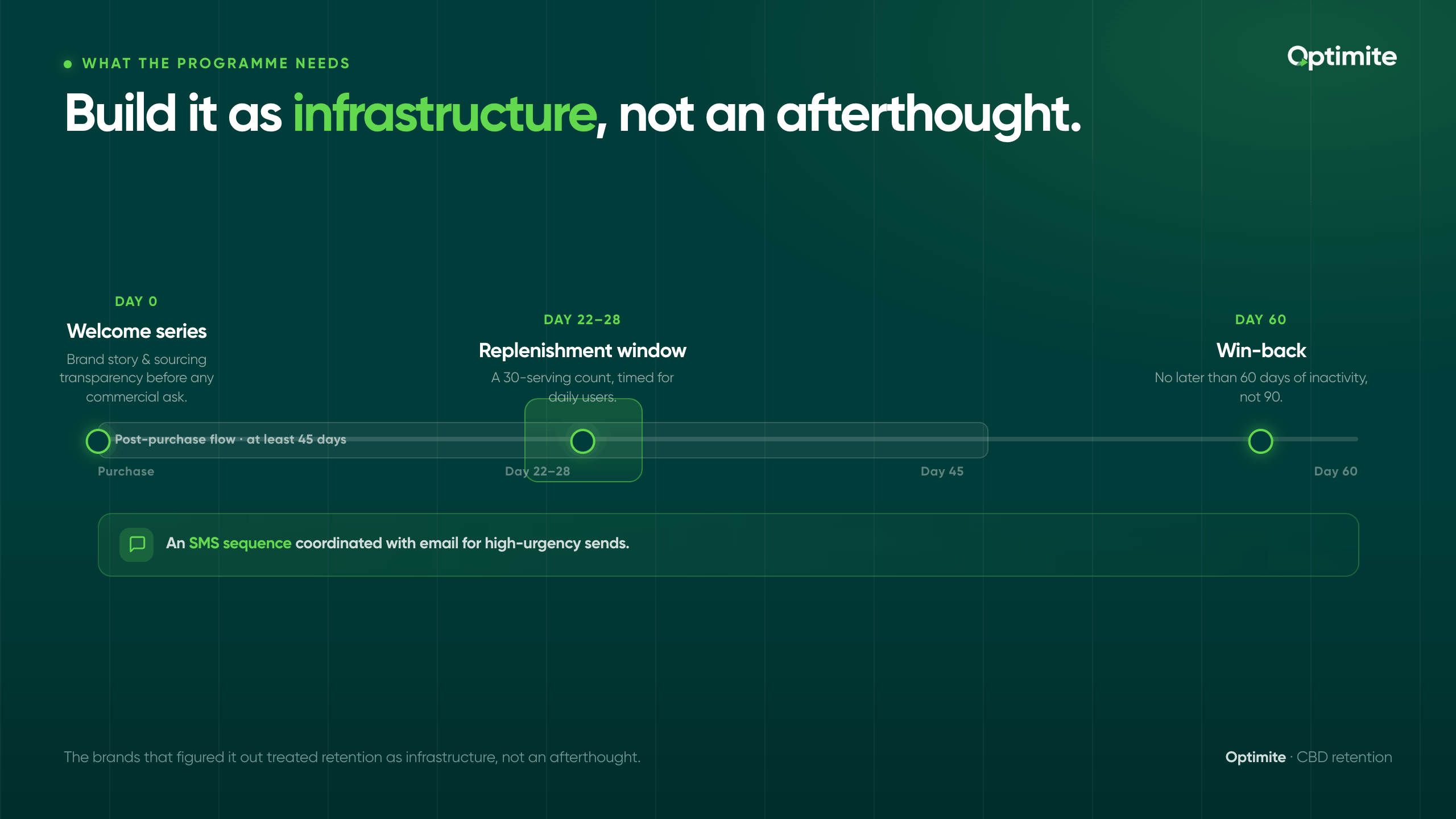
- A welcome series that leads with brand story, sourcing transparency, and product education before any commercial ask
- A post-purchase flow that extends to at least 45 days, includes consistency education, and triggers a replenishment sequence timed to the actual product consumption window
- A win-back flow triggered no later than 60 days of inactivity, not 90, because the switching cost in CBD is lower than in most categories, and the window to reactivate closes faster
- An SMS sequence coordinated with email for high-urgency sends like replenishment reminders and limited-time offers, where the compliance constraints are the same as email, but the engagement rates are significantly higher
The compliance layer matters, but it doesn't need to make the retention programme smaller. It needs to make the copy sharper. Brands that have built compliant, education-led post-purchase sequences consistently outperform those that responded to compliance constraints by removing content rather than rewriting it.
CBD retention is harder than most ecommerce categories. The compliance environment, the trust gap, the deliverability dynamics, and the acquisition constraints all compound in ways that make a poorly built retention programme significantly more costly than it would be in a less restricted category. The brands that have figured it out share one thing in common: they treated retention as infrastructure, not an afterthought, and built it with the specific constraints of the category in mind from the start. If you want to understand what that looks like for your CBD brand and where your current programme has gaps, book a free call with us and we'll walk through it together.
Keep reading.
All posts
8 Email Flows Built Specifically for Food and Beverage Brands on Shopify
Shrestha Ghosal · Jun 15, 2026

6 Segmentation Strategies That Work Specifically for Fashion E-commerce Buyers
Shrestha Ghosal · Jun 15, 2026

The Trust Gap in Wellness Retention: Why Your Customers Ghost After the First Purchase
Shrestha Ghosal · Jun 12, 2026