

The Shopify Retention Advantage Most Brands Miss
Your Shopify store is the foundation of retention. Most brands treat it like something separate. Here's why that's a mistake.
 Arpit Mehar
Most Shopify brands treat their store like it's separate from their retention strategy. Shopify is commerce. Email and SMS are retention. They're different worlds.
So they build their Shopify store. They set up their email list. They run campaigns. They wonder why their repeat purchase rate is stuck at 18%.
Here's what they don't realize: Shopify IS the retention foundation. Everything downstream depends on it. The brands winning at retention aren't doing something special. They're just leveraging what Shopify already gives them.
This post walks through what that advantage is and why most brands miss it entirely.
The secret most Shopify brands don't know
Your Shopify store knows everything about your customers.
It knows who they are. What they bought. When they bought it. How much they spent. What products they viewed but didn't buy. How many times they've purchased. What their lifetime value is. What their purchase frequency is. Everything.
Most platforms collect some of this data. Shopify collects all of it. Natively. Automatically. Without you doing anything special.
But here's the secret: most brands never connect this data to their retention strategy. They treat Shopify as a transaction engine. A store where things happen. Not as the source of truth for customer intelligence.
The brands winning at retention do the opposite. They treat Shopify as the foundation. Everything else builds on top of it. Email, SMS, loyalty programs, segmentation. All of it flows from the customer data Shopify captures.
When you build retention this way, the whole system becomes infinitely more powerful. Because you're starting from the most complete picture of your customer you can get.
Why customer data is everything in retention
Let's be direct: retention is a data problem, not a messaging problem.
Most brands think retention is about crafting the perfect email copy. The perfect subject line. The perfect offer. So they optimize those things. They A/B test subject lines. They hire copywriters. They refine their messaging.
But if your customer data is incomplete or wrong, the best message in the world lands on the wrong person at the wrong time. It's like having a precision weapon with bad targeting.
Data is the moat. Customer data determines everything downstream. Who you segment. What you send them. When you send it. Whether they buy or not.
A wellness brand we know got their customer data right. They connected Shopify to Klaviyo properly. They tagged customers by product type. They knew who subscribed vs. who bought one-time. They knew purchase frequency. Armed with this data, they built simple flows. Not complicated. Just intentional. Repeat rate went from 16% to 38% because they had good data.
Same brand could have written the world's best email copy. Without good data, it wouldn't have mattered.
Data is the foundation. Everything else is build-out.
Shopify's unfair advantage: native customer data
Here's what makes Shopify different.
Most platforms either collect data or they don't. Shopify collects everything. It's built for it. Customer data, order history, product information, customer behavior. It all flows into Shopify automatically.
Most importantly: Shopify syncs this data perfectly with downstream tools. You connect Shopify to Klaviyo (or any email platform). Your customer data flows automatically. Who bought what, when, and for how much. Your email platform knows instantly. No manual work. No data delays.
Compare this to other approaches. Some brands use Mailchimp. Mailchimp doesn't sync with Shopify natively. Your customer data stays siloed. Email doesn't know who your repeat customers are. You can't segment properly. You're flying blind.
Some brands try to build connectors themselves. It's complicated. It's expensive. It breaks.
Shopify solved this problem for you. Native integration. Automatic data flow. Perfect sync.
This is Shopify's unfair advantage. Most brands don't realize they have it. They don't leverage it. They treat Shopify as separate from retention instead of as the foundation of it.
If you're using Shopify but your email platform doesn't know your customer's purchase history automatically, you're not using Shopify's advantage. Fix your integration.
How the best brands use this advantage
A fashion brand we work with realized their Shopify data was gold.
They connected it to Klaviyo properly. Suddenly they could segment by purchase type. Full-price vs. sale. They built different flows for each. Full-price customers got loyalty messaging. Sale customers got different treatment. Repeat rate was 34% for full-price, 18% for sale. Once they knew this, they could be strategic about who they invested in.
A food brand knew their replenishment window was 45 days for meal kits and 60 days for sauces. Shopify told them exactly when each customer hit that window. They built flows triggered at exactly those moments. Replenishment reminders became passive revenue. 40% of their repeat purchases came from one simple automated flow because the data was perfect.
A supplement brand realized their subscription customers were 5x more valuable than one-time buyers. Shopify data told them this. They segmented subscribers into their own track. Different messaging. Different frequency. Higher repeat rates. Higher LTV.
The pattern is always the same. These brands leveraged Shopify's customer data to make better decisions. Not guesses. Data-driven decisions. That's the advantage.
Most brands don't segment at all. They send the same message to everyone. Even if you're using Shopify properly, if you're not segmenting, you're leaving 50% of the potential on the table.
The systems most brands don't connect
Here's what most Shopify brands get wrong.
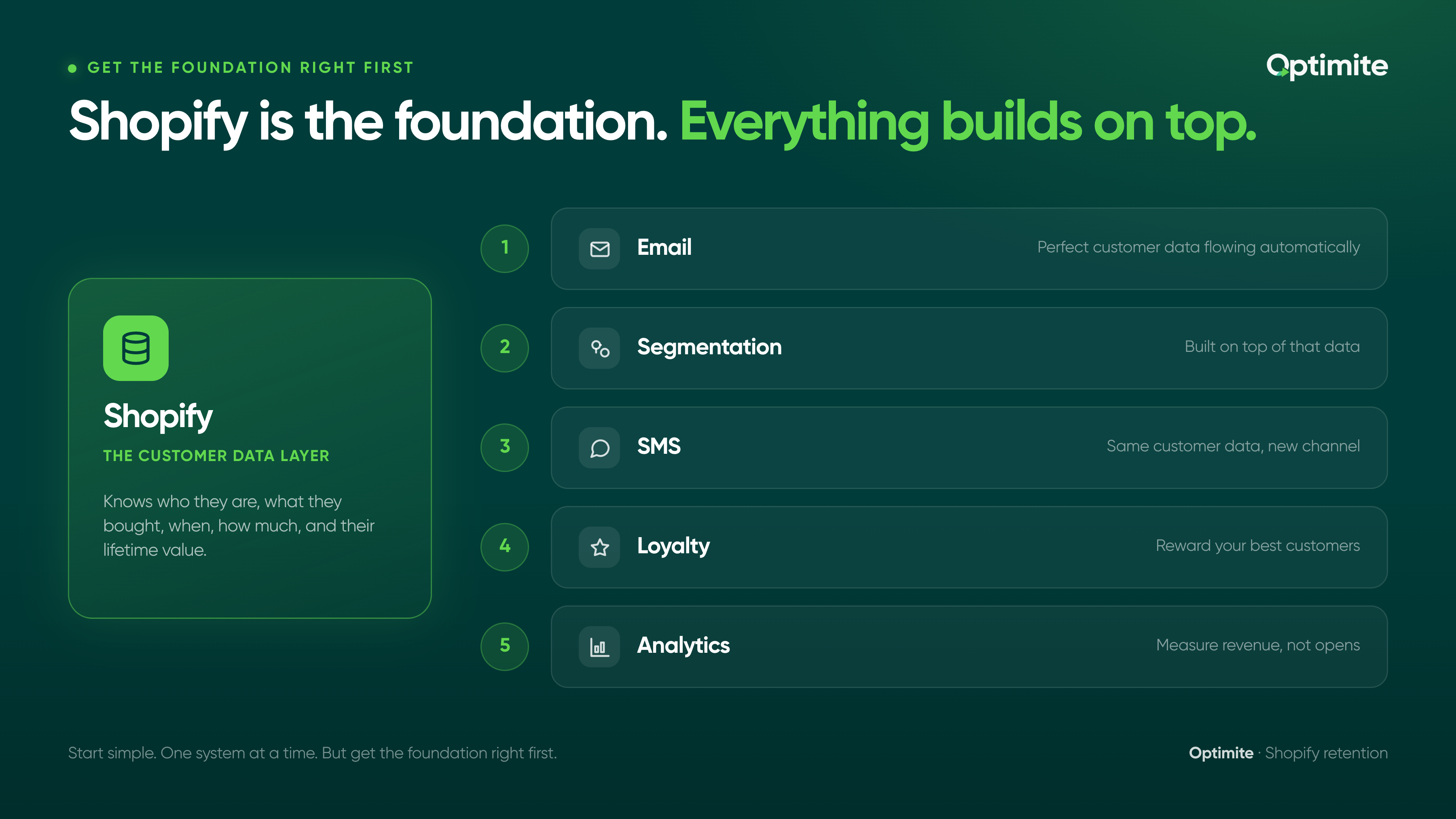
They have Shopify synced with their email platform. Good. But they stop there. Email only.
They don't connect SMS. So SMS doesn't know who's a repeat customer or a one-time buyer. SMS becomes guesswork.
They don't connect their loyalty program. So the loyalty tool doesn't know who their best customers are. Rewards aren't targeted.
They don't connect their analytics. So they can't see which email campaigns are actually driving repeat purchases. They're measuring opens instead of revenue.
They don't connect their feedback or review tools. So they don't know which products have high satisfaction vs. low.
All of this data exists in Shopify. But most brands never pipe it downstream.
The advantage is available. Most brands miss it because they don't know it exists or they don't understand how to use it.
Start simple. Shopify synced with email. Perfect customer data flowing automatically. Build segmentation on top of that. Then add SMS. Then add loyalty. Then add analytics. One system at a time. But get the foundation right first.
The compounding effect: when you get it right
Here's what happens when a brand gets this right.
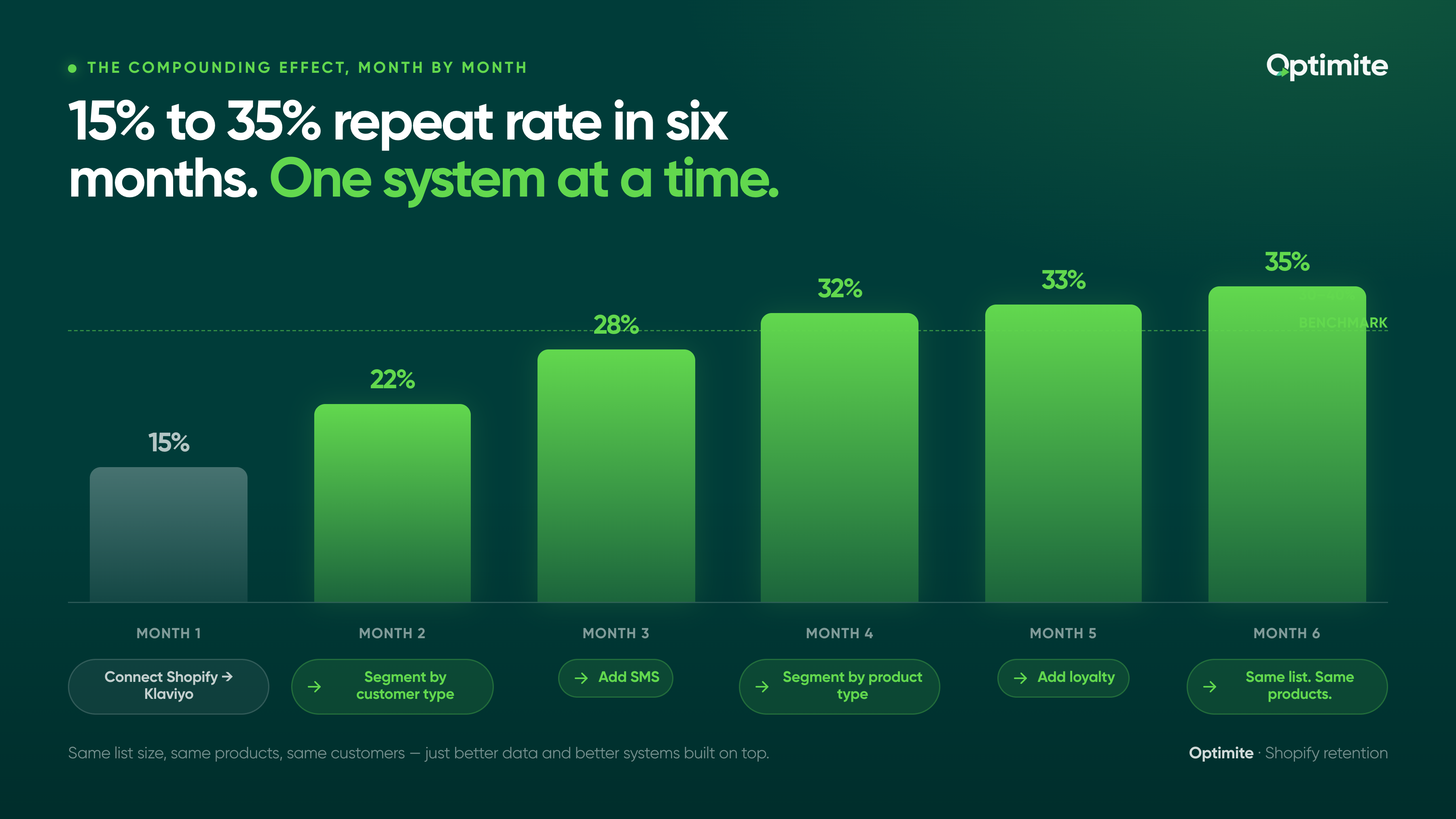
Month 1: They connect Shopify to Klaviyo properly. Data starts flowing. They can see customer history.
Month 2: They segment their list by customer type (subscriber vs. one-time, high-value vs. low-value). They build separate flows for each. Repeat rate moves from 15% to 22%.
Month 3: They add SMS. SMS gets the same customer data. SMS goes to high-engagement segments for urgency moments. Repeat rate goes to 28%.
Month 4: They add email segmentation by product type. Different products have different replenishment windows. Flows trigger at the right time for each. Repeat rate goes to 32%.
Month 5: They add loyalty. Their best customers (identified through Shopify data) get VIP treatment. These customers see 45% repeat rate while average customers see 28%.
By month 6, they've gone from 15% repeat rate to 35% repeat rate using the same list size, same products, same customers. Just better data. Better systems built on top of that data.
This is the compounding effect of getting the Shopify advantage right.
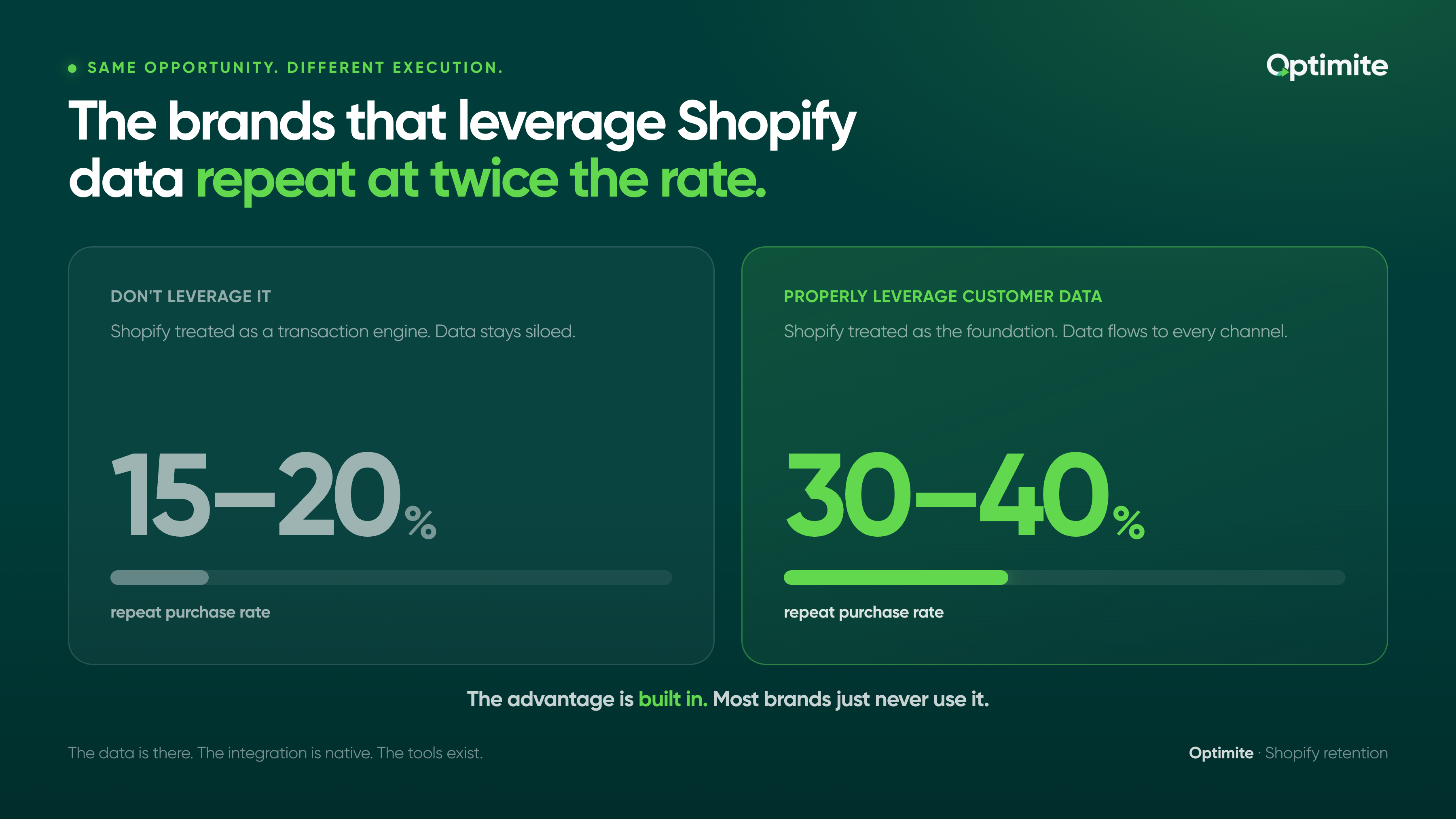
Shopify brands that properly leverage customer data see 30-40% repeat rates. Brands that don't leverage it see 15-20%. Same opportunity. Different execution.
Why most brands miss this
Here's the honest truth: most brands miss this because they think in silos.
Shopify is commerce. Retention is marketing. They're separate departments with separate budgets and separate goals. So they build them separately.
The founder is obsessed with acquisition and store optimization. The email marketer is obsessed with campaigns and open rates. They're never in the same room talking about how customer data can serve both.
By the time someone realizes "wait, we should connect these systems," months have passed. They've built separate systems. They're using poor data. They're optimizing for the wrong things.
The shift required is mental. Stop thinking of Shopify as a store and retention as marketing. Start thinking of Shopify as the customer data layer. Everything else is build-out on top of it.
The brands that make this shift are the ones winning at retention.
Shopify's advantage is available to you. It's built in. You just have to use it.
The data is there. The integration is native. The tools exist. Most brands have everything they need and they're still underperforming at retention because they don't realize what they have.
You have the advantage. Don't miss it.
If you want help setting up your Shopify data foundation properly or auditing whether you're leveraging Shopify's advantage fully, let's talk. We work with Shopify brands to turn customer data into retention systems. See how we've helped brands across wellness, fashion, and food and beverage leverage Shopify's advantage to drive 30-40% repeat purchase rates.


