

How to Map Your Shopify Customer Lifecycle in One Afternoon
Most Shopify brands jump straight into building flows. Here's how to map your customer journey first and build with intention.
 Arpit Mehar
You're about to build your email flows. You open Klaviyo. You stare at a blank canvas. You think: where do I even start?
So you build a welcome flow. Then a cart abandonment flow. Then a post-purchase flow. Then a replenishment reminder. By month three, you have six flows all doing slightly different things with no master plan.
Most Shopify brands build this way. They build flows first and map their customer journey after, if at all. By then, they've already created contradictions, missed moments, and wasted effort.
The brands that win do the opposite. They spend one afternoon mapping their entire customer lifecycle before they write a single line of email copy. They get clarity on what matters. They build intentionally. Everything else flows from that map.
This post walks through exactly how to do it. You don't need fancy tools. You don't need a data scientist. You need a piece of paper, two hours, and honest answers to a few key questions.
Why mapping matters before you build anything
Here's what happens when you skip the map and jump straight to building flows.
You build a welcome flow. It's good. Three emails over four days. You send it to all new customers. But you didn't define what "success" looks like for that flow. So you measure it against email industry benchmarks instead of your actual business. You optimize the wrong metrics.
You build a post-purchase flow next. You want to remind customers about replenishment. So you send an email on day 14 after purchase. But you didn't map your customer lifecycle first. You don't know your actual repurchase window. Day 14 might be too early for a fashion brand (60+ days) or too late for a subscription brand (45 days).
Six months in, you have six flows. A customer on your list gets hit with four different messages about the same product. They're confused. They unsubscribe. Your repeat rate stays stuck at 12%.
The cost of building without a map: wasted time, confused messaging, and a system that doesn't work.
The cost of mapping first: one afternoon.
Spend the afternoon mapping. Save six months of rebuilding later.
The three customer types every Shopify brand has
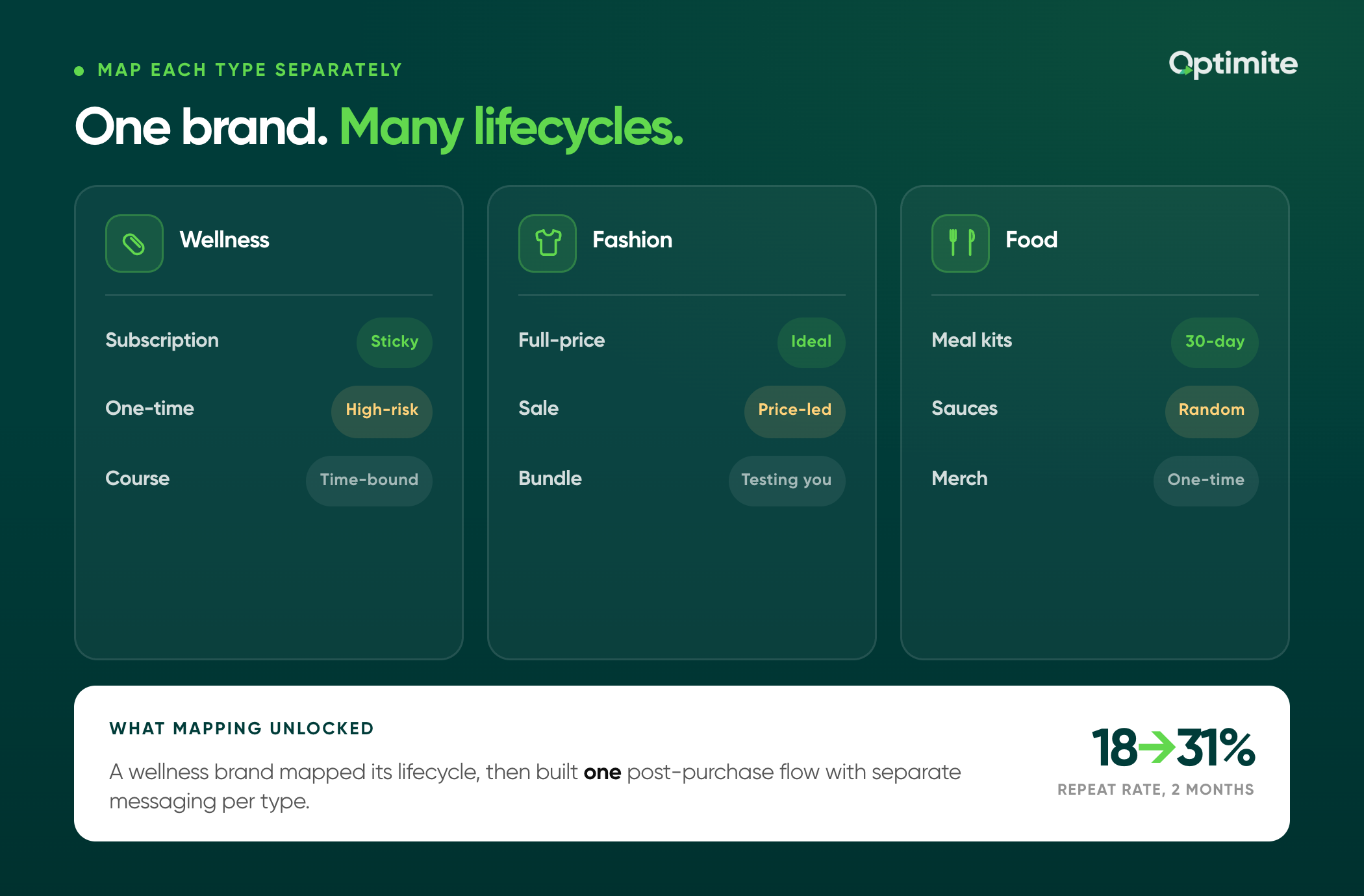
Before you map, know that your customer base probably isn't one homogeneous group. Most Shopify brands have multiple customer types. Each type has a different lifecycle.
A wellness brand sells subscriptions, one-time supplements, and a digital course. Three completely different customer types. A subscription customer is sticky (they're paying recurring). A one-time buyer is high-risk (they might never come back). A course customer is time-bound (they consume it and disappear).
A fashion brand sells full-price items, sale items, and bundles. A full-price buyer is your ideal customer (high-value, motivated). A sale buyer is price-sensitive (might not repeat). A bundle buyer is testing you (might convert to full-price buyer or leave).
A food brand sells meal kits, à la carte sauces, and merchandise. Each has a different repeat cycle. Meal kits have a 30-day cycle. Sauces are random purchase. Merchandise is one-time.
You need separate maps for each customer type. They're not the same journey. Don't treat them like they are.
Step 1: Define your stages
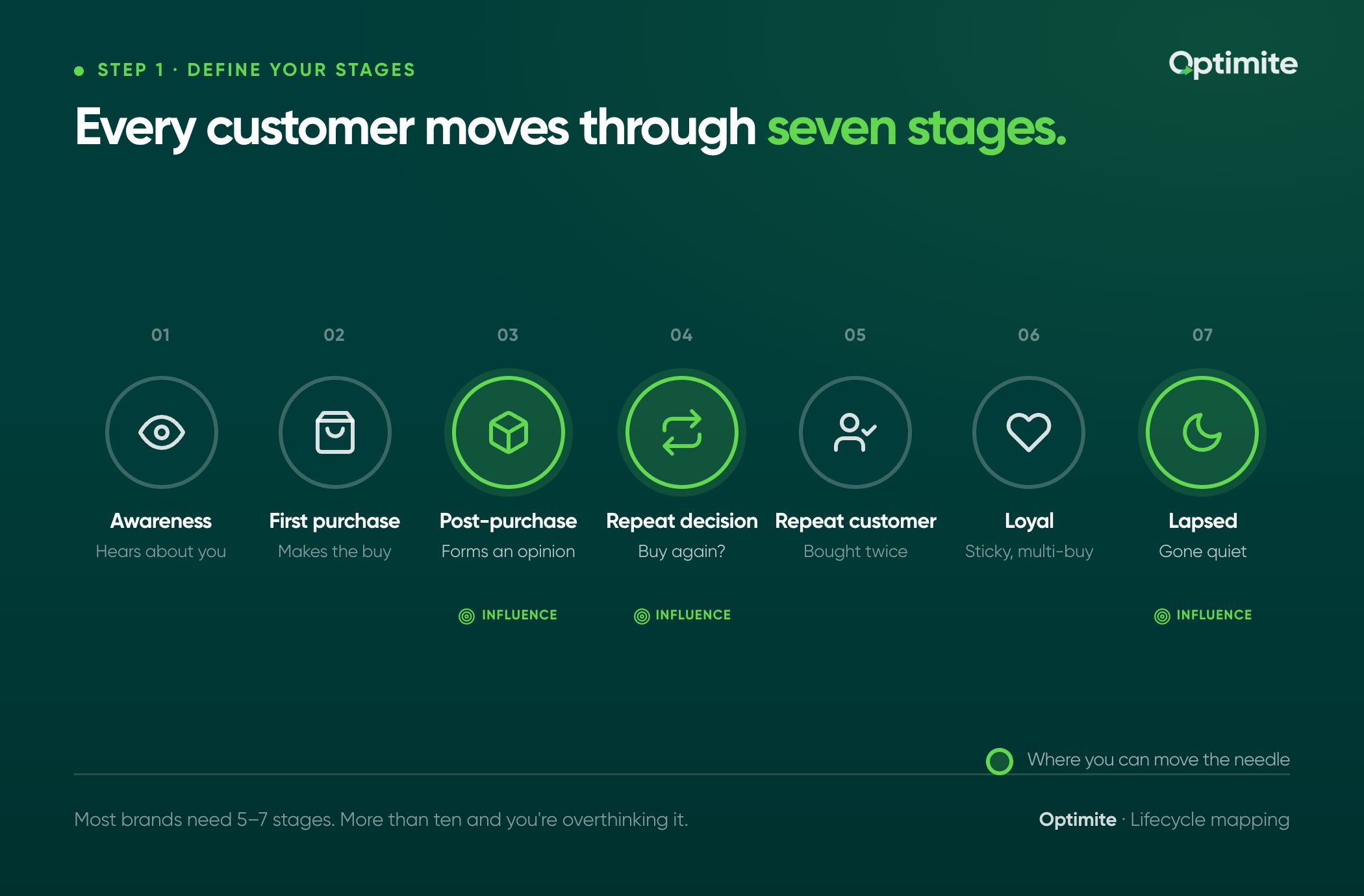
Start with a blank piece of paper. Write down: what are the stages your customer moves through?
For a repeat purchase brand like fashion, it looks like this:
Stage 1: Awareness. They learn about you (ads, organic, referral).
Stage 2: First purchase. They buy.
Stage 3: Post-purchase experience. They receive the product and form an opinion.
Stage 4: Repeat purchase decision. They decide if they'll buy again.
Stage 5: Repeat customer. They've bought twice. Momentum is building.
Stage 6: Loyal customer. They've bought multiple times and they're sticky.
Stage 7: Lapsed. They've gone silent. You need to re-engage.
That's seven stages. Simple. Clear. Every customer moves through all of them.
For a subscription brand, it looks different:
Stage 1: Awareness and evaluation. They're considering signing up.
Stage 2: First subscription. They commit to recurring payment.
Stage 3: Early churn risk. Weeks 1-4. Most churn happens here.
Stage 4: Established subscriber. They've survived the churn window.
Stage 5: Engaged subscriber. They're buying add-ons, upgrading, getting value.
Stage 6: At-risk. Engagement is dropping. Churn signals appear.
Stage 7: Churned. They've canceled.
Again, seven stages. Different from the repeat purchase brand, but just as clear.
Write down your stages. Most brands need 5-7. If you have more than ten, you're overthinking it.
Step 2: Identify the decisions
Now, for each stage, ask: what decision does the customer make in this stage?
In stage 3 (post-purchase experience), the decision is: was this purchase worth it? Will I buy again?
In stage 4 (repeat purchase decision), the decision is: am I going to reorder, or am I moving on to a competitor?
In stage 6 (loyal customer), the decision is: should I keep ordering from this brand, or is something better out there?
In stage 7 (lapsed), the decision is: is this brand worth coming back to?
These decisions matter because they tell you where you can influence behavior. You can't influence stage 1 (awareness) very much if they haven't heard of you. But you can influence stage 3 (post-purchase). You can show them how to use the product, build confidence, address concerns.
Write these decisions next to each stage. Now you have clarity on what matters at each point.
Step 3: Mark the moments you can influence
This is where the map becomes powerful.
Look at each decision. Ask: what can we do to influence this decision in our favor?
In stage 3 (post-purchase), the customer is deciding if the purchase was worth it. You can influence this by sending usage tips, addressing common concerns, and building confidence. You can also show them what else pairs with their purchase. You're making them excited about the product and primed for repeat purchase.
In stage 4 (repeat purchase decision), the customer is deciding whether to reorder. You can influence this by reminding them they're running low (for consumables), showing them new products, or offering an incentive. You're making repeat purchase easy and obvious.
In stage 7 (lapsed), the customer has gone silent. You can try to re-engage them with a special offer or a reason to come back. You can ask why they left. Or you can accept they've moved on and let them go. You're making a strategic choice about who's worth fighting for.
Mark these moments on your map. These are the intervention points. These are where your flows will live.
Most stages have 1-2 intervention moments. Some have zero (sometimes you just let the customer coast). Some have multiple (you need to show up multiple times). Be honest about where you can actually move the needle.
Step 4: Sketch your first flow
Now you're ready to sketch your first flow.
Pick one stage. Pick one intervention moment. Sketch the message.
Example: Stage 3 (post-purchase experience). Intervention moment: day 5 after purchase. Message: how to use the product plus one tip.
That's the message. Just one. One email. One job. Not a sequence yet. Just one message.
Do this for 3-4 critical moments across your lifecycle. You're not building the full flow system yet. You're sketching what the moments look like.
This sketch takes 30 minutes. It gives you the shape of your system without committing to the full build.
Don't overthink this step. You're sketching, not building. The goal is clarity, not perfection. You'll refine this later.
What happens after you map
Once you have the map, everything changes.
You know exactly what flows you need to build. You know the order to build them in (start with the highest-impact moments). You know which flows are missing (you can see the gaps now). You know which ones are redundant (you can see the overlaps).
You also know what's not your job. Stage 1 (awareness) is marketing's job, not retention's job. Don't try to solve it with email. You know that stage 7 (lapsed) might not be worth your effort for all customers. Focus on the ones who are actually valuable to win back.
A wellness brand we worked with spent one afternoon mapping their lifecycle. They identified that their post-purchase window (stage 3) was where they could move the needle most. They built one post-purchase flow. Three emails over 14 days. Specific messaging for subscription customers vs. one-time buyers. Repeat purchase rate went from 18% to 31% in two months because they knew exactly what they needed to build and why.
That's the power of the map. You're not guessing anymore. You're building with intention.
The process is simple. Grab a piece of paper. Write down your stages. For each stage, write down the customer decision. Mark where you can influence. Sketch what that influence looks like.
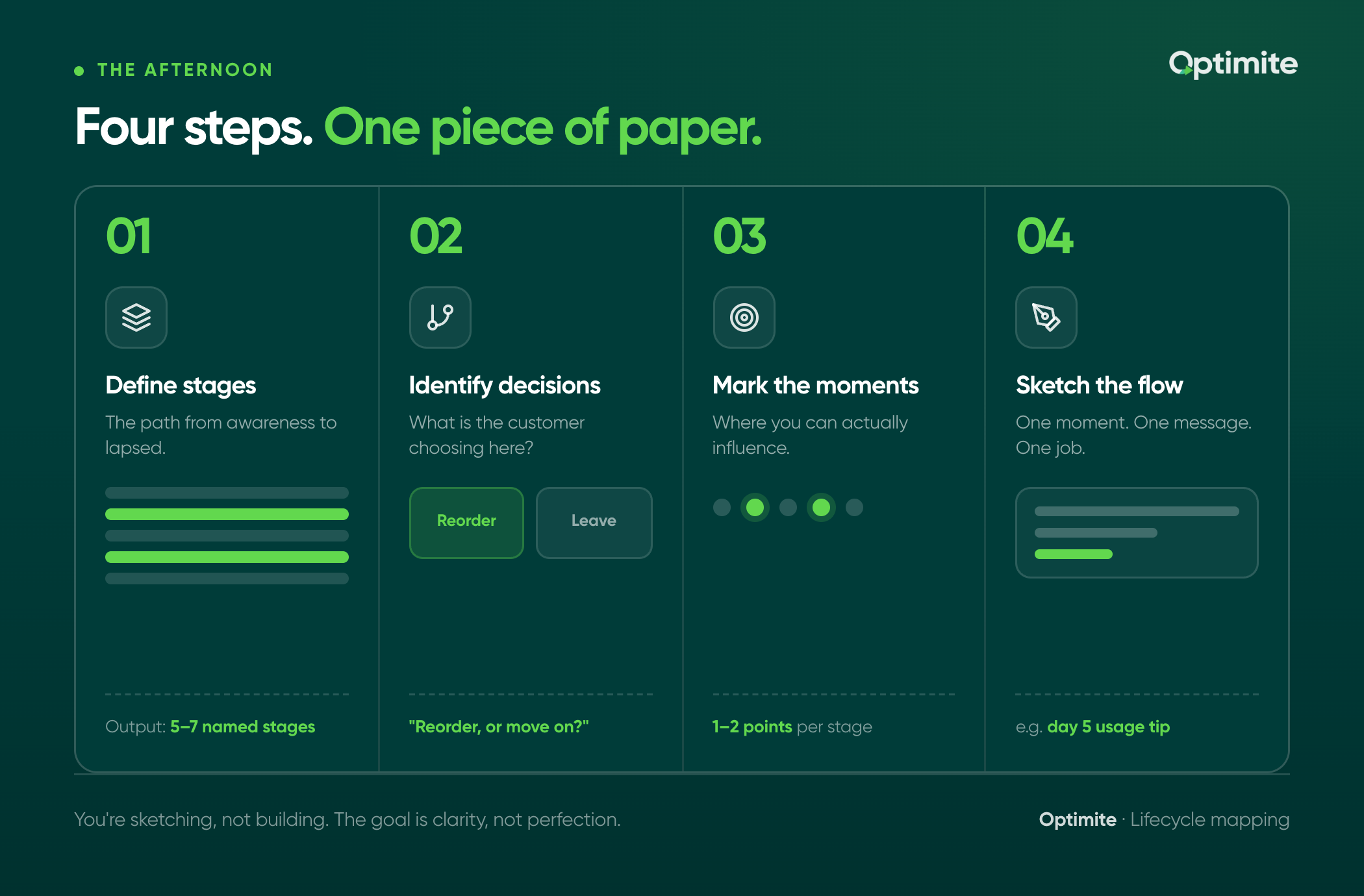
That's your lifecycle map. It takes one afternoon. It changes everything about how you build.
Most Shopify brands skip this step because it feels like it's not "building." They want to be in Klaviyo, setting up flows. But the map is the foundation. Get it right and everything else is easy. Skip it and you're rebuilding six months later.
If you want to build your lifecycle map but need guidance, or if you want an outside perspective on what your map should look like, let's talk. We work with Shopify brands at every stage and we've helped hundreds map their lifecycle and build retention systems that actually work. Check out how we've helped Shopify brands across wellness, fashion, and food and beverage turn mapping into revenue.


