

Map Your Customer Lifecycle Before You Build Any Flows
Design your customer lifecycle strategy before building flows in Klaviyo. Here's the framework that works for every D2C brand.
 Arpit Mehar
Your first customer just arrived. You're excited. You want to email them immediately. So you sit down and design a welcome sequence. You spend two days building it in Klaviyo. Three emails. Clever copy. You ship it.
Three months later, you realize you have 20 different flows all doing slightly different things. Some overlap. Some contradict each other. You have no idea what the customer should see at any given moment. The whole system feels messy.
Here's what went wrong: you built flows without a map.
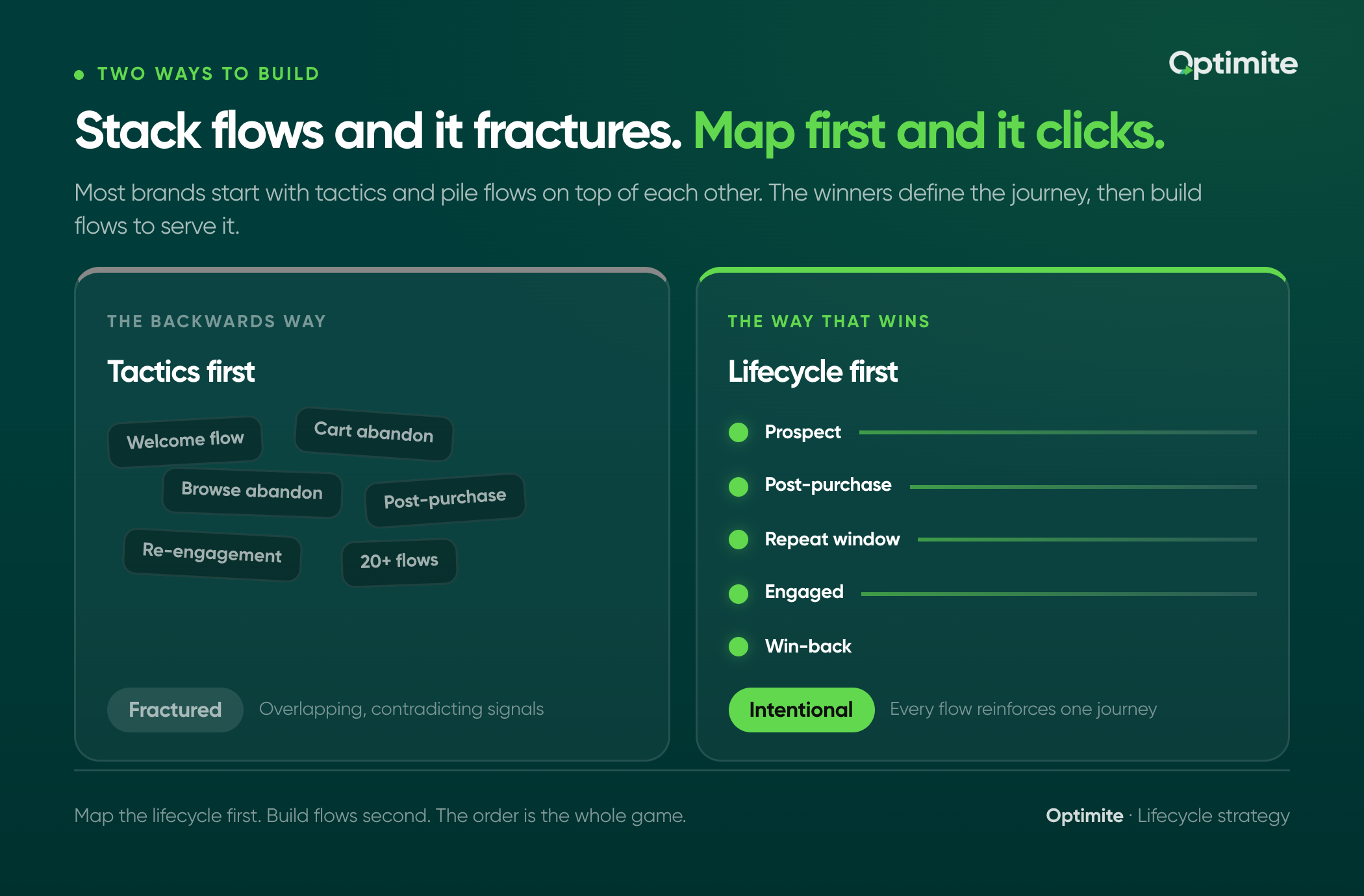
Most brands build backwards. They start with tactics. Welcome flow, cart abandonment, browse abandonment, post-purchase, re-engagement. They stack flows on top of each other like they're playing Tetris. Then they step back and wonder why the system feels disjointed.
The brands that win do the opposite. They map their customer lifecycle first. They define every stage a customer moves through. Then they design flows to support those stages. The whole system clicks because everything reinforces the same journey.
This post walks through how to do that. It's not complicated. It takes an afternoon. And it changes everything about how you build.
The backwards way most brands build and why it fails
Let's say you're running a wellness brand. You have three products: a vitamin subscription, a one-time supplement, and a digital course. They have different repurchase patterns. Different customer psychology. Different revenue potential.
Most brands treat all three the same. A customer who bought the subscription gets the same re-engagement flow as someone who bought the course. The subscription customer is sticky by design (they're paying monthly). The course customer is one-and-done. But your system treats them identically.
Or here's another one: you have a cart abandonment flow, a browse abandonment flow, and a post-purchase flow. They all mention the same product. A customer abandons their cart, gets the cart abandonment email, then comes back and buys. You send the post-purchase flow. They see your thank-you message. Meanwhile, a different customer who abandoned browsing (never got to cart) gets a different message.
The experience is fractured because the system wasn't designed with the full journey in mind. You're optimizing each flow in isolation instead of orchestrating the whole lifecycle.
This creates friction, missed opportunities, and a lot of confusing signals to your customer. It also makes it impossible to know what to build next. You're always reactive instead of proactive.
What a customer lifecycle actually is
Your customer lifecycle is the path someone takes from first learning about your brand to becoming a loyal repeat buyer. It's not the same for everyone. A wellness brand customer who subscribes has a different lifecycle than someone who buys once.
But here's the key insight: within each model, there are common stages. You need to know what those stages are and what happens in each one.
For a repeat purchase brand (fashion, beauty, food), the lifecycle looks something like this:
Stage 1: Awareness. They learn you exist. Maybe through ads, maybe through a friend, maybe through organic search.
Stage 2: First purchase. They buy something. They're converting from prospect to customer.
Stage 3: Post-purchase. They receive the product. This is when they decide if it was worth it.
Stage 4: Repeat purchase decision. Days 2-14 after their purchase, they're either thinking about buying again or mentally checking out.
Stage 5: Lapsed. They haven't bought in a while. You need to re-engage them.
Stage 6: Win-back or loyalty loop. Either they come back, or they're gone.
For a subscription brand (vitamins, meal kits, memberships), the lifecycle is different:
Stage 1: Awareness and evaluation. They learn about you and consider signing up.
Stage 2: First subscription. They commit to recurring delivery.
Stage 3: Early subscription. Weeks 1-4. This is where most churn happens. They're testing if the product is worth the recurring cost.
Stage 4: Established subscriber. They've survived the churn window and are sticky.
Stage 5: Engaged subscriber. They're buying add-ons, upgrading, becoming a power user.
Stage 6: At-risk. Engagement drops. Churn signals appear.
Stage 7: Churned. They've canceled.
The stages change based on your business model. But every brand has them. And every stage needs different messaging, different timing, different messaging strategy.
When you map this first, everything else becomes obvious. You know exactly what flows you need and what they should accomplish. You design them in the right order. You avoid building the same flow three times in different ways.
The five stages every D2C brand should map
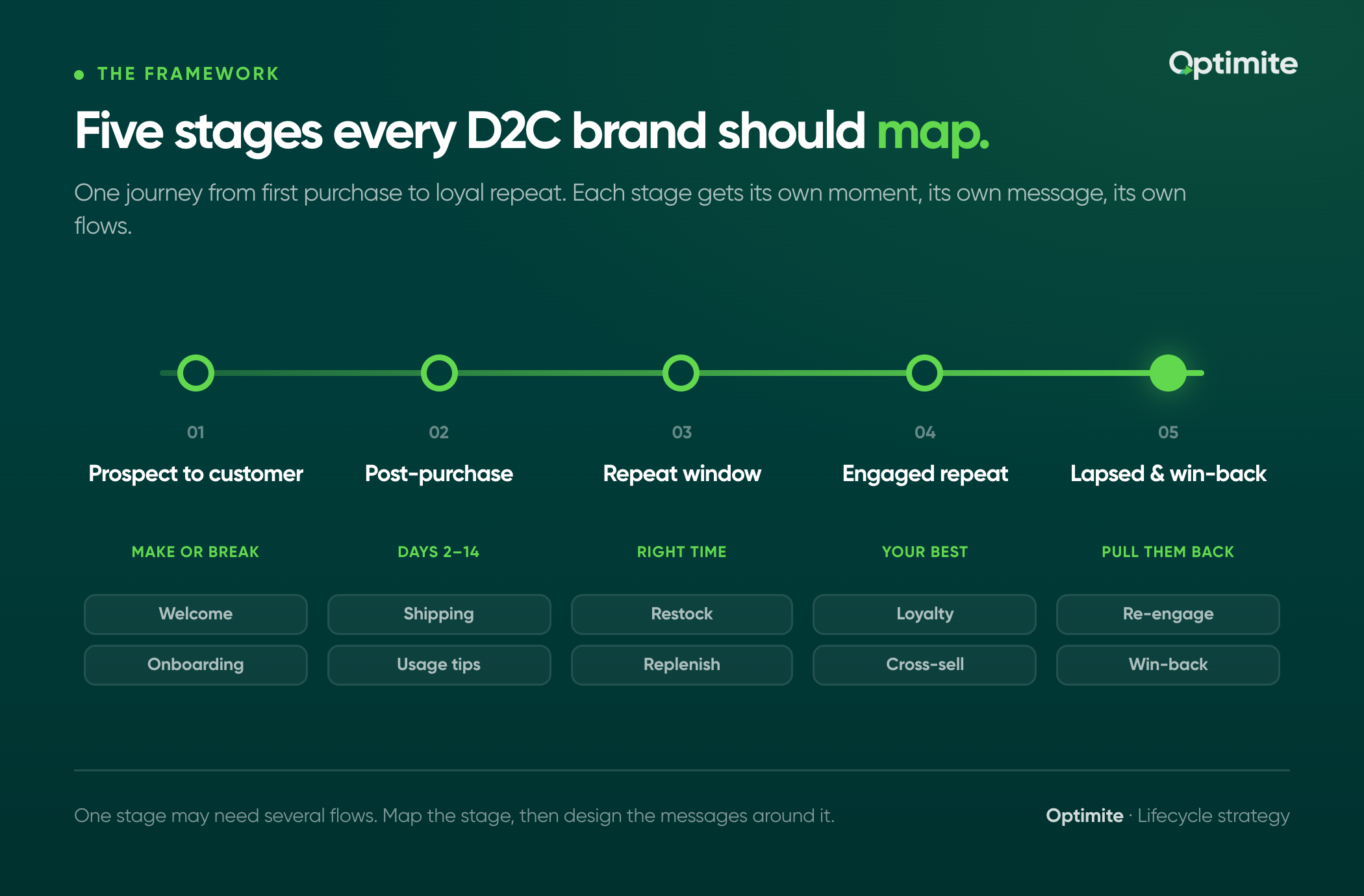
Here's a simple framework that works for most ecommerce brands:
Stage 1: Prospect to Customer The first purchase is make-or-break. Your job here is to remove friction, be clear about what they're buying, and deliver on the promise. Flows: welcome sequence, onboarding, order confirmation.
Stage 2: Post-Purchase Experience Days 2-14 after purchase. This is where the repeat purchase decision happens. You want them excited about what they bought, confident in their purchase, and primed to buy again soon. Flows: shipping updates, usage tips, product education, early incentive for next purchase.
Stage 3: Repeat Purchase Window The time when it makes sense for them to buy again based on your product cycle. For a 45-day supplement, this is day 35-45. For a fashion brand, this is 60-90 days. Your job is to catch them at the right time with the right message. Flows: "ready to restock," seasonal recommendations, replenishment reminders.
Stage 4: Engaged Repeat Customer They've bought twice and you're seeing momentum. They're your best customers. Your job is to deepen the relationship and increase frequency and AOV. Flows: loyalty programs, exclusive offers, early access, community, cross-sells.
Stage 5: Lapsed and Win-Back They've gone silent. It's been longer than your expected repurchase window. You need to figure out why and try to pull them back. Flows: re-engagement sequence, survey to understand churn, special offer, win-back campaign.
These five stages work for most repeat purchase brands. Subscription brands add an early-churn window and adjust the language. But the structure is the same.
How to map your lifecycle in one afternoon
Here's the practical walkthrough:
Step 1: List your customer types. Do you have different cohorts based on product type, AOV, acquisition channel? Write them down. A wellness brand might have "subscription customers" and "one-time supplement buyers." A fashion brand might segment by "full price buyers" and "sale buyers."
Step 2: For each cohort, map the customer journey from awareness to repeat purchase. Write down: What happens first? When do they buy? What happens after? When would they buy again? When do they get bored?
Example: Supplement subscription customer. Awareness (ad, friend referral, organic search). Signup (email capture or purchase). First shipment (4-5 days). Days 1-10 post-purchase (when are they using it?). Day 45 (time to reorder if they're sticky). Day 60 (they should have reordered by now or they're churning). Decision point: are they a keeper or gone?
Step 3: Identify the critical moments in that journey. These are the moments where you can influence their decision. Post-purchase is critical (they're deciding if it was worth it). The reorder window is critical (they're deciding to buy again or try a competitor). A churn signal is critical (they've gone silent and might be leaving).
Step 4: Design one email/SMS for each critical moment. Don't over-design. Don't build entire sequences. Just one message per moment. Welcome. Post-purchase tip. Restock reminder. Win-back offer. That's it.
Step 5: String them together and see how they flow. Does a customer who takes action on one message flow naturally to the next? Or is there a gap? Are you sending contradictory messages? This is where the map becomes powerful. You see the whole picture.
Step 6: Only then do you build the flows. Now that you know the journey, building out your email and SMS sequences in Klaviyo is straightforward. You know what each flow needs to accomplish. You know who it's for. You know when it fires. You're not guessing.
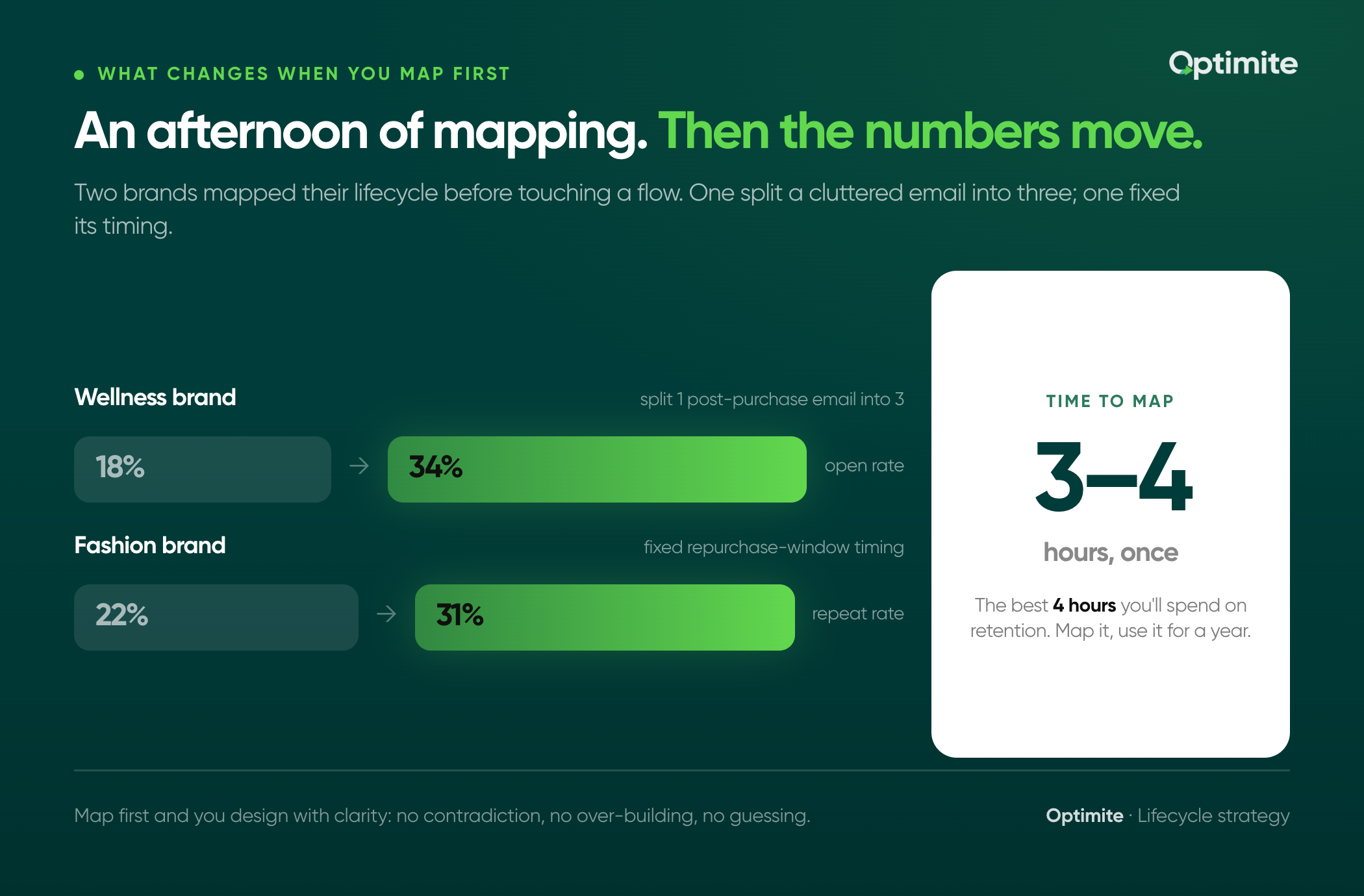
This whole process takes 3-4 hours if you do it right. It's the best 4 hours you'll spend on retention.
What happens when you design the lifecycle first
Once you have the lifecycle mapped, everything changes.
You stop building random flows and start building a system. You know exactly what you need and why. You know the order to build them in. You notice where you're missing pieces and where you're over-building.
A wellness brand we work with mapped their lifecycle and realized they had a post-purchase flow that was trying to do three different jobs at once: thank the customer, educate them on the product, and sell them an add-on. They split it into three separate emails in a sequence. The emails went from 18% open rate to 34% because each one had a single clear job.
A fashion brand mapped their lifecycle and realized they were sending cart abandonment emails to customers at the wrong time. Their repurchase window is 45-60 days. But they were hitting browsers who had never bought. They redesigned their browse flow to be educational (not sales-y) and their repurchase flow to be urgency-driven. Repeat purchase rate went from 22% to 31%.
The pattern is always the same: when you map first, you design with clarity. You avoid contradiction. You move customers smoothly through the journey. The whole system feels intentional.
Common mistakes that break the system
Mistake 1: Treating all customers the same. Your subscription customer is completely different from your one-time buyer. Your high-AOV customer is different from your low-AOV customer. Map separate lifecycles for different cohorts. They'll need different flows.
Mistake 2: Mapping too many stages. You don't need 10 stages. Five works for almost every brand. The goal is clarity, not perfection. If you have more than seven stages, you're overthinking it.
Mistake 3: Confusing the lifecycle with the flows. The lifecycle is the journey. The flows are how you communicate along that journey. One stage might need multiple flows. Or one flow might serve multiple stages. Don't confuse the two.
Mistake 4: Designing the lifecycle in a vacuum. You need data. What's your actual repurchase window? When do customers churn? What's your repeat rate by cohort? Design based on what's actually happening, not what you think is happening.
Mistake 5: Never revisiting the map. Your lifecycle should evolve as your business grows. Map it once, use it for a year, then look at the data and refine it. This isn't a one-time exercise.
The brands winning at retention all do this. They know their customer lifecycle cold. They've mapped every stage. They know what flows live where. The whole system feels like it was designed with intention because it was.
Most brands just stack flows on top of each other and hope for the best. That approach leaves money on the table.
Map your lifecycle first. Build flows second. The order matters.
If you're ready to turn this map into a full retention system tailored to your brand, let's talk about designing your lifecycle strategy.
Keep reading.
All posts
What to Do With First-Time BFCM Buyers Before They Go Cold
Shrestha Ghosal · Jun 16, 2026

5 Signs Your Post-Purchase Flow Is Leaving Repeat Revenue on the Table
Shrestha Ghosal · Jun 10, 2026

What Buyer's Anxiety Is Costing Your Retention Rate
Shrestha Ghosal · Jun 8, 2026