

How Tier-Based Flows Turn One-Time Beauty Buyers Into High-LTV Repeat Customers
 Anamika Kalwan
Here's something most beauty founders notice but rarely say out loud: their email programme feels like it's working, until they actually look at what happens after the first 30 days.
Open rates are decent. The post-purchase sequence goes out. A few people click. And then, somewhere between week four and week eight, the customer just disappears. Not angry, not complaining, just gone. The brand keeps sending campaigns. The customer stops opening. Eventually they fall off the list and get written off as churned.
But most of the time, they haven't churned. They're just halfway through a serum and getting emails that have nothing to do with where they are in the product cycle. A win-back email for someone who still has 40ml left in the bottle. A "we miss you" at day 45 when the repurchase window is actually 90. Generic content sent at generic intervals to customers who bought a very specific product for a very specific reason.
That's the core of beauty brand retention marketing done wrong. And it's more common than you'd think, even in brands doing £5M, £8M, £12M in revenue. The problem scales with the business because nobody stops to rebuild the flows that were set up in year one.
Tier-based flows fix this. Here's how they actually work.
What "long repurchase cycle" actually means for beauty
Beauty has a repurchase problem that most other verticals don't. A wellness supplement brand can predict repurchase with reasonable accuracy because a 90-capsule bottle runs out in 90 days. A fashion brand sees seasonal spikes. But beauty, especially skincare, sits in an awkward middle: repurchase windows range from 45 to 180 days depending on product type, skin routine complexity, and how quickly a customer actually uses what they bought.
A face serum might last 60 days. A moisturiser, 90. A cleanser, 30. If a customer buys a full skincare stack in one order, you're looking at a repurchase window anywhere from 8 to 16 weeks, and that window is almost impossible to predict without behavioural data.
What this creates in practice:
- Generic "time to restock" emails that arrive too early and feel pushy
- Win-back flows that trigger before the customer has even finished the product
- Post-purchase sequences that go quiet after 14 days, right when the customer is forming habits
- No mechanism to differentiate a loyal, high-LTV customer from a one-time discount buyer
The result: a retention programme that technically exists but structurally cannot keep up with how customers actually behave in this vertical.
What are tier-based flows?
Tier-based flows are lifecycle email sequences that treat customers differently based on their purchase history, spend, and engagement, rather than sending the same content to everyone at the same cadence.
The "tier" part doesn't have to mean a formal loyalty programme with points and badges. Most beauty brands don't need that, at least not yet. What they need is segmentation logic that separates customers into meaningful groups and triggers different journeys for each.
Brands using segmentation see 760% higher revenue from email compared to non-segmented sends, according to Campaign Monitor. In beauty, where repurchase windows are long and customer behaviour varies significantly by product type, that gap is even more pronounced.
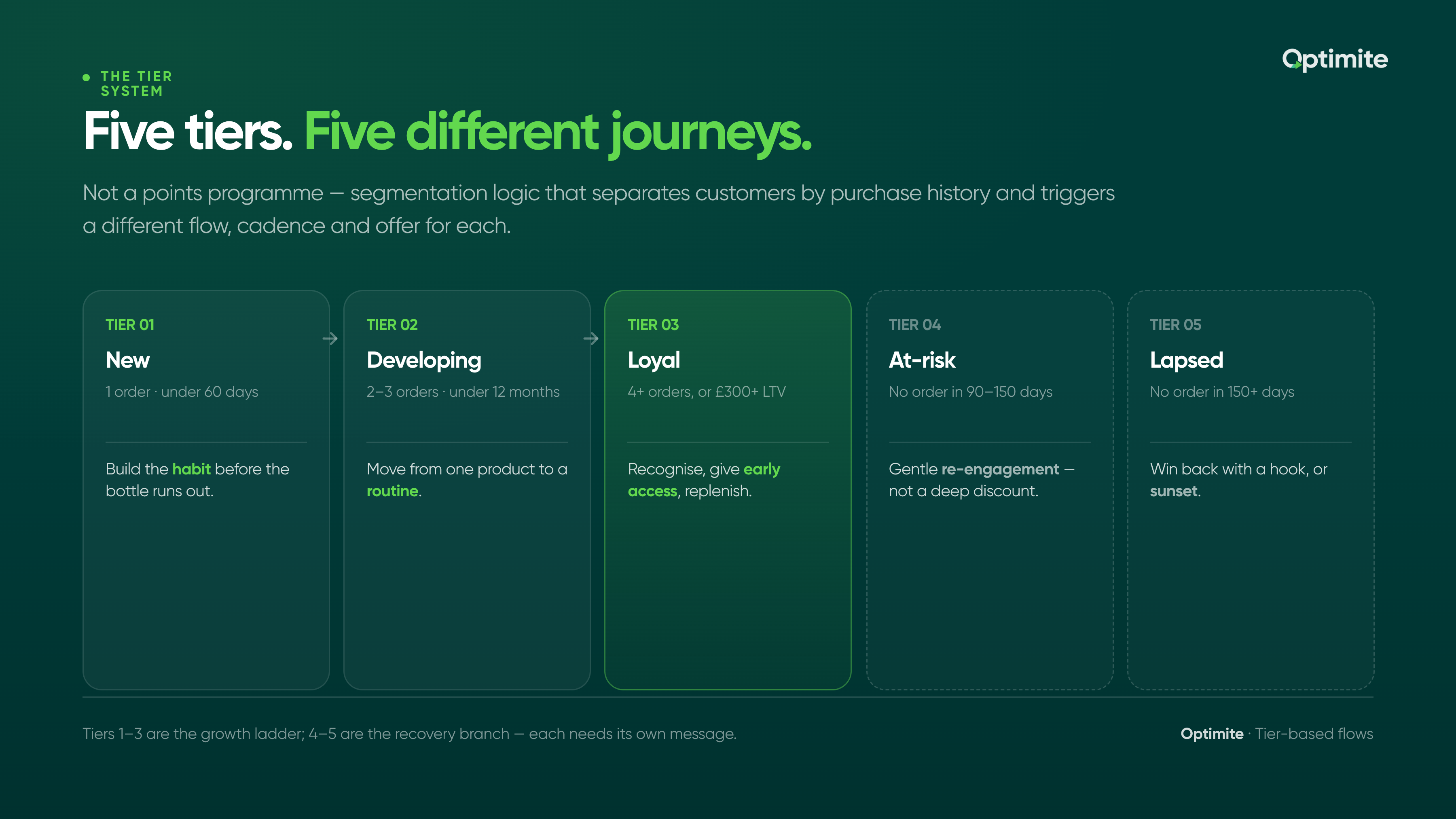
A practical tier structure for a beauty brand at the $2M to $15M stage looks like this:
- New customers (one order, under 60 days): education-heavy, product usage content, building habit
- Developing customers (two to three orders, under 12 months): cross-sell focused, moving toward a second or third product category
- Loyal customers (four or more orders, or $300+ LTV): early access, replenishment reminders, loyalty signals
- At-risk customers (no purchase in 90 to 150 days, depending on cycle): re-engagement with urgency, specific product angle
- Lapsed customers (no purchase in 150+ days): win-back with a clear hook or sunset decision
Each tier gets a different flow. Different timing. Different content. Different offer structure if offers are used at all.
How the flow structure works at each tier
New customers: the 60-day habit window
The first 60 days after a purchase are the most valuable window in beauty retention. This is when routine-forming happens. A customer who builds a habit around your serum in the first eight weeks is significantly more likely to repurchase when they run out.
Most beauty brands burn this window on a three-email post-purchase sequence that ends at day 14. A new customer flow for a beauty brand should run for at least 45 to 60 days and cover:
- Days 1 to 3: order confirmation, then a usage guide or "how to get results" email specific to what they bought
- Days 7 to 10: social proof from customers with a similar skin profile or concern
- Days 14 to 21: introduce a complementary product, not a hard sell, context-setting
- Days 30 to 35: check-in email, "you're about halfway through your serum" if product type allows this estimate
- Days 45 to 55: repurchase prompt, with clear messaging around what they've built so far
The goal isn't to sell again in week one. The goal is to make the product feel essential before the bottle runs out.
If your Klaviyo setup allows product-level tagging, build separate new customer flows by product category. A cleanser buyer needs different education than a treatment serum buyer. The more specific the content, the higher the engagement.
Developing customers: moving from one product to a routine
A customer who has bought twice is the most underinvested segment in most beauty brands. They've shown intent. They came back. But most brands send them the same campaign emails as everyone else and hope they convert to a third purchase on their own.
The developing customer flow has one job: move the customer from a single product to a routine. That's the inflection point that dramatically increases LTV.
Across beauty brands we've worked with, customers who purchase across three or more product categories have LTV that runs 2.5 to 4 times higher than single-category buyers. Getting someone from "I buy your cleanser" to "I buy your cleanser, serum, and SPF" is where long-term retention is actually built.
Content for this tier works best when it:
- Explains why the products work better together, not just that they do
- Uses before/after or transformation stories from real customers
- Introduces one new product category at a time, not the full range at once
- Times the cross-sell to roughly 30 days after their second purchase, when they're engaged but not mid-cycle
Loyal customers: the tier most brands take for granted
Once a customer crosses four or five purchases, most brands effectively stop communicating with them in any structured way. They're in the general campaign list. They get the same weekly emails as a subscriber who has never bought.
That's the wrong move. Loyal customers are your most profitable segment and your most sensitive to feeling overlooked.
Sending your highest-LTV customers the same promotional emails you send to cold subscribers is one of the fastest ways to erode brand loyalty. These customers don't want to feel like a number on a list. They want early access, recognition, and communication that reflects what they've spent.
A loyal customer flow is less about driving the next purchase and more about deepening the relationship. Practically, this means:
- Early access to new product launches before general email goes out
- Replenishment reminders that feel personal rather than automated
- Occasional "thank you" moments, without a discount attached
- Direct feedback loops: asking loyal customers what they want to see next
Replenishment reminders deserve specific attention here. For beauty, a well-timed replenishment email, based on average product usage data, typically drives open rates 2 to 3 times higher than standard campaigns. It's also one of the lowest-friction purchases in the customer journey because the customer already knows the product works.
At-risk and lapsed: two different problems, two different flows
Most brands combine at-risk and lapsed customers into one win-back flow. The two groups need completely different messages.
An at-risk customer hasn't bought in 90 to 120 days but was a regular buyer. They're probably still using your product, just running low. The job here is a gentle re-engagement, not a heavy discount. A well-timed reminder that acknowledges the gap and prompts a repurchase usually works without eroding margin.
A lapsed customer has been gone for 150 days or more. The approach needs to be different:
- Acknowledge the gap directly rather than pretending nothing happened
- Lead with what's new: new formulations, new products, new results
- Make a clear offer if the brand's margin allows it, but only once
- If there's no re-engagement after two to three emails, exit them from active flows and make a sunset decision
Keeping unengaged contacts in your active list hurts deliverability. A clean list with a 30% open rate performs better long-term than a bloated list sitting at 15%.
The Klaviyo setup that makes this work
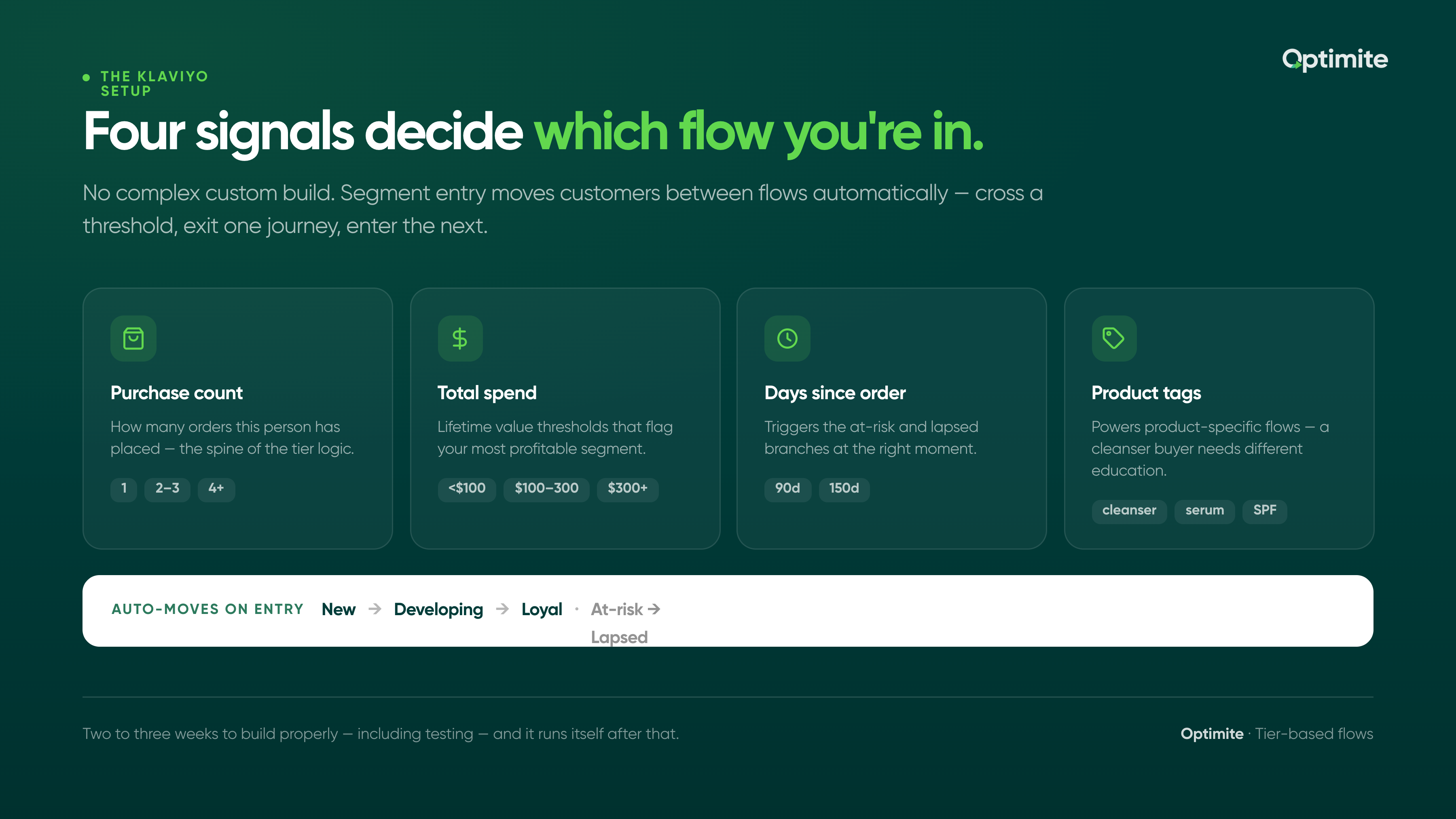
Tier-based flows for beauty brands don't require complex custom builds. The segmentation logic sits inside Klaviyo and can be set up using a combination of:
- Purchase count: how many orders has this person placed
- Total spend: lifetime value thresholds, under $100, $100 to $300, $300+
- Days since last order: used to trigger at-risk and lapsed branches
- Product category tags: for product-specific flows, if your catalogue supports this
The flows run as automated sequences triggered by segment entry. When a customer crosses from tier one to tier two, they exit the new customer flow and enter the developing customer flow. When they hit the loyal threshold, they move again.
This kind of lifecycle email marketing setup typically takes two to three weeks to build properly in Klaviyo, including testing. The payoff is meaningful: for beauty brands we work with, properly structured post-purchase flows typically add 8 to 15% incremental revenue in the first 90 days compared to a single flat sequence.
What gets in the way of doing this well
A few things consistently slow beauty brands down when they try to build tier-based flows:
- Product data isn't clean in Klaviyo. If product categories aren't tagged consistently, the segmentation logic breaks. Fix the catalogue tagging first.
- The team doesn't have bandwidth to maintain multiple flows. Build two tiers first: new customers and loyal customers. Add the middle tiers once the structure is proven.
- Repurchase windows are assumed, not measured. Most brands guess at when a product runs out. Pull the actual time-between-orders data from Klaviyo for your top SKUs. It'll be different from what you assumed, and the flows will be better for it.
- Every email becomes promotional. Relationship-building content consistently outperforms discount-led emails in beauty over the long run. Tier-based flows only work if the content at each tier is genuinely useful, not just an offer with a different subject line.
Where to start if you're rebuilding from scratch
If your beauty brand currently has a flat post-purchase sequence and a general campaign list with no segmentation, start here:
- Pull your customer list and segment by purchase count. Find out what percentage of your customers are at one order, two to three orders, and four or more orders.
- Calculate average time between first and second order for buyers who did come back. That's your repurchase window baseline.
- Build the new customer flow first. Sixty days, five to seven emails, usage and habit-focused. Ship that before building anything else.
- Once that's live, identify your loyal customer segment (four or more orders, or a spend threshold that makes sense for your AOV) and build a simple recognition sequence for them.
- Add the at-risk flow after that, triggered at roughly 1.2x your average repurchase window.
The full architecture doesn't need to exist on day one. Beauty brand retention marketing done in phases is better than a perfect system that never gets built.
After six years and 500+ retention programmes shipped, the pattern is consistent: the brands that win in beauty retention aren't the ones with the most sophisticated tech stack. They're the ones that understand their customer's product cycle and build their email programme around it.
If you want a second opinion on how your current flows are structured, we do free retention audits for ecommerce brands. Book a call with us today!
Keep reading.
All posts
8 Email Flows Built Specifically for Food and Beverage Brands on Shopify
Shrestha Ghosal · Jun 15, 2026

6 Segmentation Strategies That Work Specifically for Fashion E-commerce Buyers
Shrestha Ghosal · Jun 15, 2026

The Trust Gap in Wellness Retention: Why Your Customers Ghost After the First Purchase
Shrestha Ghosal · Jun 12, 2026