

AI Agents in Klaviyo: What DTC Brands Need to Know
 Shrestha Ghosal
For the past few years, AI in Klaviyo meant two things: predictive analytics and send time optimisation. Useful, but mostly passive. You still made the decisions. AI just gave you better data to work with.
That is changing. AI agents are a different category of tool entirely. They do not just inform decisions. They make them, act on them, and iterate. For a DTC brand running lifecycle marketing on Klaviyo, that shift has real implications for how your retention programme runs and who is responsible for the outcomes. 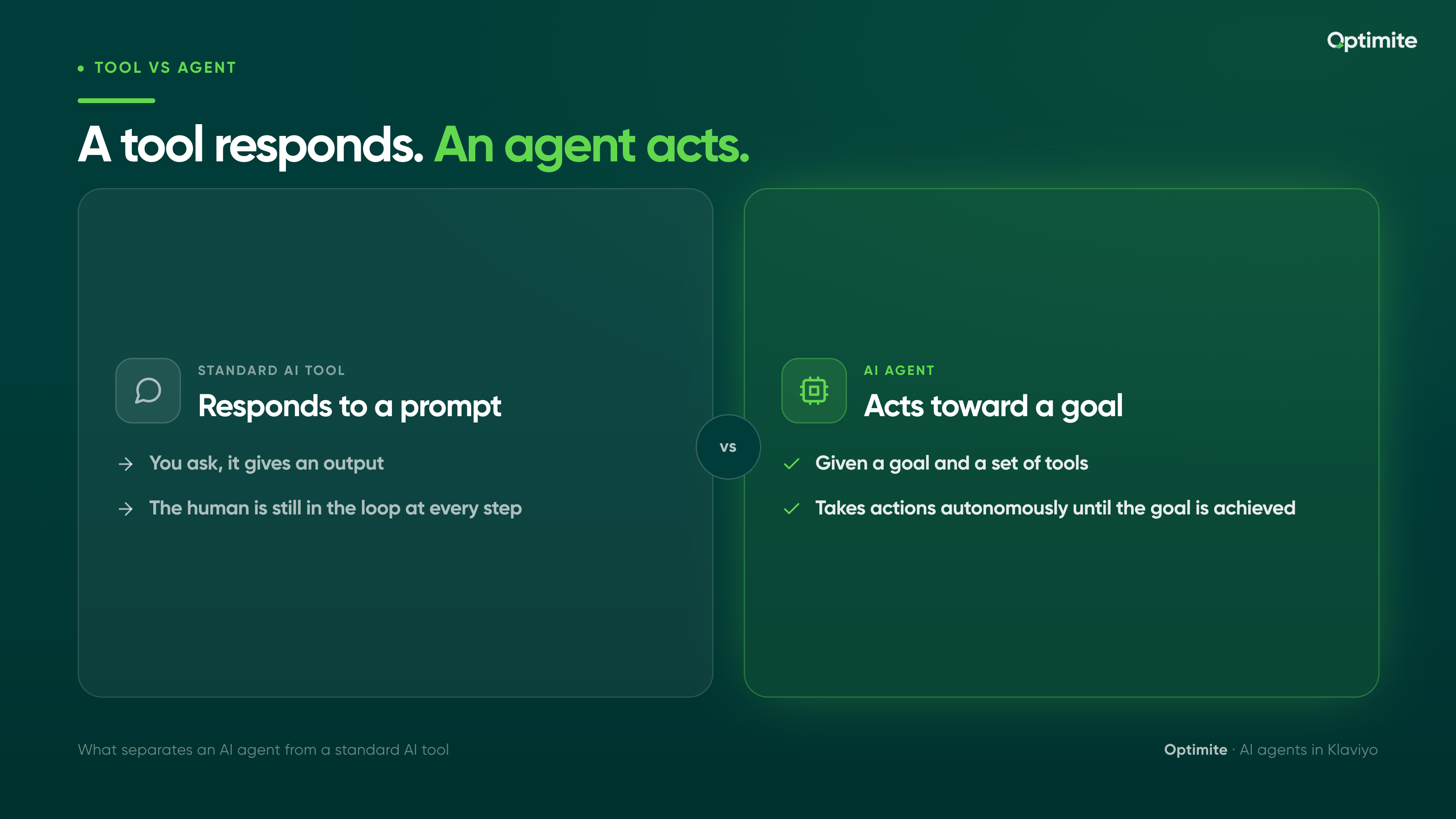
This post explains what AI agents actually are, what they are doing inside Klaviyo today, and what your brand needs to think about before this becomes standard.
What an AI agent actually is
Most people use the terms AI and AI agent interchangeably. They are not the same thing.
A standard AI tool responds to a prompt. You ask it something, it gives you an output, and you decide what to do with that output. The human is still in the loop at every step.
An AI agent operates differently. It is given a goal, a set of tools to work with, and permission to take actions autonomously until that goal is achieved. It observes results, adjusts its approach, and keeps going without waiting for a human to review each step.
In the context of Klaviyo, that means an AI agent could:
- Identify a segment of lapsing customers
- Draft a re-engagement sequence
- Launch the sequence
- Monitor open and click rates
- Adjust subject lines or send times based on early performance
- Report back with what it did and why
All of that, without a strategist queuing up each action manually.
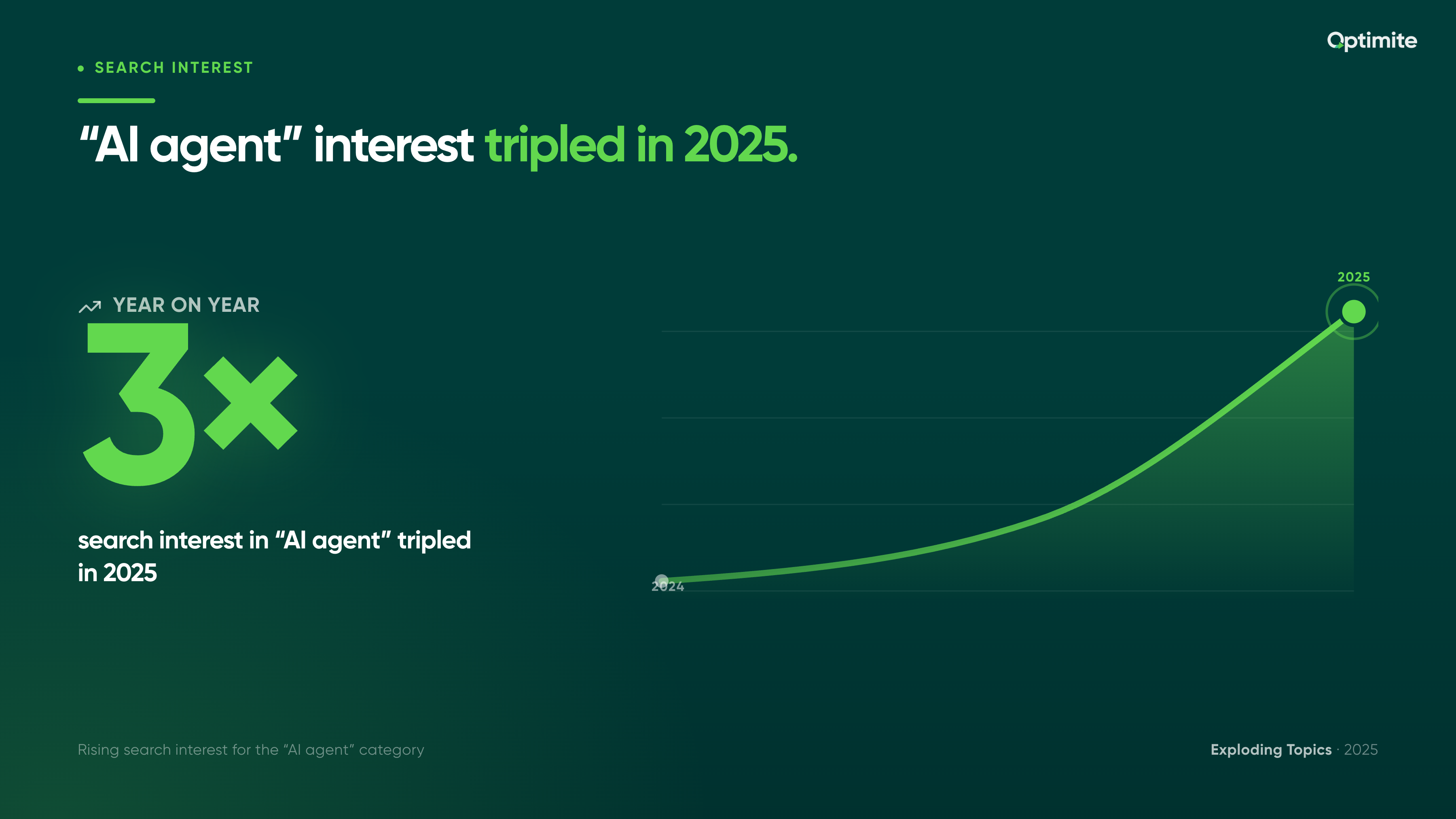
Search interest in "AI agent" tripled in 2025, according to Exploding Topics. The category is moving from research labs into martech stacks faster than most brands are tracking.
What Klaviyo is building toward
Klaviyo has been laying the foundation for agent-style automation for several years. Predictive analytics, AI-generated subject lines, smart send time, and recommended segments are all early expressions of the same underlying direction: reduce the manual work required to run a high-performing retention programme.
The next step is connecting those individual features into something more coherent. Rather than a strategist opening Klaviyo, checking the analytics dashboard, identifying an opportunity, creating a segment, building a flow, and scheduling a campaign, an agent-style system handles the observation-to-action loop directly.
This is not speculative. Klaviyo has signalled this direction publicly, and the underlying infrastructure, their CDP layer, event tracking, and API surface, is already built to support it.
For brands, the practical implication is that the gap between spotting a retention problem and acting on it compresses significantly. A lapsing cohort that might have gone untouched for a month while it waited for a strategist to action it gets caught and engaged in days.
If you are not using Klaviyo's predictive analytics features yet, start there. Understanding predicted next order date, churn risk, and lifetime value predictions gives you the baseline data that agent-style tools will eventually act on. The brands that have clean data now will get more from AI agents faster.
Where AI agents change your retention programme
The impact is not uniform across every part of lifecycle marketing. Some areas shift significantly. Others barely change.
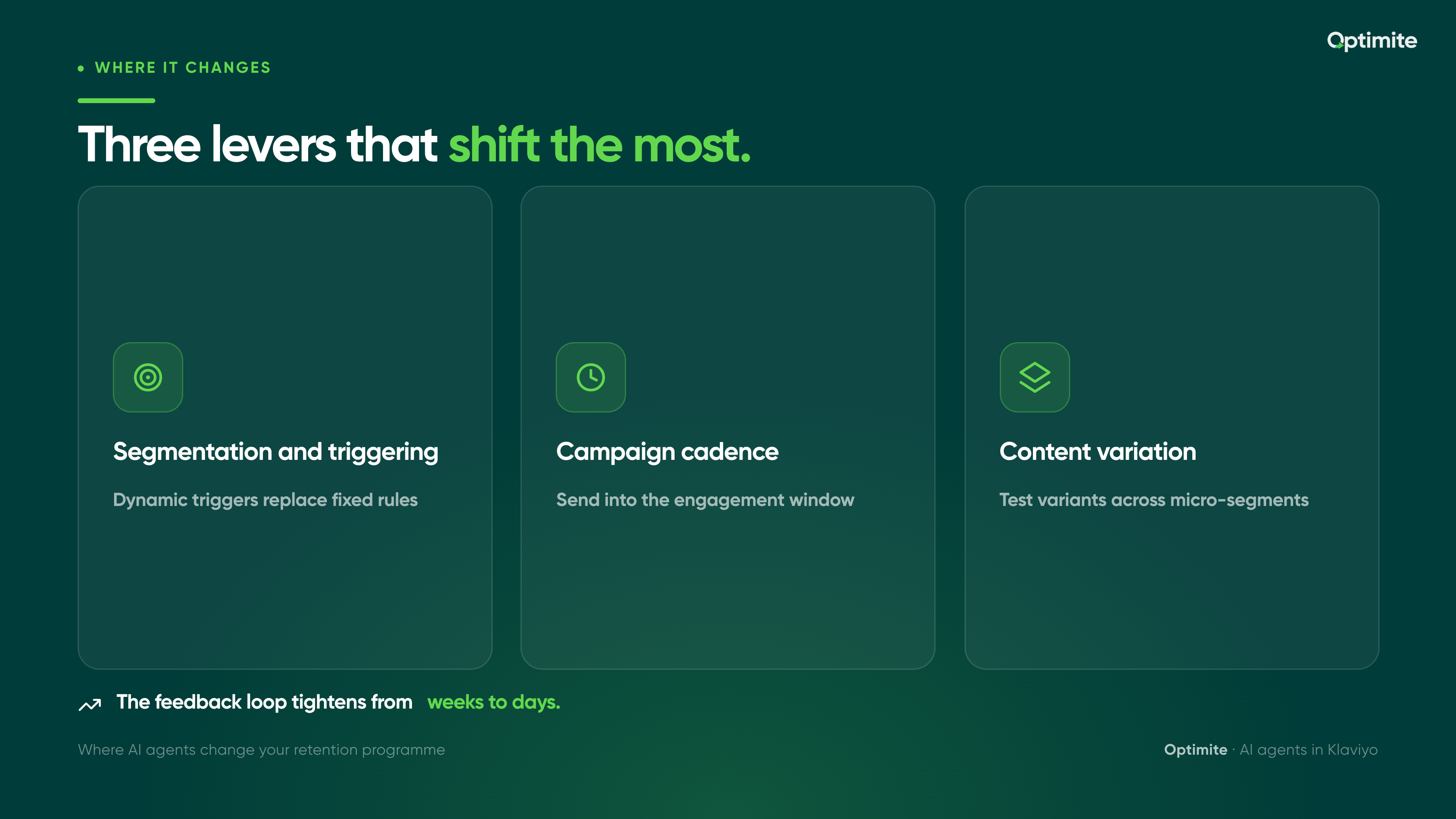
Segmentation and triggering is where agents have the most immediate effect. Fixed rules like "send this email 7 days after purchase" get replaced by dynamic triggers based on predicted behaviour. A customer with a high churn risk score and a pattern of browsing without buying gets a different sequence than a high-LTV repeat buyer who just went quiet. The agent reads the signals and routes accordingly.
Campaign cadence changes too. Instead of a monthly calendar where a human decides what to send on which date, an agent can identify when a specific segment is showing engagement signals and send into that window. For a supplement brand on a 30-day repurchase cycle, this matters a lot. Sending on day 25 when the customer has already opened three emails that week beats a fixed day-28 trigger every time.
Content variation is the third lever. Agents can test subject line variants, preview text, and send times across micro-segments without a strategist setting up each A/B test manually. The feedback loop tightens from weeks to days.
What does not change: brand voice, strategic positioning, and the offer itself. An agent can decide when and to whom to send. Deciding what your brand stands for, or whether a 20% discount is right for your margins, stays with the humans.
Do not hand an AI agent access to your full list without guardrails. Start with a defined segment, a clear goal, and a review checkpoint. Agents optimise for the metric you give them. If you give them an open rate, they will optimise for open rate, which may not be the same as revenue.
The data requirement most brands underestimate
AI agents are only as good as the data they work with. This is where a lot of brands will hit a wall before they ever get to the exciting part.
For an agent to make smart decisions about when to send, who to target, and what to say, it needs:
- Clean customer profiles with purchase history, product categories, and average order value
- Accurate event tracking across the full customer journey, not just email opens
- Zero-party data: stated preferences, quiz responses, product affinities
- Consistent tagging so the agent can distinguish a first-time buyer from a VIP
Most brands on Klaviyo have some of this. Few have all of it. A fashion brand we work with had excellent flow performance but almost no zero-party data, which meant their personalisation was limited to purchase history alone. When you layer AI on top of incomplete data, you get confident-sounding decisions based on partial information.
The brands that will get the most from AI agents in 2026 and beyond are the ones investing in data infrastructure now. That means auditing your Klaviyo property for profile completeness, building post-purchase surveys into your flows, and tagging customers by product affinity rather than just order count.
Zero-party data, information customers give you directly, is becoming the clearest competitive advantage in retention. It does not rely on third-party cookies, it does not degrade over time the way behavioural signals do, and it is exactly the kind of signal an AI agent can act on with precision.
What this means for how you run your retention programme
The strategist role does not disappear. It shifts.
Right now, a retention strategist spends a significant portion of their time on execution: building segments, scheduling campaigns, setting up A/B tests, monitoring flows. AI agents absorb a meaningful share of that work. What remains is the higher-order thinking: deciding which cohorts to prioritise, setting the commercial guardrails, reviewing agent outputs for quality, and making calls that require brand context.
For brands working with a retention agency, this changes what you should expect from your partner. An agency still doing everything manually is not going to keep pace. The output should be faster, the iteration cycles shorter, and the reporting more granular.
At Optimite, we have been integrating AI tooling into how we run programmes across our 500+ brand portfolio precisely because it lets us catch opportunities earlier and act on them faster than agencies running on manual workflows. The work does not get less careful. It gets more responsive.
If you want to see what a properly structured programme looks like in practice, the work we have done across DTC brands is all in our case studies.


