

The Retention Marketer's Guide to Prompt Engineering
 Shrestha Ghosal
Retention marketers using AI and getting mediocre output are blaming the tool. The output is mediocre because the input was vague. Prompt engineering sounds like a developer skill, but at its core, it is just the discipline of giving AI the context it needs to do something useful. For retention teams working across email, SMS, segmentation, and lifecycle strategy, that discipline is worth learning. Teams with structured prompt processes report roughly 340% higher ROI compared to ad-hoc prompting, according to ProfileTree. That gap does not come from using a different model. It comes from knowing how to brief one. 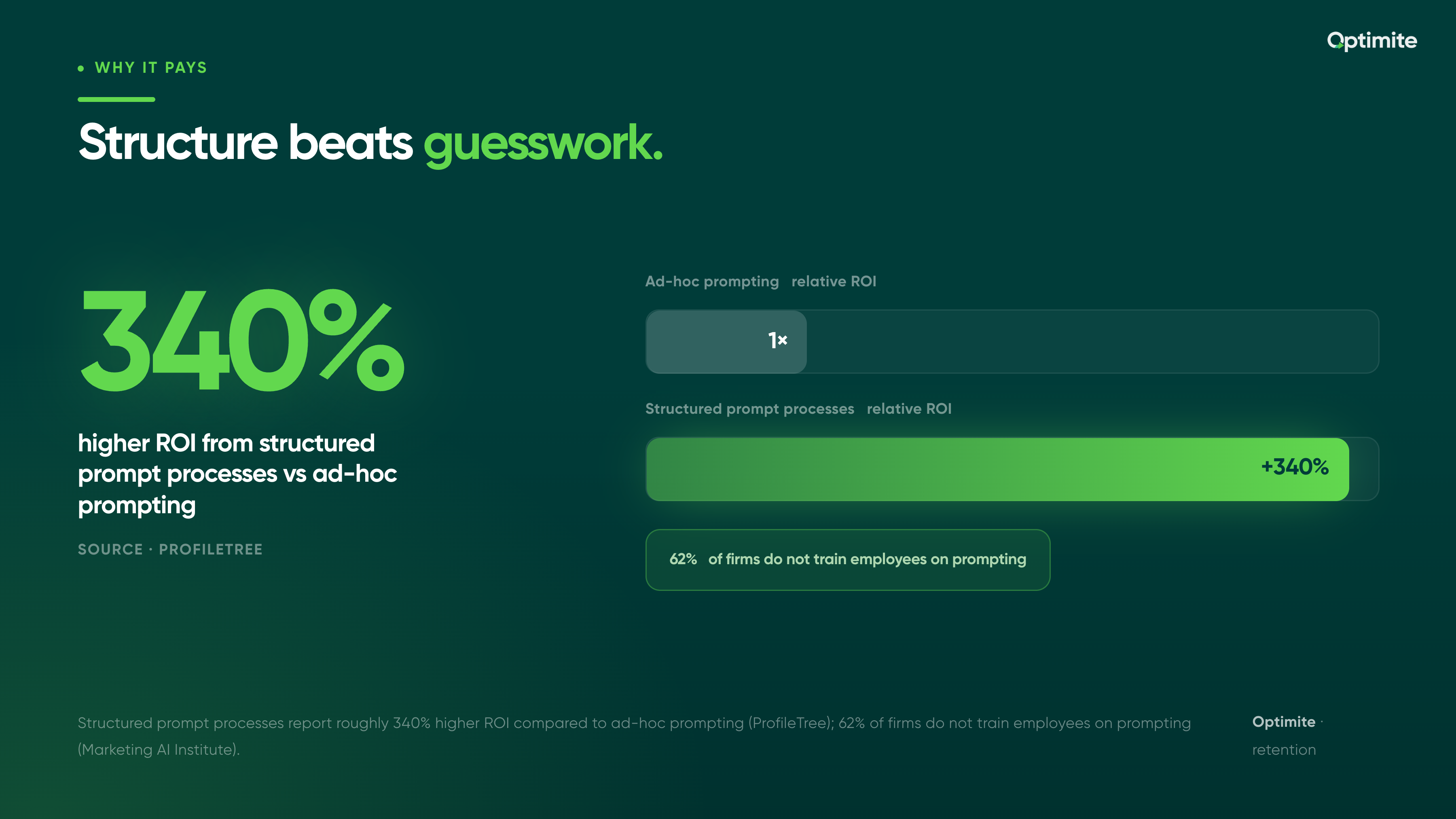
This guide is not about becoming a developer. It is about learning to treat AI the way you would treat a new copywriter on your team: one who needs context, constraints, and clear direction before they can produce anything worth reading.
What prompt engineering actually means in a retention context
Prompt engineering is the practice of structuring your inputs to get consistently useful outputs from an AI model. For a retention marketer, that means writing prompts that produce email copy in your brand voice, segmentation logic that fits your Klaviyo setup, flow briefs that account for your customer lifecycle, and campaign angles that match where your audience actually is.
The challenge is that most marketers start with the ask and skip the context. They write "write me a win-back email" and then wonder why the output sounds like every other win-back email on the internet. The model has no idea who your brand is, who the customer is, why they lapsed, or what tone is appropriate. Without that, it defaults to average.
According to the Marketing AI Institute, 62% of firms do not train employees on prompting, even as AI adoption accelerates. That is a significant gap, and for retention teams, it shows up directly in the quality of flow copy, campaign briefs, and segmentation hypotheses they are generating.
The brief-first principle
Before you write a single prompt, write a brief. The brief is the context layer that sits above every prompt you run for a specific brand or project. A good retention brief contains:
- Brand voice: how the brand sounds (tone, register, vocabulary it avoids)
- Customer context: who you are writing for, what stage of the lifecycle, what they have done or not done
- Channel constraints: SMS has 160 characters and no HTML; email has different rules; the two should not be interchangeable
- Commercial goal: are you recovering revenue, building loyalty, or pushing a specific product?
- Restrictions: offers that are off the table, compliance language if required, competitor mentions to avoid
Once you have a brief, your prompts become shorter and sharper because you are not explaining everything from scratch each time. You paste the brief at the top and then ask the specific question. This is what separates teams that get consistent, on-brand output from teams that are rewriting AI-generated copy from scratch every time.
Save your brief as a reusable block in Notion, ClickUp, or wherever your team works. Paste it at the top of every AI session for that brand. A 200-word brief at the start of a session will save you 45 minutes of editing at the end.
How to prompt for email copy that sounds like your brand
Generic prompts produce generic copy. The way to fix this is to give the model examples of what good looks like before you ask it to produce anything. This is called few-shot prompting, and it is one of the highest-leverage techniques available to a retention marketer.
Here is what that looks like in practice:
- Paste two or three subject lines or email openers that represent your brand at its best
- Describe what makes them work: short, direct, no exclamation marks, or conversational and warm, whatever applies
- Then ask the model to produce new copy in the same register
The output quality difference between a cold prompt and a few-shot prompt is significant, particularly for brands with a specific voice. A wellness brand that never uses urgency language, a fashion brand that writes in lowercase, a supplement brand that leads with data rather than emotion: none of these nuances survives a generic prompt. They do survive a well-constructed brief with examples.
For flow copy specifically, add the trigger logic to your prompt. A browse abandonment email for someone who viewed three products but did not add to cart is a different brief from a winback email for someone who last purchased nine months ago. The model needs that context to write something relevant.
Prompting for segmentation logic, not just copy
This is where most retention marketers leave value behind. AI is not just useful for writing words. It is useful for helping you think through segmentation conditions, suppression logic, flow architecture, and campaign strategy. The prompts are different from copy prompts, and they require a different kind of brief.
For segmentation work, your prompt needs:
- The Klaviyo properties you have available (what data exists, what does not)
- The behaviour you are trying to isolate or exclude
- The commercial outcome you are building toward
An example prompt that works: "I am building a VIP segment in Klaviyo for a skincare brand. I want to identify customers who have placed three or more orders, have an average order value above $85, and have opened at least one email in the last 90 days. What conditions should I set and what logic errors should I watch for?"
That prompt will produce something genuinely useful. "Build me a VIP segment" will not.
Do not ask AI to make decisions about suppression logic or deliverability without checking the output against your actual account data. A prompt that looks right in theory can recommend suppressing an engaged segment because the model does not know your specific list composition. Always verify segmentation outputs in Klaviyo before activating.
The prompts that consistently fail
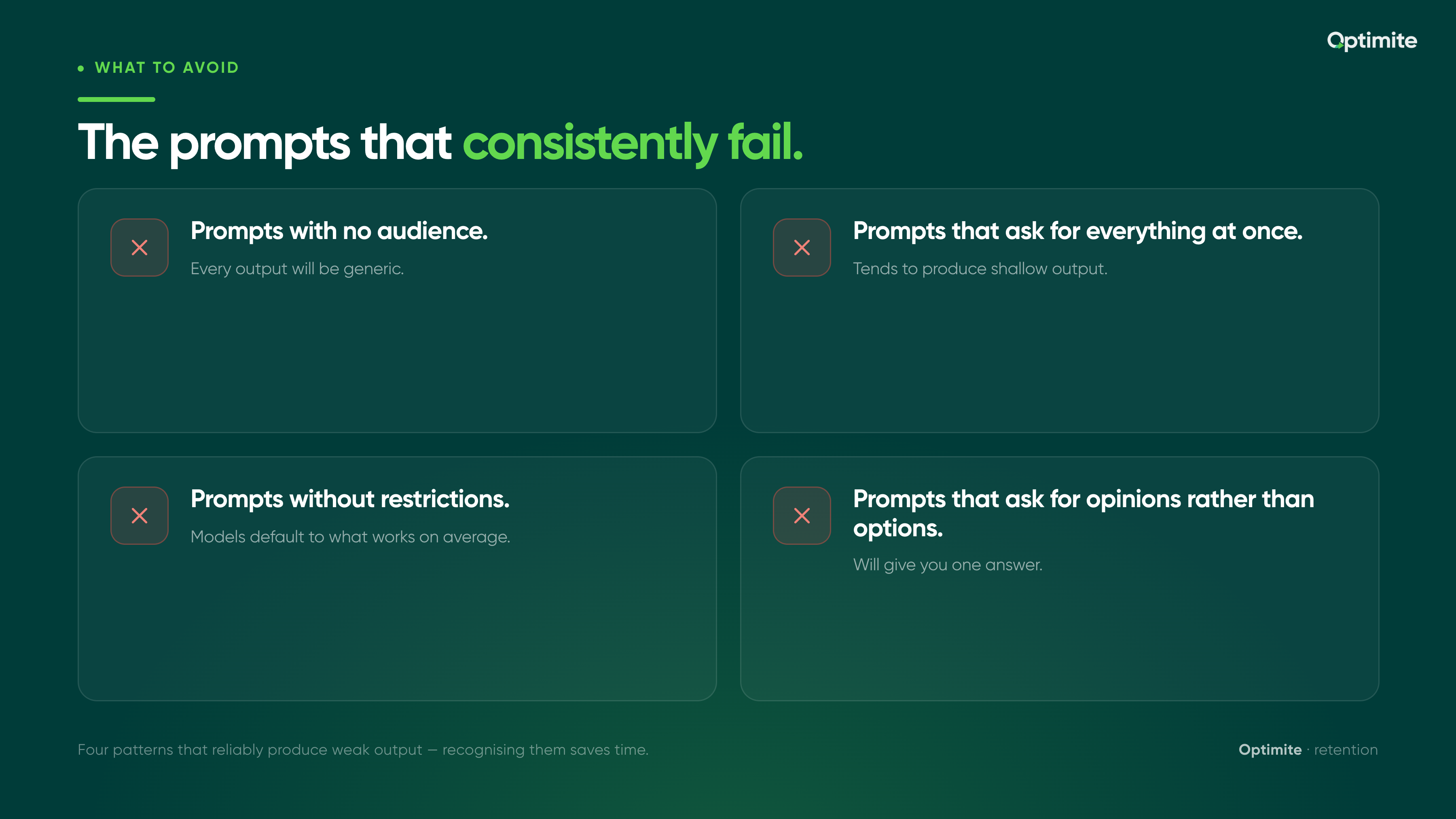
Some patterns reliably produce weak output, and recognising them saves time.
Prompts with no audience. "Write a subject line for a promotional email" gives the model nothing to work with. Every output will be generic because there is no customer in the brief. Add who you are writing for, what they know about the brand, and where they are in the lifecycle.
Prompts that ask for everything at once. "Write me a complete five-email post-purchase sequence" in a single prompt tends to produce shallow output across all five emails. Better to prompt for one email at a time, review and adjust, then move to the next. The constraint improves the depth.
Prompts without restrictions. If there are things the output should not do, say them explicitly. No urgency language. No countdown timers. No discount-first positioning. Models default to what works on average. Your brand may not be average, and the prompt needs to say so.
Prompts that ask for opinions rather than options. "What is the best subject line?" will give you one answer. "Give me five subject lines for this email, ranging from direct to curiosity-led, and tell me when you would use each", gives you a range you can actually evaluate.
A repeatable prompt structure retention teams can use
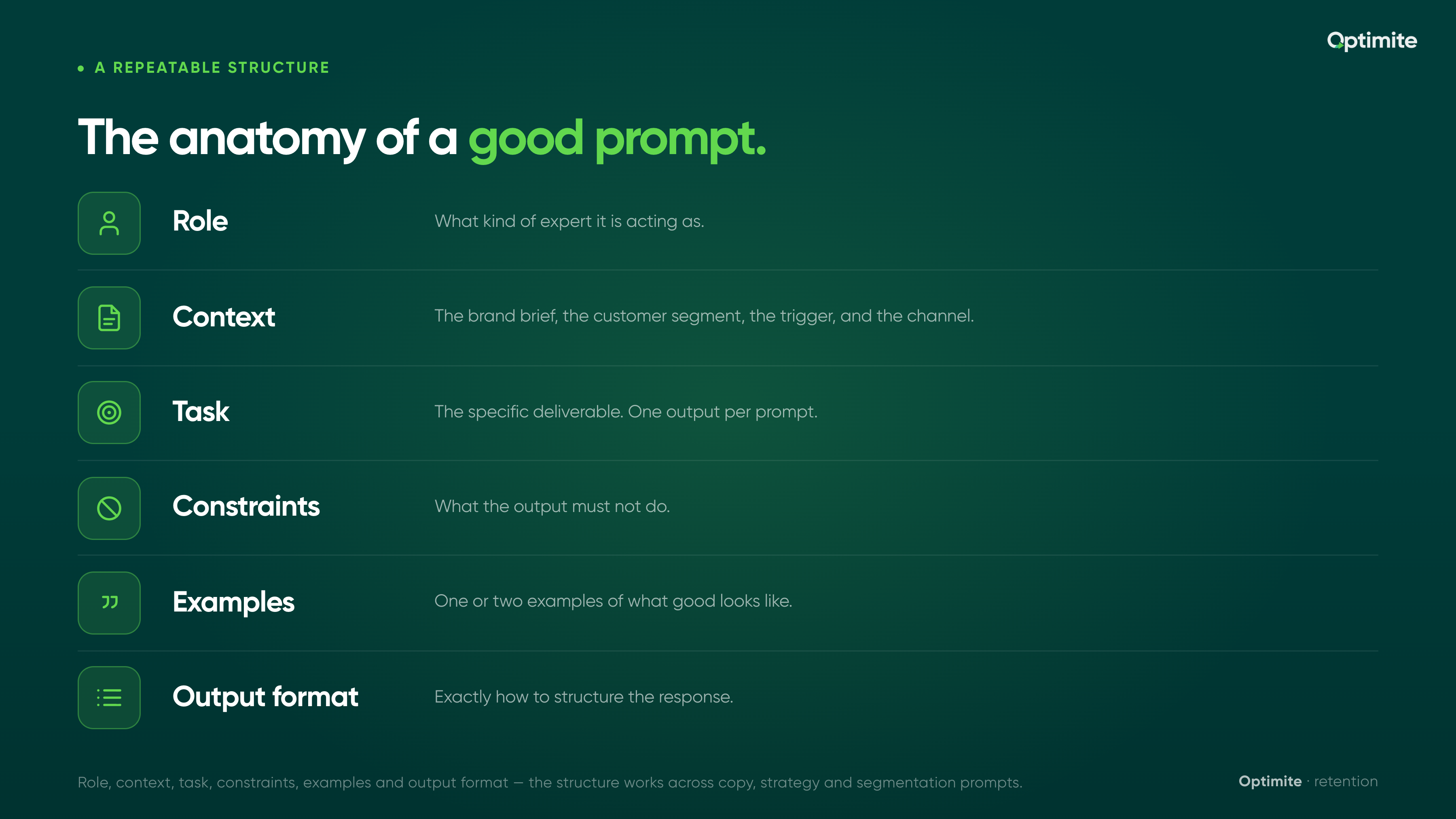
Across all prompt types, whether copy, strategy, or segmentation, a reliable structure follows this pattern:
Role: Tell the model what kind of expert it is acting as. "You are a senior retention copywriter for DTC ecommerce brands."
Context: Paste the brand brief, the customer segment, the trigger, and the channel.
Task: State the specific deliverable clearly. One output per prompt.
Constraints: List what the output must not do. Format, length, tone restrictions, topics to avoid.
Examples: Paste one or two examples of what good looks like for this brand.
Output format: Tell the model exactly how to structure the response. "Return three options, each with a subject line, preview text, and a two-sentence rationale."
Structured prompt processes reduce AI errors by up to 76%, according to research cited across multiple 2025 industry analyses. For a retention team producing flow copy, campaign briefs, and segmentation logic across multiple brands or SKUs, that reduction in errors compounds quickly into real time saved.
The goal of a good prompt is not to get AI to do your job. It is to get AI to do the repeatable, time-consuming parts of your job so your team can spend more time on strategy, judgment calls, and the work that actually requires knowing the brand. The best retention programmes use AI to move faster, not to replace the expertise underneath.
Where to start if your team is not prompting consistently
The first step is a prompt library, not a training programme. Take the five most common tasks your team uses AI for, and write a reusable prompt template for each one. Post-purchase email. Win-back subject line. Segmentation brief. Campaign angle for a promotional send. Flow review request. Five templates, documented in one place, available to the whole team.
From there, the habit builds itself. Teams that standardise prompts early build compounding advantages: better output quality, faster production, and consistent brand voice across every AI-assisted piece of work. AI-driven personalisation and automation in email have been shown to increase revenue by up to 41% and lift click-through rates by over 13%, but only when the inputs are structured well enough to produce personalised output rather than averaged output.
If you want to see how Optimite structures AI-assisted retention workflows across email, SMS, and lifecycle for DTC brands, book a free call with our team and we will walk you through exactly how we do it.
Keep reading.
All posts
Claude Cowork for DTC Brands: What It Does, What Changes, and How to Start
Shrestha Ghosal · Aug 14, 2026

AI Agents in Klaviyo: What DTC Brands Need to Know
Shrestha Ghosal · Jun 24, 2026

Why AI Is Killing the A/B Test
Shrestha Ghosal · Jun 18, 2026