

The AI Trends Businesses Should Watch Closely
 Shrestha Ghosal
There is no shortage of AI coverage right now. What there is a shortage of is AI coverage that tells a DTC brand what actually matters for retention versus what is noise. The landscape in 2026 includes AI agents, generative copy tools, predictive analytics, zero-party data infrastructure, and a dozen other developments, all being described as transformative. Some of them are. Most of them are not yet, or not for brands at the $1M to $30M scale.
This post covers the trends worth watching closely, what they mean in practical terms for email, SMS, and lifecycle strategy, and where most brands are currently behind. 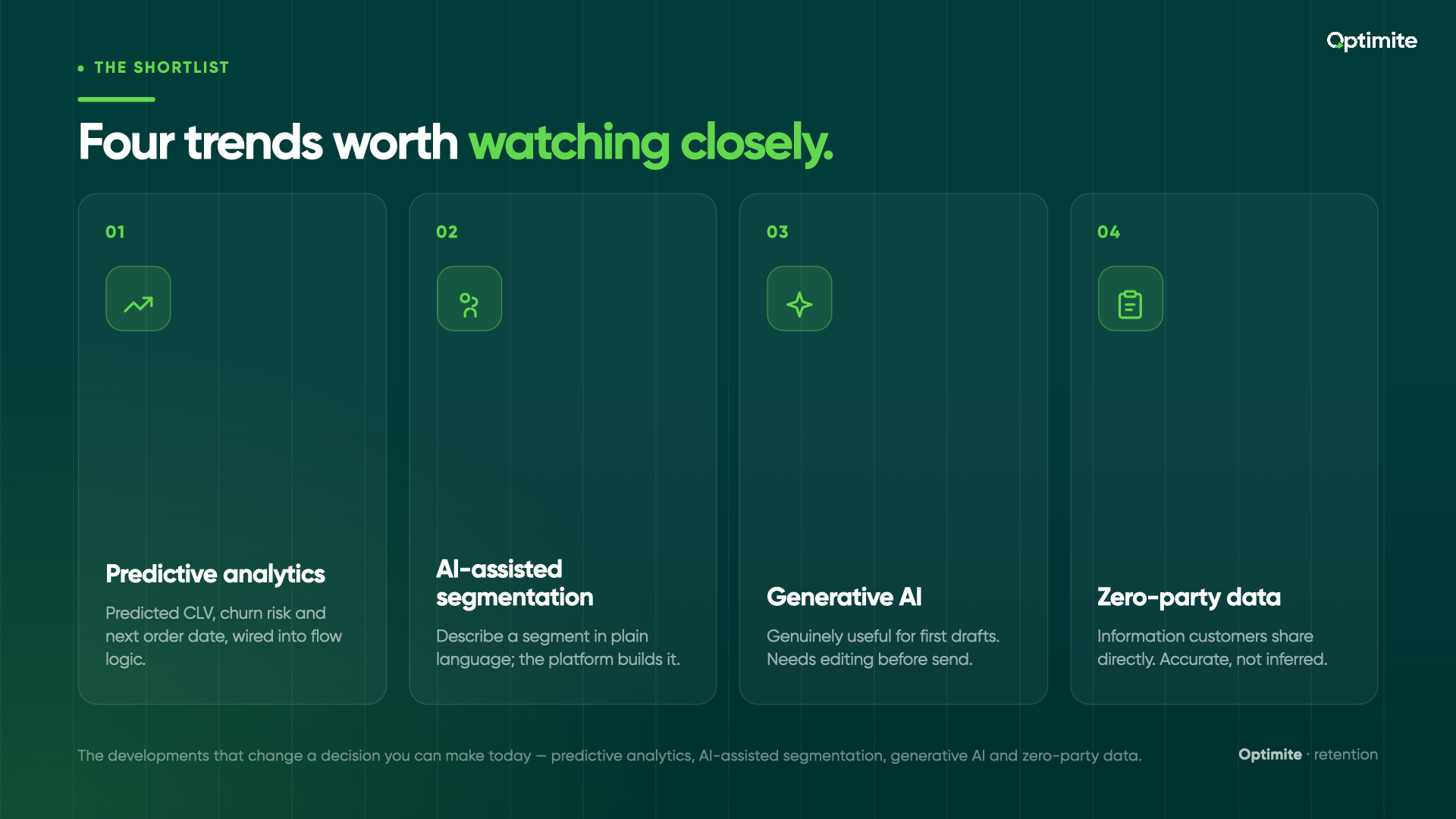
Predictive analytics is moving past send-time optimization
For the past few years, AI in email marketing largely meant one thing: send-time optimization. Tools like Klaviyo's Smart Send Time have been widely adopted, and they work. Delivering an email when a specific subscriber is most likely to open it improves engagement without changing a word of copy.
The more significant shift happening now goes beyond timing. Using predictive data to make lifecycle decisions is a fundamentally different capability. Klaviyo's predictive analytics suite now forecasts each customer's expected next order date, predicted lifetime value, and churn probability at the individual level.
What it means in practice: a brand can now trigger a flow the moment a customer's predicted CLV crosses a threshold, rather than waiting for a fixed number of orders. It can suppress a win-back attempt for a segment where AI has flagged low reactivation probability, saving list health for sequences more likely to convert. According to Klaviyo's 2025 State of Email data, brands using AI-driven segments see revenue per recipient increases of 18 to 45% compared to traditional demographic segmentation.
The brands getting the most from this are not treating predictive data as a reporting feature. They are wiring it directly into flow logic.
If you are on Klaviyo and have at least 12 months of order data and 1,000 or more customers, the predicted CLV and churn risk fields are available and usable today. The minimum data threshold matters: below it, the predictions are unreliable. Above it, they are actionable segmentation conditions.
AI-assisted segmentation is closing the gap between what brands know and what they act on
Most DTC brands know more about their customers than their segmentation reflects. They have purchase history, product category data, engagement signals, discount sensitivity, and repurchase timing. What they typically lack is the time and technical resources to translate all of that into active segments.
Klaviyo's Segments AI and tools like it are closing that gap. The practical shift is that a retention marketer can now describe a segment in plain language, and the platform will build the conditions. "Customers who bought in the last 60 days, have a predicted CLV above $300, and have not opened an email in the last 30 days" becomes a live segment without manual condition-building.
The more important development is Audience Optimization, a feature Klaviyo introduced in early 2026. When enabled at campaign scheduling, it scores each recipient's likelihood of unsubscribing based on recent engagement signals and removes high-risk profiles before the send. This is predictive removal of subscribers at the tipping point, preserving the relationship for a better-timed send rather than burning it permanently.
For brands managing lists of 50,000 or more, this kind of pre-send intelligence compounds significantly over time. Deliverability improves, unsubscribe rates fall, and the active list stays cleaner.
Generative AI in campaign production: where the value is, and where it is not
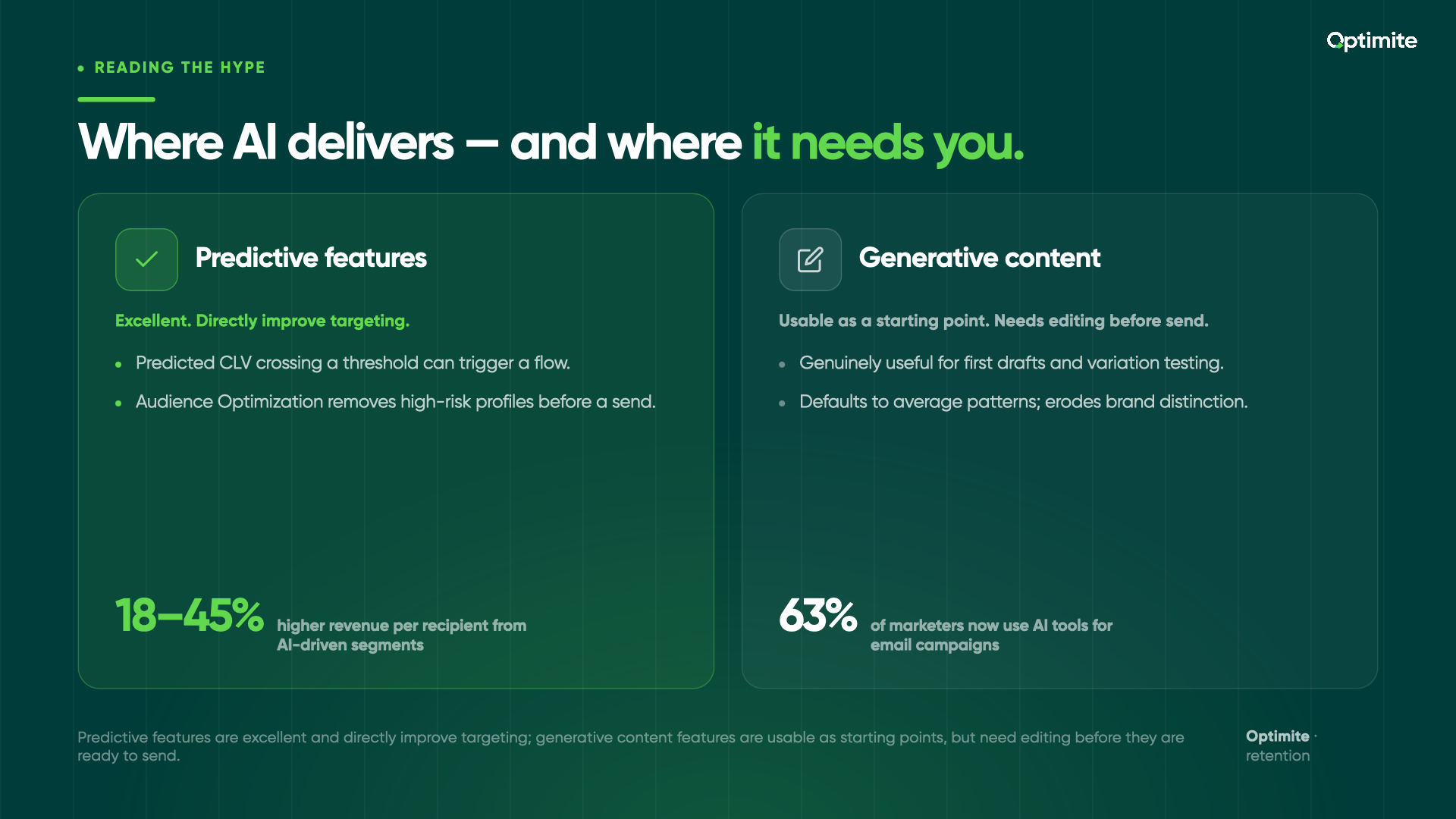
63% of marketers now use AI tools for email campaigns, and the most common use case is copy generation. Subject lines, preview text, body copy, and flow sequences are all being drafted with AI assistance.
The value is real but uneven. Generative AI is genuinely useful for first drafts, subject line options, and variation testing at a speed that was not previously possible. Where it consistently underperforms is in producing copy that sounds like a specific brand rather than an averaged version of all brands. A wellness brand with a specific voice, a fashion brand that uses restraint rather than urgency, a supplement brand that leads with science rather than social proof: these nuances require prompt engineering and editorial judgment that the tool alone does not supply.
The honest summary from reviewing AI content features across platforms: predictive features are excellent and directly improve targeting. Generative content features are usable as starting points, but need editing before they are ready to send. The brands treating AI-generated copy as a first draft they improve are getting value. The brands treating it as a final output are sending emails that erode brand distinction over time.
Generative AI trained on broad datasets defaults to the highest-frequency patterns in email marketing: urgency, social proof, discount-led subject lines, benefit lists. If your brand deliberately avoids these patterns, AI copy tools will pull you toward them unless you constrain the output with explicit brand guidance. The tool reflects what works on average. Average is not always appropriate.
Zero-party data is becoming the input that determines what AI can do
Most AI personalization in email is built on behavioural data: what a customer clicked, what they browsed, what they bought. That data is increasingly incomplete. iOS privacy changes degraded open tracking. Third-party cookies are effectively gone. What a subscriber does is becoming harder to measure reliably.
Zero-party data is the counterweight. It is information customers share directly: quiz responses, preference centre selections, post-purchase survey answers, stated repurchase frequency. Unlike inferred data, it is accurate because it comes from the customer rather than a probabilistic model.
According to Marika Tselonis, director of retention at Kulin, brands succeeding in 2026 will have better ingredients alongside better AI: rich, consensual data that reveals what customers want, captured directly rather than inferred from behaviour. That framing is correct. The AI tools available to DTC brands are largely commoditized. The competitive advantage is in the quality and depth of the data you feed them.
According to Forrester research, zero-party data drives 25 to 40% higher email engagement compared to generic campaigns. Post-purchase surveys that capture stated intent increase repeat purchase rates by 18 to 23%. These are not marginal improvements.
For retention teams, this means the list-growth strategy and the data-collection strategy need to be designed together. A quiz that acquires a subscriber while also capturing skin type, goal, or product preference is more valuable than a standard pop-up that captures an email address alone. The preference data becomes the segmentation condition. The segmentation condition determines what the subscriber receives. What the subscriber receives determines whether they buy again.
The AI capability most brands are not using yet
Klaviyo AI Agents, released in 2025 and expanded through 2026, take natural language instructions and produce draft flow structures the operator can edit and ship. "Build a winback flow for customers who have not purchased in 90 days" returns a structured draft rather than requiring a manual build from scratch.
Strategic thinking stays with the team. The agent does not know your brand's suppression logic, your discount policy, or your seasonal context. What it does do is remove the blank-page problem and reduce the time from brief to a testable draft.
The retention teams moving fastest right now are combining predictive segmentation, AI-assisted flow building, and zero-party data collection into a connected system rather than using each feature in isolation. The sum is meaningfully greater than the parts.
Early adopters of AI-driven retention practices show 41% better retention metrics than brands that have not yet integrated AI into their lifecycle programmes, according to Gartner-cited data. That gap is not permanent, but it is real now, and it widens the longer the decision to act is deferred.
The question worth asking about any AI trend is not "is this impressive" but "does this change a decision I could not previously make, or make a decision faster and more accurately than before?" Predictive CLV does. Audience Optimization does. AI-generated copy improves speed. Zero-party data improves input quality. Each one earns its place on that basis, not on novelty.
What AI does not change in a retention programme
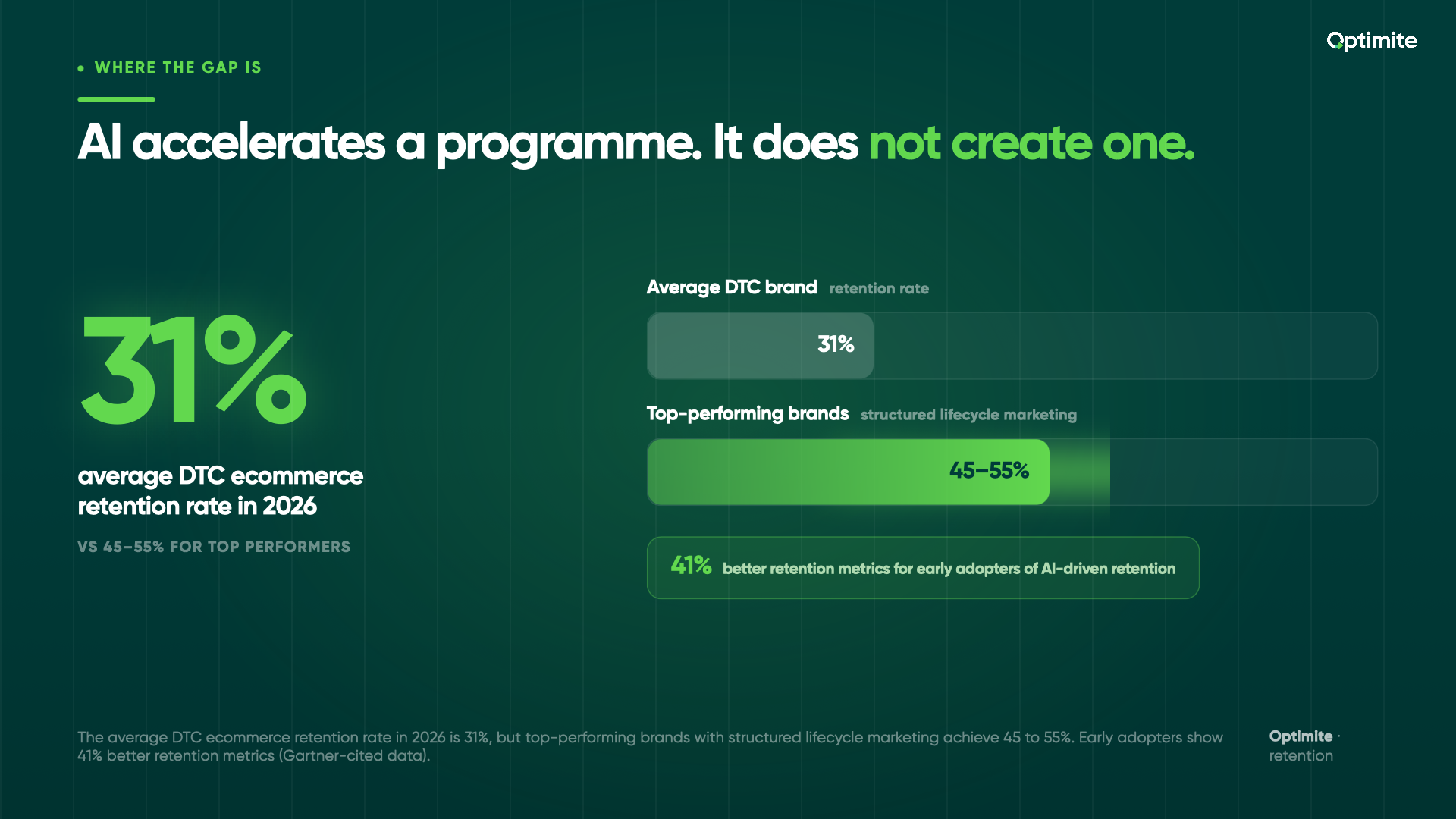
The fundamentals underneath a retention programme are not being disrupted by AI. A post-purchase flow that does not set expectations, address anxiety, and create a reason to return will underperform regardless of how smart the send timing is. A segmentation strategy built on thin data will produce thin results even with AI conditions applied to it. A brand with low product-market fit cannot automate its way to strong repeat purchase rates.
AI makes a good retention strategy faster and more precise. It does not substitute for having one.
The average DTC ecommerce retention rate in 2026 is 31%, but top-performing brands with structured lifecycle marketing achieve 45 to 55%. That gap is almost entirely explained by the presence or absence of a structured post-purchase programme and a deliberate approach to the second purchase window. AI accelerates the execution of that programme. It does not create it.
How to decide which trends to act on now
The filter is simple: does this trend change what you can do with data you already have, or does it require building new infrastructure before it delivers value?
Predictive analytics in Klaviyo requires existing purchase data. If you have it, the feature is available now and usable today. Audience Optimization requires an engaged list. If you have one, enable it. AI-assisted segmentation requires clarity on what segment you are trying to build. If you have that, the tool speeds up execution. Zero-party data collection requires intent to capture it at the right moments in the customer journey. That is a strategy and flow design decision more than a technology one.
The trends that require entirely new infrastructure, new platforms, or significant technical resources before they produce value are worth monitoring but not worth prioritizing ahead of the ones that improve what you are already doing.
If you want to see how Optimite is applying these trends across retention programmes for DTC brands, including where we are seeing measurable lift and where the hype outpaces the reality, book a free call with our team and we will walk you through what we are doing right now.
Keep reading.
All posts
Claude Cowork for DTC Brands: What It Does, What Changes, and How to Start
Shrestha Ghosal · Aug 14, 2026

AI Agents in Klaviyo: What DTC Brands Need to Know
Shrestha Ghosal · Jun 24, 2026

Why AI Is Killing the A/B Test
Shrestha Ghosal · Jun 18, 2026