

How AI Is Shortening the Feedback Loop Between Send and Optimization
The brands improving fastest aren't the ones with the biggest lists. They're the ones acting on data the fastest.
 Shrestha Ghosal
7 min read
The feedback loop has always had a lag problem. You send a campaign on Tuesday. You check open rates on Wednesday. You notice the subject line underperformed, click rate was flat, and one segment converted at half the rate of the others. By the time you've worked out what to change and briefed the next send, it's the following week. Sometimes the week after that.
For most DTC brands, that lag is the norm. And it compounds. Slow feedback means slow learning. Slow learning means the same mistakes repeat across campaigns, across flows, across months. The brands pulling ahead on email optimization ecommerce right now are the ones that have shortened this cycle, in some cases from weeks to hours.
AI is the reason the cycle is compressing. This post covers exactly where the feedback loop breaks down, what AI is doing to close it, and what a faster learning cycle looks like in practice for a brand doing $2M to $15M in revenue.
Where the feedback loop breaks down
Most brands are slower at acting on data than they realise. The send happens on time. The results come in. But the distance between reading a result and changing something is longer than it looks.
There are four places the loop slows down.
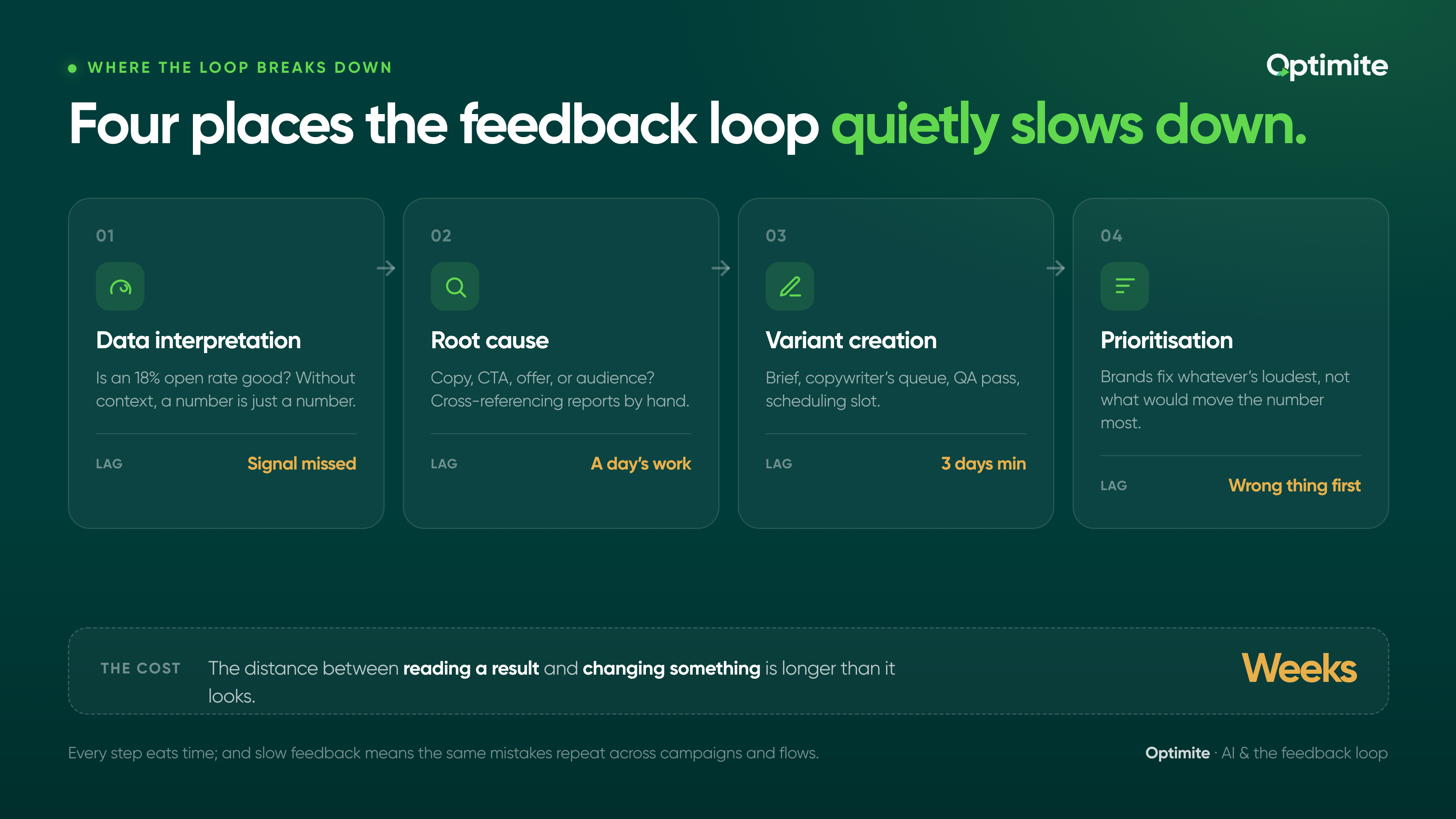
- Data interpretation. Open rate is 18%. Is that good or bad? Depends on the segment, the send time, the subject line angle, the day of week, the vertical, and what you sent the week before. Without context, a number is just a number. Most teams read the surface metrics and miss the signal underneath.
- Root cause identification. If click rate dropped, was it the copy, the CTA placement, the offer, or the audience? Working that out manually means cross-referencing multiple reports, segmenting the data by hand, and making educated guesses most of the time.
- Variant creation. Once you know what to test, someone has to write the variants. For most teams, that means a briefing conversation, a copywriter's queue, a QA pass, and a scheduling slot. Three days minimum, often more.
- Prioritisation. What to fix first is rarely obvious. Brands end up optimising whatever is loudest, which is usually not whatever would move the number most.
Every one of these steps eats time. And time is where ecommerce email automation either compounds or stagnates.
What AI is doing to close it
The change AI brings to this loop is speed at each step, without removing the human decision at the end.
On data interpretation, AI tools can surface the signal that matters from a send within minutes of the data coming in. Open rate by segment, click rate by device, conversion rate by acquisition source, unsubscribe rate by send frequency cohort. A report that would take a retention analyst 90 minutes to build manually is available before the next morning's standup. The analyst still reads it. They just spend their time deciding what to do rather than compiling what happened.
On root cause identification, this is where the AI retention marketing gap between brands is widening fastest. Tools that sit on top of Klaviyo data can now identify which variable correlates most strongly with underperformance on a given send. That's not a diagnosis, it's a shortlist. But it cuts the investigation from a day's work to 20 minutes.
On variant creation, the constraint was always time, not ideas. A copywriter who knows what to test can generate four subject line variants in an hour with AI assistance. The same work used to take a day when every variant had to be written from scratch, briefed, and reviewed. For a brand running weekly campaigns, that's the difference between testing one thing per month and testing four.
On prioritisation, AI can rank opportunities by estimated revenue impact based on historical send data. A 3-point improvement in open rate on the welcome series is worth more than a 3-point improvement on a quarterly re-engagement campaign, because of send volume and list position. Most brands don't have the bandwidth to calculate that. AI does it automatically.
What a faster loop looks like in numbers
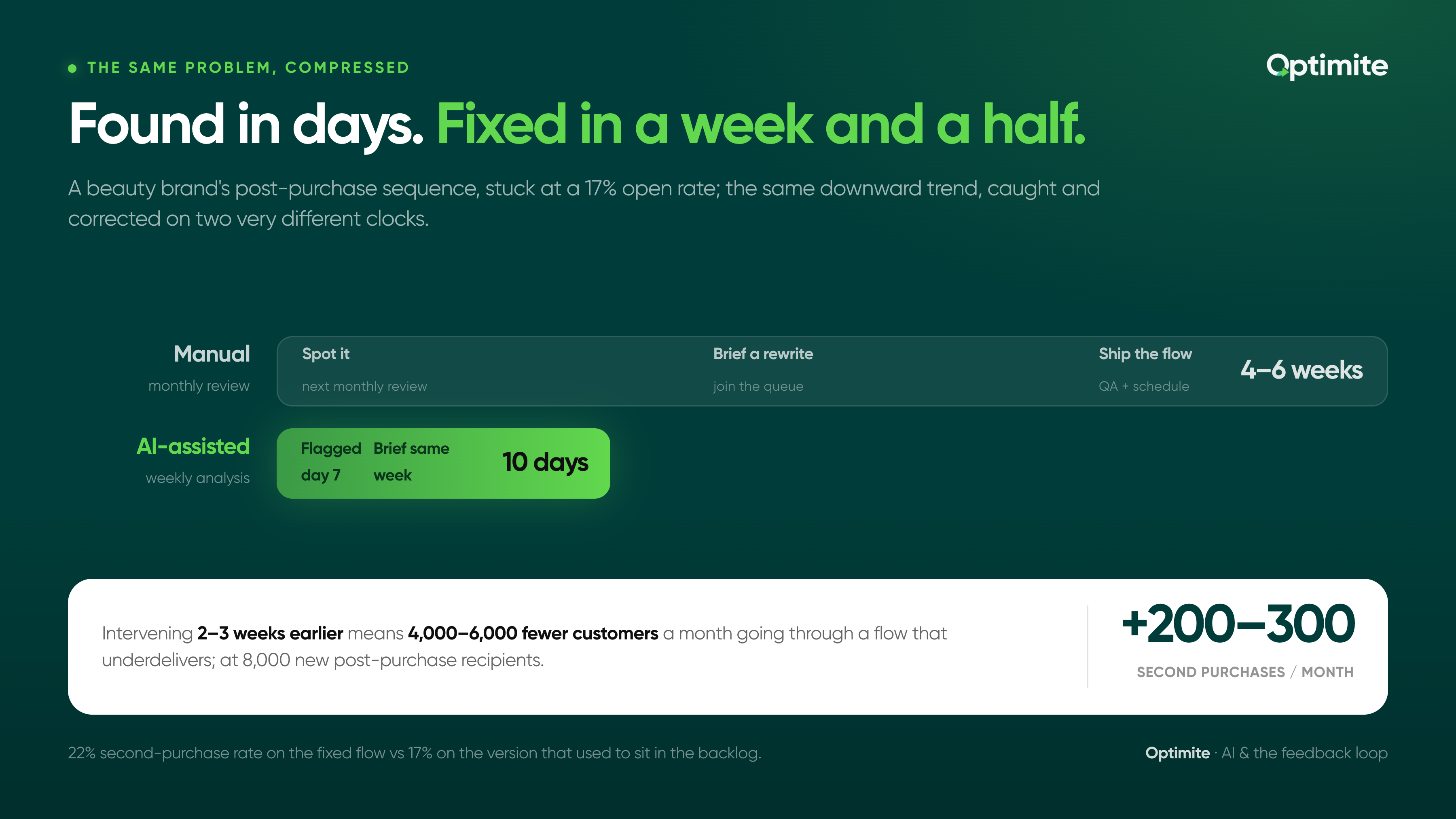
The practical impact shows up in how quickly a brand's metrics move after a change is made.
A beauty brand we work with was seeing a consistent 17% open rate on their post-purchase sequence. Manual process: review rates monthly, brief a rewrite, ship the updated flow four to six weeks after the problem was identified. By the time the fix was live, the brand had sent the underperforming email to several thousand new customers.
With AI-assisted analysis running weekly, the same problem gets flagged within seven days of the data showing a downward trend. The variant briefing happens same week. The rewrite ships within ten days of the initial flag. The brand stops sending the underperforming version two to three weeks earlier than they would have otherwise.
For a brand with 8,000 new post-purchase recipients per month, two to three weeks of earlier intervention means 4,000 to 6,000 fewer customers going through a flow that's underdelivering. On a sequence with a 22% second-purchase rate versus a 17% underperforming version, that's 200 to 300 additional second purchases per month from an optimization that used to sit in a backlog.
That's the compounding effect of a faster email marketing feedback loop. Each cycle, the brand learns faster, ships faster, and earns more from the same list.
The three feedback loops AI is compressing most
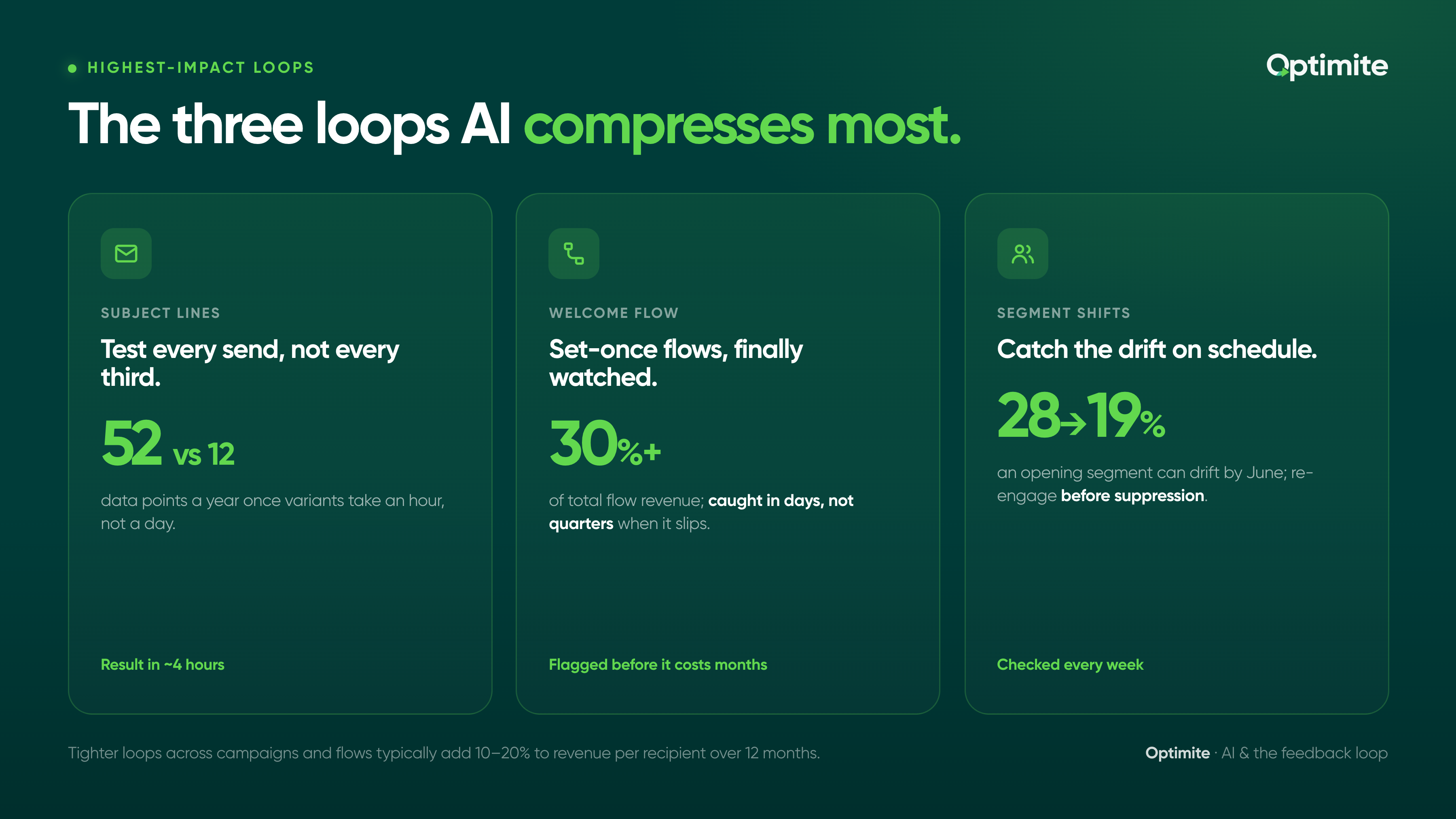
Not every part of a retention programme benefits equally from faster feedback. The highest-impact loops are the ones with the most send volume and the most room for optimization.
Campaign subject lines. This is the most immediate feedback loop in the programme. A subject line test produces a result within 4 hours of send. AI-assisted variant generation means you can run that test every campaign rather than every third one. Across 12 months of weekly campaigns, a brand running subject line tests on every send accumulates 52 data points. A brand testing once a month has 12. The difference in how well they understand their list's behaviour is structural.
Welcome flow performance. Welcome flows are the highest-revenue flow for most DTC brands, often accounting for 30% or more of total flow revenue. They're also the flow most brands set once and rarely revisit. AI-assisted monitoring flags performance drops within days rather than quarters. A welcome flow that starts degrading because of a list quality change gets caught and fixed before it costs months of revenue.
Segment behaviour shifts. Lists change. A segment that opened at 28% in January may be at 19% in June because of acquisition source changes, seasonal behaviour, or deliverability drift. Catching that shift early means re-engaging the segment before it becomes a suppression problem. Manual monitoring catches it when someone thinks to look. AI catches it on schedule, every week, without someone having to remember.
What this means for how you run your programme
The practical implication for a DTC brand doing $2M to $15M is straightforward: the brands you're competing with are compressing these loops. If your current process runs on monthly reporting, quarterly flow reviews, and ad-hoc subject line testing, you're leaving months of learning on the table every year.
The shift isn't about replacing your team or buying a new platform. Klaviyo AI features handle a significant portion of the analysis work natively, and the tools that sit on top of Klaviyo data are accessible at most budget levels. What changes is the operating rhythm. Weekly data reviews instead of monthly. Variant testing on every campaign instead of occasionally. Flow performance monitoring that flags issues before they become problems.
For a $5M wellness brand sending to 40,000 subscribers, tightening the feedback loop across campaigns and flows typically produces a 10 to 20% lift in revenue per recipient over 12 months. That's not from a single big change. That's from faster iteration, compounded across every send.
Across the 500+ ecommerce brands we work with at Optimite, the ones improving fastest share one characteristic: they act on data quickly. The DTC email optimization advantage belongs to brands that shorten the distance between knowing something and doing something about it. AI makes that shorter. The question is whether your programme is set up to use it.
If you want to see where your feedback loop is slowest and what closing it would mean for your numbers, book a free call with us and we'll walk through it with you.
Keep reading.
All posts
Claude Cowork for DTC Brands: What It Does, What Changes, and How to Start
Shrestha Ghosal · Aug 14, 2026

AI Agents in Klaviyo: What DTC Brands Need to Know
Shrestha Ghosal · Jun 24, 2026

Why AI Is Killing the A/B Test
Shrestha Ghosal · Jun 18, 2026