

Advanced Segmentation in Klaviyo Without Being a Data Scientist
Build behavioral segments in Klaviyo without SQL or a data team. Three practical tricks to increase relevance and repeat purchases.
 Arpit Mehar
Most brands segment their Klaviyo list by one thing: purchase history. They'll create a segment called "Customers" and another called "Non-customers" and call it done.
The ones growing faster are doing something different. They're segmenting by behavior. Not because they have a data scientist on staff, but because Klaviyo makes it simple if you know what to look for.
Behavioral segmentation sounds complicated. It's really just answering three questions: When did they last buy? How often do they buy? How engaged are they? String those answers together and you unlock 2-3x more relevant messaging. Better relevance means higher open rates, fewer unsubscribes, and more repeat purchases.
This post walks through three specific Klaviyo tricks that let you build sophisticated segments in under 10 minutes each. No SQL. No data science degree. Just clarity on what to look for and where to find it in Klaviyo.
Why behavioral segmentation matters
A segment is only as good as the relevance it creates. When you send the same email to your whole list, you're optimizing for the middle. The high-frequency buyers think your cadence is too slow. The inactive ones think it's too aggressive. Everyone gets annoyed.
Behavioral segments flip that. A high-frequency buyer gets different messaging than a lapsed one. A customer who only buys during sales gets flagged for promotions. Someone who hasn't engaged in 30 days goes into a re-engagement flow instead of your standard nurture.
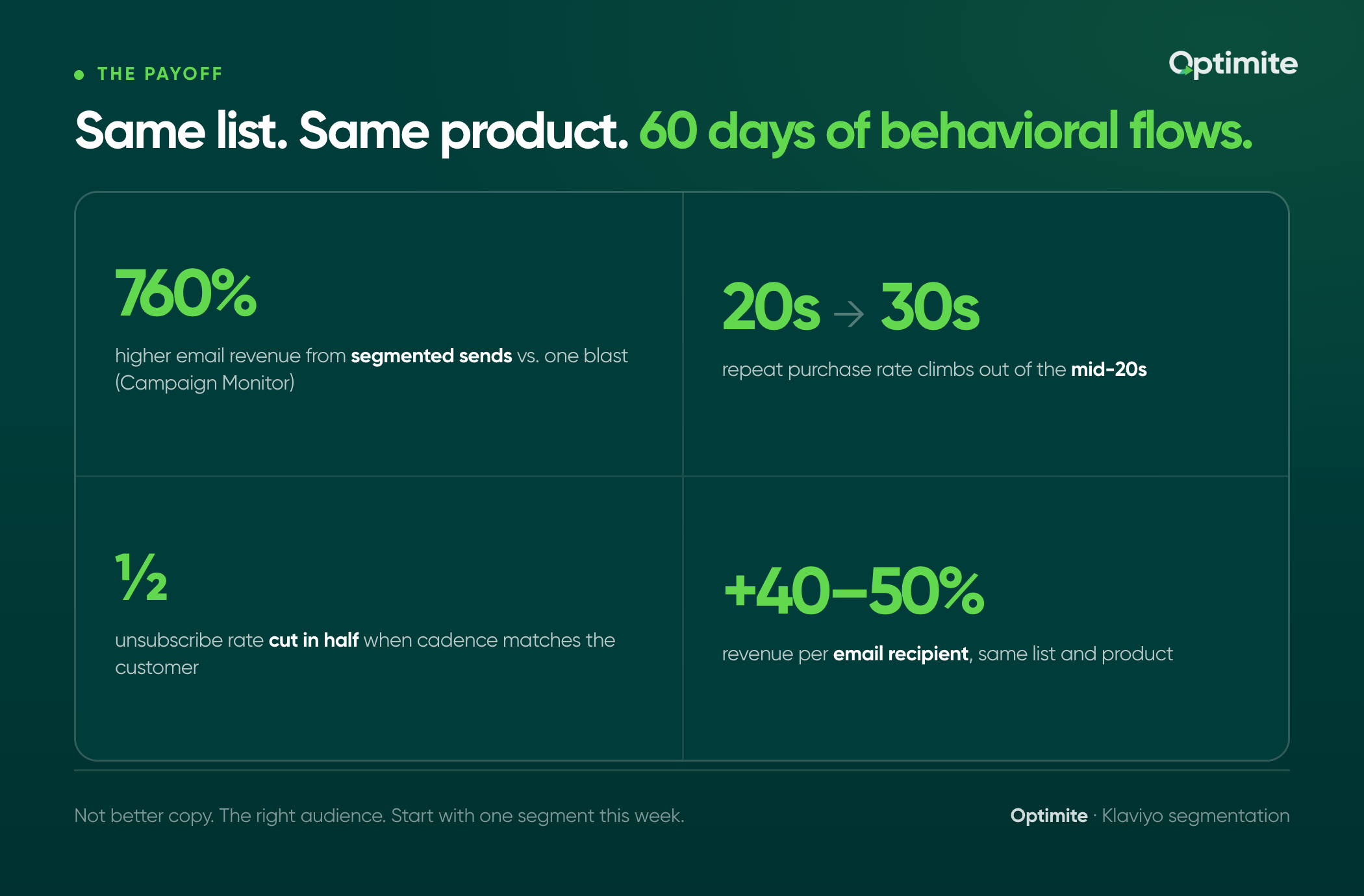
Brands using segmentation see 760% higher revenue from email versus non-segmented sends, according to Campaign Monitor benchmarks. That's not because the copy is better. It's because the audience is right.
Here's what holds most brands back: they think advanced segmentation requires a data team. They imagine complex rules stacked on top of each other, SQL queries, and integration hell. In reality, Klaviyo's interface was built exactly for this. The three tricks below take 10 minutes each to set up and run automatically forever.
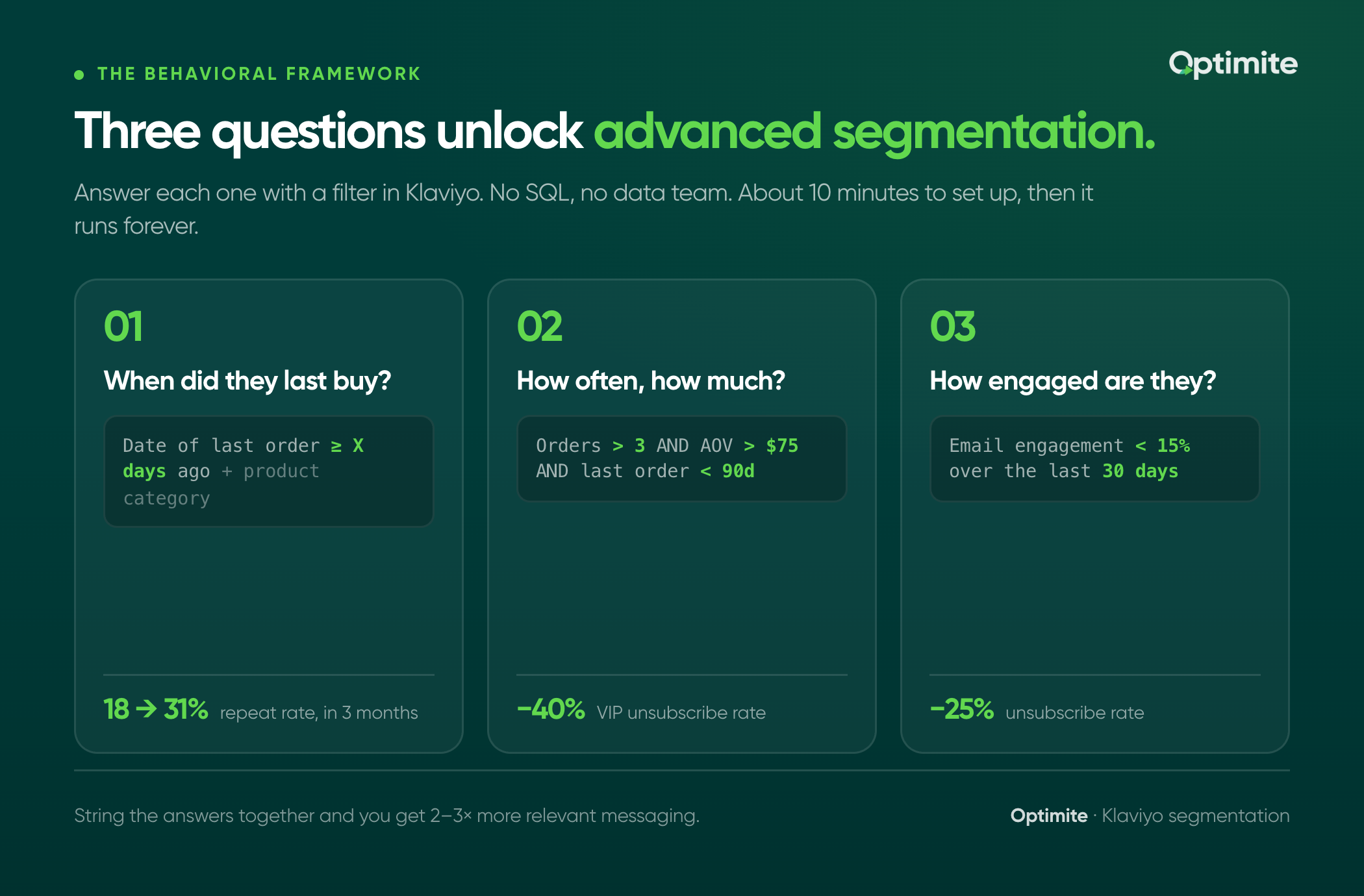
The three Klaviyo tricks that unlock advanced segmentation
Trick 1: Recency-based segments (last purchase + product category)
Recency is the single strongest predictor of future purchase behavior. A customer who bought three weeks ago is more likely to buy again than someone who bought three months ago. So the first trick is simple: segment by when they last bought, then layer in what they bought.
Here's how it works in Klaviyo:
Go to Segments > Create Segment. Add a filter: "Date of last order" is "greater than or equal to" X days ago. For a 30-day repurchase window (like a wellness brand), set this to 45-60 days. For a 90-day window (like fashion), set it to 120 days.
Now layer in a second filter with AND logic: "Product category" equals "Energy Greens" (or whatever your repeatable category is).
You've just created a segment of customers who bought from your repeatable category recently and are likely ready to repurchase. Hit save and this segment updates daily.
A wellness brand we've worked with used this to send a "Ready to restock" message to supplement buyers every 45 days. Their repeat purchase rate jumped from 18% to 31% in three months. Not because the email copy was brilliant. Because the timing was right.
Recency segments should be built around your typical repurchase window, not calendar dates. If your product has a 60-day cycle, segment for "last order more than 40 days ago" so you catch them slightly early. This gives you a 3-week window to convert before they hit day 45 and buy from a competitor.
Trick 2: Purchase frequency + average order value stacking
Some customers buy once a year. Others buy monthly. A VIP customer might spend $200 per order while a new customer averages $45. These two groups need completely different treatment.
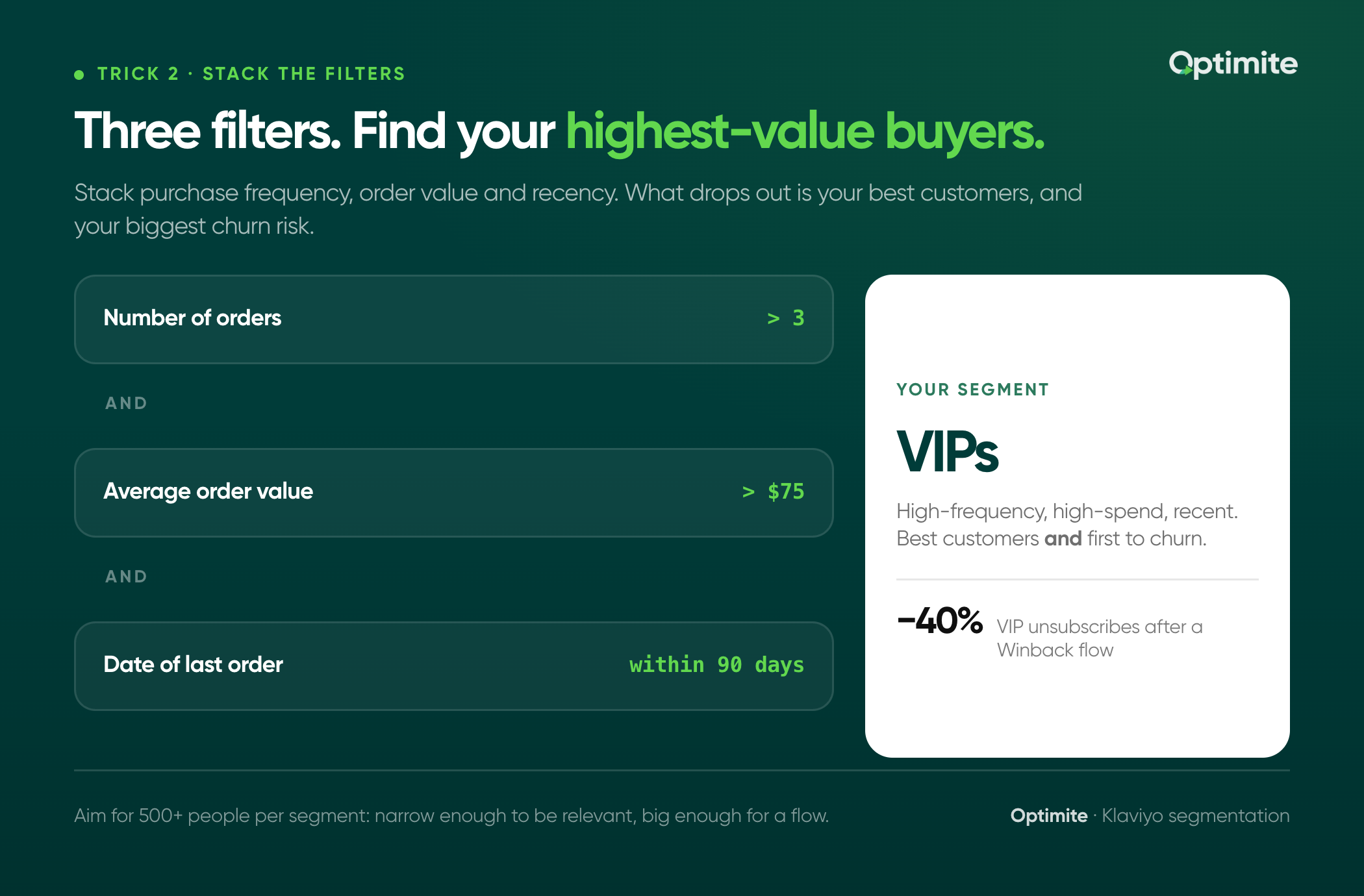
The second trick stacks purchase frequency and AOV to identify your highest-value repeaters (and your at-risk VIPs).
In Klaviyo, create a new segment with these filters combined:
- Number of orders greater than 3
- AND average order value greater than $75
- AND date of last order within the last 90 days
This pulls your high-frequency, high-spend recent buyers. These are your best customers and also your churn risk. If a VIP goes quiet for 30 days, that's an emergency. A lower-frequency customer is normal.
So what do you do with this segment? You treat them differently. They skip your standard welcome-back flow after 60 days of inactivity. They get a VIP re-engagement sequence that acknowledges their status and offers something exclusive. Early access to new products. A personal offer. A thank-you gift. Something that says "we notice you, we value you, and we want you back."
Building personalized lifecycle flows around these high-value segments is where retention systems actually make money. A beauty brand using this approach created a "VIP Winback" flow just for high-spend repeat customers. Their unsubscribe rate for VIPs dropped 40% because the messaging felt personal, not generic.
Trick 3: Engagement scoring without complexity
The third trick sounds technical but it's actually the simplest. You're just measuring how much your customers interact with your emails, then using that score to decide what to send them.
In Klaviyo, go to Segments > Create Segment. Add a filter: "Email engagement" is "less than 15%" over the last 30 days.
This pulls all your silent subscribers. People who aren't clicking, aren't opening. They're still on your list but mentally checked out.
Here's where most brands mess up: they ignore this segment or, worse, send MORE emails to re-engage them. That doesn't work. Instead, create a separate "low-engagement" segment and send them something completely different. A single, honest email asking what they want. Or move them to a much lower cadence (once per month instead of twice per week). Or a targeted re-engagement sequence.
One of our clients, a food and beverage brand, segmented for low engagement and found that 40% of their list hadn't opened an email in 60 days. They moved those people to a monthly digest format and removed them from daily sends. Unsubscribe rate dropped 25% because people weren't being hammered.
The key insight: low engagement doesn't mean disinterest. Often it means your cadence or content doesn't match their preferences. Segmenting lets you test different approaches with different groups.
Building your first behavioral segment step-by-step
Let's walk through a complete example. You're running a fashion brand with a 45-day repurchase window. You want to catch customers ready to buy again.
Step 1: Go to Segments > Create Segment. Name it "Ready to Repurchase."
Step 2: Add filter: "Date of last order" is "greater than or equal to" 45 days ago.
Step 3: Add filter (AND): "Email engagement" (opens in last 30 days) is "greater than 20%."
Step 4: Add filter (AND): "Product category" equals "Apparel" or "Footwear" (your repeatable categories).
Step 5: Check the segment count. Should be 5-20% of your list. If it's higher, your filters are too loose. If it's lower, tighten your recency window.
Step 6: Save and set to update daily.
Now push this segment into a flow. A simple three-email sequence: Day 0 reminder ("We've got new styles in"), day 4 gentle push ("See what's trending"), day 8 final touch with incentive ("20% off, this week only").
This is advanced segmentation in its entirety. It's not magic. It's just asking the right questions and letting Klaviyo do the work.
Don't over-segment. A common mistake is creating 50 micro-segments and losing track of how many flows you're managing. Start with 3-5 behavioral segments that address your biggest revenue leaks. Master those first. Add more later.
Common mistakes that tank segment relevance
Mistake 1: Setting recency windows too wide. If your repurchase window is 60 days, don't segment for "purchased in the last 90 days." That catches people who bought 85 days ago and might not be ready. Tighten it. You're looking for the sweet spot where they're ready, not three weeks away.
Mistake 2: Forgetting engagement is a component. A customer who bought recently is a good prospect. A customer who bought recently AND opens your emails is a great one. Don't ignore engagement. It's free data.
Mistake 3: Creating segments that are too specific. "Customers who bought Vitamin D in the last 45 days and opened at least one email from the Sunday digest" is data-perfect and traffic-dead. You need 500+ people in a segment for a meaningful flow. If your segment is 50 people, it's too narrow.
Mistake 4: Segmenting but not changing the message. This is the biggest one. You build a smart segment and then send the same email you'd send to everyone. That defeats the purpose. Segmentation only works if the message changes. High-frequency buyers get different subject lines, different CTAs, different offers than new customers.
Measuring impact: what changes when you segment better
How do you know if your segments are working? Track three metrics:
Conversion rate by segment. Your "ready to repurchase" segment should convert 2-3x higher than your cold segment. If they're converting at the same rate, your segmentation isn't specific enough.
Unsubscribe rate by segment. Engaged segments should have lower unsubscribe rates. If your low-engagement segment is unsubscribing at 0.5% and your high-engagement segment at 0.3%, that's normal. If both are the same, your messaging isn't changing enough.
Revenue per segment. Multiply segment size by conversion rate by average order value. Your VIP segment should be generating 30-50% of your revenue. If it's generating 10%, either your identification is wrong or your messaging isn't resonating.
Wellness brands we've worked with typically see significant lifts when they move from generic messaging to segment-based flows. We've documented these results in our case studies. After building five behavioral segments around purchase frequency, engagement, and product preference, they typically experience within 60 days:
- Repeat purchase rate climbs from mid-20s to mid-30s
- Unsubscribe rate cuts in half
- Revenue per email recipient increases 40-50%
Those results aren't anomalies. That's what happens when your messaging matches your audience.
The best part? None of this required a data scientist. One person in marketing, armed with Klaviyo and these three tricks, automated the entire system in under a week.
Start with one behavioral segment this week. Pick the lowest-hanging fruit in your business. If you're losing repeat customers, start with recency. If you have VIP churn, start with AOV-stacking. Once that segment is shipping and showing results, add the next one.
Advanced segmentation isn't a luxury. It's how you scale without hiring more people. And it doesn't require a PhD.
Ready to see how segmentation works in your Klaviyo account? Book a call with us and we will walk through your current segments and identify opportunities.


