

7 Shopify Retention Strategies Most Brands Miss in Year One
Most Shopify brands chase acquisition in year one. Here are the retention strategies that separate winners from burnout.
 Arpit Mehar
You just launched your Shopify store. You got your first customers. Now you're thinking about the next step.
Most Shopify brands spend their first year obsessed with acquisition. How do I get more traffic? How do I convert browsers into buyers? The whole focus is forward-facing: more ads, more customers, more revenue.
But here's what happens by month 12: you've spent $50K on ads and brought in 500 customers. Your repeat rate is 12%. You're spending money to replace customers instead of keeping them.
The brands that win think differently. They spend year one building the foundation for retention. Not instead of acquisition. Alongside it.
We work with Shopify brands across wellness, fashion, food and beverage, and beauty. The ones who nail year one aren't the ones with the biggest ad budget. They're the ones who understand their customer lifecycle, segment smartly, and build email and SMS systems that actually work.
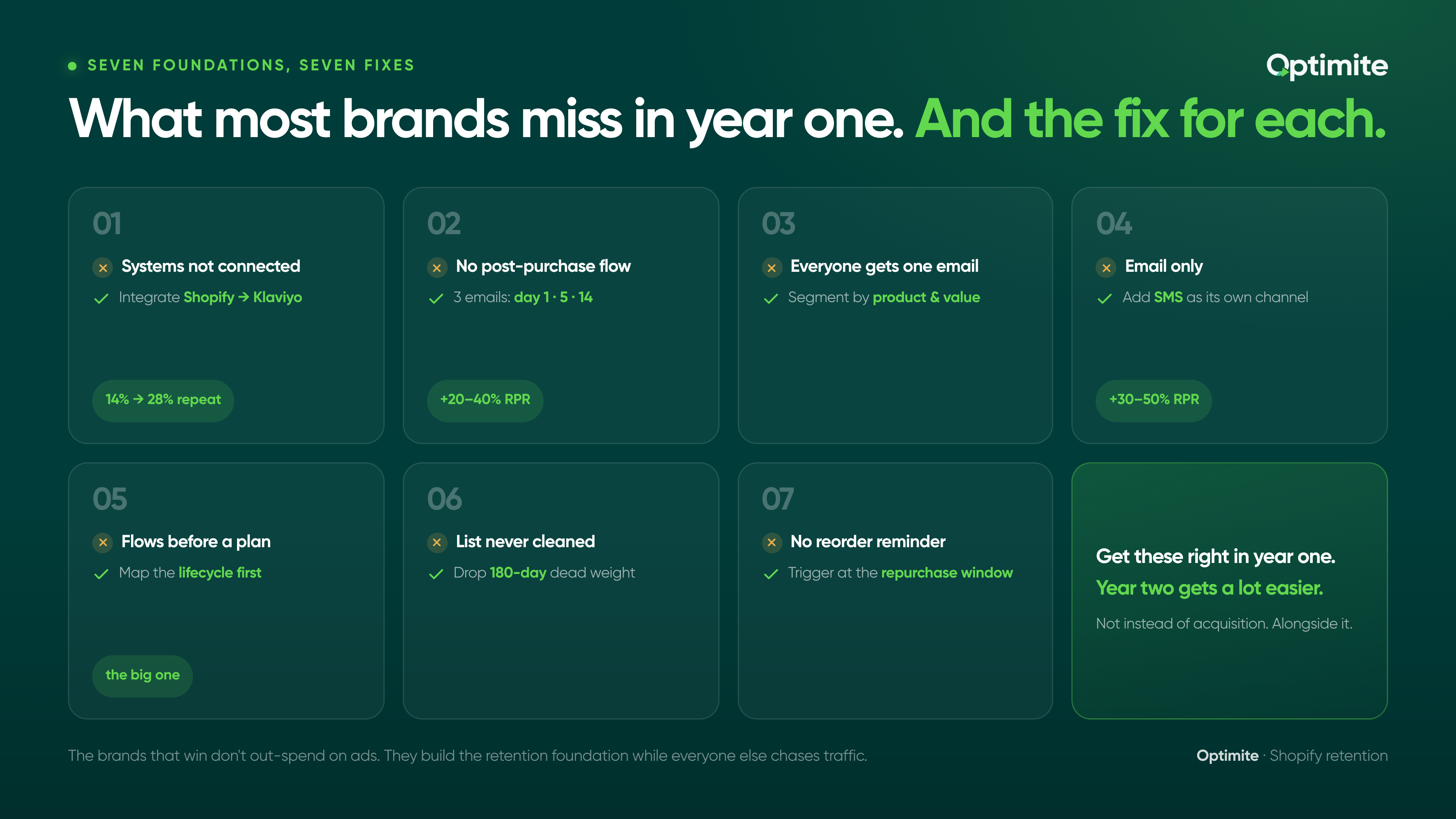
Here are seven strategies most Shopify brands miss. If you get these right in year one, year two becomes a whole lot easier.
Not connecting Shopify to your email platform properly
Your Shopify store sits in Shopify. Your email lives in Klaviyo or Mailchimp or Klaviyo. Two separate systems. No bridge between them.
So when someone buys from your store, they might not even land on your email list. Or they land on your list, but Klaviyo doesn't know who they are as a customer. No purchase history. No order data. No repeat purchase signals.
This kills segmentation before you even start.
The fix sounds technical but it's simple: integrate Shopify with your email platform properly. If you're using Klaviyo, set up the official Shopify integration. It syncs customer data, purchase history, and revenue automatically. No manual work. Now Klaviyo knows who bought what, when, and for how much. You can segment based on real customer behavior.
A fashion brand we worked with had been using Shopify for eight months with zero integration. They were sending emails to their list, but their email platform had no idea who the repeat customers were. When we connected Shopify to Klaviyo, they suddenly had access to six months of purchase data. They segmented their repeat customers into a separate list and changed the messaging completely. Repeat purchase rate went from 14% to 28% in two months just from better segmentation.
The other common mistake: setting up the integration but not configuring the field mappings. Your Shopify customer data and your email platform need to map to the same fields. Customer name, email, phone number, purchase history. If these don't align, your data gets messy. Take 30 minutes to get this right. It saves hours of cleanup later.
Skipping post-purchase automation entirely
You make a sale. You send an order confirmation. Done.
That's where most Shopify brands stop. The rest of the customer journey gets zero attention.
But days 2-14 after purchase are when customers decide if they'll buy again. They're using your product. They're forming opinions. If you're not showing up during this window with education, support, and a gentle nudge toward repeat purchase, you're leaving money on the table.
A post-purchase flow should do three things: confirm and reassure, educate and engage, and prime for repeat. That's three emails over 14 days. Not overwhelming. Just intentional.
Day 1: Thank you and shipping info. Day 5: How to use the product plus a tip. Day 14: Here's what else we make that pairs well with what you bought.
Most Shopify brands ship nothing after order confirmation. The ones that do ship post-purchase flows see 20-40% increases in repeat purchase rate because they're building momentum while the customer is still excited.
Treating all customers the same instead of segmenting by product type
Your Shopify store sells multiple things. A vitamins brand sells subscriptions, one-time supplements, and a digital course. A fashion brand sells full-price items, sale items, and bundles. A food brand sells meal kits, sauces, and merchandise.
These are completely different customer journeys. But most brands send the same emails to everyone.
A subscription customer is sticky by design. They've committed to recurring payment. Their lifecycle is completely different from someone who bought once.
A full-price buyer is different from a sale buyer. The person who paid full price on day one is probably more valuable long-term than the person who bought on a 70% discount.
You need separate segments and separate strategies for each.
Don't use one win-back flow for all lapsed customers. A customer who was subscribing monthly and suddenly stopped is a crisis. A customer who bought once and never engaged was probably never a repeat customer to begin with. Treat them differently.
Segment by product type. Segment by purchase price. Segment by purchase frequency. Then build flows that match each segment's actual behavior and value.
Ignoring SMS as a separate channel
You have an email list. You're sending email campaigns and flows. But SMS is still just a thought experiment.
Here's the thing: SMS and email are not the same channel. They have different purposes. Email is where you tell the story, educate, and build relationship. SMS is where you create urgency and drive action.
If you're not using SMS, you're missing 20-30% of your repeat purchase potential because SMS-engaged customers convert at higher rates during urgency moments like flash sales, limited inventory alerts, and reorder reminders.
Set up SMS alongside email in year one. Not instead of. Alongside. A replenishment reminder goes out via email on day 45 of the subscription cycle. SMS goes out on day 50 to customers who didn't click the email. Different message. Different purpose. Both working together.
Brands using both email and SMS see 30-50% higher repeat purchase rates than email-only brands, according to our data across 500+ clients.
Building flows before mapping your customer lifecycle
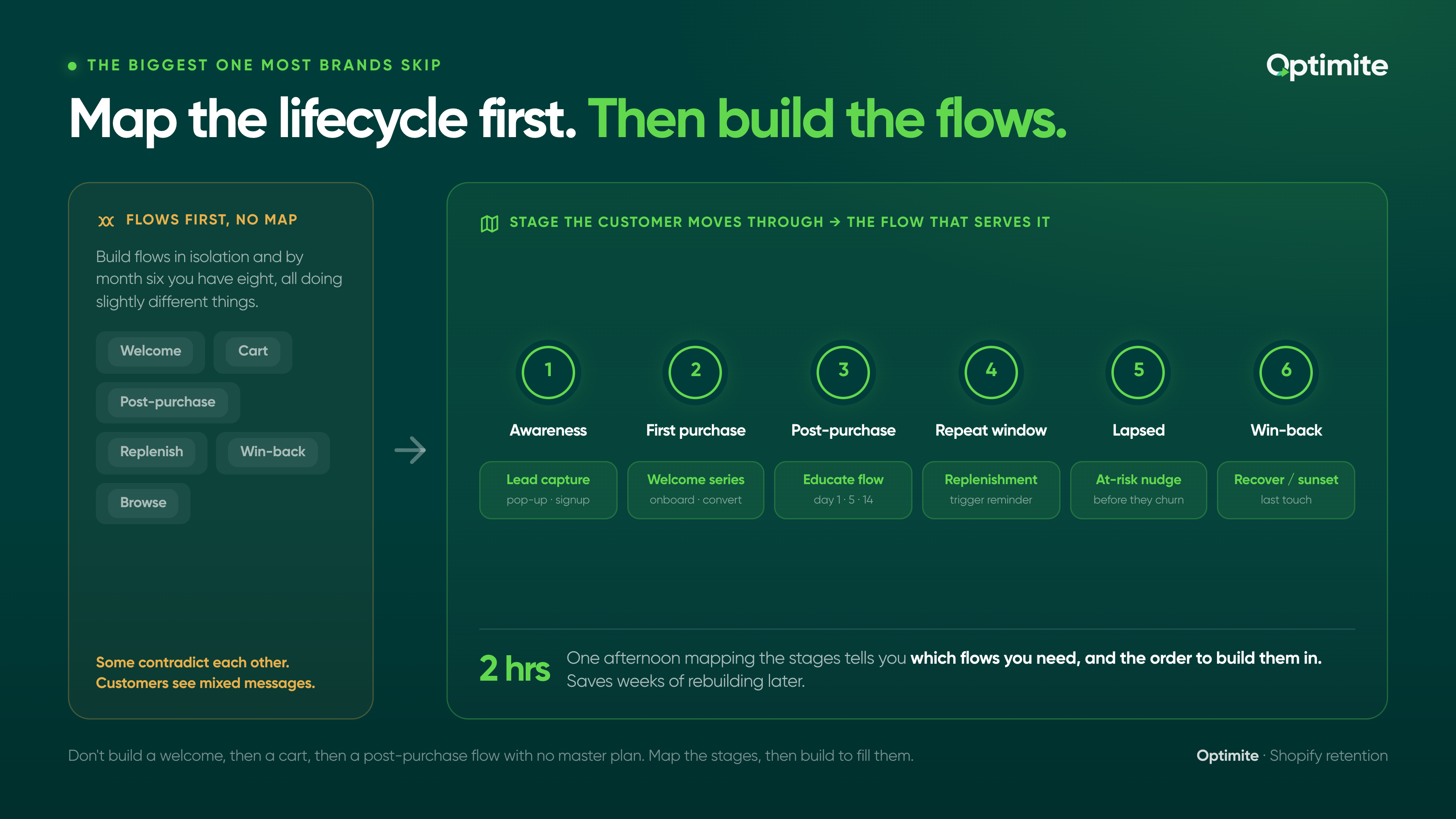
This is the biggest one.
Most Shopify brands jump straight into building flows without mapping out what their customer lifecycle actually looks like. So they build a welcome flow, then a cart abandonment flow, then a post-purchase flow, then a replenishment flow. Each one in isolation. With no master plan.
By month six, they have eight flows all doing slightly different things. Some contradict each other. Customers see mixed messages. The whole system feels disjointed.
The brands that win map their lifecycle first. They ask: What are the stages our customer moves through? When do they make decisions? Where can we influence them?
For a subscription brand, that looks like: awareness, first subscription signup, early churn risk (weeks 1-4), established subscriber, engaged subscriber, at-risk, and churned.
For a repeat purchase brand: awareness, first purchase, post-purchase experience, repeat purchase window, lapsed, and win-back.
Only after you've mapped these stages do you build flows. Now you know what you need. You know the order to build them in. You know which flows are missing and which ones are redundant.
This doesn't take long. Two hours. One afternoon. Saves weeks of rebuilding later.
Setting up email list capture but never cleaning it
You're collecting emails. Every Shopify store does. But you're not cleaning that list.
Dead emails pile up. Typos from people typing fast. Spam addresses. Bounces. After a few months, 15-20% of your list is garbage. This tanks your sender reputation. ISPs see all those bounces and assume your email is spam.
Suddenly your open rates crater. You're doing everything right on the email side. Your copy is good. Your segmentation is solid. But your emails land in spam because your sender reputation is damaged.
Set up list hygiene from day one. Remove hard bounces immediately. Every quarter, identify inactive subscribers (no opens in 180 days) and remove them. Only send to addresses you know are valid.
A smaller, cleaner list outperforms a large, dirty list every single time. This is not negotiable.
Launching without a repurchase trigger strategy
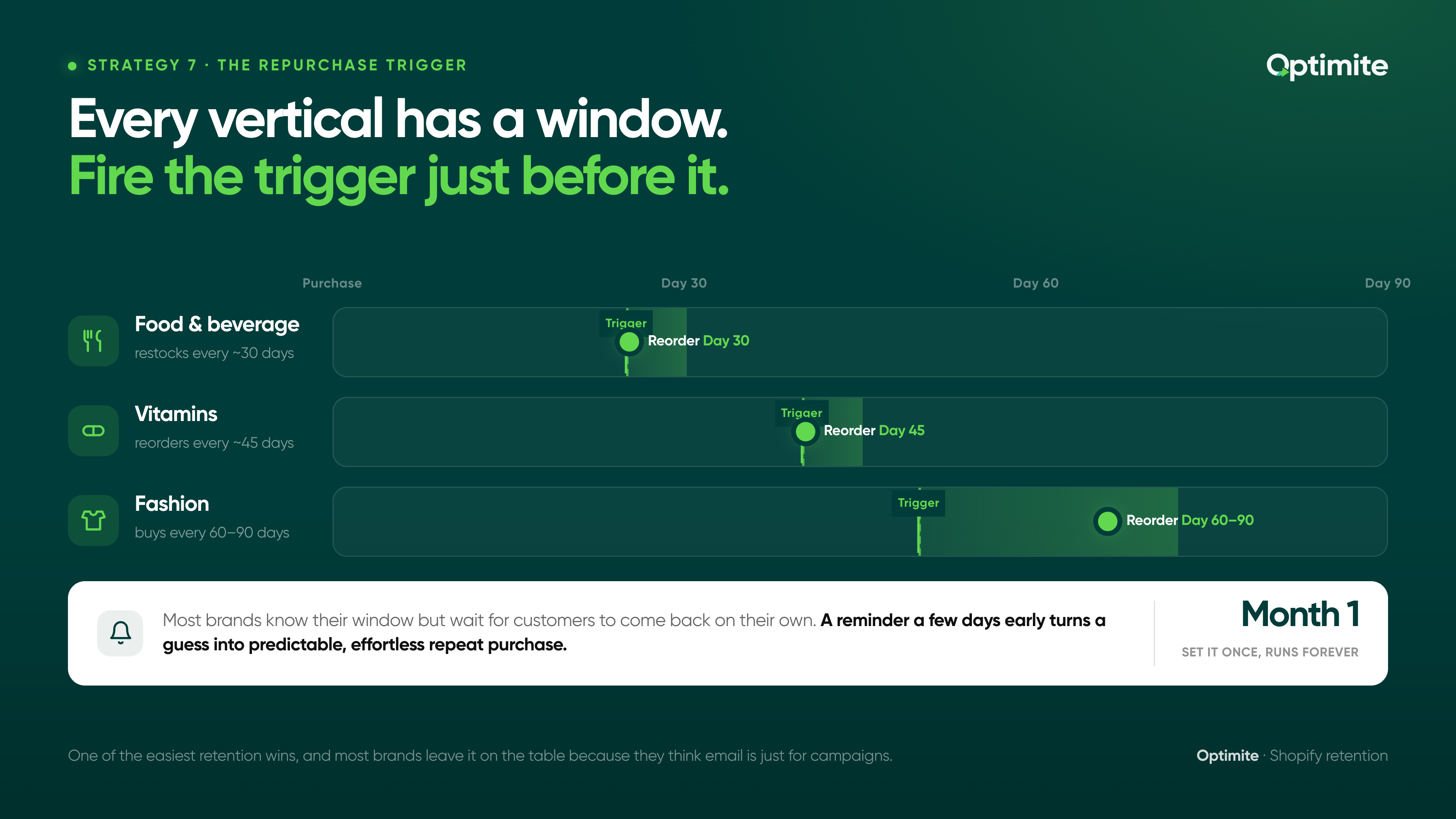
Your customer's repurchase window is predictable. A vitamin subscription customer reorders every 45 days. A fashion customer buys every 60-90 days. A food customer restocks every 30 days.
Most Shopify brands know their repurchase window but do nothing with that information. They wait for customers to come back naturally. Some do. Most don't.
The fix: set up a trigger-based reminder at the right time. A vitamin customer gets an email on day 40 of their cycle. Not spammy. Just a reminder that they're probably running low. They click. They reorder. Same customer. Predictable, effortless repeat purchase.
This is one of the easiest retention wins and most brands leave it on the table in year one because they think "email is just for campaigns."
Repurchase triggers are flows, and flows are where repeat purchase happens. Set them up in month one.
The pattern is always the same. Shopify brands that crush retention in year two mapped their lifecycle in year one. They connected their systems properly. They built flows instead of crossing their fingers. They segmented thoughtfully. They kept their list clean.
The brands struggling in year two are the ones who spent year one chasing acquisition. They have the customer base but no retention system to turn them into repeaters.
You have a choice. Spend year one building right, or year two fixing what you should have done in year one.
If you want to audit your Shopify retention setup and identify where you're missing strategy, let's talk. We work with Shopify brands at every stage of growth and we can spot the gaps fast. Check out how we've helped Shopify brands across fashion, wellness, and food and beverage build retention systems that actually work.


