

10 Retention Truths Every Shopify Brand Learns the Hard Way (From $500K to $10M)
 Anamika Kalwan
8 min read
There's a version of scaling a Shopify brand that looks great from the outside. Revenue is up, ad spend is working, the product is moving. Then someone pulls the email dashboard and the number staring back at them is 8% of total revenue. The benchmark is 25 to 30%.
That gap exists at almost every stage of growth. The shape of it changes, the cause of it changes, but the gap keeps showing up. After six years of building retention programmes for 500+ brands, the patterns are consistent enough to map. Here's what Shopify brands learn at each stage, usually after it's already cost them something.
At $500K, your acquisition engine is lying to you about growth
When paid social is working and revenue is climbing, it's easy to read that as proof the business is healthy. But acquisition growth and retention health are two completely different signals, and at $500K most brands are only measuring one of them.
The question to ask at this stage: what percentage of last month's revenue came from customers who had already bought before? For most brands at $500K, that number is below 20%. The acquisition channel is doing all the work, and the margin pressure that comes with it is already building.
Repeat customers spend 67% more per order than first-time buyers on average, according to Bain & Company. A brand doing $500K with a 15% repeat purchase rate has a very different business than one doing $500K with a 35% repeat rate.
The fix at this stage is not a complex retention stack. It's visibility. Pull your repeat purchase rate, your average order value by customer cohort, and your email revenue share. Those three numbers tell you whether you have a retention problem or a retention opportunity.
Your first retention hire is not a person, it's a welcome flow
At $500K, you don't need a retention team. You need one flow built properly.
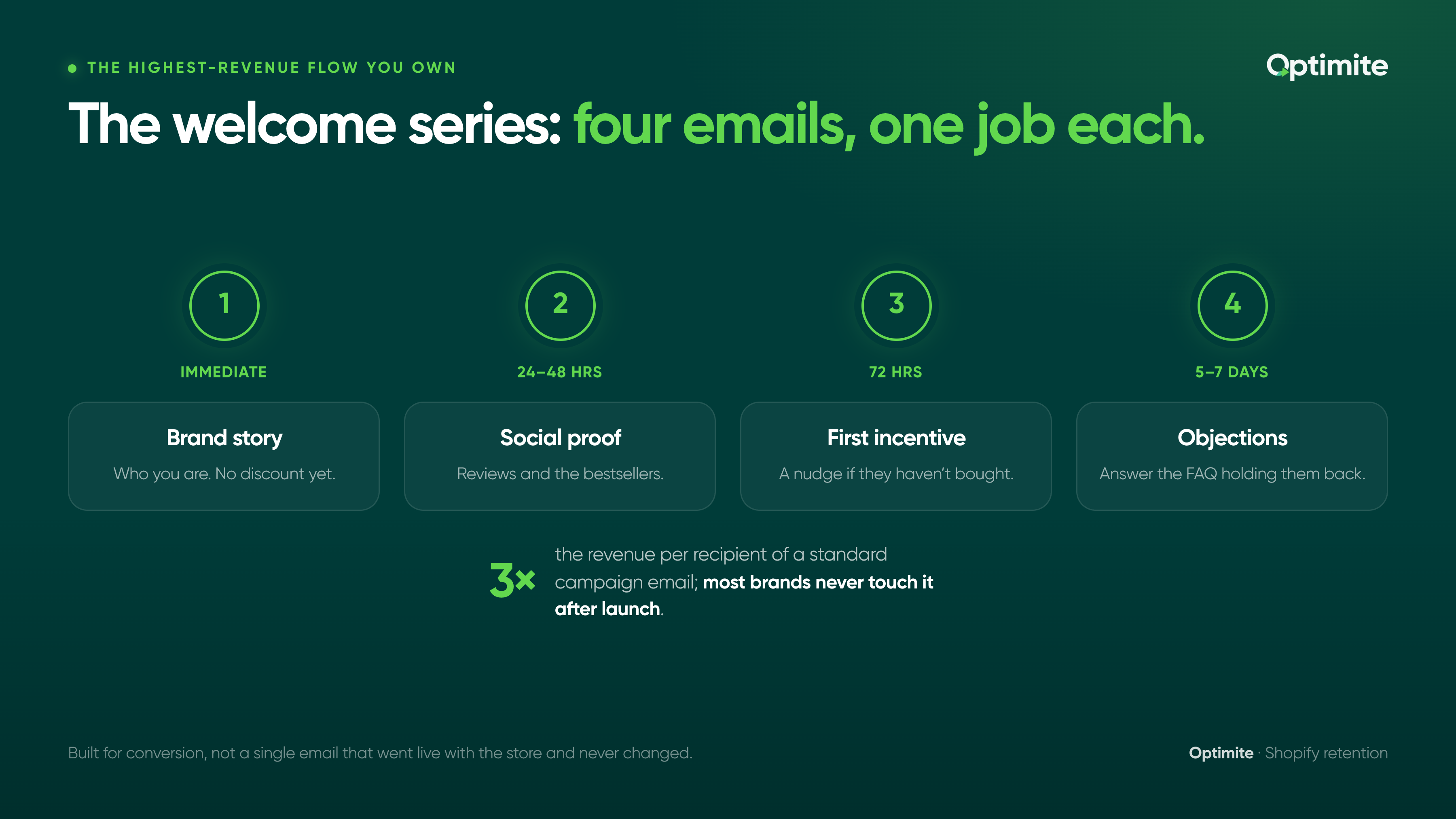
The welcome series is the single highest-revenue automated sequence for most DTC brands. Klaviyo's own benchmark data shows welcome flows generate 3x the revenue per recipient of standard campaign emails. And yet the majority of Shopify brands at this stage either have no welcome flow, or have a single email that went live when the store launched and has never been touched.
A welcome flow built for conversion at this stage looks like:
- Email 1: immediate, brand story, no discount yet
- Email 2: 24-48 hours later, social proof and bestsellers
- Email 3: 72 hours later, incentive for first purchase if not yet converted
- Email 4: 5-7 days later, objection handling or FAQ
That's it. Four emails, one job each. This is the foundation your lifecycle flows are built on. Get it right before building anything else.
At $1M, one automated flow is not a retention programme
Crossing $1M is the moment most founders feel like retention is handled. They have a welcome flow, maybe an abandoned cart sequence. Revenue from email is ticking along. The problem is that "ticking along" at $1M usually means 8 to 12% of revenue. The top quartile of brands at this size generate 28 to 35%.
The gap between those two numbers is almost always explained by what happens after the first purchase. The welcome flow catches pre-purchase subscribers. The cart flow catches abandoners. But the post-purchase window, the 72 hours after someone buys for the first time, often has nothing in it.
At $1M, the retention programme needs:
- A working welcome flow (built properly, not just live)
- An abandoned cart sequence (3 emails minimum)
- A post-purchase flow that starts the relationship, not just confirms the order
- A basic win-back for customers who haven't bought in 90 days
These four lifecycle flows are the minimum viable retention stack. Everything else is optimisation.
The post-purchase window is the most valuable 72 hours you're not using
Most Shopify brands treat the post-purchase email as an order confirmation. Name, address, items ordered, expected delivery. Done.
That's a missed opportunity. Post-purchase emails see open rates 2 to 3x higher than standard campaign emails, because the customer just bought something and they're paying attention. That attention window is narrow and it closes fast.
The job of your post-purchase flow is not to confirm the order. The order confirmation does that. The flow's job is to make the customer feel like they bought from the right brand, reduce post-purchase anxiety, and plant the seed for the next purchase before the first one arrives.
A post-purchase flow for a wellness brand doing $2M looks different from one for a fashion brand at $8M. The repurchase window is different, the product involvement is different, the emotional state of the customer is different. But both need more than a shipping notification.
Segmentation at $2M looks nothing like segmentation at $5M
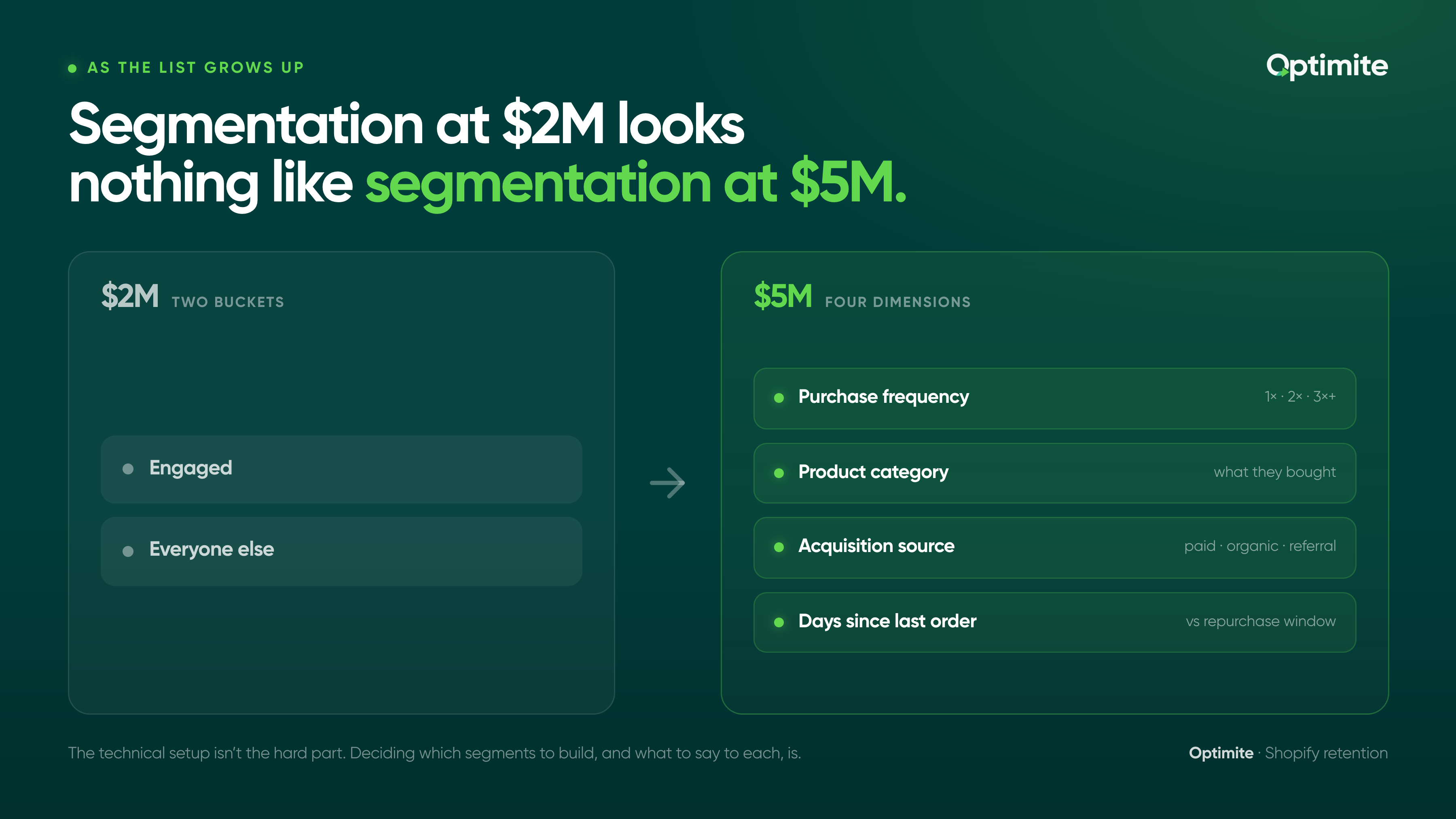
At $2M, segmentation usually means splitting the list into "engaged" and "everyone else." That's a start. It protects deliverability, keeps open rates healthy, and stops you mailing cold contacts who drag your sender reputation down.
But by $5M, the list has grown, the customer base is more diverse, and the single engaged/unengaged split starts leaving money behind. At this stage, the brands generating the most from Klaviyo email marketing are segmenting by:
- Purchase frequency (one-time vs. two-time vs. three-plus buyers)
- Product category purchased (especially relevant for beauty, wellness, and home brands with wide catalogues)
- Acquisition source (paid social buyers behave differently from organic or referral buyers)
- Days since last purchase relative to the average repurchase window
This is where Klaviyo's segmentation logic starts to earn its keep. The technical setup is not complicated. The strategic decision of which segments to build and what to say to each one is where most brands stall.
BFCM will inflate your list and wreck it if you have no plan for January
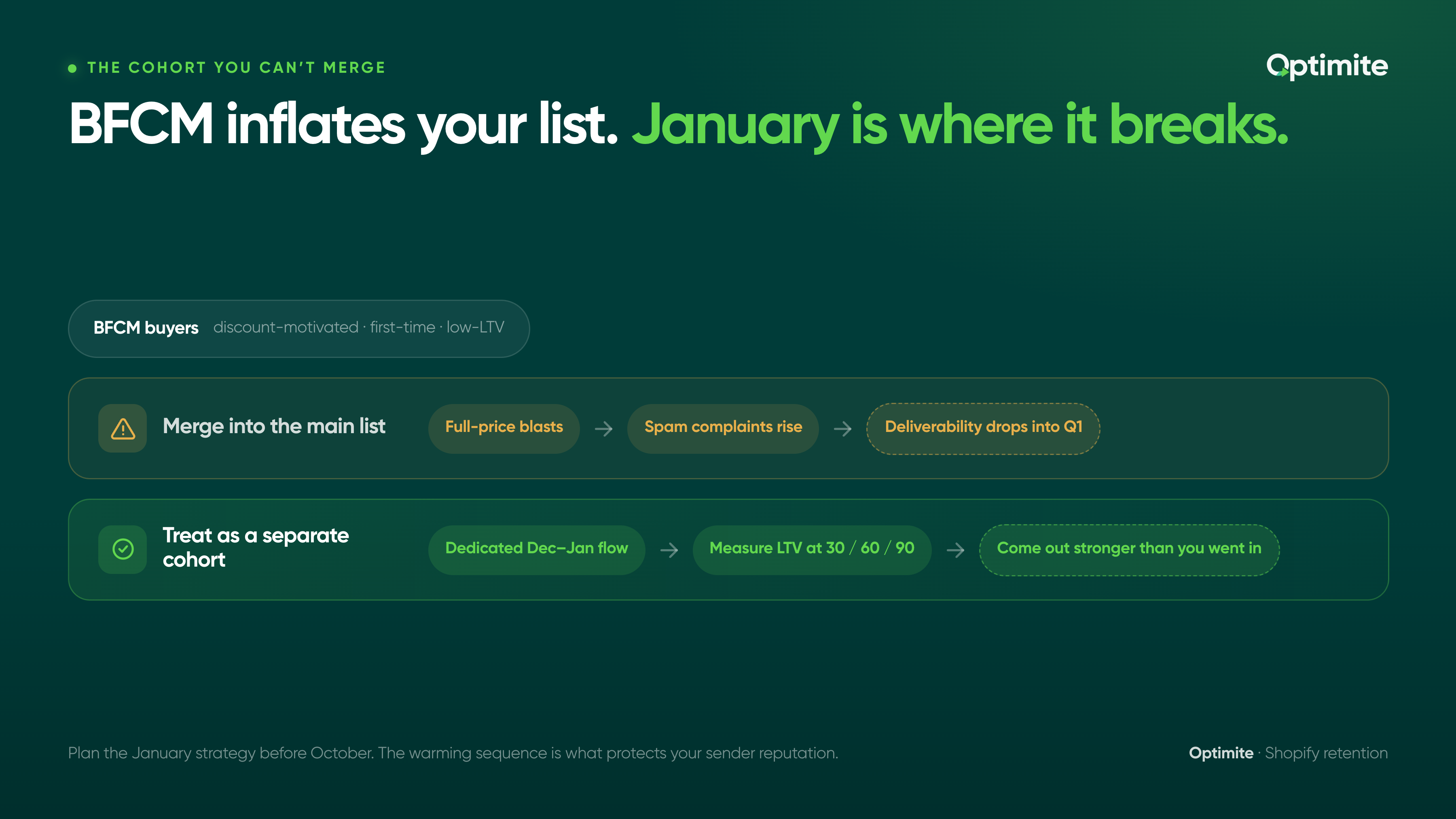
Black Friday brings in buyers. A lot of them. Discount-motivated, first-time, low-LTV buyers who signed up for 20% off and have no particular attachment to your brand.
The brands that win retention after BFCM treat those buyers as a separate cohort, not as an extension of their main list. They have a dedicated post-BFCM flow that runs through December and into January. They don't blast that cohort with full-price campaigns at the same cadence as their loyal customers. And they measure BFCM buyer LTV at 30, 60, and 90 days to understand what that cohort is actually worth.
Merging BFCM buyers into your main engaged segment without a warming sequence is one of the fastest ways to damage your sender reputation. Open rates drop, spam complaints rise, and deliverability problems follow into Q1 when you need your list to perform.
The brands that come out of BFCM in a better position than they went in are the ones who planned the January strategy before October.
At $3M, email revenue share becomes a board conversation
Something shifts around $3M. Revenue is significant enough that the percentage coming from owned channels starts to matter on the P&L. If email is generating 10% of revenue and the benchmark for a brand at this size is 28 to 30%, that gap is worth quantifying.
For a brand doing $3M, the difference between 10% email revenue share and 28% is roughly $540,000 per year. A $540,000 gap belongs in a board conversation or a budget review.
The brands crossing $3M that take retention seriously at this point typically share a few things in common:
- They've moved from campaign-only sending to a full flow infrastructure
- They've invested in Klaviyo segmentation beyond basic engagement splits
- They treat email and SMS as a combined system, not separate channels
- They're measuring revenue per recipient, not just open rates
If your board is asking about retention and you don't have a retention programme built, that conversation is going to keep happening.
SMS is not a backup channel, and brands that treat it as one prove it with their unsubscribe rates
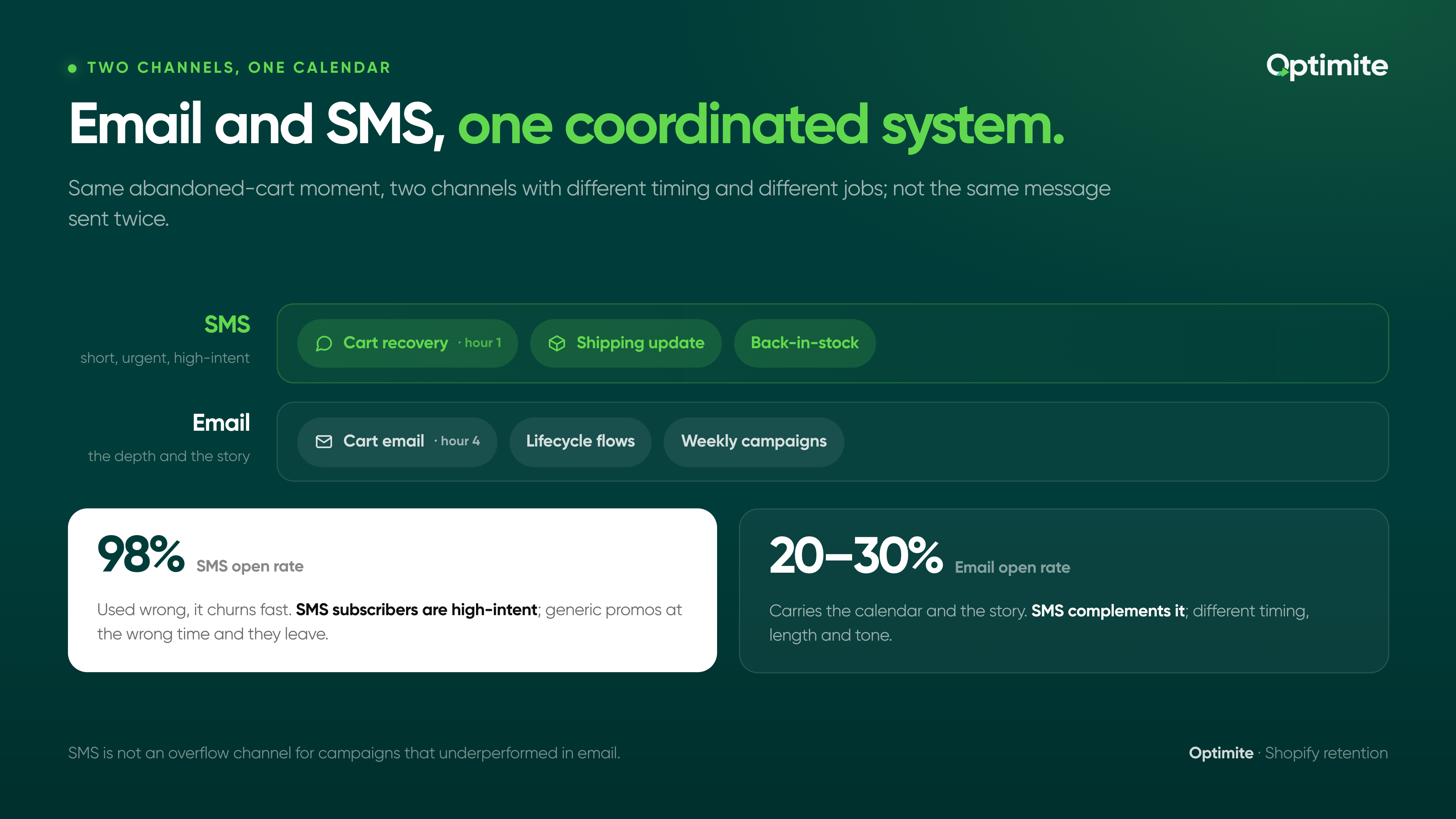
SMS open rates average 98% compared to 20 to 30% for email. That number gets cited a lot. What gets cited less often is the unsubscribe rate when SMS is used wrong.
The brands that treat SMS as an overflow channel for campaigns that didn't perform well in email see unsubscribe rates that damage their list faster than almost any other mistake. SMS subscribers are high-intent. They opted in knowing they'd get texts. When those texts are generic promotions at the wrong time, they leave and they don't come back.
SMS used well in a Shopify retention programme looks like:
- Abandoned cart recovery (SMS at hour 1, email at hour 4)
- Post-purchase shipping and delivery updates
- Back-in-stock alerts for products the customer has shown intent on
- Loyalty tier milestone notifications
- Time-sensitive offers with a genuine reason for urgency
The SMS strategy should complement the email calendar, not duplicate it. Different timing, different message length, different tone.
The retention stack that got you to $5M is the exact thing slowing you to $10M
This is the one most founders resist hearing. The flows are live, the campaigns are going out, email is generating 22% of revenue. Things are working. Why would you rebuild something that works?
Because at $10M, the list is bigger, the customer segments are more complex, the repurchase patterns are clearer, and the margin pressure from acquisition is real. The retention programme generating 22% of revenue at $5M could be generating 32% at $10M if it was built for the scale you're at now, not the scale you were at three years ago.
The specific things that break between $5M and $10M:
- Welcome flows built for small lists that are now mailing 50,000 subscribers with the same single path
- Segmentation logic that made sense at $2M but hasn't been updated since
- Post-purchase flows with one track, regardless of what was purchased or which customer bought it
- No loyalty or retention programme for the top 10% of customers who are generating 40%+ of revenue
Growth exposes the gaps. The brands that cross $10M cleanly usually rebuilt their retention infrastructure at $5M, not after.
At $10M, retention is infrastructure, and you either built it or you're rebuilding it
There's no $10M Shopify brand that doesn't have a retention programme. But there's a significant difference between a brand with retention bolted on and a brand with retention built in.
Bolted-on retention looks like flows that were set up in year one and haven't changed, campaigns sent on a loose calendar with no strategic arc, and an SMS list that grows and churns without a clear purpose. Revenue from email exists. It just isn't growing proportionally with the business.
Built-in retention looks like:
- A full lifecycle infrastructure covering welcome, cart, post-purchase, win-back, and replenishment
- Segmentation that reflects how customers actually behave, not just when they last opened an email
- Email and SMS working as a coordinated system with clear roles for each channel
- A loyalty programme that rewards the customers worth retaining
- Monthly performance reviews that flag which flows are underperforming before they become a problem
At $10M, the cost of not having this built is measurable. If you're generating $1M from email at this size, the brands with a properly built retention programme are typically generating $2.5M to $3M. That's a gap worth closing.
If you want to see where your retention programme sits against what's possible at your revenue stage, a free retention audit is the fastest way to find out. No pitch, just a clear read on what's working and what's costing you.
Keep reading.
All posts
What to Do With First-Time BFCM Buyers Before They Go Cold
Shrestha Ghosal · Jun 16, 2026

5 Signs Your Post-Purchase Flow Is Leaving Repeat Revenue on the Table
Shrestha Ghosal · Jun 10, 2026

What Buyer's Anxiety Is Costing Your Retention Rate
Shrestha Ghosal · Jun 8, 2026