

Win-Back Triage: When to Fight for a Lapsed Customer
Strategic triage framework for deciding which lapsed customers are worth fighting for and which to let go.
 Arpit Mehar

You notice a customer hasn't bought in 90 days. They're in your lapsed segment. You want to win them back. So you fire up a win-back flow. Three emails. A special offer. A heartfelt message about why you miss them.
You might be wasting your money.
Not all churn is created equal. Some customers are worth fighting for. Some have already mentally left and throwing more emails at them is just noise. Some will never be profitable to win back even if you succeed.
Most brands don't think about this. They see a lapsed customer and treat it as a problem to solve. They build a generic win-back flow and send it to everyone. They hope something sticks.
The brands that win are more strategic. They triage. They ask: is this customer worth trying to recover? Or should we let them go and focus energy elsewhere?
This post walks through how to think about win-back strategy. Not as "how do we email them" but as "which customers should we even try?"
Not all churn is worth fighting
Let's get uncomfortable with a truth: some of your customers should churn.
You have customers who buy once, never engage, and are expensive to serve. They cost more to support than they generate in profit. If they churn, you're actually better off. Your customer base becomes higher quality. Your support costs drop. Your repeat rate improves.
Understanding which customers should be in your business and which shouldn't is fundamental to retention strategy. The goal isn't to keep everyone. The goal is to keep the right customers.
If you win those marginal customers back, you've made your business worse.
Most brands don't see it this way. They see churn as a failure. They're determined to fix it. But churn is information. It tells you which customers are a good fit for your business and which aren't.
A fashion brand we work with had a 28% repeat rate. They wanted to improve it. So they built win-back flows for lapsed customers. It worked. They moved the repeat rate to 32%. But they also moved their average customer lifetime value from $340 to $310. The customers they won back were cheaper and less sticky than their core base. They'd contaminated their repeat customer pool.
Here's the reframe: some churn is healthy. You want to keep the customers who fit your business and let the ones who don't slip away. Your job is to figure out which is which.
The triage framework: three types of lapsed customers
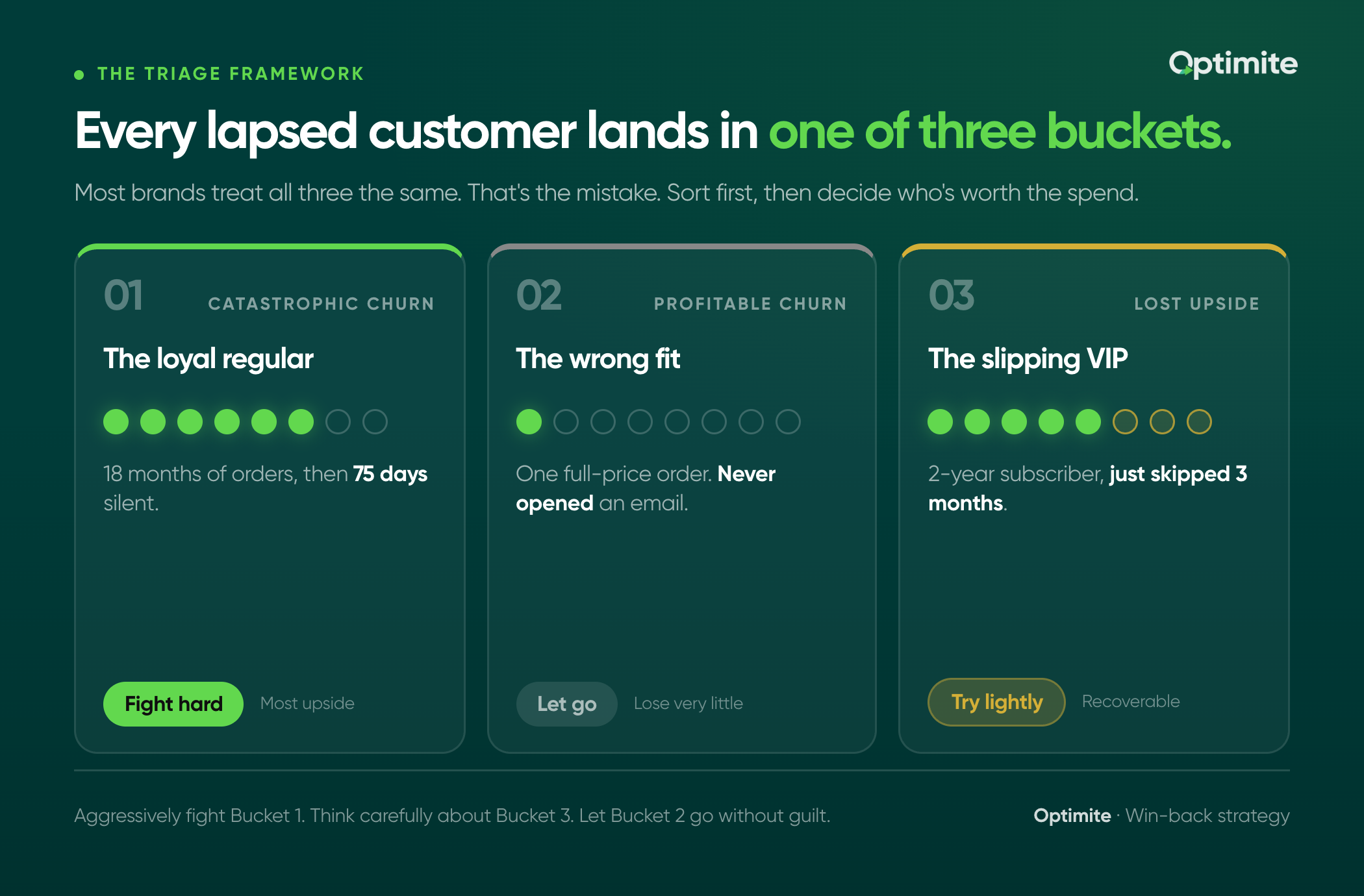
When someone stops buying, they fall into one of three buckets:
Bucket 1: Valuable customers who temporarily stopped These are your high-LTV repeat buyers who've had a gap in purchases. Maybe they got busy. Maybe your product isn't in their current rotation. But they've proven they're valuable to you. They bought multiple times. They had high AOV. They engaged with your emails. If they come back, they'll be worth a lot.
Example: A customer who buys from your supplement brand every 45 days for 18 months, then goes silent for 75 days. That 30-day gap is unusual for them. They've proven they're sticky. They're worth fighting for.
Bucket 2: Marginal customers who weren't a good fit These are one or two-time buyers with low AOV and no engagement signals. They bought because your ad was good, not because they love your product. They weren't going to be repeat customers anyway. If they churn, you've lost very little.
Example: A customer who bought once from your fashion brand at full price. Never opened your emails. Never came back. Now it's been 120 days. That customer was probably never going to repeat. Winning them back means spending money to acquire a customer who's already proven they're not loyal.
Bucket 3: At-risk valuable customers These are high-value customers who are showing churn signals. They used to engage. They used to buy frequently. Now they've gone quiet. Something changed. Maybe they found a competitor. Maybe your product doesn't work for them anymore. Maybe they just need a reminder. These customers are hardest to predict, but they have the most upside if you win them back.
Example: A customer who subscribed to your vitamin service for two years, then skipped months 24-26. That skip is new behavior. They're at risk. Figuring out why they skipped and addressing it could re-activate them.
Most brands treat all three buckets the same. That's the mistake.
Profitable churn vs. catastrophic churn
Here's the frame that actually matters: is the churn hurting your unit economics?
When a Bucket 2 customer (marginal, low-value) churns, your business gets better. You have fewer low-value customers dragging down your metrics. Your repeat rate might even improve because the denominator got smaller and more selective.
When a Bucket 1 customer (valuable repeat buyer) churns, your business gets worse. You've lost high-LTV revenue. You've lost a predictable repeat customer. That's catastrophic.
When a Bucket 3 customer (at-risk valuable) churns, you're losing upside. But you might recover it.
Your win-back strategy should reflect this. You should aggressively fight for Bucket 1. You should think carefully about Bucket 3. You should let Bucket 2 go without guilt.
Most brands are backwards. They spend the same effort on all three. That's resource waste.
How to identify which customers to win back
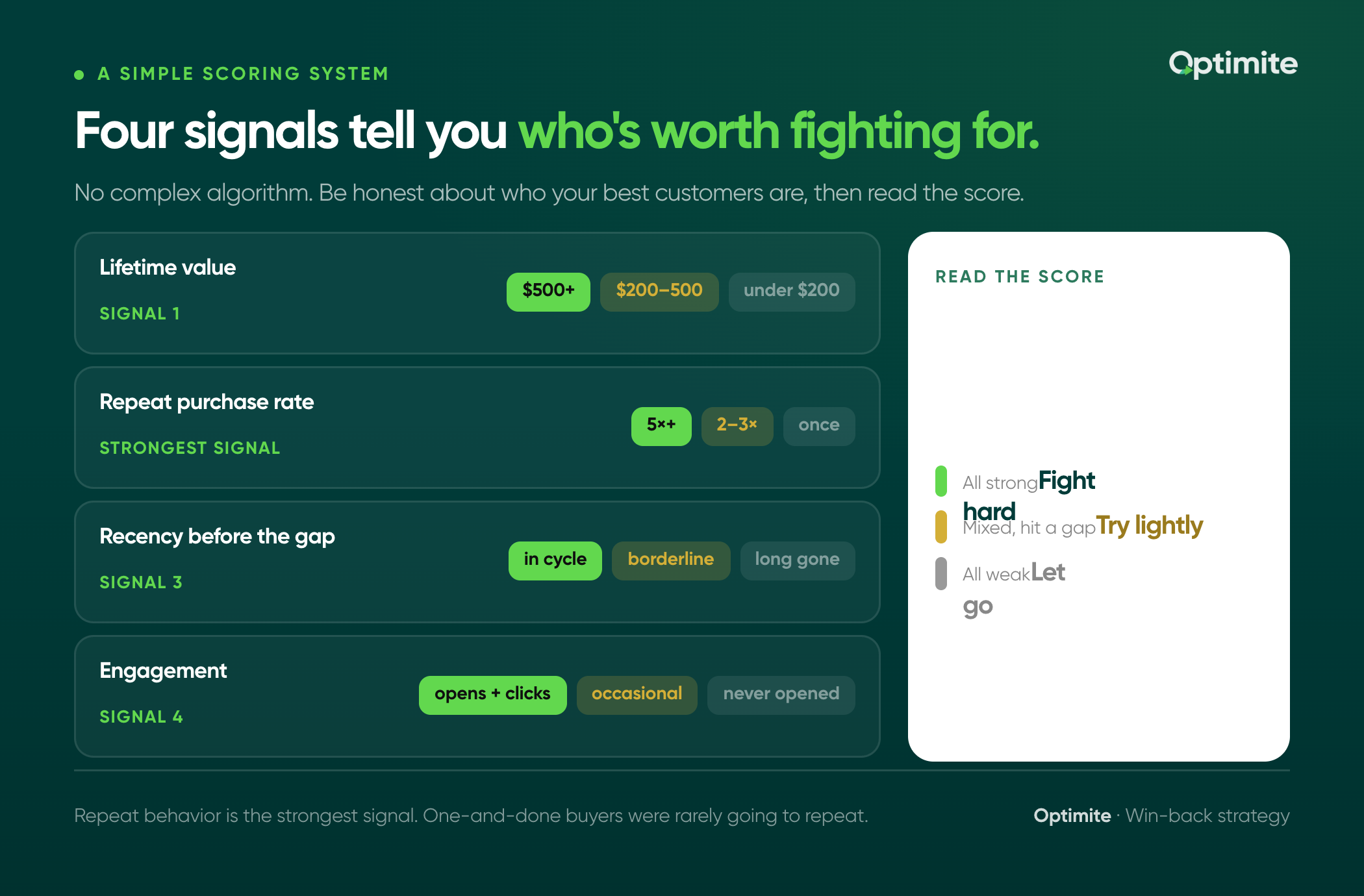
You need a simple scoring system. Not complicated. Just a few data points that tell you whether someone is worth fighting for.
Signal 1: Lifetime value before churn Did they spend $500+ total? $200-500? Under $200? Customers with higher LTV are worth more to win back. That's obvious, but most brands don't calculate it. You need to know what each customer has spent over their relationship with you.
Signal 2: Repeat purchase rate Did they buy once? Twice? Five times? Customers who showed repeat behavior are more likely to repeat again. Those who bought once and disappeared were probably never going to be repeaters. This is the strongest signal.
Signal 3: Recency before the gap When was their last purchase before they went silent? If they bought 60 days ago and you're now at 120 days, that's concerning but maybe just a cycle. If they bought 400 days ago and went silent, they were already on their way out. Customers in your recent repeat cycle are worth saving. Old customers are already leaving.
Signal 4: Engagement signals Did they open emails? Click? Read? Customers who engaged with your communications are more likely to re-engage. Customers who never opened a single email won't magically start now.
Put these together into a simple score:
Valuable high-repeat customer who went silent during their normal cycle and was engaged = Bucket 1. Fight hard.
One-time buyer, low spend, no engagement, long time since purchase = Bucket 2. Let go.
Two or three-time repeat buyer, decent spend, used to be engaged, hit a gap = Bucket 3. Try something, but don't over-invest.
You don't need a complex algorithm. You need to be honest about who your best customers are and whether you're actually fighting for them.
When to let go and move on
This is the hard part. You need permission to stop trying.
A customer who bought once three years ago and never engaged is gone. Stop emailing them. You're wasting money and list real estate. They won't respond. And if they do, they're probably not a good customer anyway.
A customer whose LTV was $45 and you're considering spending $20 to win back is a bad deal. You'd need to win them back twice for it to pay off. Unlikely.
A customer who left your category entirely (they bought supplements but now only buy skincare) might just not be your customer anymore. Let them be someone else's customer.
The hard truth: you'll never win back everyone. And you shouldn't try. The customers you let go are the ones who were already leaving. Accepting that is strategic.
The economics of win-back campaigns
A good win-back campaign costs you money upfront. You're spending on emails, SMS, offer discounts. You want a clear payback.
A typical win-back sequence costs maybe $3-5 per customer to deploy (email platform costs, labor, offer discount). You want to win back at least 2-5% of people you attempt. That's a 15-30% conversion rate on people you attempt (if only 20% of lapsed open your emails and 25% of those convert, that's 5%).
If you win someone back at $3 cost and they spend $50, you're making $47. That's a solid payback. But that only works if you're targeting valuable customers in the first place. If you're targeting $30 lifetime value customers, your payback disappears.
This is why triage matters. You're not trying to win back everyone. You're trying to win back the customers where the math works.
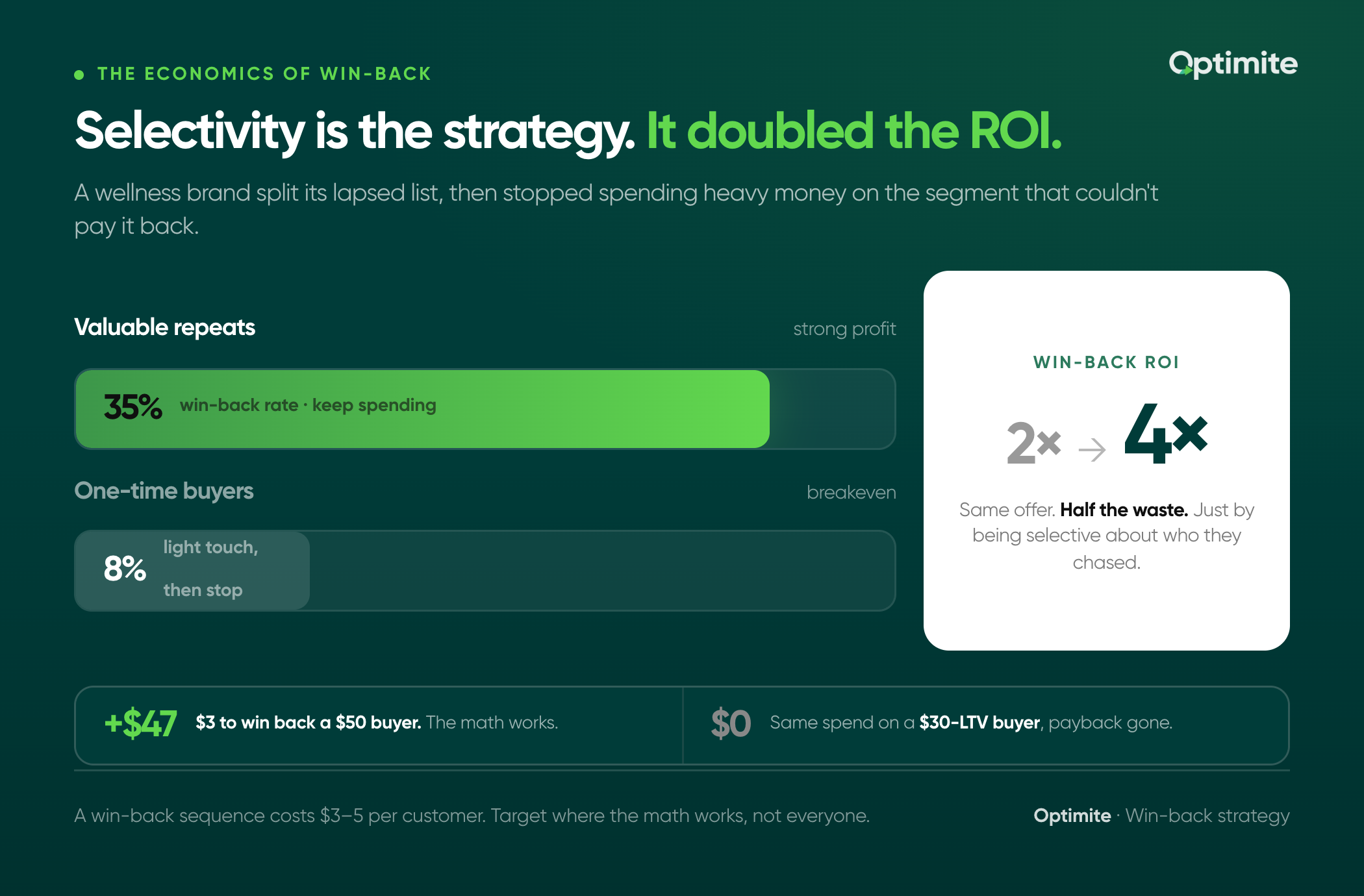
A wellness brand we work with segmented their lapsed list into "valuable repeats" and "one-time buyers." They sent the same win-back offer to the valuable segment (35% win-back rate, strong profit) and a much lighter touch to the one-time segment (8% win-back rate, breakeven). They stopped spending heavy money on the one-time group. Their win-back ROI went from 2x to 4x by being more selective.
Common mistakes in win-back strategy
Mistake 1: One-size-fits-all win-back flow. You send the same flow to everyone who goes silent. High-value customers should get more effort. Low-value customers should get a single email and then you move on.
Mistake 2: Over-investing in unwinnable segments. You've determined a customer is unlikely to repeat. So you send them five more emails. You're throwing good money after bad. Set a limit. If they don't respond to your first two touchpoints, stop.
Mistake 3: Using win-back to salvage the business. If your core repeat rate is 15%, chasing lapsed customers won't fix it. You have a product or positioning problem, not a retention problem. Fix that first.
Mistake 4: Offering discounts to customers who left because they wanted to leave. If someone is lapsed and not engaging, a discount won't convince them to come back. They're not price-sensitive because they're not interested. Save your discounts for customers who need a gentle reminder.
Mistake 5: Never analyzing what went wrong. You see a customer churn. You win them back. Then they churn again three months later. You've solved nothing. Ask why they left in the first place. Was it a product issue? Competitive? Life circumstance? Your answer changes your strategy.
Win-back strategy is about making a strategic decision about who's worth fighting for. That means being selective instead of chasing every customer who leaves.
Valuable customers who temporarily disappeared? Fight hard. They'll come back and they'll be worth a lot.
Customers who were never a good fit? Let them go. You're better off without them.
At-risk valuable customers? Try something, but be prepared to let them go if they don't respond quickly.
The brands that win at retention aren't trying to win back everyone. They're being selective. They're focusing energy on customers who matter. That's the real win-back strategy.
Ready to build a win-back system that actually works? Book a call and let's talk about your churn patterns.
Keep reading.
All posts
Subscription Churn Prediction and Winback Strategies
Arpit Mehar · Oct 28, 2026

What to Do With First-Time BFCM Buyers Before They Go Cold
Shrestha Ghosal · Jun 16, 2026

5 Signs Your Post-Purchase Flow Is Leaving Repeat Revenue on the Table
Shrestha Ghosal · Jun 10, 2026