

What Changes in Your Klaviyo Performance When You Add an AI Layer to Segmentation
The metrics that move, the ones that don't, and what it means for your retention programme.
 Shrestha Ghosal
Conversations about AI and email marketing stay abstract for too long. You hear that AI improves personalisation, that it makes segmentation smarter, that it helps brands send the right message at the right time. None of that is wrong. But none of it tells you what actually changes in your Klaviyo account when you add an AI layer to how you build and manage segments.
This post is about the specifics. What metrics shift, by how much, and why. What stays the same. And what brands running $2M to $15M in DTC revenue are seeing when they move from manual segmentation logic to AI-assisted segmentation.
The problem with manual segmentation at scale
Manual segmentation works well when your list is small and your product range is simple. You create a segment of customers who bought in the last 90 days, haven't bought in the last 30, and opened at least one email in the last 60. You send them a repurchase nudge. It converts reasonably well.
But that logic has a ceiling. A wellness brand doing $6M in revenue might have 80,000 contacts, 12 product SKUs with different repurchase windows, three acquisition channels feeding the list with different intent profiles, and seasonal variation that makes a 90-day purchase window mean something very different in February than in November.
Building and maintaining segment logic for all of that manually takes time most teams don't have. So most brands default to a handful of broad segments, send to them consistently, and accept that the targeting is imprecise. The revenue impact of that imprecision doesn't show up as a single number. It shows up slowly, as declining open rates, rising unsubscribes, and a list that burns through its engaged window faster than it should.
What AI actually does to your segment logic
When you add an AI layer to segmentation in Klaviyo, AI doesn't replace your segment structure. It improves the precision of who lands in each segment and when.
In practice, this means three things.
First, segment membership becomes dynamic in a way that manual rule-based logic can't replicate. A customer who bought a supplement 28 days ago and has opened three emails but not clicked is assigned a different repurchase likelihood score than a customer with the same purchase date who clicked twice and visited the product page. Manual segmentation treats them identically. AI segmentation routes them differently.
Second, the trigger timing for flows improves. Instead of a fixed 30-day post-purchase window, AI-assisted segmentation can identify when a specific customer is approaching peak repurchase intent based on their individual behaviour pattern and product type. A fashion brand with a 60 to 90-day repurchase window sees meaningfully different results when the flow fires at the right moment for each customer rather than at a uniform interval.
Third, suppression logic gets sharper. Customers who are showing disengagement signals get suppressed from high-frequency sends earlier, before they unsubscribe. That keeps list health stronger over time and reduces the reactivation work you'd otherwise need to do.
Before adding an AI layer, audit your current segment logic and map out where manual rules are creating false positives. Customers landing in the wrong segments are the most common source of poor engagement data, and AI can't fix a structural problem you haven't identified first.
The metrics that actually move
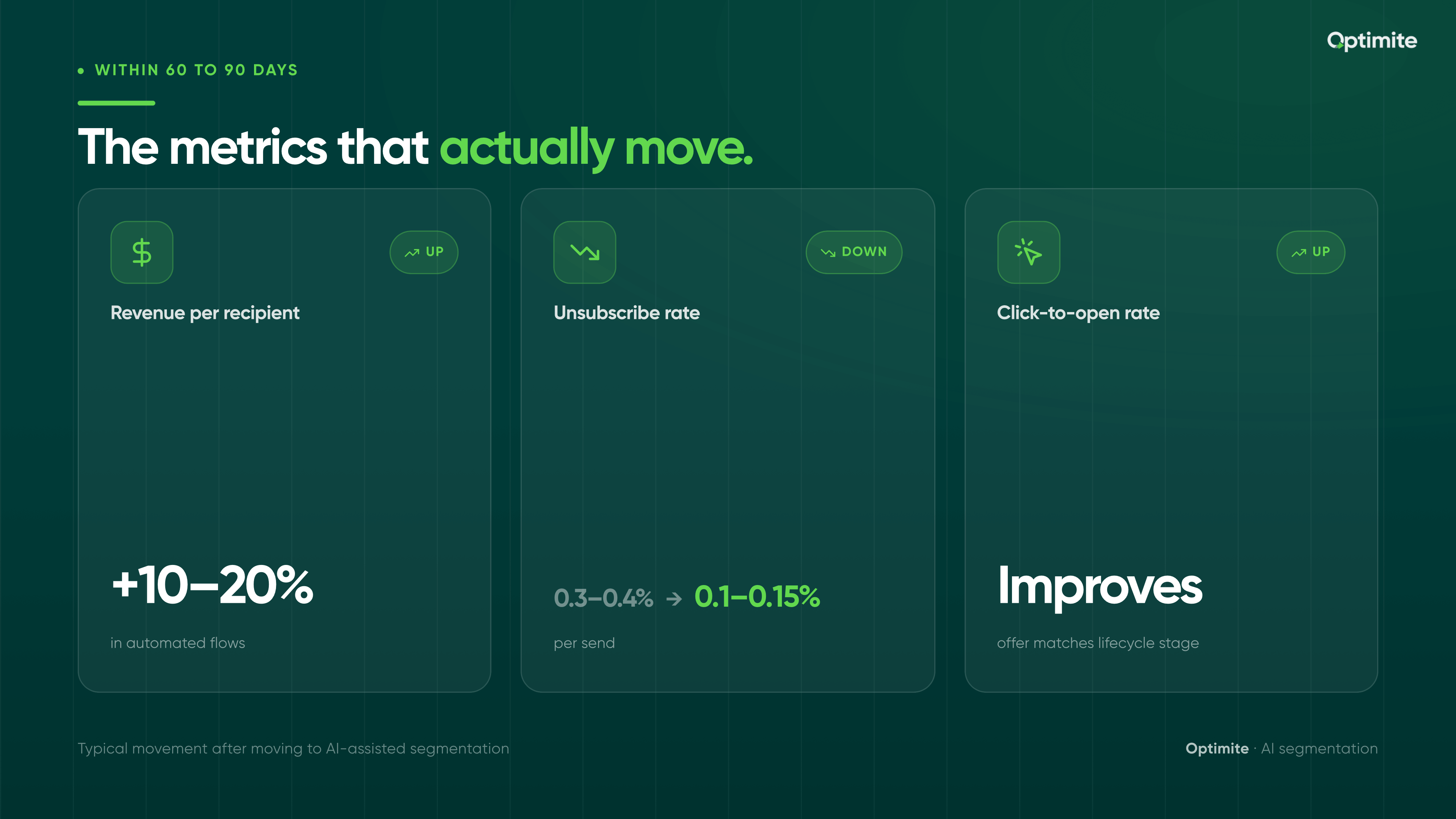
Here's where the specifics matter. Across DTC brands in the wellness, beauty, and fashion verticals that have moved to AI-assisted segmentation, a consistent set of metrics shifts within 60 to 90 days.
Revenue per recipient in automated flows is typically the first to move. When segments are more precise, flows fire for the right customers at the right time. A 10 to 20% improvement in revenue per recipient in post-purchase and repurchase flows is a realistic benchmark for brands with lists above 30,000 contacts.
Unsubscribe rates tend to fall within the first send cycle after better suppression logic kicks in. For brands previously sending to broad engagement segments without behaviour-based suppression, a drop from 0.3 to 0.4% per send down to 0.1 to 0.15% is common. That matters more than it sounds. Every subscriber you retain is a future revenue opportunity you haven't spent an acquisition budget to create.
Click-to-open rates improve when segment-level personalisation means the offer in the email matches where the customer actually is in their lifecycle. A customer being served a first-purchase welcome offer six weeks after buying something is a mismatch that AI segmentation tends to catch and correct.
What doesn't move quickly is overall list size or acquisition-side metrics. AI segmentation improves what you do with the list you have. The improvement is concentrated in lifecycle-stage relevance and engagement quality, not volume.
Where fashion and wellness brands see the most impact
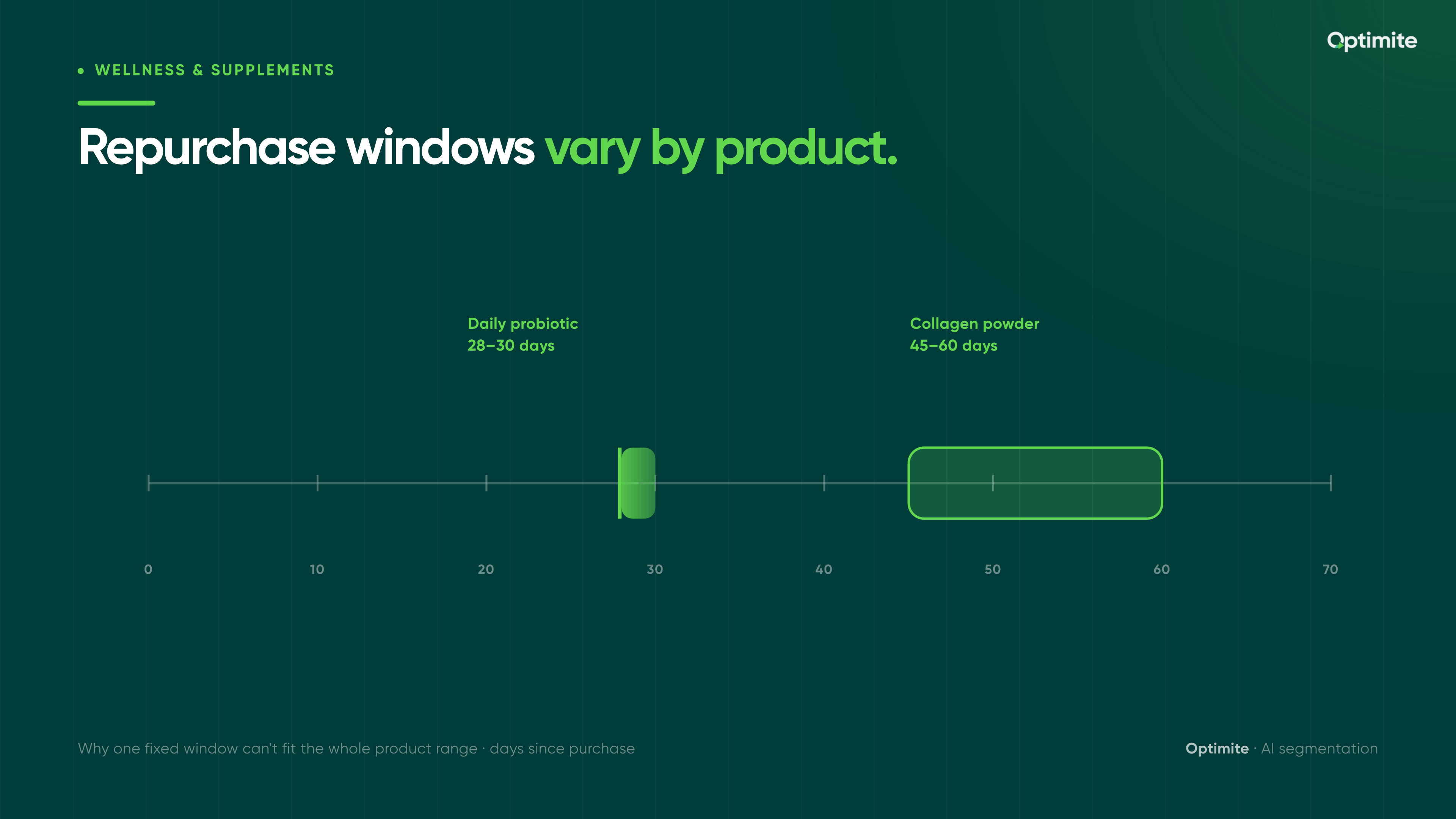
The vertical matters because repurchase windows vary significantly, and that's exactly where AI segmentation creates the most leverage.
For wellness and supplement brands, the repurchase cycle is predictable but variable by product. A daily probiotic has a 28 to 30-day window. A collagen powder used less consistently might be 45 to 60 days. Manual segmentation usually picks one window and applies it across the product range. AI segmentation builds individual repurchase predictions by product and customer behaviour, which, for a brand with four or five core SKUs, creates a much sharper trigger architecture across the whole lifecycle system.
For fashion brands, the seasonal dimension is the main lever. Purchase intent in October looks different from purchase intent in May, and a customer who bought a coat in November has a different repurchase profile than one who bought a summer dress in June. AI segmentation handles that variation automatically rather than requiring you to build separate seasonal segment logic and maintain it manually.
Beauty brands sit somewhere in between. Repurchase windows vary by product format; the loyalty signal from a second purchase is particularly strong in beauty, and the segment that predicts a third purchase from a customer who just made their second is where AI segmentation tends to generate its clearest revenue lift.
Don't migrate to AI-assisted segmentation during a peak send period like BFCM or a major product launch. The initial calibration period, where the model learns your list's behaviour patterns, takes three to four weeks. Running it during a high-volume period distorts the training data and delays accurate predictions.
What you still have to do yourself
AI segmentation doesn't remove the strategic layer. It removes the manual maintenance burden. Those are different things.
You still need to decide what segments matter for your business. You still need to write the emails that go to each segment. You still need to set the flow structure and determine what a good lifecycle looks like for your customer. AI improves the precision of who receives what and when. The strategy, the creative, and the offer logic remain human decisions.
The bigger gains come when better segmentation is paired with flows that are actually built to match the lifecycle stage. An AI-segmented repurchase flow that sends a generic campaign-style email gets marginal improvement. One that sends lifecycle-appropriate content for a customer at the 28-day mark sees a real shift.
The infrastructure underneath the segmentation still matters. Klaviyo is the platform where most of this gets built and maintained, and the quality of the data flowing into it determines the quality of what AI can do with it. Incomplete purchase data, poor profile enrichment, or inconsistent event tracking upstream all limit what AI segmentation can achieve.
What this means for how you build retention
The direction of travel is clear. Segmentation that relies purely on manual rule-based logic will become increasingly difficult to maintain as lists grow and customer behaviour becomes more complex. The brands investing in AI-assisted segmentation now are building a structural advantage that compounds over time because the model gets better as it accumulates more data about how your specific customers behave.
The practical question is whether your current retention infrastructure is in good enough shape to take advantage of it. If your flow architecture is incomplete, your data hygiene is poor, or your lifecycle strategy hasn't been defined properly, better segmentation will surface those problems faster rather than solving them.
If you want to understand what your Klaviyo retention programme would look like with a proper AI-assisted segmentation layer built on a solid infrastructure foundation, book a free call with the Optimite team.
Keep reading.
All posts
Claude Cowork for DTC Brands: What It Does, What Changes, and How to Start
Shrestha Ghosal · Aug 14, 2026

AI Agents in Klaviyo: What DTC Brands Need to Know
Shrestha Ghosal · Jun 24, 2026

Why AI Is Killing the A/B Test
Shrestha Ghosal · Jun 18, 2026