

The Hidden Economics of Repeat Customers
Your CAC spreadsheet is incomplete. Here's the economics of repeat customers and how it changes your growth budget.
 Arpit Mehar
You're sitting in a board meeting. The marketing team just presented their customer acquisition plan. CAC is $45. Payback period is 6 months. It looks fine on the spreadsheet.
But your actual profit math is broken.
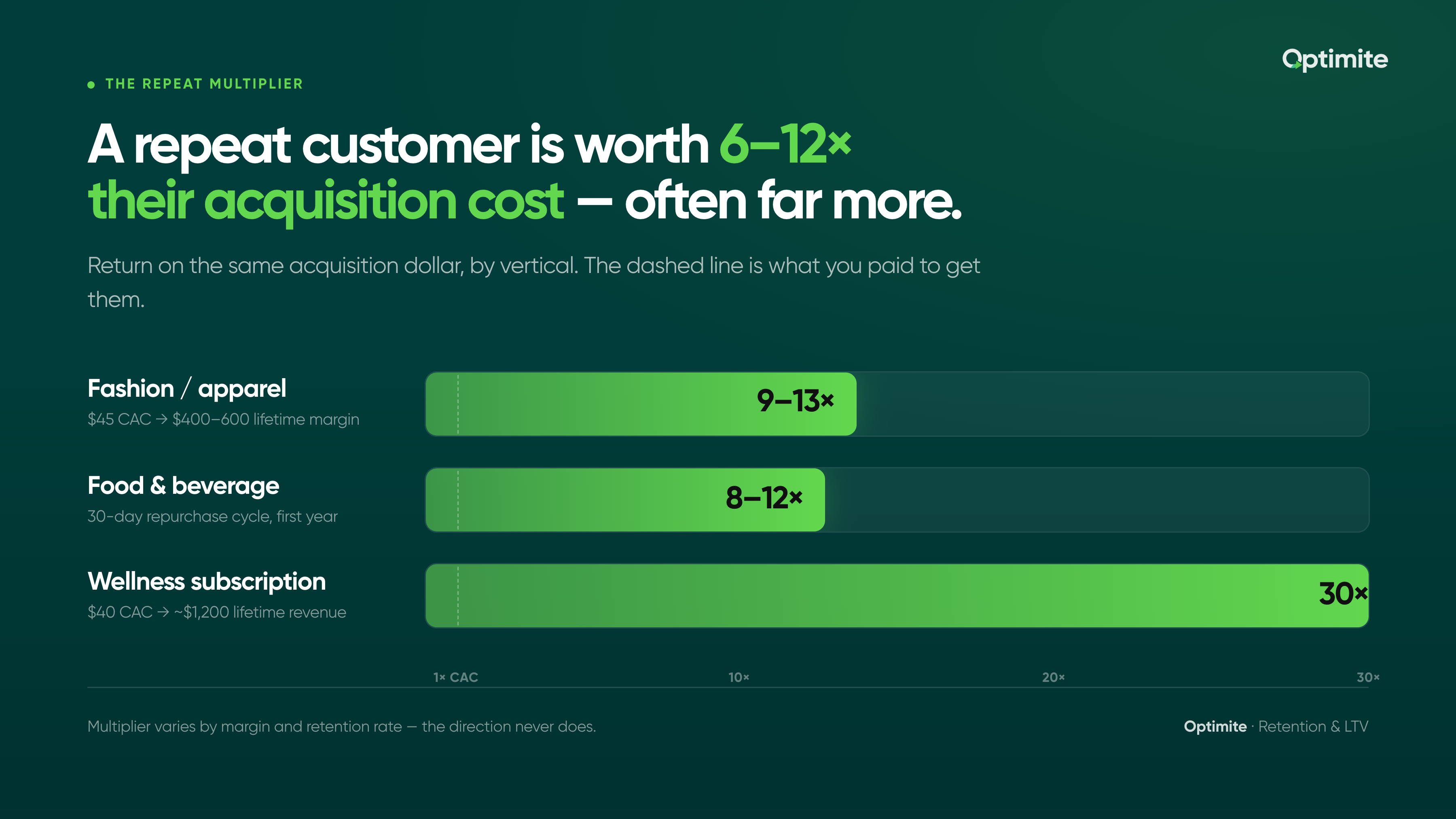
Here's why: you're calculating CAC as a one-time cost. You're treating the customer like they'll buy once, then disappear. In reality, a repeat customer is worth 6 to 12 times the acquisition cost of a new one. That changes everything about how you should spend money.
Most founders know this in theory. But they don't actually use it to make budget decisions. They keep spending 70% on acquisition and 30% on retention. They chase traffic. They optimize for CAC. And they leave massive profit on the table because they're measuring the wrong thing.
This post walks through the math. It's not complicated. Once you see it, you'll never unsee it.
Your CAC math is incomplete (and it's costing you millions)
Let's start with a real scenario. You're a wellness brand doing $5M in annual revenue. You spend $500K on customer acquisition. That gets you 10,000 customers at $50 CAC. Sounds reasonable.
But here's what your spreadsheet is missing: of those 10,000 customers, only 40% ever buy again. The other 6,000 are one-time buyers. Your acquisition spend on those customers is sunk. You'll never recover it.
Of the 4,000 repeat customers, the average one buys 2.5 times in their lifetime. That's $1,250 in revenue per repeat customer. Minus cost of goods sold and fulfillment, that's maybe $400 in gross margin per repeat customer.
So you spent $50 to acquire them, and you made $400 in margin from them. That's an 8x return.
But you spent the same $50 on the 6,000 one-time buyers. You made maybe $30 in margin from them. That's a 0.6x return. You actually lost money on half your acquisition spend.
The problem is your CAC metric doesn't tell you this. It just says "average CAC is $50." That number hides the fact that you're making money on repeats and losing it on one-timers.
Most brands don't know their repeat purchase rate. They don't segment their P&L by customer cohort. So they optimize for the wrong thing. They chase CAC down to $40 without realizing that the repeat rate dropped from 40% to 30%, which actually crushed their unit economics.
The repeat customer multiplier: 6-12x is real
Let's make this concrete with the real numbers.
A repeat customer spends more. They spend faster. They have higher margins because you're not repeating the fulfillment education. They refer friends. They're less price-sensitive.
According to Bain & Company research on online customer loyalty, repeat customers spend 67% more than first-time buyers on average when measured over their relationship lifetime. In apparel specifically, customers in months 31-36 of their relationship spend 67% more than those in months 0-6. But it gets better than that when you look at lifetime value.
Take a fashion brand. First-time customer AOV is $80. Repeat customer AOV is $95. Repeat customers buy 2.2 times per year. First-time customers never buy again (in your cohort). That repeat customer is worth $209 in gross revenue. Minus 35% for COGS, that's about $135 in gross margin. The CAC was $45. That's a 3x return in year one.
But that repeat customer buys again next year. And the year after. Lifetime, they're worth $400-600 in gross margin from the same $45 acquisition cost. That's 9-13x your investment.
A wellness subscription brand? Even better math. Repeat customer with a $40 CAC might generate $1,200 in lifetime revenue if they stay subscribed for 2-3 years. That's 30x the acquisition cost.
A food and beverage brand with a 30-day repurchase cycle? Repeat customers are worth 8-12x CAC in the first year alone.
The multiplier changes by vertical, retention rate, and margin structure. But the direction is always the same. Repeat customers are worth 6-12x more than you're accounting for in your acquisition budget.
How Bain & Company proved the profit leverage
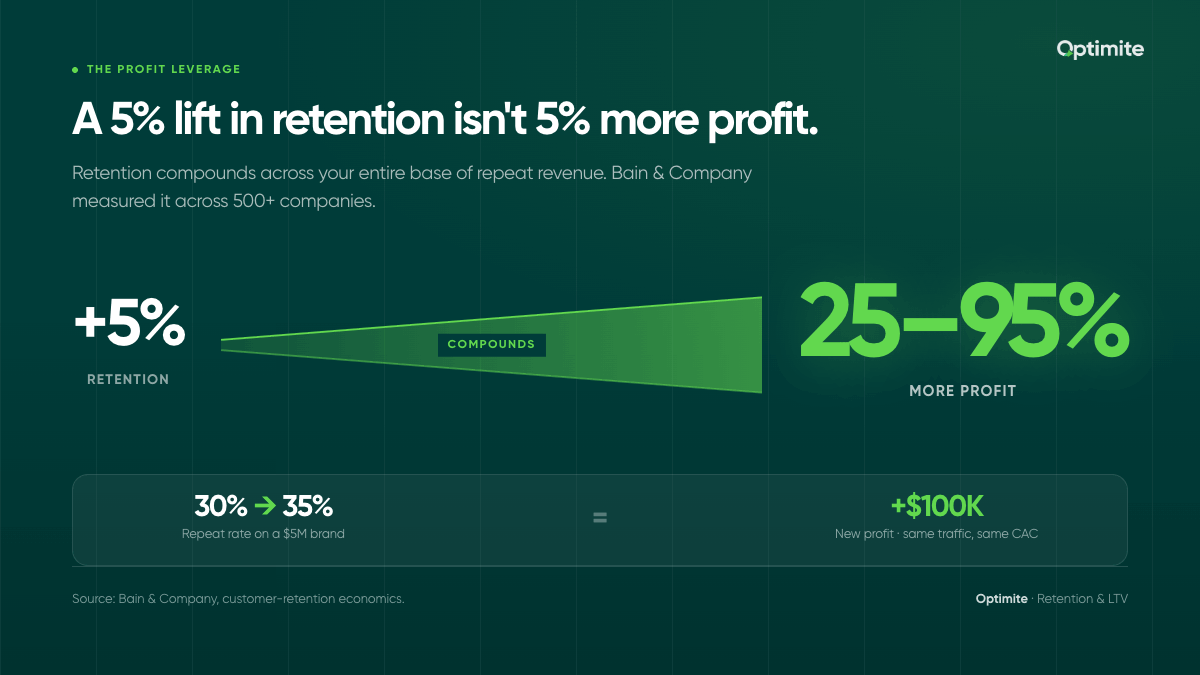 This isn't theory. Bain & Company studied this across 500+ companies. They found something remarkable: increasing retention by just 5% can increase profits by 25% to 95%.
Let that sink in. A 5% improvement in retention doesn't mean 5% more profit. It means 25-95% more profit.
Why? Because retention compounds. It's not additive; it's multiplicative. Every percentage point of retention improvement applies to your entire revenue base from repeats. It also improves your unit economics on acquisition because you're amortizing CAC across more purchases.
Here's a practical example. A $5M brand with a 30% repeat purchase rate has about 1,500 repeat customers. If you improve the repeat rate to 35%, that's 250 more repeats. At $400 lifetime margin per repeat, that's $100K in new profit. On the same customer base. Same traffic. Same CAC. Just better retention.
But it goes deeper. When your repeat rate improves, you can afford to spend more on acquisition. Your CAC payback period extends, but your lifetime profit per customer increases. You have more room in your budget for growth.
Brands that understand this math spend differently. They don't optimize for CAC. They optimize for CAC multiplied by repeat purchase rate. They don't chase the cheapest traffic. They chase traffic that has the highest repeat potential.
Building the real LTV model: new vs. repeat
Here's what the math actually looks like when you separate new from repeat customers.
Take your last 100 customers. Track them for a year.
New cohort economics:
- CAC: $50
- First purchase AOV: $85
- Repeat rate: 35%
- Revenue per new customer acquired: $85 × (1 + 0.35 average repeats) = $85 × 1.35 = $114
- Gross margin (40% after COGS): $46
- Profit per new customer after CAC: $46 - $50 = -$4
Wait. You're losing money on the aggregate new customer. That's the problem.
But if you segment by cohort:
- One-time buyers (65%): Revenue $85, margin $34, profit after CAC: -$16
- Repeat buyers (35%): Revenue $85 + (1.9 repeats × $95) = $266, margin $106, profit after CAC: +$56
Now the picture is clear. Repeat customers are funding the acquisition cost of one-timers. You're profitable on repeats, not profitable on the aggregate.
So what should change?
Your CAC budget should shift. You should spend more to acquire customers with repeat potential. A customer from an email list or referral (higher repeat rate) might justify $60 CAC. A customer from brand-new paid acquisition (unknown repeat rate) might only justify $30.
Your retention budget should explode. That repeat customer generating $56 of profit? Every dollar you invest in keeping them is a dollar of leverage. If you improve their repeat rate from 35% to 40%, you're adding $14 per customer in profit. That's a 14x return on small retention investments like SMS sequences or post-purchase flows.
What this means for your growth budget
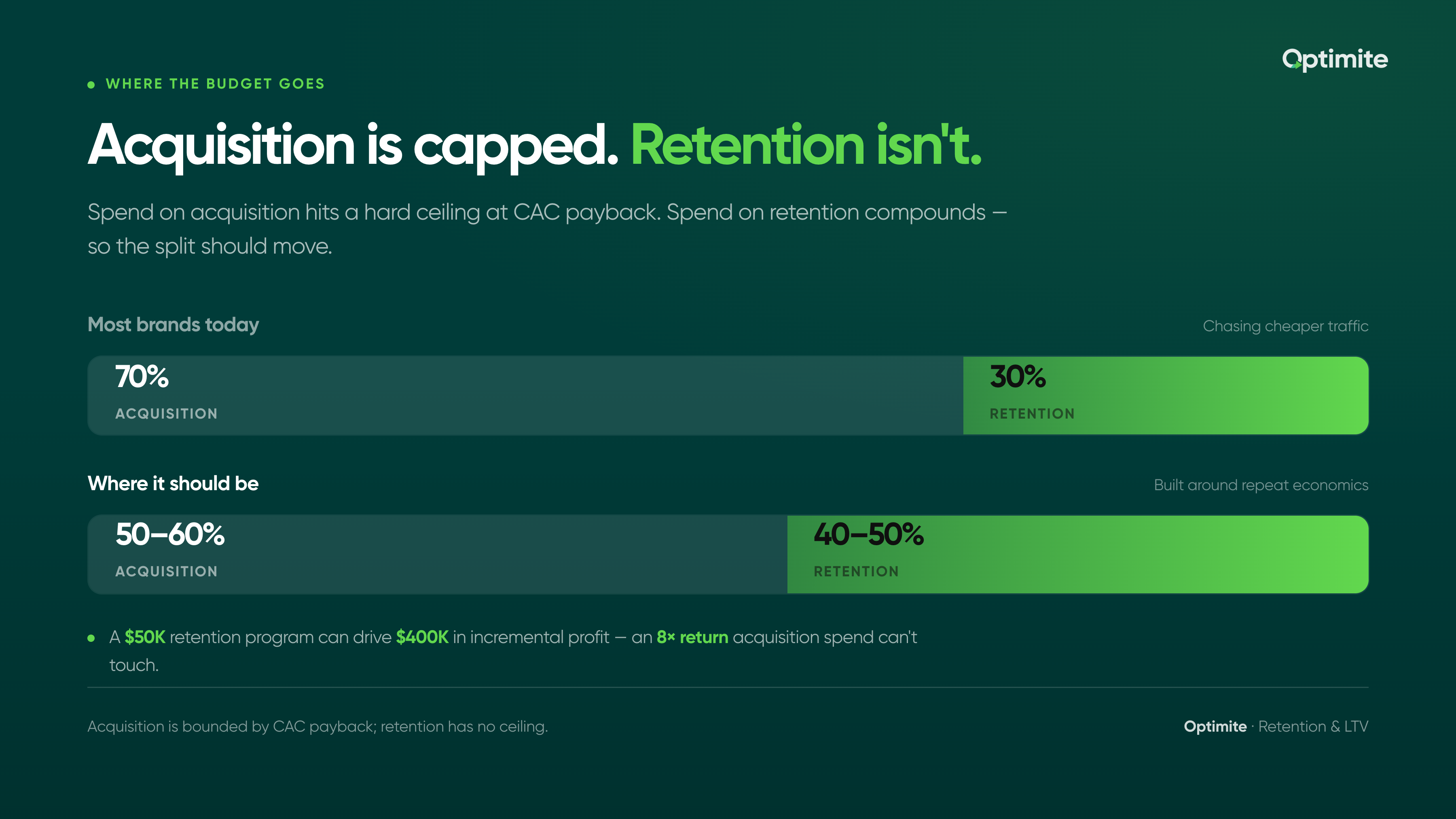
Most brands are split wrong. They spend 70% on acquisition, 30% on retention. They should be closer to 40-50% on retention, 50-60% on acquisition, depending on their repeat rate and margins.
Here's why: acquisition spending is capped by CAC payback. If your CAC is $50 and first-purchase margin is $40, you can't spend more than $40 on acquisition without going negative year one. That's a hard ceiling.
But retention spending has no ceiling. If a retention email costs $0.10 to send and improves repeat purchase rate by 1%, that pays for itself 100 times over.
A wellness brand with 25% repeat rate could move to 35% with better email and SMS flows. That's a 10 percentage point improvement. On 10,000 annual customers, that's 1,000 additional repeats. At $400 lifetime margin per repeat, that's $400K in incremental profit. And it costs maybe $50K to build and run a better retention program.
That's an 8x return on retention spend. Your acquisition budget will never hit that.
So the budget shift isn't "be less aggressive on acquisition." It's "realize acquisition is constrained and retention isn't, so shift accordingly."
The brands getting this right are building retention systems that improve repeat rate. They're not chasing cheaper CAC. They're chasing better repeat economics.
Where most founders get it wrong
Mistake 1: Optimizing for CAC without repeat rate context. Your CAC is meaningless if you don't know your repeat rate. A $40 CAC with 50% repeat rate is better than a $30 CAC with 20% repeat rate.
Mistake 2: Using aggregate economics to make budget decisions. Your blended unit economics hide the truth. You need to segment by cohort. New vs. repeat. Channel by channel. Vertical by vertical. Only then can you see which investments are actually profitable.
Mistake 3: Treating retention as a cost center, not a profit center. Retention is your highest-margin business. Every percentage point of repeat rate improvement is pure profit leverage. It should get a disproportionate share of your budget.
Mistake 4: Not measuring repeat rate at all. Most founders don't even know their repeat purchase rate. They know CAC. They know LTV. But they don't track what percentage of each cohort repeats. That's the hinge pin that determines everything.
The brands winning with this math
The fastest-growing D2C brands have internalized this. They know their repeat rate by channel. They know their CAC multiplied by expected repeats. They're building retention systems to improve repeat rate. They're shifting budget toward retention.
A fashion brand we work with had a 28% repeat rate. CAC was $35. They thought they needed to lower CAC. What they actually needed was to raise repeat rate. They built a post-purchase flow, a browse abandonment flow, and an engagement-based re-engagement flow. Repeat rate moved to 38% in six months. CAC stayed at $35. But the lifetime profit per customer went from $45 to $80. That's a 78% improvement in unit economics without changing acquisition strategy.
A wellness brand moved from 22% to 32% repeat rate with better email segmentation and SMS. Same CAC, different economics. Suddenly they could justify spending more on acquisition because the payback improved.
A food and beverage brand realized their repeat rate dropped from 40% to 35% when they switched acquisition channels. Same CAC, worse repeats. They pulled back from the new channel and doubled down on referrals and email capture, which had 45% repeat rates.
All of these decisions flow from one thing: understanding that repeat customer economics are the real economics. CAC is just the starting point.
If you want to understand how to actually improve your repeat rate, we built a full retention strategy approach that walks through the system. But the math starts here.
The one metric that matters
If you take nothing else from this, track this: CAC multiplied by expected repeat purchase rate.
A new customer at $50 CAC with a 30% repeat rate is really a $65 customer in expected value. A customer at $50 CAC with a 50% repeat rate is a $100 customer.
Budget accordingly. Invest in channels and offers that drive repeat-prone customers. Build retention systems that turn one-time buyers into repeats. Measure repeat rate obsessively.
Your CAC spreadsheet is right. Your budget allocation probably isn't. Want to see what better retention could unlock for your brand? Book a call with us today and we'll help you find out!
Keep reading.
All posts
Figma Make Is Changing How DTC Brands Build and Test
Arpit Mehar · Aug 5, 2026

The Channel Mix Shift Happening Across DTC Brands Right Now
Shrestha Ghosal · Jun 13, 2026

Ad Spend Goes Up. Email Revenue Stays Flat. Here Is Why.
Shrestha Ghosal · Jun 5, 2026