

Ad Spend Goes Up. Email Revenue Stays Flat. Here Is Why.
 Shrestha Ghosal
Every week, we talk to ecommerce founders who have the same story. They doubled their ad budget. Acquisition numbers looked fine. And then they opened their Klaviyo dashboard and saw the same email revenue share they had six months ago sitting somewhere between 8% and 12% of total revenue.
If the top of the funnel is growing, why is email revenue for ecommerce brands not growing with it? That question deserves a real answer, and it has nothing to do with email being a dying channel.
More customers in, same revenue out
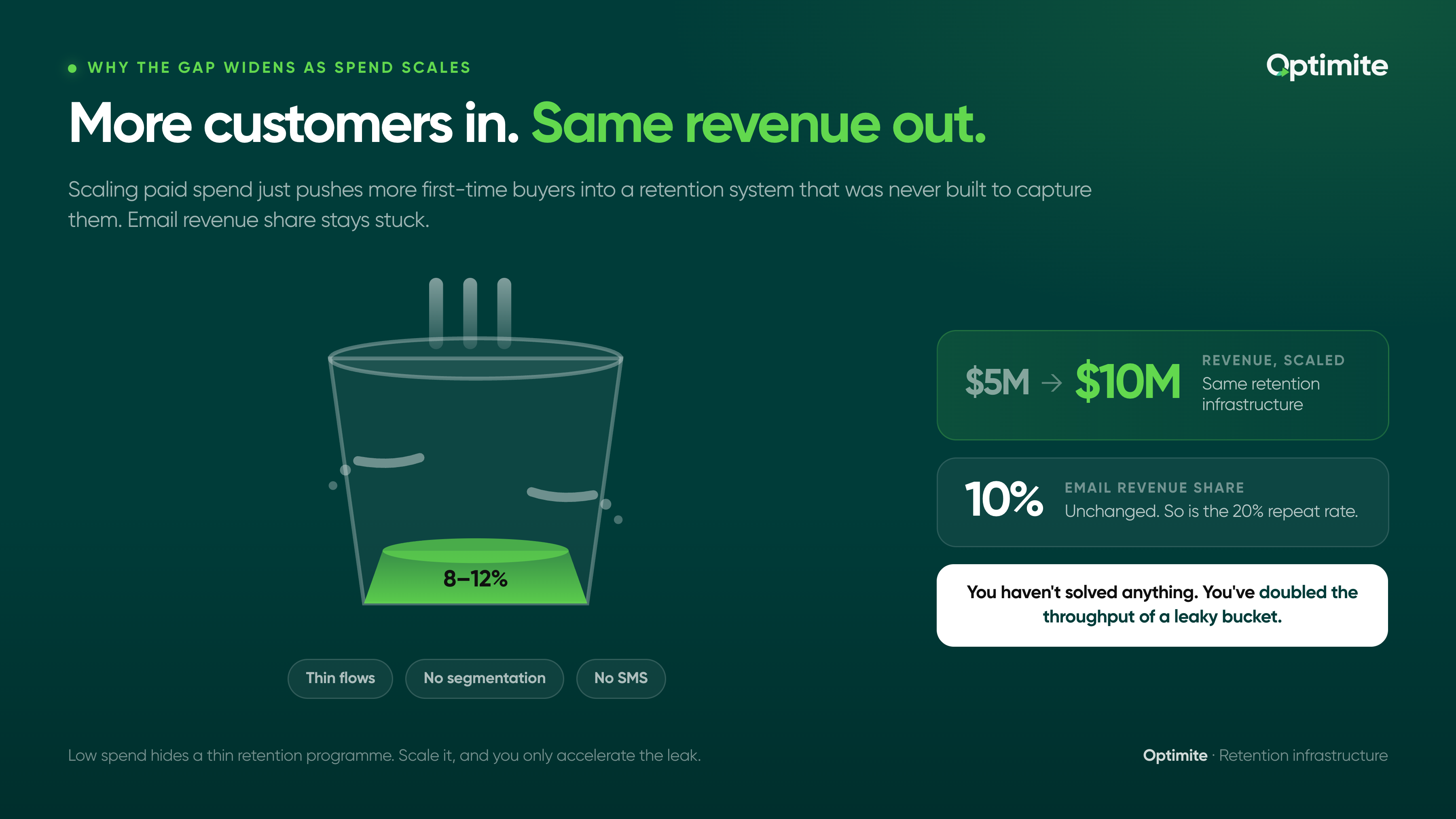
When you scale paid spend, you are pushing more first-time buyers into the top of the funnel. That is the job you are paying for. But what happens to those buyers after the first order depends entirely on your retention infrastructure, not your acquisition agency.
Most DTC brands in the $1M to $15M range have some retention infrastructure. A welcome flow, probably. An abandoned cart sequence. Maybe a post-purchase email. But the issue is that these flows were built once, usually quickly, and have not been meaningfully updated since. So as volume goes up, you are running more people through a leaky system.
Bain & Company research shows that repeat customers spend on average 67% more than first-time buyers. If your retention programme is not capitalising on that difference, you are handing a significant portion of available revenue back to acquisition costs.
What a flat email revenue share actually signals
A flat email revenue share as paid spend scales usually points to one of a few structural gaps:
- Flows without depth. A welcome flow with two emails, a cart sequence that stops after three days, and a post-purchase email that reads like a shipping notification. Each of these flows should be earning revenue across a longer window than they currently are.
- No behavioural segmentation. If your Klaviyo flows send the same content to a customer who bought once eighteen months ago and a customer who bought three times in the last ninety days, you are averaging down your results. These two buyers need different messaging, different timing, and different offers.
- Campaigns carrying all the weight. Across the 500+ brands we work with, well-built retention programmes typically generate 40 to 60% of email revenue from automated flows, not campaigns. If your campaigns are doing the heavy lifting because your flows are thin, you are working harder than you need to and your revenue is less predictable.
- No SMS in the mix. SMS open rates average around 98%, compared to 20 to 30% for email. For replenishment products in wellness and beauty, or high-frequency fashion brands, leaving SMS out of the lifecycle entirely means leaving a reliable engagement layer on the table.
None of these are acquisition problems. They are retention infrastructure problems.
The flows doing the least work in most accounts
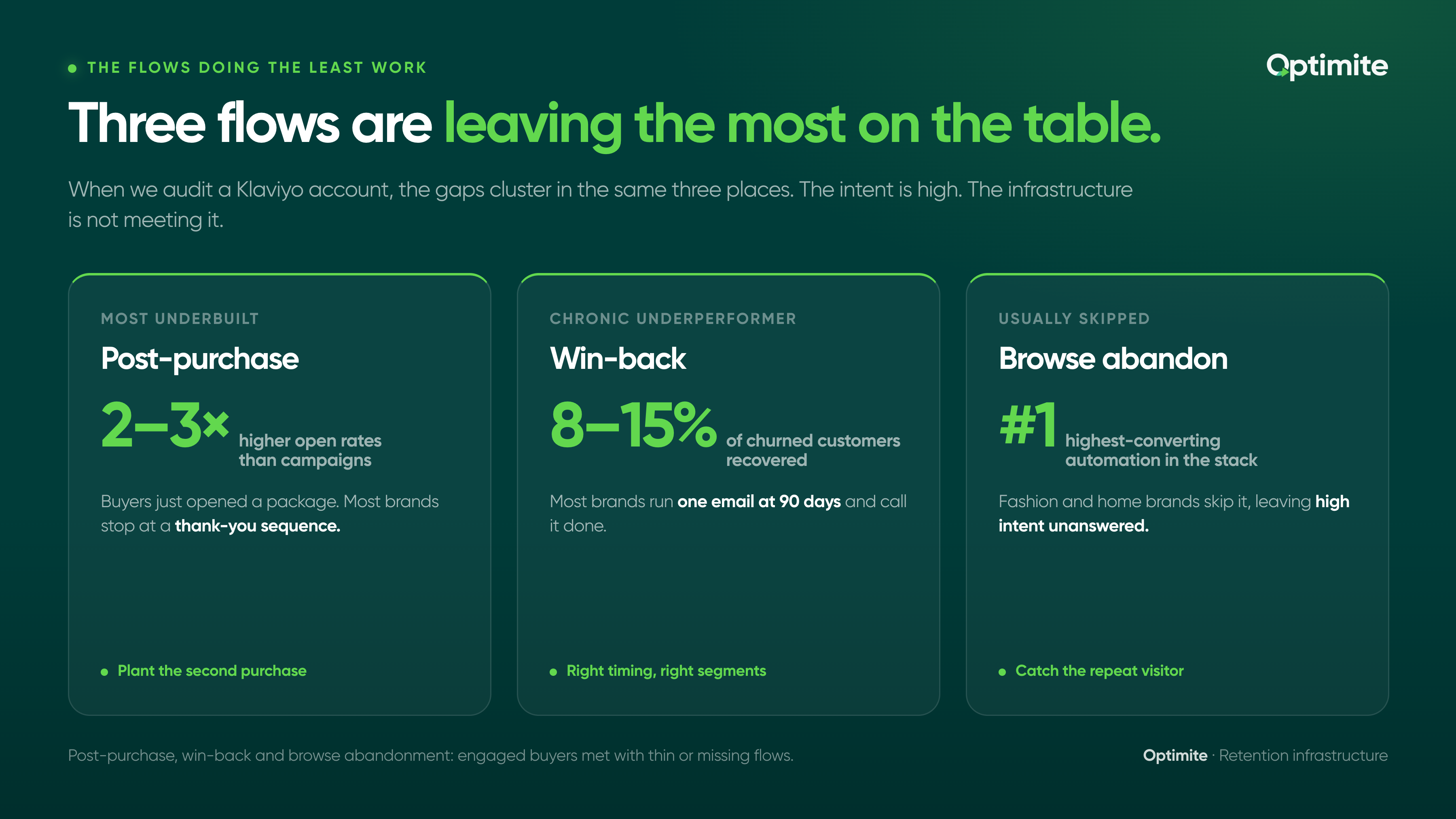 When we audit a Klaviyo account, the gaps tend to cluster in the same places. Post-purchase is the most underbuilt flow we see. Most brands treat it as a thank-you sequence and stop there. That is a significant missed opportunity: post-purchase flows see open rates two to three times higher than standard campaign emails, according to Klaviyo benchmark data. Buyers are engaged. They just opened a package. The question is whether you are using that engagement to plant the seed for a second purchase.
A purely transactional post-purchase sequence (order confirmed, shipped, delivered) does nothing to resolve the anxiety a customer feels after spending. By the time your replenishment email arrives six weeks later, they have already half-talked themselves out of buying again.
The other chronic underperformer is the win-back flow. Most brands either have no win-back, or they have a single email that goes out at 90 days lapsed and calls it done. A properly structured win-back sequence for a wellness brand or a beauty brand, with the right timing logic and segment conditions, routinely recovers 8 to 15% of otherwise-churned customers. That is not a small number when you are running paid acquisition to replace those same people.
Browse abandonment is the third. Fashion and home brands in particular tend to skip it. But for a buyer who has visited a product page multiple times without converting, a well-timed browse abandonment email is one of the highest-converting automations in the retention stack.
Why the gap widens as spend scales
Here is what makes this particularly expensive at scale. When ad spend is low, a thin retention programme has a smaller blast radius. You are not running that many buyers through it. But once you scale paid acquisition, you are accelerating the rate at which customers enter a system that is not built to capture them.
A brand doing $5M a year with 10% email revenue share and a 20% repeat purchase rate is leaving a material amount on the table. Scale that brand to $10M in revenue with the same infrastructure and you have not solved anything. You have doubled the throughput of a leaky bucket.
According to Bain & Company and Harvard Business School research, increasing customer retention by 5% can increase profits by anywhere from 25% to 95%. The range is wide because the impact depends on average order value, product category, and purchase frequency. But the direction is consistent: retention compounds. Acquisition does not.
What closing the gap actually requires
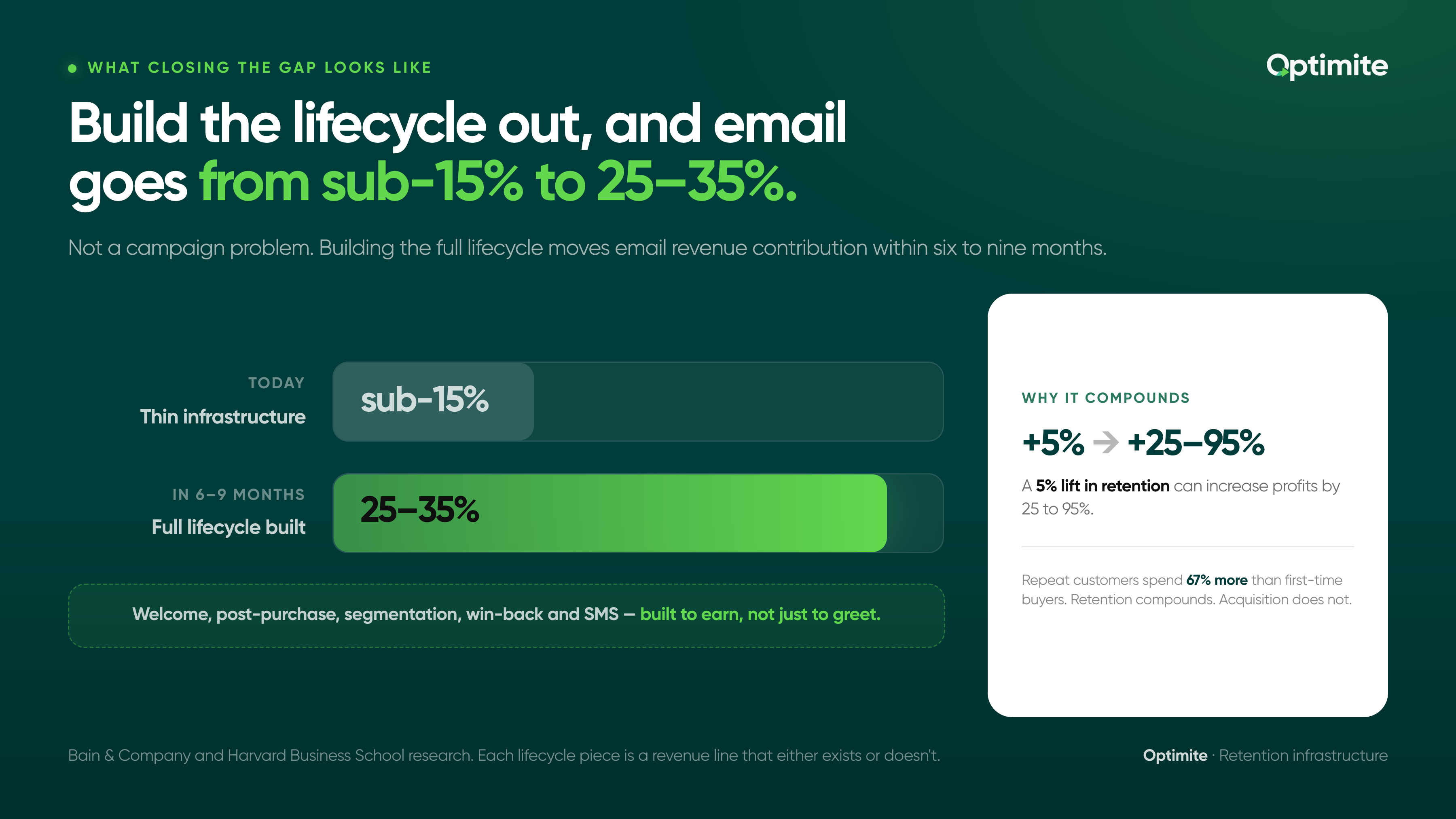
Getting email revenue for ecommerce brands from 10% to 25% or 30% of total revenue is not a campaign problem. It requires building out the lifecycle properly. In practice, that means:
- A welcome flow built to earn, not just to greet. Five to seven emails over ten to fourteen days, with segmentation based on acquisition source and first purchase category.
- Post-purchase flows structured around the repurchase window for your product. For a supplement brand with a 30-day product cycle, that means timely educational content, a refill prompt, and a cross-sell sequence layered in at the right intervals.
- Segmentation logic that separates high-value buyers from low-engagement subscribers and treats them differently across both flows and campaigns.
- A win-back programme that uses purchase history and engagement data to decide when to offer an incentive and when to suppress.
- SMS integrated into the lifecycle where it makes sense, particularly for replenishment-driven verticals like wellness and beauty, or for high-intent cart and browse abandon moments.
This is not a list of nice-to-haves. For a $5M to $15M DTC brand, each of these represents a specific revenue line that either exists or does not. When we build the full lifecycle for brands in that range, email revenue contribution typically moves from sub-15% to 25 to 35% within six to nine months.
How to diagnose where your account is leaking
If you want to understand your own retention gap before doing anything else, start here. Pull your Klaviyo data and look at three things:
Flow revenue as a share of total email revenue. If campaigns are generating more than 60% of your email revenue and flows are generating less than 40%, your automation stack is underbuilt relative to what it should be doing.
Repeat purchase rate over 90 and 180 days. How many customers who bought once have bought again within three months? Within six? If your 90-day repeat rate is below 15%, there is likely a gap in your post-purchase and browse sequences.
Revenue per recipient from your top three flows. Most accounts have one flow doing most of the work, usually welcome or cart. If your post-purchase RPR is a fraction of your welcome RPR, that is your signal. The intent is high but the infrastructure is not meeting it.
These three numbers will tell you more about your retention health than open rates and click rates combined. Pull them before your next strategy conversation.
The compounding cost of leaving it too long
Every month that passes with thin retention infrastructure is a month of paid acquisition spend that did not convert into retained customers. The buyers who came in through Meta last quarter and did not receive a strong post-purchase experience are now available to be re-acquired by a competitor.
Retention marketing for e-commerce brands compounds in both directions. Strong infrastructure builds a base of repeat buyers that reduces acquisition dependency over time. Weak infrastructure turns every acquisition campaign into a one-time transaction.
We work with DTC brands on Klaviyo across wellness, beauty, fashion, food and beverage, and home. If you want to understand exactly where your retention programme is leaking and what it would take to close the gap, book a free call with our team and we will walk through your account with you.


