

The Channel Mix Shift Happening Across DTC Brands Right Now
Email and SMS were never meant to run in parallel. Here's what the coordinated model looks like and why it's pulling ahead.
 Shrestha Ghosal
Something has shifted in how DTC brands are running their retention programmes. There's no single moment you can point to. But across hundreds of e-commerce brands, the pattern is consistent: the brands pulling ahead on retention are no longer treating email as the centrepiece and SMS as the add-on. They're building channel systems, and the ones still treating them separately are paying for it in repeat purchase rates.
This post is about what that shift looks like, why it's happening now, and what it means for how you build your retention infrastructure going forward.
What the old channel model looked like
For most DTC brands, the retention stack was email-first by default. You set up Klaviyo, built your welcome flow, added an abandoned cart sequence, and maybe threw in a post-purchase email. SMS came later, usually bolted on when open rates started sliding, or a BFCM push needed more reach.
The channels operated in parallel. Email handled the narrative. SMS handled urgency. There was minimal coordination between the two, and the logic was simple: more touchpoints, more revenue.
That model worked well enough when acquisition was cheap, and retention was considered a secondary priority. But in 2024 and into 2025, the economics shifted. Customer acquisition costs across Meta and Google climbed sharply, and the brands that survived and scaled were the ones that extracted more value from the customers they already had.
Repeat customers spend 67% more on average than first-time buyers, according to Bain and Company. For a brand doing $5M in revenue, shifting even 10% of your customer base from one-time to two-time buyers is a seven-figure retention play.
The shift: from parallel channels to coordinated systems
The change happening now is about coordination. Not just "we send email and SMS" but "we know which customer gets which channel, at which point in their lifecycle, based on what we know about how they engage."
A fashion brand in the $8M range running a coordinated channel system looks different from one still on the old model. Their welcome flow routes customers into the right channel mix based on acquisition source, engagement signals, and product category. A customer who clicked through SMS-first and opened two emails in 48 hours gets a different path than one who opened every email but never engaged with SMS at all.
The practical result: higher revenue per recipient, lower unsubscribe rates, and a list that stays healthy across peak periods instead of burning out after BFCM.
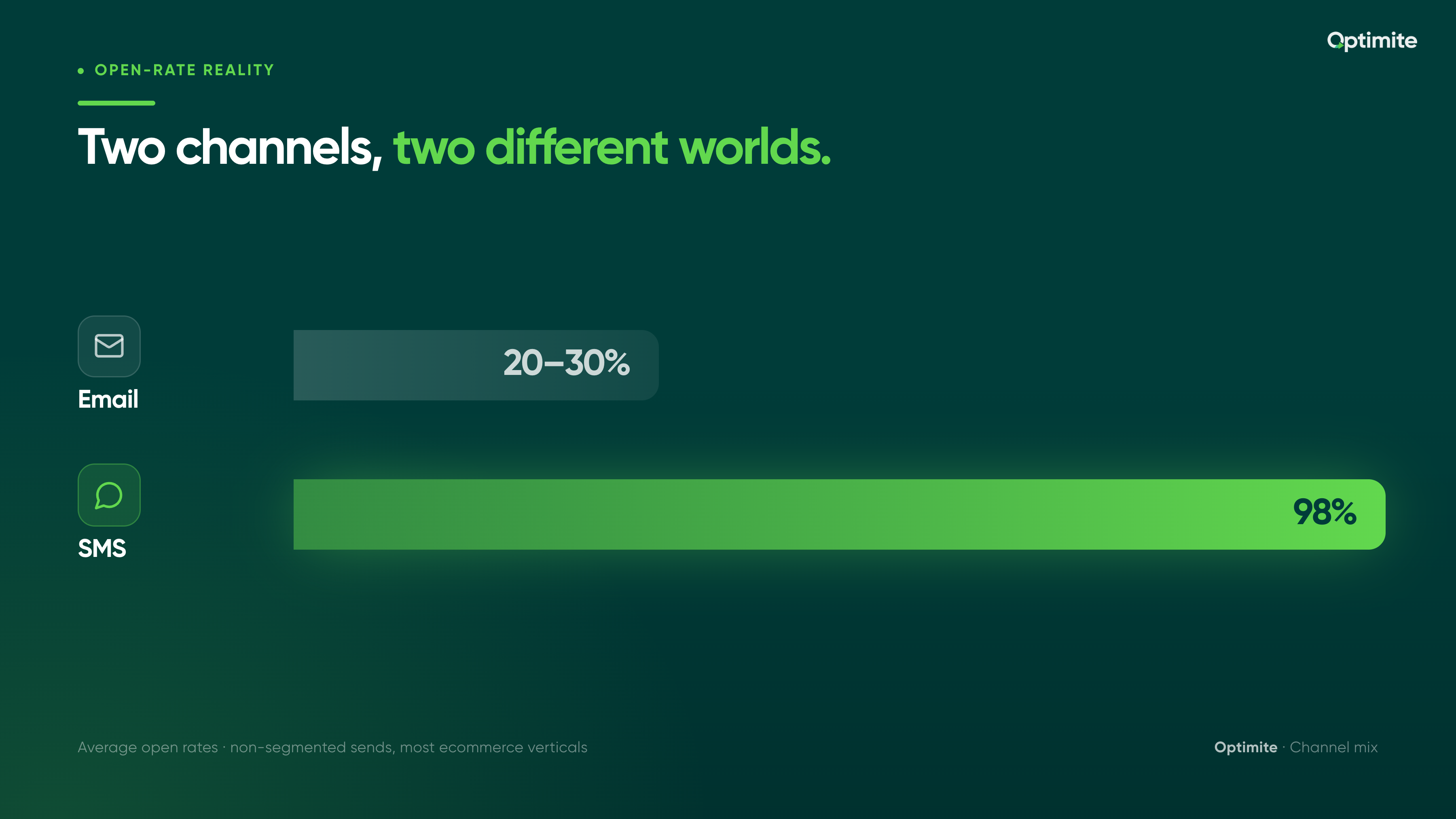
- Email average open rates for non-segmented sends sit at 20 to 30% across most ecommerce verticals
- SMS open rates average 98%, but click rates vary significantly depending on message relevance and timing
- Brands coordinating both channels see 15 to 25% higher revenue per recipient in automated flows compared to running them independently
Why this is happening now
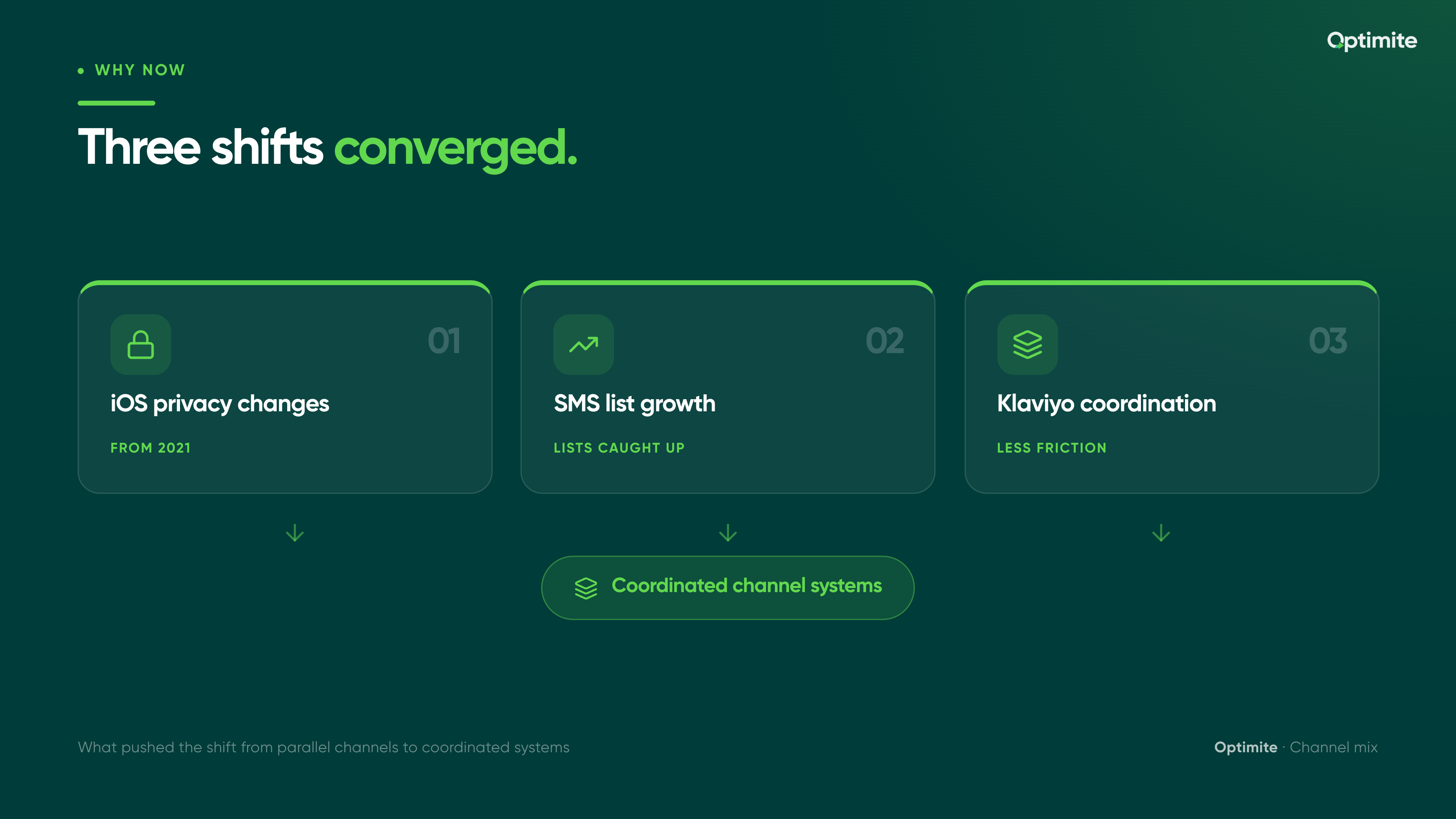 Three things converged to push this shift forward.
First, iOS privacy changes from 2021 onwards degraded open rate data significantly. Brands that relied on email opens to trigger next-step logic in their flows found those triggers firing incorrectly. A coordinated SMS layer gave them a second signal source that iOS couldn't touch.
Second, SMS list growth accelerated. Brands that invested in list growth infrastructure, specifically pop-ups with strong SMS opt-in offers, saw their SMS lists catch up to or exceed their email lists faster than expected. Once you have an SMS list of meaningful size, the case for running it as a secondary channel stops making sense.
Third, Klaviyo made cross-channel coordination easier. Conditional splits based on channel engagement, suppression logic that accounts for recent SMS clicks, and unified customer profiles across both channels removed the technical friction that kept most brands from building properly coordinated systems.
If you're still running email and SMS as independent sequences with no shared logic between them, start with one change: add a conditional split at the top of your post-purchase flow that checks for SMS opt-in and routes accordingly. You'll see engagement data in two weeks that justifies the broader build.
What this means for wellness, beauty, and fashion brands specifically
The impact of this channel shift plays out differently depending on your vertical and your repurchase window.
For wellness and supplement brands with a 28 to 45-day repurchase cycle, the coordinated approach changes the mid-cycle touchpoint strategy. Email carries the educational content, the how-to content, and the habit reinforcement. SMS handles the well-timed nudge when repurchase intent is high, typically around days 25 to 30. Running both without coordination usually means the customer gets both on the same day, which creates noise and trains them to ignore you.
For fashion brands, the channel split is more about the journey stage. Email handles the brand relationship, the editorial content, and the new arrivals that need context. SMS handles time-sensitive moments: a back-in-stock alert on a specific item, a 24-hour sale window, a shipping update that keeps post-purchase anxiety low. Fashion brands doing this well have seen post-purchase NPS scores improve simply because the communication feels considered rather than broadcast.
For beauty brands, the shift shows up most clearly in loyalty and repeat purchase flows. Tier-based systems that notify customers about reward thresholds via SMS see redemption rates 2 to 3 times higher than email-only notifications. The channel match matters because the message type demands immediacy.
Running high-frequency SMS campaigns to your full list without engagement-based suppression is the fastest way to drive unsubscribe rates above 5%. Once a customer opts out of SMS, you've lost that channel permanently. Build suppression logic before you build send volume.
The retention infrastructure shift underneath it all
What the channel mix shift actually requires is a rethink of how retention infrastructure gets built. The brands that are pulling ahead aren't just coordinating sends. They're making decisions at a structural level that most brands haven't reached yet.
That includes:
- Unified segmentation that reads behaviour across both channels before making send decisions
- Flow architecture that treats channel as a variable, not a constant
- List growth infrastructure that captures SMS opt-ins at the same rate as email opt-ins
- Suppression logic that prevents the same customer from receiving high-frequency sends across both channels in short windows
- A cadence review process that looks at combined send pressure, not just email or SMS frequency in isolation
Most brands running $2M to $8M in revenue don't have all of this in place. They have some of it. The gap between some and all of it is where the retention revenue gap lives.
Where this leaves you
The brands building coordinated channel systems are now setting up an advantage that compounds. Retention infrastructure gets better as it accumulates data. A brand that builds proper cross-channel coordination in 2025 has a structural edge by 2026 that's genuinely hard to close.
The question worth asking is how much of your current retention programme is built on a model that was designed for a different period, and how much work it would take to rebuild it properly.
If you want to understand where your current channel mix stands and what coordinated retention infrastructure would look like for your brand specifically, book a free call with Optimite.


