

SMS and Email Sequencing in Klaviyo: The Complete Strategy
Master omnichannel sequencing in Klaviyo. Learn when to use SMS vs email and how to sequence them for maximum conversion.
 Arpit Mehar
You're running a flash sale. You have 48 hours. You want every customer to know about it. So you set up an email campaign in Klaviyo. You send it at 10 AM on Tuesday. Then, because SMS gets better open rates, you send a text message too. Same message. Same offer. Same time.
Your customer gets both at the same moment. They see the email. They see the text. They're not confused about the offer, but they are annoyed. You've just told them the same thing twice.
Most brands use SMS and email like they're the same channel with different limits. Email is for longer copy. SMS is for urgency. So they send the same message through both and hope one lands.
The brands winning at retention think differently. They use SMS and email as one integrated system. Each channel does a specific job. They sequence them strategically. The customer sees the right message, on the right channel, at the right time.
This post walks through how to do it in Klaviyo.
Most brands waste SMS by using it like email
Here's the core problem: SMS and email are not the same channel.
Email is where you educate. You explain the story behind a product. You answer questions. You build context. Email is high-capacity. You can write 200 words and people will read it.
SMS is where you create urgency and drive action. You get 160 characters. You need a link. You need a clear call-to-action. SMS is high-velocity. It works because it's rare and it interrupts.
But most brands treat them identically. They write the same copy for both. They send at the same time. They use SMS as just another email channel.
So SMS becomes email with fewer characters. And it stops working.
A wellness brand we work with was sending SMS at the same time as email, with the same message. Open rates were fine on both channels. But SMS unsubscribe rate was 8%. Their email unsubscribe rate was 2%. The SMS was noise because it was redundant.
They changed the system: email for product education and context. SMS for time-sensitive offers and urgency. They staggered the timing. SMS went out 4 hours after email, but only to customers who hadn't clicked the email. Unsubscribe rate dropped to 3%. SMS engagement went up because it was actually new information, not a repeat.
That's the win-back strategy for SMS. Stop treating it like email. Start treating it like its own channel with its own job.
The difference between email and SMS
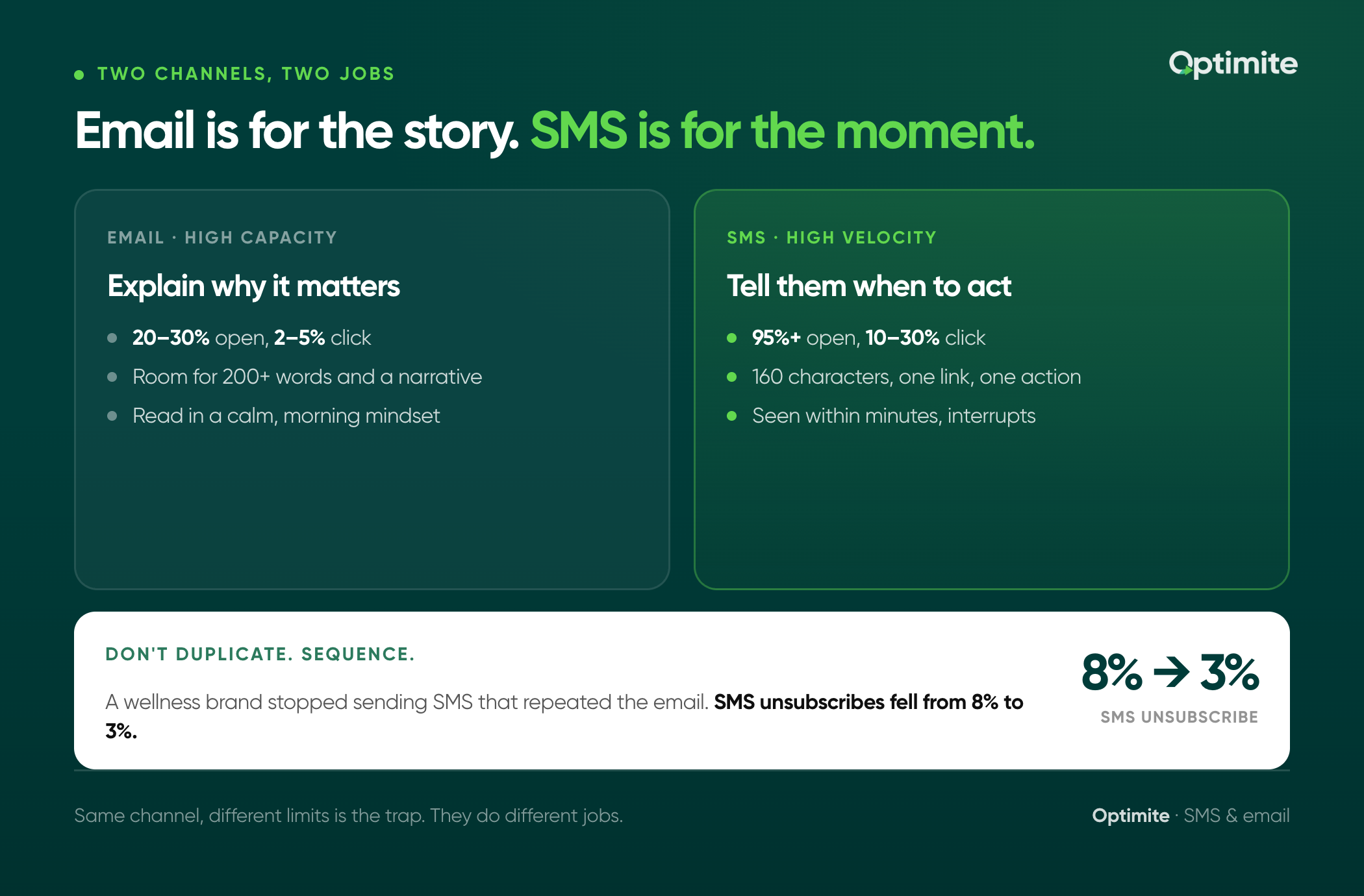
Here's what each channel actually does:
Email Reach is good. Open rate is 20-30% depending on list health and segmentation. Click-through rate is 2-5%. People check email deliberately. They're in a reading mindset. The content can be long. There's room for storytelling, education, and multiple CTAs.
SMS Reach is exceptional. Delivery is 98%+. Open rate is effectively 95%+. Everyone sees your text within minutes of receiving it. Click-through rate is 10-30% depending on offer relevance. But you have 160 characters. People are not in a reading mindset. They're interrupted. So you need one clear thing to do. One link. One call.
The tactical implication: email is your storytelling channel. SMS is your urgency and action channel.
Use email to explain why a product matters. Use SMS to tell someone when to buy it.
When to use email
Use email to introduce and educate A new product launch needs context. Why does it exist? Who is it for? What problem does it solve? That's an email job. You need 300-500 words to do it right. SMS won't work.
Use email to build narrative A post-purchase sequence is email-heavy. You're saying thank you, explaining how to use the product, sharing tips, building a connection. That needs length and warmth. SMS doesn't have room for relationship building.
Use email to reach people when they're not rushing Most email opens happen in the morning or during breaks. People are reading. They're open to persuasion. They have time.
Use email to drive repeat purchase through education A replenishment reminder is about helping someone remember they need your product. You might share usage tips, new products in the category, or educational content. SMS urgency doesn't fit here. Email context does.
When to use SMS
Use SMS for time-sensitive offers Flash sales, limited inventory, expiring codes. SMS works because it creates urgency. The recipient sees your text immediately. They feel the pressure. They act fast.
Use SMS to remind someone mid-journey A customer abandoned their cart at 2 PM. You sent email at 4 PM. They didn't click. At 6 PM, you send SMS. The message is simple: "Still interested? Complete your purchase by midnight." The SMS lands right when they're thinking about the afternoon.
Use SMS to confirm orders or ship notifications This is transactional, but it works. "Your order 12345 shipped. Track here." SMS is faster and more reliable than email for critical moments. People check their texts before email.
Use SMS to drive immediate action An inventory alert. A re-engagement offer only valid today. An app notification about a live sale. These need to land NOW. SMS does that. Email doesn't.
Use SMS for high-CLV segments only SMS has higher costs than email. It makes sense for your best customers. A customer who has spent $500 with you? Worth SMS. A customer who spent $40 and never engaged? Email only.
Sequencing: the right order in the same journey
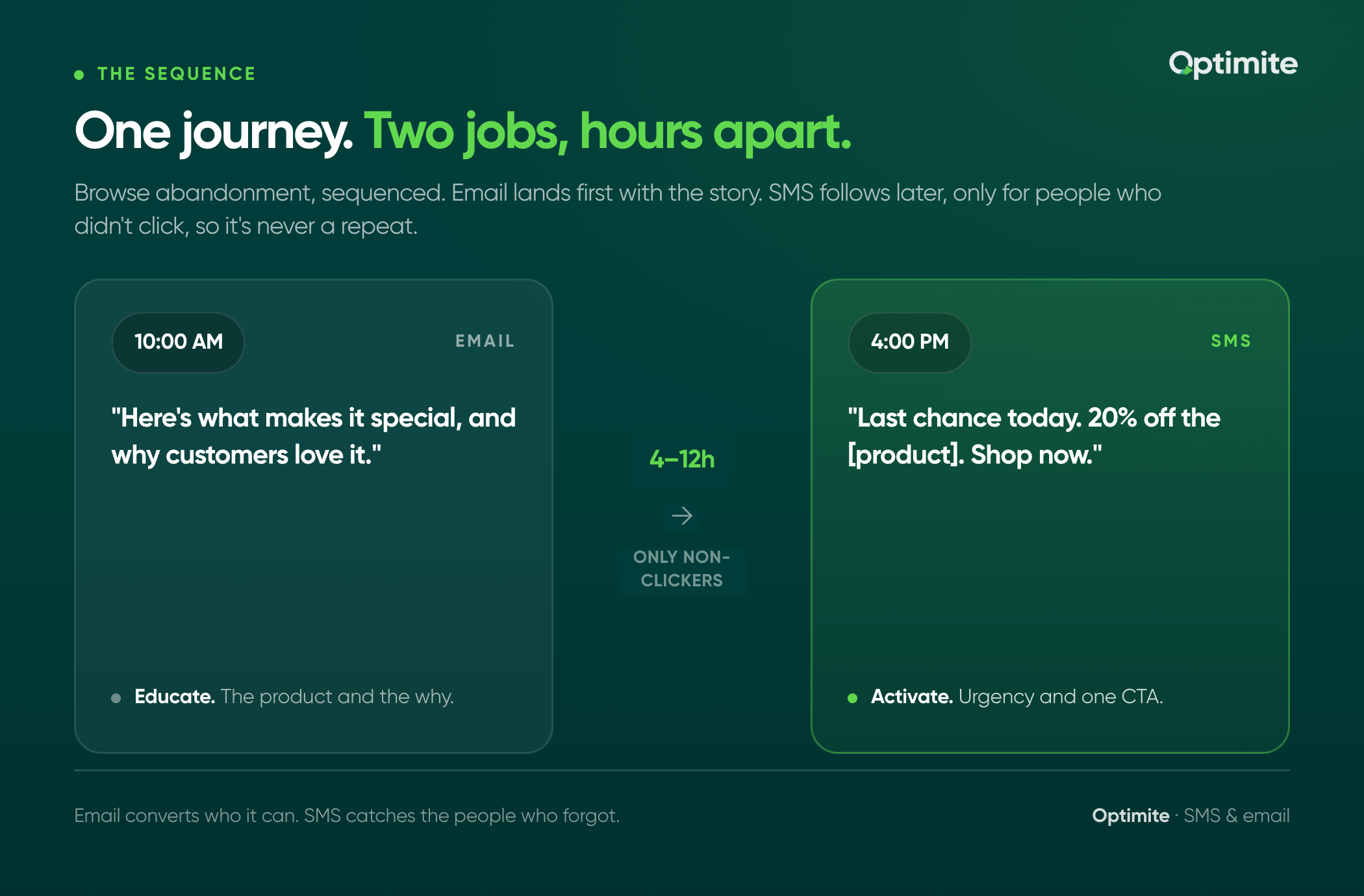
This is where the system becomes powerful. You're not choosing email or SMS. You're choosing the sequence.
Here's a common example: browse abandonment.
Poor sequence (most brands do this): Send email to customer who abandoned browse at 10 AM. Send SMS at 10
AM with the same product and message. Result: Annoyed customer. Confused about what they should do.Good sequence: Email at 10 AM: "We noticed you were checking out this product. Here's what makes it special and why customers love it." Include the product image, description, and a link.
SMS at 4 PM to people who didn't click the email: "Last chance today. 20% off the [Product Name] you were looking at. Shop now." Time-specific, urgent, clear CTA.
Result: Customer gets the story. If they're interested but need a nudge, SMS lands later with urgency. Better open rate on SMS. Better conversion overall.
Here's another: post-purchase.
Poor sequence: Day 1 email: Thank you for your order. Day 1 SMS: Thank you for your order. Result: Same message, two channels. Feels redundant.
Good sequence: Day 1 email: Thank you. Here's your order confirmation. Arrives in 3-5 days. In the meantime, here's how to use the product.
Day 3 SMS (to high-value customers only): Your order is out for delivery. Track here.
Day 7 email: How are you loving the product? We'd love to see photos. Here are some tips to get the most from it.
Day 14 SMS (only to engaged customers): Ready to stock up? Reorder now and get 15% off your next purchase.
Result: Each touchpoint does something different. Email gives context and education. SMS gives urgency and time-specific information. Customer feels supported, not bombarded.
Sequencing strategy in Klaviyo
This is how you set it up:
Step 1: Define the jobs for each channel Email: story, education, relationship SMS: urgency, action, immediate response
Step 2: Sequence timing by job If email is job one (educate), email goes first. If SMS is job two (drive action), SMS goes 4-24 hours later.
Step 3: Segment SMS intelligently Not everyone gets SMS. High-value customers yes. New customers who haven't opted in to SMS, no. Recent engagers who clicked the email, no. They already got the message.
Step 4: Make SMS independent Don't reference the email in SMS. Don't say "As we mentioned." Write SMS like it's the first touch. Short, clear, actionable.
Step 5: Test timing Try SMS at different delays. 2 hours after email. 6 hours. 24 hours. See where conversion is highest. The answer changes by audience and product.
Common mistakes in SMS-email sequencing
Mistake 1: Sending the same message twice If email and SMS say the same thing, one is redundant. Make them different. Different message. Different ask. Different timing.
Mistake 2: SMS blast to everyone SMS has list fatigue risk. Use it strategically. High-value customers. Engaged segments. Time-sensitive moments. Not every email should have an SMS twin.
Mistake 3: SMS without a clear CTA Email can have multiple links. SMS should have one. One link. One action. If your SMS has three things to do, it fails.
Mistake 4: SMS that's too long If you're writing more than one sentence for SMS, rewrite it shorter. SMS is not email in a text format. It's a different medium. Treat it like one.
Mistake 5: No delay between email and SMS Sending them simultaneously feels like a mistake to the customer. At least 2-4 hours between channels. Let email land first, convert who it will convert, then SMS lands as a follow-up for people who didn't act.
Mistake 6: Ignoring SMS compliance SMS has specific requirements. You need explicit opt-in for SMS marketing. You need clear unsubscribe instructions. You need to respect frequency caps. Set up SMS compliance in Klaviyo before launching any SMS flow.
Real examples: how it works at different stages
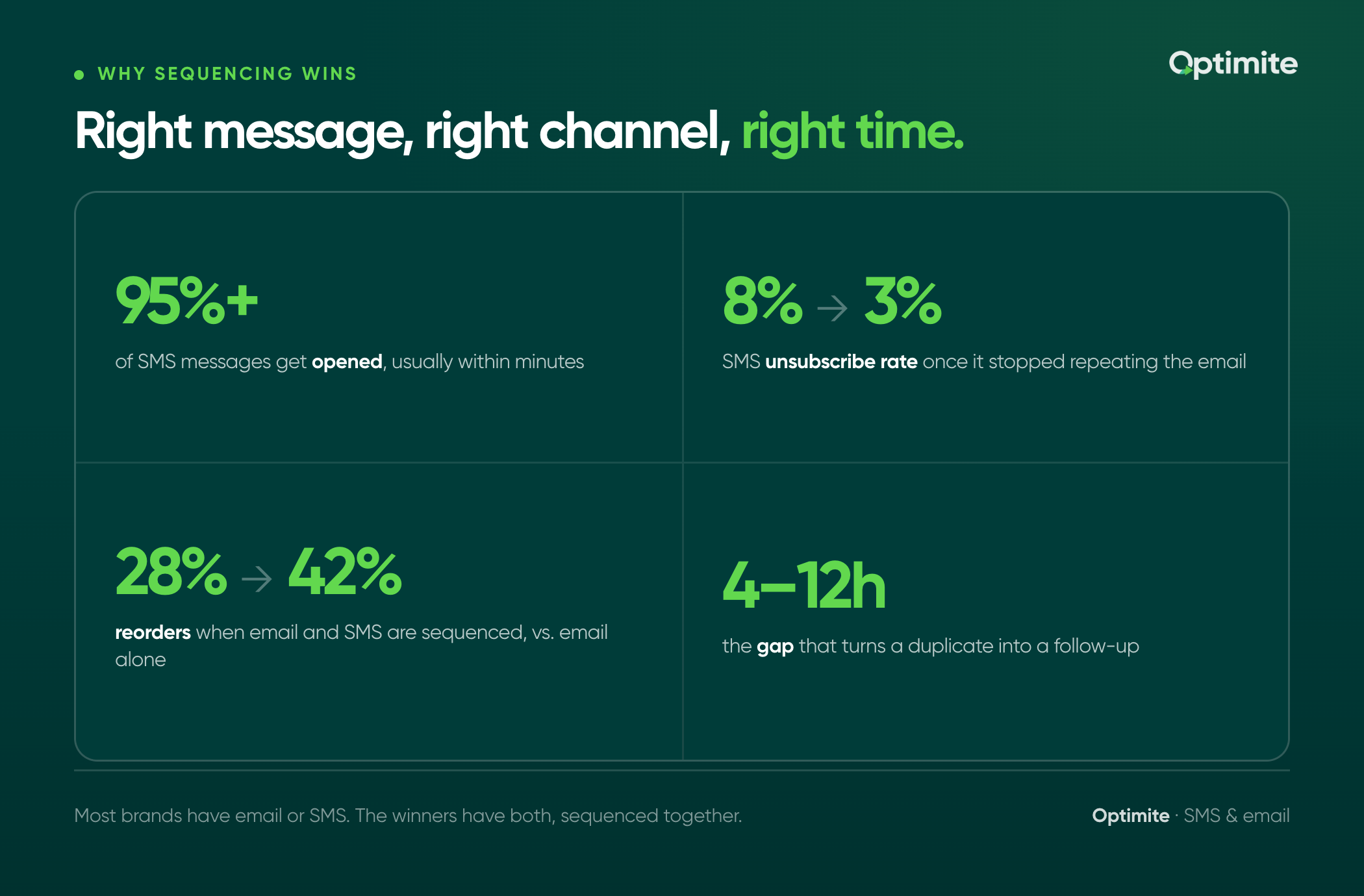
We've tested this strategy across different brands and verticals in our case studies. Here are a few concrete examples from how we've deployed it:
Fashion brand: browse to purchase
Email at 12 PM: Browse abandonment. Product image, description, why it sells, customer reviews. Link to the product.
SMS at 6 PM (to customers who didn't click email): Flash sale ending tonight. 20% off [product name]. Link.
Result: 34% email open rate. 18% email click rate. 22% SMS open rate. 24% SMS click rate. Many customers convert on one or the other. Some convert on both (different sessions).
Wellness brand: restock reminder
Email on day 35 (normal repurchase day): Your subscription is ready for a new shipment. Current order details. How to customize or skip. No urgency.
SMS on day 45 (if they haven't confirmed yet): Your shipment is holding. Confirm by midnight to ship tomorrow. Yes/No.
Result: 28% of people who got email but not SMS reordered. 42% of people who got both sequences reordered. Email captures people ready to reorder anyway. SMS captures the people who forgot.
Food brand: post-purchase engagement
Email on day 1: Thank you. Arrives in 2 days. Here's how to use it. Tips. Recipes.
Email on day 5: How did your first order go? We'd love photos. Here are some user-generated examples.
SMS on day 7 (high-value customers only): Quick poll. How are you loving it? 1-5 stars. SMS link to fast feedback.
Email on day 21 (if they engaged): Your next shipment is ready. Same plan or customize? Here are new products to try.
Result: Multiple touchpoints, each with a different job. Email builds relationship. SMS drives immediate feedback. Customer feels connected to the brand, not marketed to.
The pattern is always the same. Email sets up the context. SMS drives the action. Timing creates the right moment. Segmentation keeps it relevant.
Most brands have email or SMS. The brands winning at retention have both, sequenced together.
Email alone is too slow for urgency. SMS alone has no room for storytelling. Together, timed right and targeted right, they create a system where the customer gets the information they need when they need it.
Start by mapping out your most important journeys. Identify where email educates and where SMS drives action. Then sequence them with 4-12 hours between channels. Segment SMS to your best customers. Measure and refine.
Your SMS list will thank you. Your conversion rate will follow.
Ready to build a sequencing system that actually works? Book a free call with us today and let's talk about your SMS and email strategy.
Keep reading.
All posts
Using AI to Personalise SMS Without Burning Your Unsubscribe Rate
Shrestha Ghosal · Jun 24, 2026

Post-Purchase Email Sequence: The 5 Emails Every E-commerce Brand Needs
Shrestha Ghosal · Jun 17, 2026

How to Test Email Subject Lines Without Wasting Your List
Arpit Mehar · Jun 16, 2026