

Post-Purchase Email Sequence: The 5 Emails Every E-commerce Brand Needs
 Shrestha Ghosal
Some e-commerce brands spend 80% of their marketing budget getting a customer to buy once. Then they send an order confirmation, a shipping update, and go quiet.
That silence is where revenue leaks.
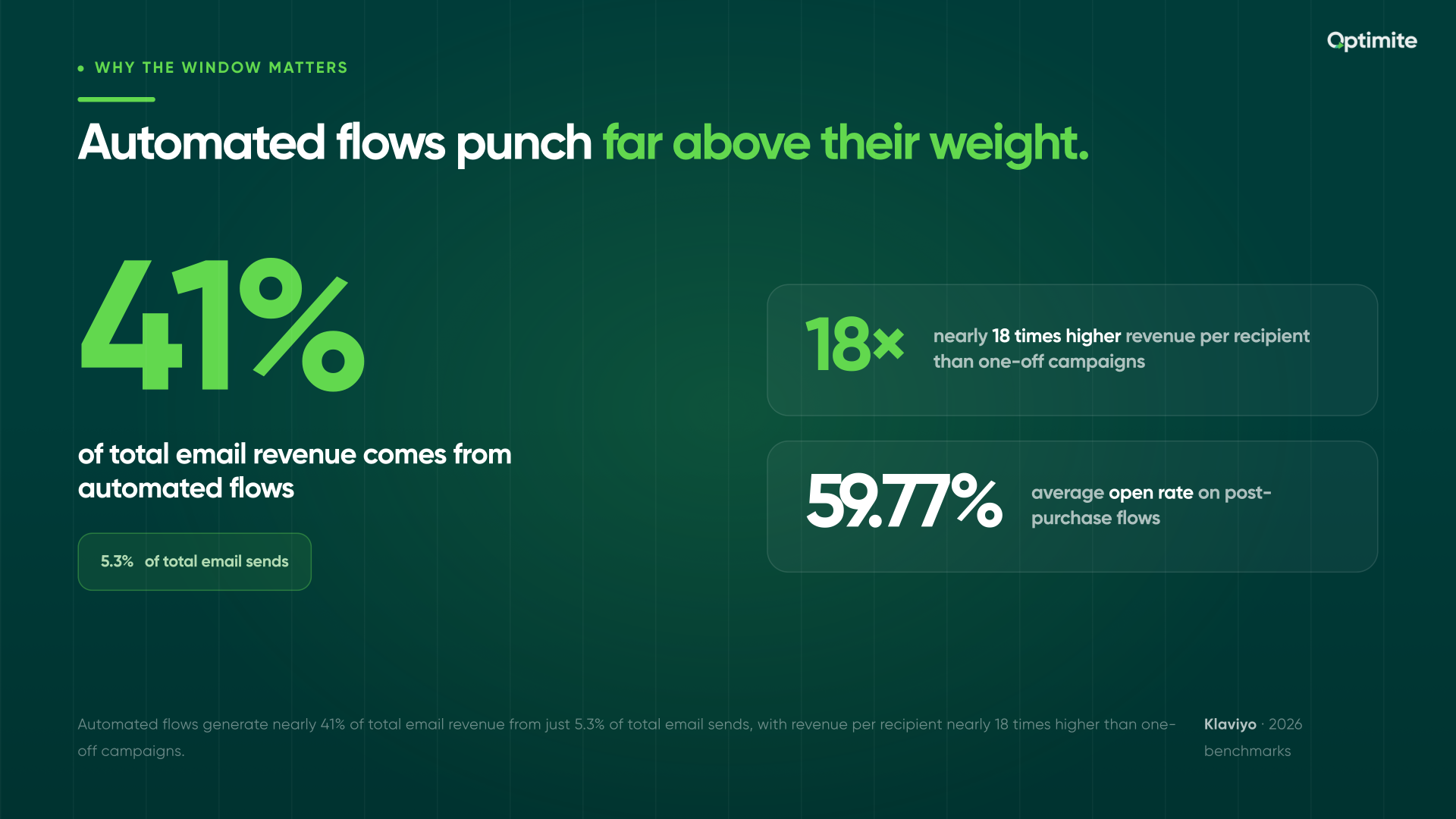
According to Klaviyo's 2026 email marketing benchmarks, automated flows generate nearly 41% of total email revenue from just 5.3% of total email sends, with average revenue per recipient that is nearly 18 times higher than that of one-off campaigns. Post-purchase flows sit at the centre of that. Yet in most Klaviyo accounts we audit, the post-purchase flow is the most underdeveloped automation in the entire account. Welcome series: built. Abandoned cart: built. Post-purchase: three transactional emails and a review request that fires on day two when the product hasn't even arrived yet.
This guide covers what a post-purchase email sequence actually needs to do, the five emails that belong in every ecommerce brand's flow, what goes inside each one, and the specific mistakes that turn a high-intent window into a missed opportunity.
Why the 48 hours after a purchase is your highest-leverage window
When a customer hands over their credit card details, they are paying attention. They are slightly anxious. They are wondering whether they made a good call.
That psychological state, called post-purchase dissonance, is well documented. A 2022 Slickdeals report found that 74% of US online shoppers have experienced buyer's remorse. The gap between what a customer expected and what they experience in the hours after a purchase is often what decides whether they come back.
This matters more than most brands realise. According to data from Gorgias, repeat customers account for only 21% of total customers but generate 44% of revenue and 46% of all orders. The post-purchase window is where you either start building one of those repeat customers or quietly lose them to indifference.
The post-purchase email sequence is the system that fills that window with intention.
According to Klaviyo benchmarks, post-purchase flows have an average open rate of 59.77%. That is higher than almost any campaign you will ever send. These emails arrive when a customer is most engaged with your brand. Using that window to send a generic confirmation and disappear is a structural mistake.
The 5 emails that belong in every post-purchase flow
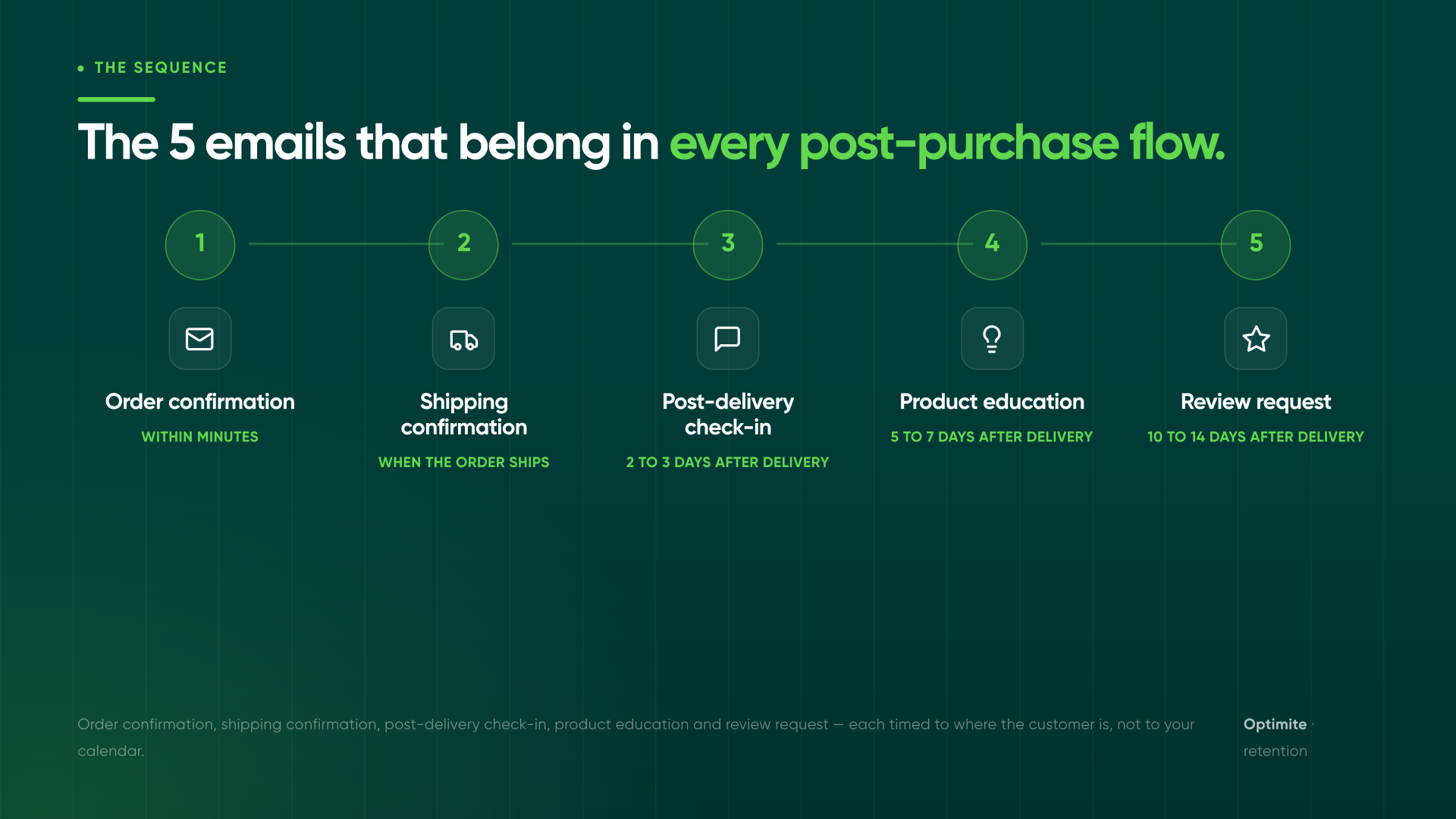
Email 1: The order confirmation within minutes of purchase
This email serves a functional purpose, and most brands treat it accordingly. Order number, items purchased, total paid, and estimated delivery date. Functional, accurate, and forgettable.
The opportunity here is larger than most brands use. Your customer just opened an email within seconds of buying something from you. Open rates on confirmation emails are among the highest in any brand's entire send history.
What to include beyond the transactional basics:
A single line that acknowledges the customer made a good choice. Not effusive, not corporate. Something specific to the product they bought or the brand they just joined. Something that demonstrates you know this product and you know what your customers experience with it.
A clear customer service contact in the same email. The most common trigger of post-purchase anxiety is the fear that something will go wrong and it will be hard to fix. Showing the support channel upfront, before anything has gone wrong, is a trust signal most brands underuse.
One soft brand signal. A sentence or two about what you stand for, framed around the customer's purchase, not around your mission statement.
No upsell in this email. The customer just gave you money. The confirmation is not the moment to ask for more.
Email 2: The shipping confirmation when the order ships
This email is almost universally treated as a logistics notification. Tracking number, carrier, and estimated arrival. That is necessary. It is not sufficient.
The shipping confirmation arrives at a moment of genuine anticipation. The customer knows the product is on its way. Their engagement level is high. You have their attention for 30 seconds, and most brands waste it on a courier link.
What the shipping confirmation should do:
Tell the customer what happens when the product arrives.
Set up the next email. Mention that you will check in after delivery. This creates an expectation that reduces the chance of your follow-up email being read as random marketing.
Keep it short. This is a transitional email. The goal is to maintain warmth and set expectations.
Email 3: The post-delivery check-in within 2 to 3 days after delivery
This is the most underbuilt email in most post-purchase sequences and the one with the most direct impact on repeat purchase rate.
The post-delivery check-in arrives after your customer has received the product. They have opened the package, used it once or seen it in their space, and formed a first impression. That first impression is happening with or without you. The question is whether you are part of it.
What this email is for:
Acknowledge the delivery. Something specific to the product experience.
Create a moment of two-way communication. Ask one question that the customer can answer by replying to the email. This is low friction, and the responses are genuinely useful.
Surface your community, where relevant. If you have an active social community, ambassador programme, or user-generated content hub, this is the appropriate moment to mention it. The customer has the product. They have an opinion. The timing is right.
No hard sell. This email is doing relationship work.
Email 4: The product education email within 5 to 7 days after delivery
This is the email that separates brands with high repeat purchase rates from brands stuck with low ones. Most brands skip it entirely or combine it with an upsell. That is a structural error.
The product education email does something specific: it increases the likelihood that your customer gets genuine value from what they bought.
What goes in a product education email depends on your vertical, but the principle is consistent. You are answering the questions your customer has not yet asked. The ones that, if unanswered, lead to underwhelming first impressions.
For a supplement brand: the science behind the key ingredient, the timeline for when effects become noticeable, and common mistakes in the first week.
This email should be primarily informational. If you include a product recommendation, make it one, make it directly relevant to what the customer bought, and frame it as a natural complement rather than a promotion.
Email 5: The review request within 10 to 14 days after delivery
Almost every e-commerce brand sends a review request. However, the timing of a review request matters more than the incentive attached to it. Most brands send the review request three to five days after delivery, before the customer has formed a strong opinion. The result is a lukewarm review from someone who has used the product once, or no review at all, because the customer feels they cannot speak to it yet.
The right timing is at peak satisfaction. Peak satisfaction is different for every product category.
Ask yourself honestly: when does a customer who bought this product typically feel best about having bought it? That is when the review request should arrive.
The mechanism behind the review request as a retention tool is documented in research on public commitment. A customer who has publicly endorsed a product has, in effect, reinforced their own decision to buy it. The act of writing a positive review makes a customer meaningfully more likely to purchase again because they articulated to themselves and to others why the purchase was a good one.
How segmentation changes the sequence
A post-purchase sequence built for all customers performs worse than one that accounts for where a customer is in their relationship with your brand.
First-time buyers need more of everything in this sequence. More reassurance in the confirmation email. More education in the product email. More explicit framing of who you are as a brand. The relationship is new, and the equity is low.
Repeat buyers need less setup and faster movement in the relationship. Skip the brand story in the confirmation email for a customer on their fourth order. Replace the product education email with a recognition email: something that acknowledges they have been buying from you, makes them feel seen, and surfaces your loyalty tier or VIP programme if you have one.
Klaviyo's conditional split function makes this easy. A trigger for "number of orders placed is 1" versus "number of orders placed is greater than 1" gives you two sequences that perform the same structural work for very different audiences.
Bloomreach data shows that post-purchase follow-ups hit a 6.8% conversion rate on average. In accounts where we have segmented first-time buyers from returning buyers and built separate sequences for each, the conversion rate on the first-time buyer sequence is consistently above that benchmark.
The specific mistakes that cost you repeat customers
1. Sending the cross-sell too early. The order confirmation email is not a selling opportunity. Neither is the shipping confirmation. The moment a customer's payment clears is the moment they are least receptive to being sold again. The post-purchase sequence earns the right to make product recommendations through emails 1, 2, and 3. Email 4 is where a relevant, single, well-framed recommendation belongs.
2. Timing the review request to your calendar, not to the customer's experience. If your review request is timed to day 3 or day 5 across all products, it is almost certainly firing at the wrong moment for a meaningful percentage of your customers. Build the timing around your actual average delivery window plus the product's value realisation timeline.
3. Treating first-time and repeat buyers identically. A returning customer who gets a brand story and product education email they have already read is a customer who quietly starts ignoring your emails. Segment these audiences from day one.
4. Skipping emails entirely. The post-delivery check-in is the email most brands skip because it seems low-value. In practice, across every account we have built this into, the check-in email has one of the highest reply rates in the entire lifecycle. Replies give you qualitative data about the product experience that no analytics dashboard can generate. They also create a direct interaction between the customer and your brand that has a measurable effect on long-term retention.
5. Building the sequence once and never reviewing it. Your post-purchase sequence should be reviewed quarterly. If any of the engagements are declining, something in the content, the timing, or the segmentation has drifted.
What a well-built post-purchase sequence actually produces
In accounts where we build and optimise a complete post-purchase sequence from scratch, the most consistent outcomes are:
1. A measurable reduction in the time to the second purchase. Customers who receive a complete, well-timed post-purchase sequence typically make a second purchase 20 to 30% faster than customers who receive only transactional emails.
2. Higher review volume with better quality. A review request timed to peak satisfaction with a specific prompt consistently generates more reviews and more detailed ones than a day-3 request with a generic "tell us what you think."
3. Higher repeat purchase rates on subsequent cohorts. According to Opensend data, post-purchase email sequences featuring personalised product recommendations based on previous buying behaviour typically boost repeat rates by 10 to 15%.
4. Lower unsubscribe rates. A post-purchase sequence that delivers genuine value, education, and one moment of two-way communication conditions subscribers to expect useful content from you. That expectation carries forward into how they engage with your campaigns.
Where to start
If you have a post-purchase flow that is currently three transactional emails and a review request, the fastest place to start is the post-delivery check-in. Ask one specific question. Send it two to three days after your average delivery date. Set up a Klaviyo notification for replies and read them.
Within two weeks, you will have qualitative data about your customer's product experience that your entire analytics stack cannot give you. You will also have created the first moment of genuine two-way communication in your post-purchase lifecycle. Most of your competitors have not done this.
The full sequence takes longer to build correctly. Segmenting by order number, timing the review request properly, and building product education content for each category takes time. But the structure above is the right sequence to build toward, and the post-delivery check-in is the right place to start.
If you want to see what your current post-purchase flow is missing and where the biggest revenue gap is, let's talk over a free 30-minute call. We will pull your Klaviyo data, map your current sequence against the benchmarks, and tell you what to fix first.


