

Post-Purchase Automation: From Thank You to Repeat Purchase
Days 2-14 after purchase are critical. Here's how to build email sequences that drive repeat purchase velocity and customer lifetime value.
 Arpit Mehar
You just made a sale. The customer bought your product. You send them a thank-you email. Order confirmation. Shipping tracking. Done.
Except that's when the real work starts.
Days 2-14 after purchase are when your customer decides if they'll ever buy again. They're using your product. They're forming an opinion. They're either getting excited about ordering again or mentally moving on to the next thing.
Most brands treat post-purchase as a completion stage. The sale is done. Ship the product. Send a thank-you. Move on to the next acquisition campaign.
The brands winning at retention treat post-purchase as the beginning of the repeat purchase journey. They use those days 2-14 to set up a customer who comes back frequently and spends more.
This post walks through how to build a post-purchase flow system that drives repeat purchase velocity and lifetime value.
The thank-you email is just the start
Let's be clear on what the thank-you email does: it confirms the order. It makes the customer feel secure. It sets delivery expectations.
That's table stakes. Every brand does it.
But a thank-you email is not a post-purchase flow. It's one email. The flow is what comes after.
A fashion brand we work with was sending a thank-you email and then waiting 45 days (their repurchase window) to send anything else. They figured the customer would come back when they needed something.
Some did. But most didn't. They forgot the brand existed. A competitor caught their attention. The repeat purchase rate was 18%.
We built a post-purchase flow that started day 2. Day 2: styling tips for the product they bought. Day 5: how to care for it. Day 9: new arrivals in the category. Day 14: exclusive 15% off if they buy again this week.
Repeat purchase rate moved to 31%. Same products. Same customers. Different follow-up strategy.
That's the power of post-purchase automation done right. You're not asking for the next sale immediately. You're building the conditions where repeat purchase becomes obvious.
The critical window: days 2-14 after purchase
This window matters more than you think.
On day 1, your customer is happy about the purchase. They just spent money. The order confirmation email is enough.
Days 2-4, they're waiting for the product. Engagement is low. You could email them, but there's not much to say. Shipping updates work. Content doesn't.
Days 5-7, they receive the product. This is when they form their first impression. Does it look like the photos? Does it work as advertised? Is quality what they expected?
This is where you want to show up. A usage tips email. A care guide. A "here's how to get the best out of this" message. You're helping them have the best experience possible.
Days 8-14, they've used the product once or twice. They have an opinion now. Are they satisfied? Would they buy again? Is it integrated into their life or sitting in a drawer?
This is where repeat purchase messaging lands. You're not making the sale yet. You're planting the seed. "We have more in this category. Customers who try this also love this. Here's something new you might like."
By day 14, if you've done this right, repeat purchase is top of mind, not an afterthought.
The three jobs post-purchase flows need to do
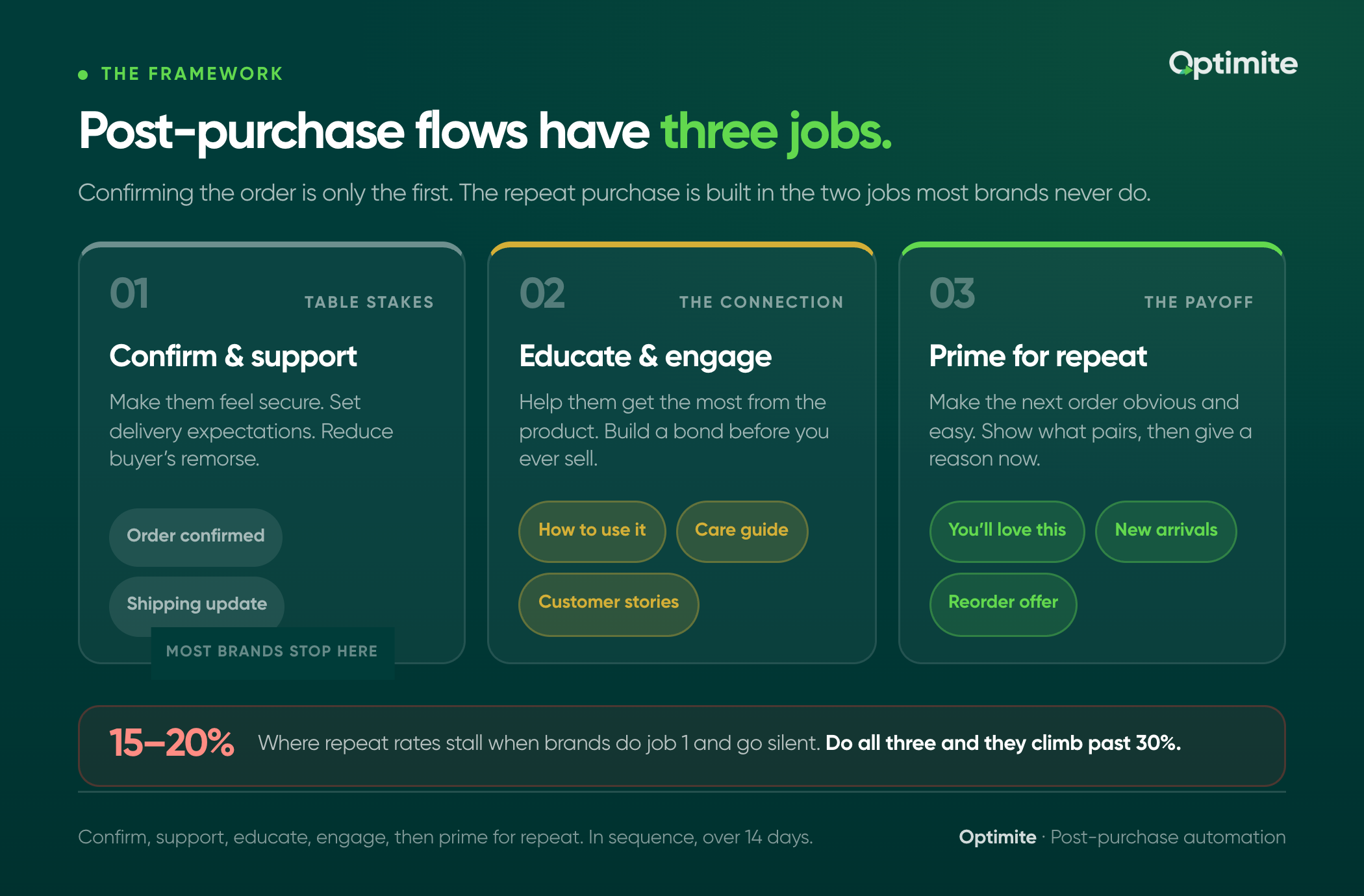
Job 1: Confirm and support Make the customer feel secure. Confirm the order was received. Set delivery expectations. Answer common questions. Reduce buyer's remorse.
Emails: order confirmation, shipping update, delivery notification. Transactional and reassuring.
Job 2: Educate and engage Help them get the most from their purchase. Share tips, usage guides, care instructions. Build a connection with the product and the brand.
Emails: "here's how to use this," "pro tips," "customer stories," "care guide," "what to do next."
Job 3: Prime for repeat Make repeat purchase obvious and easy. Show them what else is available. Remind them they can order again. Give them incentive to come back sooner than they might naturally.
Emails: "here's what pairs with what you bought," "new arrivals," "exclusive offer for repeat customers," "restock reminder."
Most brands skip jobs 2 and 3. They do job 1 (confirm) and then nothing. That's why repeat purchase rates are stuck at 15-20%.
The winning strategy does all three, in sequence, over 14 days.
Flow structure: how to sequence post-purchase
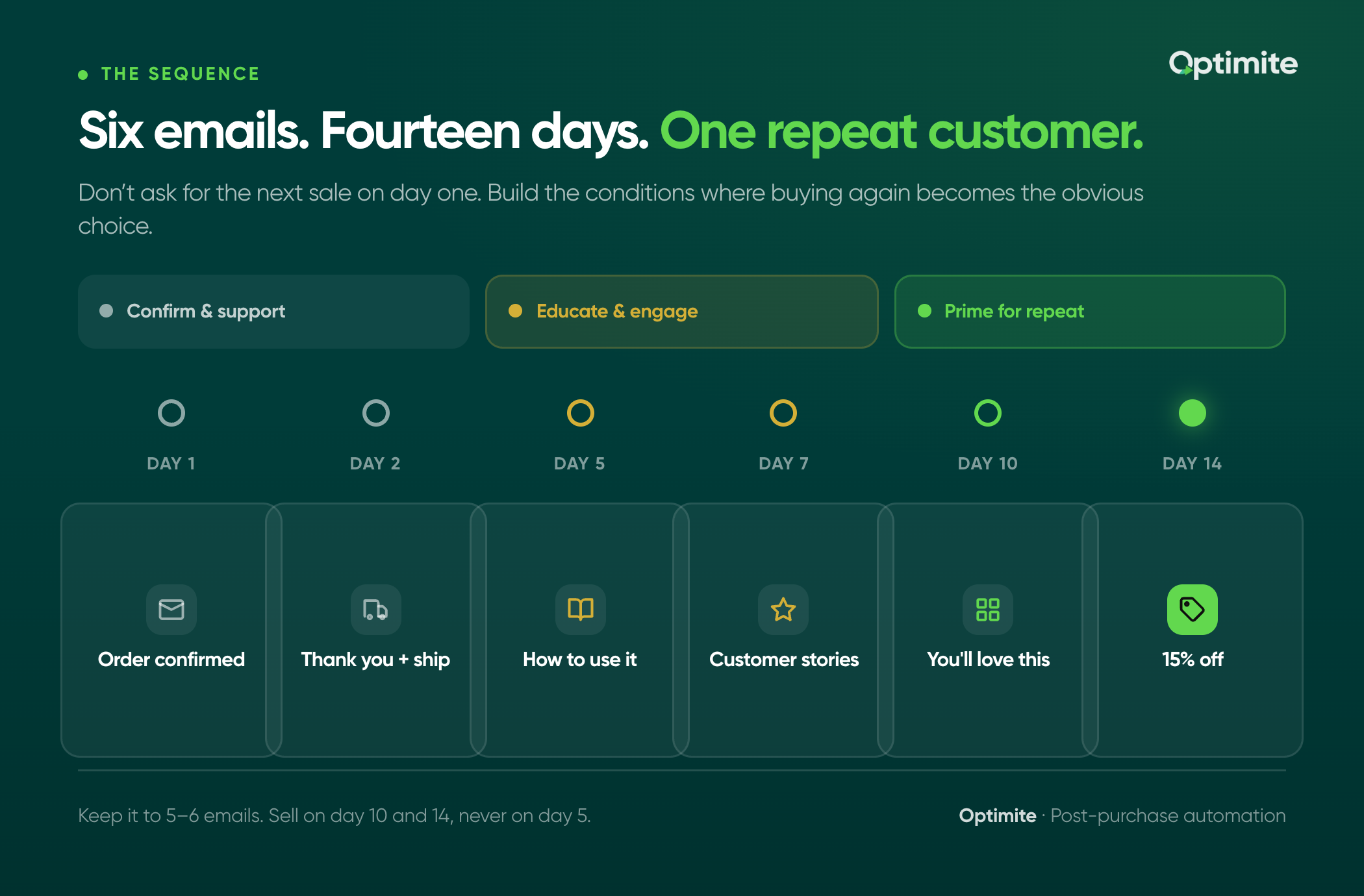
Here's how to build it:
Day 1: Order confirmation Transactional. Confirm order number, product, price, delivery date. Make the customer feel secure. No sell.
Day 2: Thank you and shipping Short and warm. Thank them for the order. Let them know when it ships. Include a FAQ link or customer service number for questions.
Day 5: Arrival and welcome Assume the product arrived. Welcome them. Share a usage tip or care guide. Make them feel supported.
Day 7: Engagement They've had the product a week. Share something valuable. Customer testimonials. Before-and-after photos. Tips from other users. Build excitement about the product.
Day 10: New products They're settled into the product. They're thinking about what's next. Show them related products. Cross-sells. New arrivals. Make repeat purchase obvious.
Day 14: Special offer Time-limited offer for next purchase. "Reorder and get 15% off." "Buy again before end of month and get free shipping." Create urgency without being pushy.
This is the skeleton. You adjust based on your product and industry. Subscription brands might skip day 14 (they're auto-replenishing). Perishable goods might move day 5 earlier (product arrives faster). Fashion might add a review request on day 10 (after they've worn it).
But the structure stays the same. Confirm, support, educate, engage, prime for repeat.
Email template guide for each stage
Day 1: Order Confirmation Subject: Your order is confirmed Content: Order number. Product name and image. Price. Delivery date. Tracking link when available. Tone: Transactional, reassuring. CTA: Track your order.
Day 2: Thank You and Shipping Subject: Thank you, [Customer]. Your order ships today. Content: Warm thank-you. When to expect delivery. A single FAQ or link to customer service. Tone: Friendly, helpful. CTA: View FAQ or Track your order.
Day 5: Arrival and Engagement Subject: Your [Product Name] arrived. Here's what to do first. Content: Welcome message. 2-3 quick tips on how to use it. Care instructions if applicable. Tone: Helpful, supportive. CTA: View care guide or View tips.
Day 7: Testimonials and Excitement Subject: How other customers are using [Product Name] Content: 2-3 customer testimonials or before-and-after photos. Short. Visual. Builds confidence. Tone: Inspirational, social proof. CTA: See more customer stories.
Day 10: Related Products and Cross-Sells Subject: Since you loved [Product Name], you'll love this Content: 2-3 related products. Why they pair well. Brief description of each. Tone: Helpful, not pushy. CTA: Shop the collection or Explore similar products.
Day 14: Limited-Time Offer Subject: 15% off your next order. Valid through [date]. Content: Offer details. What they can get. When the offer expires. A sense of urgency without aggression. Tone: Direct, time-bound. CTA: Claim your offer or Shop now.
The crucial metrics
Don't just track open rate and click rate. Track what matters for repeat purchase.
Engagement rate by day: Which days get opens? Which emails drive clicks? If day 5 emails aren't opening, that's a signal that the timing or subject line is wrong. Adjust and retest.
Click-to-repeat conversion: Of the people who clicked the day 10 and day 14 emails, how many actually placed another order within 30 days? This tells you if your post-purchase flow is actually priming repeat purchase.
Repeat rate cohort: Compare repeat purchase rate for customers who went through your post-purchase flow versus those who didn't. What's the lift? If it's less than 8 percentage points, your flow isn't working.
LTV impact: Customers who went through the full post-purchase flow should have higher lifetime value than those who didn't. How much higher? That's your return on the effort.
Unsubscribe rate by stage: If your day 14 email has a 0.5% unsubscribe rate and your day 5 has 0.1%, people are getting annoyed by the day 14 offer. Maybe it's too aggressive. Adjust.
Common mistakes that kill repeat purchase
Mistake 1: Too many emails too fast Sending an email every day for 14 days is overkill. You create fatigue. Stick to 5-6 emails over 14 days. Space matters.
Mistake 2: Selling on day 5 The product just arrived. The customer is still forming their opinion. Don't ask them to buy again yet. Support them. Educate them. Sell them on day 10 or 14, not day 5.
Mistake 3: Generic templates "Thanks for your order" works for a t-shirt and a vitamin. But the follow-up should be specific. Vitamin buyer gets usage tips. T-shirt buyer gets styling ideas. Generic kills engagement.
Mistake 4: No segmentation A customer who buys a $400 item should get different treatment than someone who buys a $40 item. High-AOV customers might get a phone call on day 2. Low-AOV customers get an email on day 5. Treat them differently.
Mistake 5: Ignoring product type A perishable good has a different flow than a durable good. A subscription has a different flow than a one-time purchase. Build flows specific to what you're selling, not generic flows for all products.
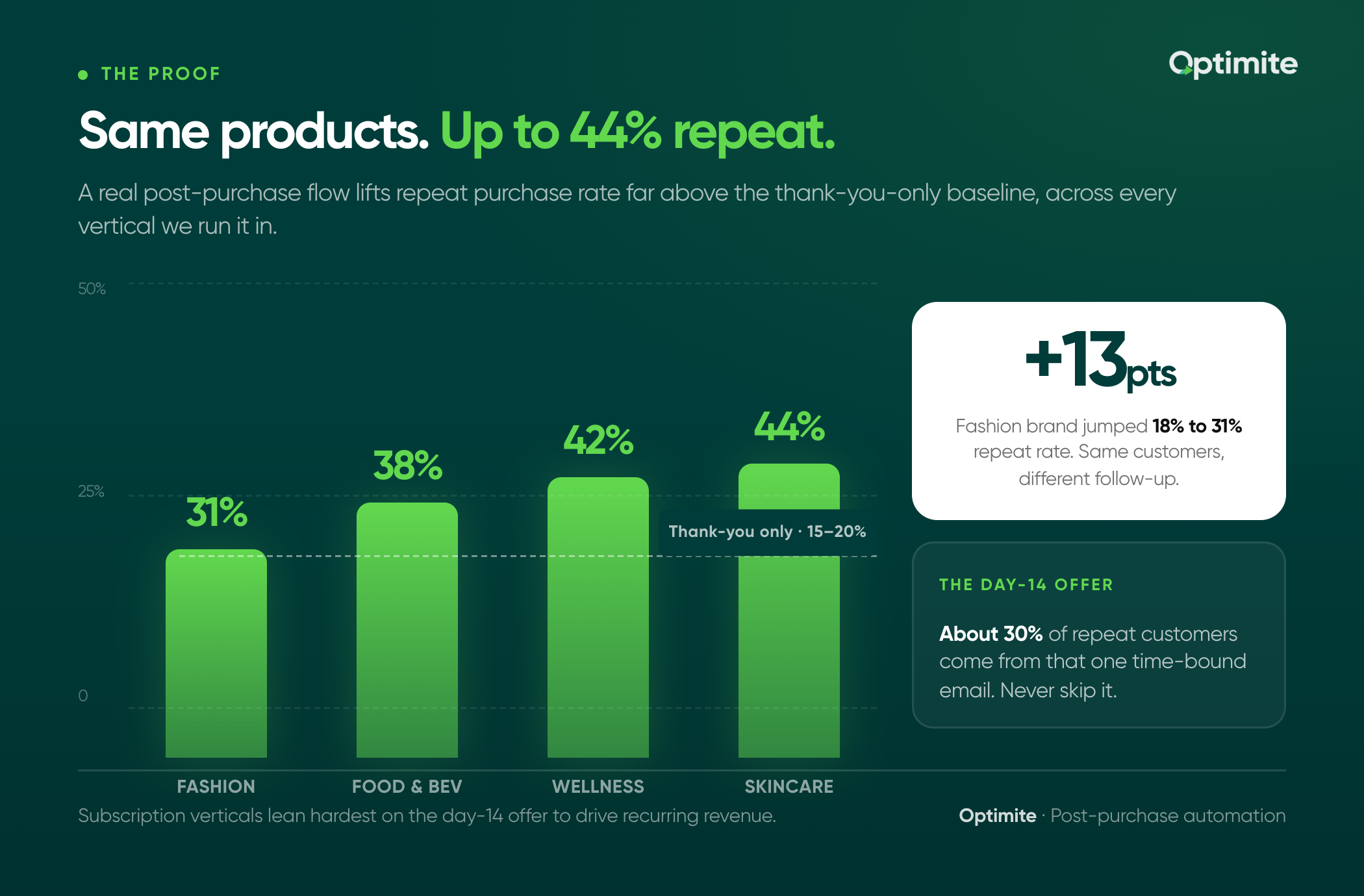
Mistake 6: No offer on day 14 Some brands skip the special offer because they think it's pushy. But 30% of your repeat customers will come from that day 14 offer. Don't skip it.
Real examples by vertical
We've tested these flows across different verticals and brands. Check out our case studies to see how post-purchase automation has driven repeat purchase lift for D2C brands.
Fashion brand Day 1: Order confirmation. Day 2: Thank you and shipping. Day 5: Styling tips for the item they bought. Day 7: Customer photos wearing the item. Day 10: New arrivals in that category. Day 14: 15% off next purchase, valid this week. Result: 31% repeat purchase rate. 22% of repeats from day 14 offer.
Wellness brand Day 1: Order confirmation. Day 2: Thank you. Shipping date. Day 5: How to use the supplement. Best time of day. What to expect. Day 7: Customer testimonials on results. Day 10: Related products that pair well. Day 14: Subscribe and save 20% (or) reorder and get 15% off. Result: 42% repeat purchase rate. Heavy on day 14 offer (subscription angle).
Food and beverage brand Day 1: Order confirmation. Day 2: Thank you. Delivery date. Day 5: Recipe ideas using the product. Day 7: Customer meal photos. Day 10: New flavors or seasonal items. Day 14: Reorder before end of month and get free shipping. Result: 38% repeat purchase rate. Day 7 email (recipes) drives highest engagement.
Skincare brand Day 1: Order confirmation. Day 2: Thank you and shipping. Day 5: How to use the product. Skincare routine suggestions. Day 7: Before-and-after customer photos. Day 10: Related products that pair well (serum to go with moisturizer, for example). Day 14: Subscribe for 20% off monthly shipments. Result: 44% repeat purchase rate. Subscription angle on day 14 drives monthly recurring revenue.
Post-purchase automation is where repeat purchase velocity happens. Not through acquisition. Not through discounts. Through a well-designed sequence that educates, engages, and makes the next purchase obvious.
Build a flow. Test it. Measure repeat rate lift. Refine based on engagement data. Your second customer purchase is sitting in days 2-14 after the first one. You just have to show up and help them get there.
Ready to build a post-purchase system that actually drives repeat purchase? Book a call and let's talk about your automation strategy.
Keep reading.
All posts
Using AI to Personalise SMS Without Burning Your Unsubscribe Rate
Shrestha Ghosal · Jun 24, 2026

Post-Purchase Email Sequence: The 5 Emails Every E-commerce Brand Needs
Shrestha Ghosal · Jun 17, 2026

How to Test Email Subject Lines Without Wasting Your List
Arpit Mehar · Jun 16, 2026