

How to Use AI to Turn One Campaign Into Five Without Sending More
One brief. Five versions. Zero extra sends. Here's how AI-assisted personalisation works in practice for DTC retention programmes.
 Shrestha Ghosal
One campaign brief. Five segment-specific emails. The same number of sends you were already planning.
That's the shift AI makes possible in ecommerce email marketing strategy, and it's one of the most underused applications in DTC retention right now. Brands are spending time writing one version of every campaign and sending it to their entire list. The result is predictable: strong opens from a small slice of engaged subscribers, soft performance from everyone else.
Personalisation has always been the answer. The barrier has always been time. Writing five versions of the same campaign used to take a copywriter a full day. AI brings that down to under an hour, which means the economics of segmented sends finally make sense for brands that aren't running a 10-person marketing team.
Why sending the same email to everyone is expensive
When every subscriber gets an identical copy, the email works well for one slice of your list and poorly for the rest. You might see a 22% open rate and feel satisfied. But that 22% is carrying the weight. The other 78% either ignored it or found it irrelevant, and every irrelevant send chips away at engagement rates, deliverability, and eventually your sender reputation.
The brands generating 25-30% of total revenue from email aren't sending more campaigns. According to Klaviyo's benchmarks, segmented sends consistently outperform broad sends on revenue per recipient by a significant margin. The difference comes from relevance. Relevance, at scale, requires personalisation by segment.
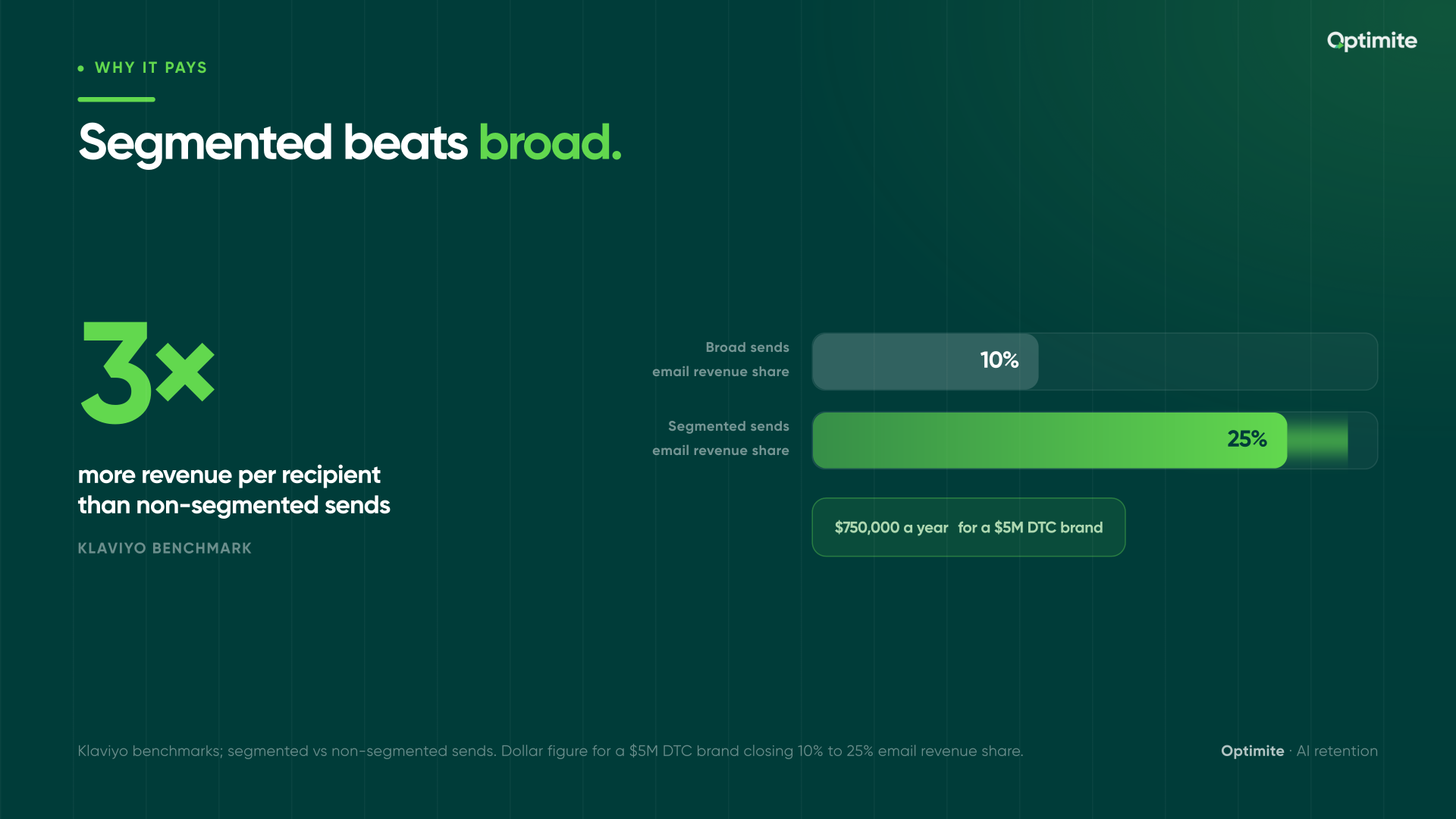
For a $5M DTC brand, closing the gap between 10% and 25% email revenue share is worth $750,000 a year. The channel underperforms when the content treats everyone the same.
Klaviyo data shows that segmented campaigns generate up to 3x more revenue per recipient than non-segmented sends. Most brands already have the segments. The bottleneck is writing different content for each.
What AI actually does in this workflow
The role of AI here is editorial and structural, not creative. You bring the campaign idea, the offer, and the brand voice. AI helps you reframe that same core message for different audience contexts without rebuilding the brief from scratch.
Here's what that looks like in practice:
- You write one master brief: the offer, the product angle, the CTA, the send date
- You define your key segments: new subscribers, one-time buyers, multi-buyers, lapsed customers, VIPs
- AI drafts a version for each segment, adjusting the hook, the framing, and the proof points to match where each customer is in their lifecycle
- You review, edit for voice, and ship
The output isn't five completely different emails. It's five variations of the same email: same offer, same CTA, different opening, different tone, different emphasis. A VIP customer doesn't need to be told what your brand does. A first-time buyer does. A lapsed customer needs a reason to come back. A multi-buyer is already loyal, so reward them accordingly.
The five segments that make sense to split
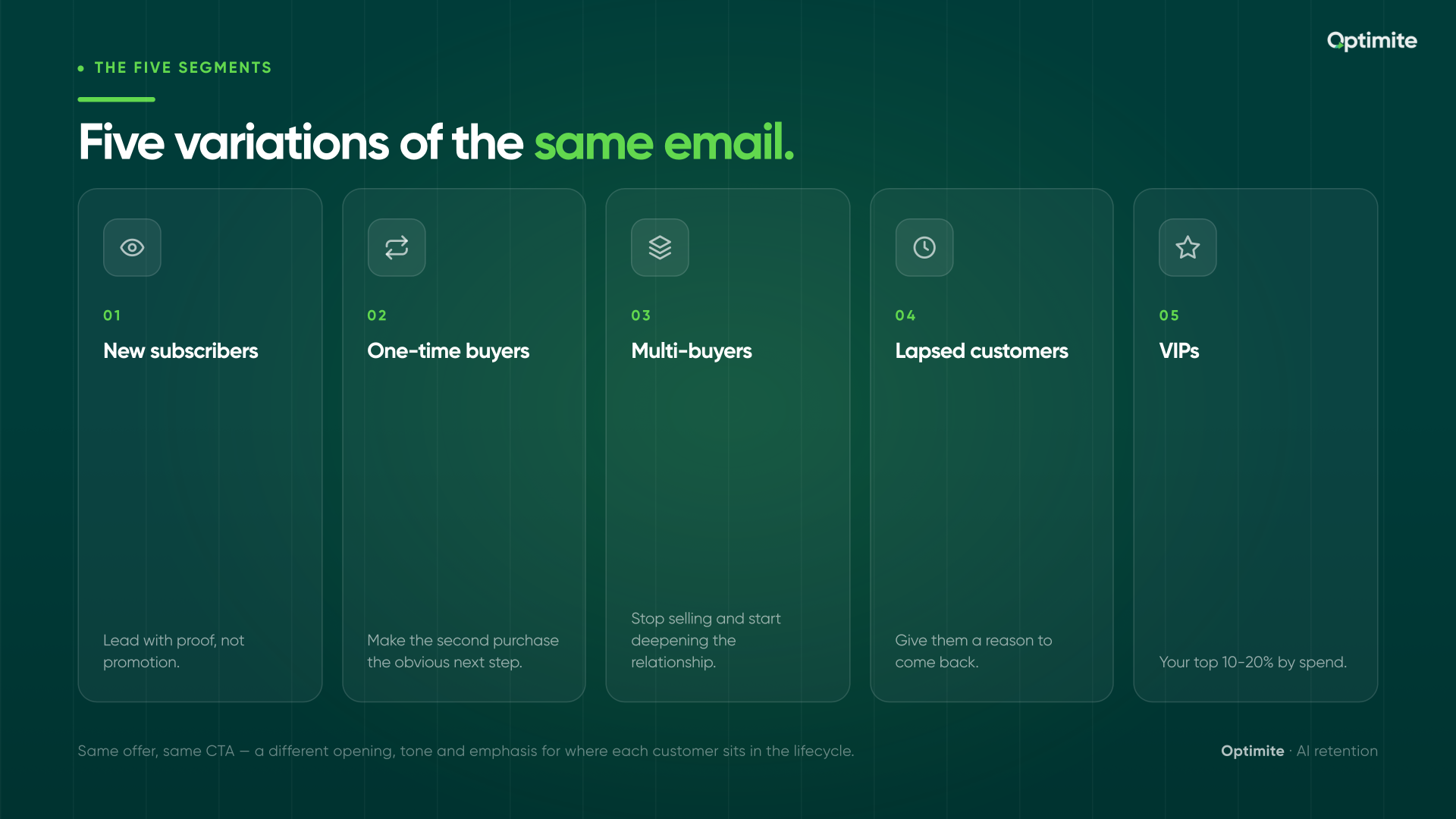
Not every campaign needs five versions. But there are five customer segments that almost always respond better to tailored copy than to a one-size-fits-all message.
1. New subscribers who haven't bought yet They're still forming their opinion of your brand. Lead with proof, not promotion. Use social signals, bestsellers, and brand story over discount hooks.
2. One-time buyers They converted once, which means the brand worked for them at some level. The job of this version is to make the second purchase feel like the obvious next step. Lead with the product they bought, connect it to the next logical purchase.
3. Multi-buyers (two or more orders) These customers already trust you. Stop selling and start deepening the relationship. Early access, loyalty acknowledgement, and product education work better than generic promotional copy here.
4. Lapsed customers (90 days or more since last order) These customers have drifted. The version for this segment needs a clear hook to pull them back: what's new, what's changed, what they might have missed.
5. VIPs Your top 10-20% by spend. They deserve different treatment, and they can usually tell when they're getting the same email as everyone else. Exclusivity, behind-the-scenes framing, and personal tone drive stronger results for this group.
Start with just two versions before scaling to five. Split your list into active buyers and inactive subscribers. Write one campaign for each and measure the difference in revenue per recipient. That data will justify the rest.
How to build the AI workflow step by step
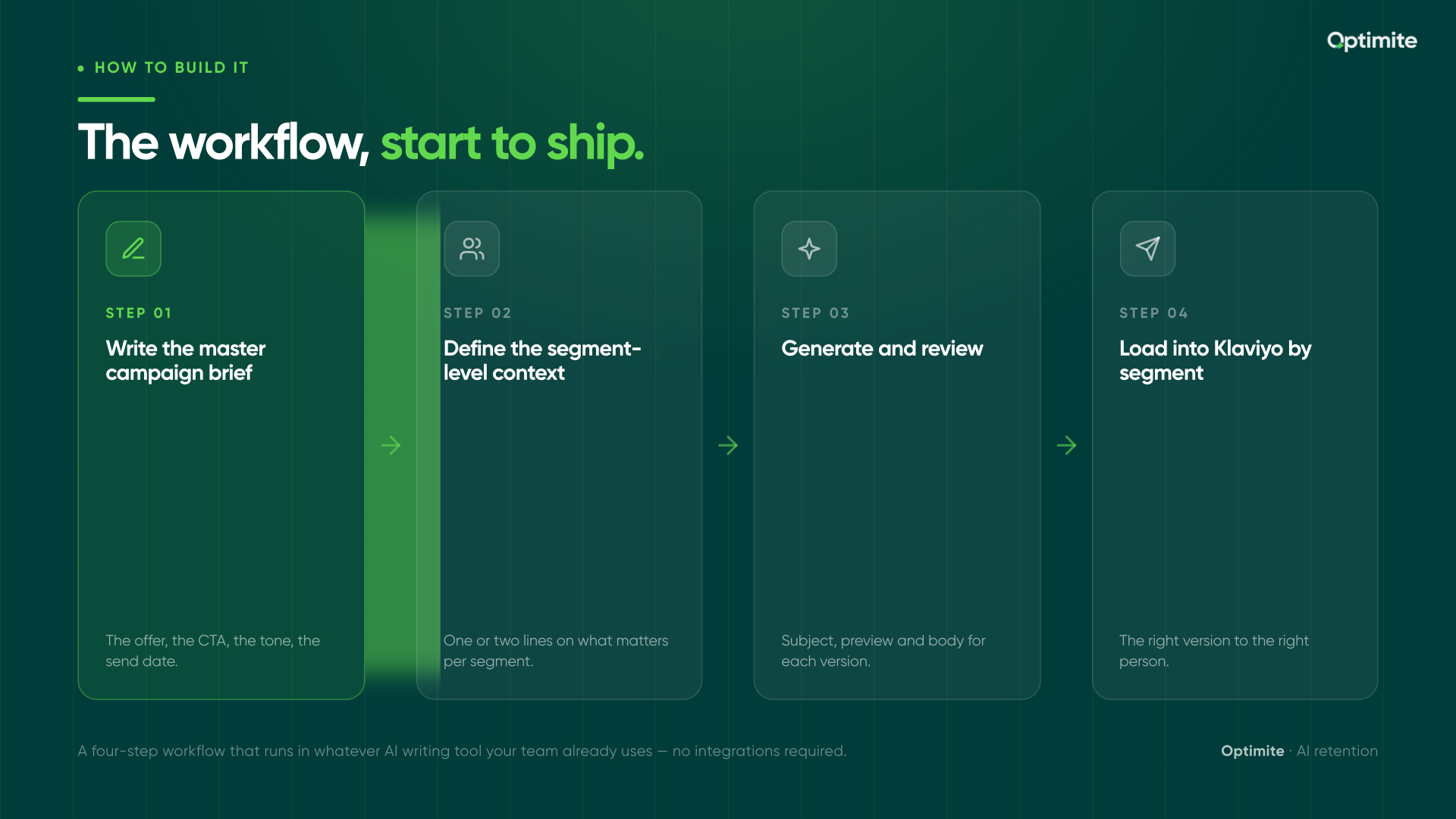
This isn't a technical setup. It doesn't require API integrations or custom tooling. The workflow runs in whatever AI writing tool your team already uses.
Step 1: Write the master campaign brief
Before touching AI, define the campaign clearly:
- What's the offer or angle (new product, restock, promotion, seasonal moment)
- What's the primary CTA
- What tone does this campaign call for (urgency, warmth, exclusivity)
- What's the send date and where it sits in the broader calendar
A vague brief produces vague outputs across every variant. This document becomes the shared input for all five versions.
Step 2: Define the segment-level context
For each of the five segments above, note one or two sentences about what matters most to that customer right now. This is the context AI uses to reframe the same message. You're not re-briefing from scratch. You're adding a lens.
Step 3: Generate and review
Run the brief plus segment context through your AI tool. Ask for subject line, preview text, and body copy for each version. Review for voice consistency, cut anything generic, and tighten the opening line for each. This step takes under 30 minutes once you've done it twice.
Step 4: Load into Klaviyo by segment
With your five versions ready, set up a campaign send in Klaviyo where each segment receives its own variant. You're not A/B testing here. You're sending the right version to the right person.
Don't use AI to write the segmentation logic itself. AI handles copy well. Segment definitions should come from your retention data: purchase count, days since last order, total spend. Poorly defined segments mean personalised copy lands on the wrong audience, and the whole exercise breaks down.
What this does for your ecommerce email marketing metrics
The impact shows up across three metrics almost immediately.
Revenue per recipient goes up. When the message matches where a customer actually is, they're more likely to act. Across wellness, beauty, and fashion brands, moving from single-version sends to segmented versions typically adds 15-25% to revenue per recipient on the same campaign.
Unsubscribe rates go down. Irrelevant emails are one of the leading drivers of list fatigue. When your lapsed segment gets a re-engagement angle instead of a generic promotional blast, fewer of them opt out.
Repeat purchase rate improves over time. One campaign won't change your repeat purchase rate. But consistent, segment-aware sending across three to six months compounds. Customers receive communication that feels considered and that shapes how they perceive your brand between purchases.
The brands doing 30%+ of revenue from email achieve that through relevance applied consistently across the lifecycle. AI makes that relevance achievable.
This workflow is most impactful for brands sending four or more campaigns per month. Below that frequency, the time investment in building and maintaining segment-level versions may outweigh the gain. Get the send cadence right first, then layer in personalisation.
What to watch for as you scale this approach
A few patterns show up once brands start running this workflow regularly.
-
Voice drift. When five versions go out, inconsistencies in tone become more noticeable. Build a short review checklist for your team: Does every version sound like the brand? Is the CTA consistent? Is the formatting clean across all five?
-
Segment overlap. If your segments aren't mutually exclusive, some subscribers will qualify for multiple versions and get placed into one arbitrarily. Review your segment logic before every campaign, not just when you set it up.
-
Over-engineering early. Not every campaign needs all five versions. A simple restock email for a single product might only need two: one for buyers of that product, one for everyone else. Match the complexity of personalisation to the size of the opportunity.
Brands with clean Klaviyo segmentation and a consistent send cadence see the highest return from AI-assisted personalisation. If your list hygiene is poor or your segments are outdated, fix those first. AI amplifies what's already in the system.
The faster you build this in, the more it compounds
Personalisation at scale used to be the advantage of brands with large in-house teams and deep tech stacks. A $20M brand with a four-person retention team could afford it. A $3M brand couldn't.
That gap has closed. The workflow above runs on tools most teams already have. The skill it requires is knowing your customer segments well enough to brief against them, which is exactly what a good e-commerce retention marketing strategy is built on anyway.
The brands that implement this now build a compounding advantage. Each campaign adds data. Each send sharpens the segment understanding. After six months, you're not just sending better campaigns. You're developing a clearer picture of what different parts of your list actually respond to, and that picture informs everything from flow strategy to product development.
If you want to build this into your retention programme properly, book a free call with our team and we'll walk through where AI-assisted personalisation fits in your current setup.
Keep reading.
All posts
Claude Cowork for DTC Brands: What It Does, What Changes, and How to Start
Shrestha Ghosal · Aug 14, 2026

AI Agents in Klaviyo: What DTC Brands Need to Know
Shrestha Ghosal · Jun 24, 2026

Why AI Is Killing the A/B Test
Shrestha Ghosal · Jun 18, 2026