

Claude Cowork for DTC Brands: What It Does, What Changes, and How to Start
 Shrestha Ghosal
8 min read
Running a DTC brand means your team is almost always doing more than it should. Someone is pulling the weekly report and also writing the campaign brief. Someone is synthesising customer feedback and also managing the calendar. The work gets done, but the execution layer eats hours that should be going toward decisions.
Claude Cowork is where that starts to shift. You give it a task, connect it to your files and tools, and it works through the job while your team focuses elsewhere. When it's done, you review the output.
What is Claude Cowork
Think of it as a capable team member who works in the background. You give it a job.
That job can involve your files, your calendar, your email, your connected tools, your data sources. It can run while your laptop is closed. It can be scheduled to repeat every week without anyone triggering it manually.
What that looks like in practice for a DTC ecommerce brand:
- Your weekly performance report, pulled from your connected data and formatted for your Monday morning review, without anyone building it
- A campaign brief drafted against your brand voice and last quarter's best-performing emails, ready for a copywriter to refine
- Three months of customer survey responses synthesised into themes and the exact phrases your customers keep using
- A post-purchase flow outline built from a product brief, ready for your retention team to pressure-test
You set the task up once, connect the right sources, and it runs.
Cowork runs across your files, calendar, email, connected tools, and the web. Sessions continue in the background even when your device is offline, so the output is there when you come back to it.
Where a lean DTC team feels the difference
A DTC brand is typically running a small team across a wide surface area. The founder is making decisions across acquisition, retention, ops, and finance. The marketing team is writing, reporting, briefing, and scheduling simultaneously. Analysts, ops people, and content resources all share the same headcount constraint.
Cowork absorbs the execution work that currently sits across those roles. The recurring, repeatable tasks that follow the same pattern every week and take longer than they should.
The DTC brands getting the most from Cowork identified that work first. The things that happen every week and eat time that should be going somewhere more valuable.
Start with the task that bothers your team most on a recurring basis. The one where someone says "I spent three hours on this again." That recurring task is the right first job for Cowork.
What your marketing team can delegate today
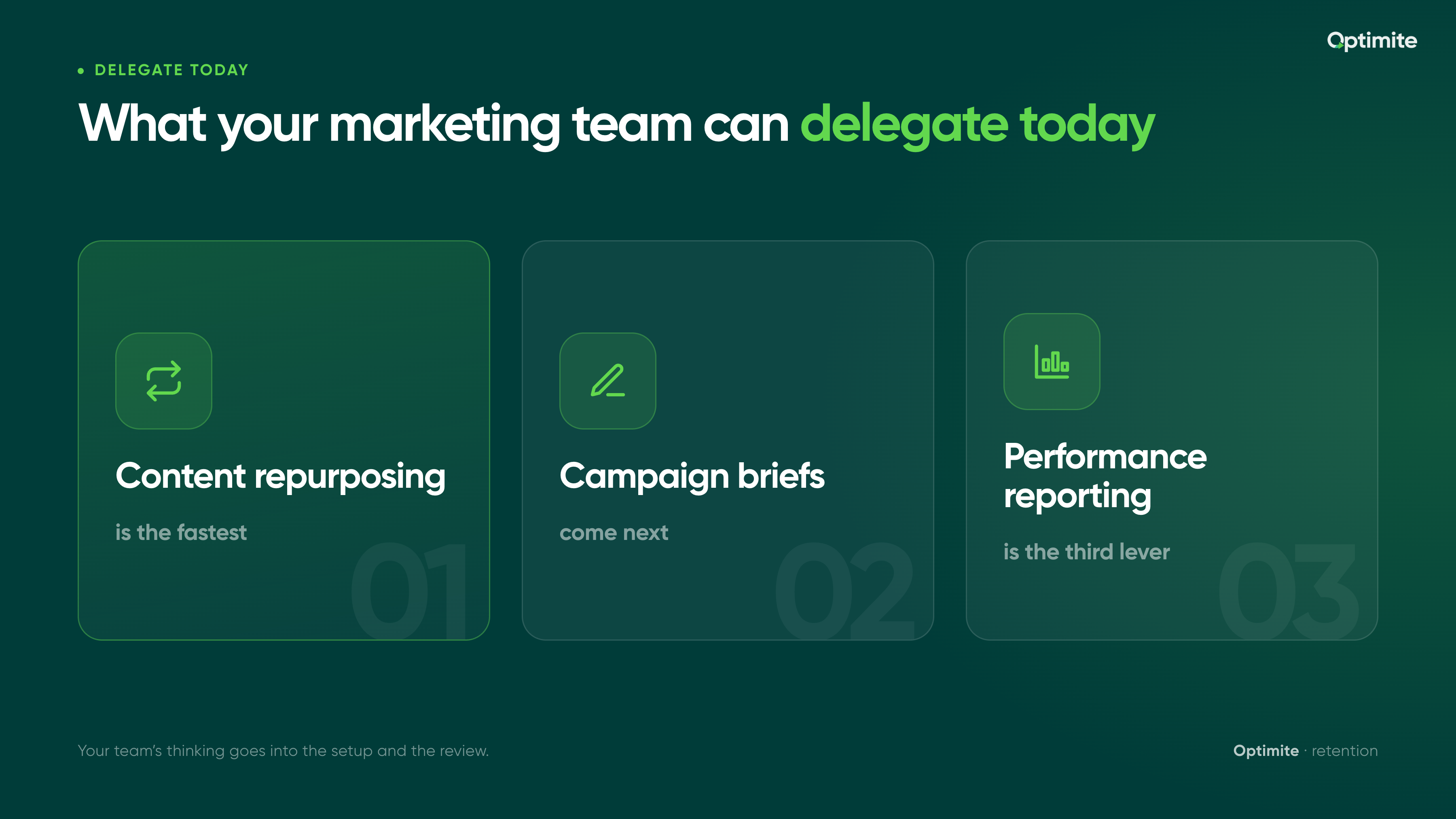
For a retention marketing team running alongside Klaviyo, the most immediate wins are in the work that wraps around the actual strategy.
Content repurposing is the fastest. One campaign email becomes an SMS, a social caption, a blog outline, and a subject line test variant. Cowork works against your brand voice doc, so the output stays consistent without someone reformatting each version manually.
Campaign briefs come next. Upload your brand voice doc and your best-performing recent emails. Feed in the campaign angle and the product. Cowork drafts the brief structure, and your copywriter refines it.
Performance reporting is the third lever. Connected to your data sources, Cowork pulls the numbers, assembles them against your template, and surfaces the output. Your team reads the report and acts on it.
The pattern across all three is the same. Your team's thinking goes into the setup and the review. The execution in between stops being manual.
What it does for ops and the founder
The value for a DTC founder goes well beyond marketing.
Scenario modelling used to require a CFO or a consultant. With Cowork, you upload your P&L, connect a live data source, and run plain-language scenarios: what does a 20% increase in ad spend do to margin, what does adding $4 to average order value change, what if the returns rate drops by two points. Cowork outputs the numbers and the month each impact lands, without anyone building formulas manually.
On the ops side, recurring work that nobody formally owns gets handled on a schedule:
- Inventory summaries surfaced before they become a stockout
- Competitor promotions tracked and summarised weekly
- Shared drive organisation maintained rather than left to drift
- Customer feedback from multiple sources pulled into one monthly insight doc
The founder's time is the most constrained resource in a growth-stage DTC brand. Cowork earns its place by absorbing execution work and putting that time back where it belongs.
Cowork handles the execution layer. The decisions about what to prioritise, what offer to run, and how to position a product still sit with your team.
How Cowork changes the speed of retention marketing
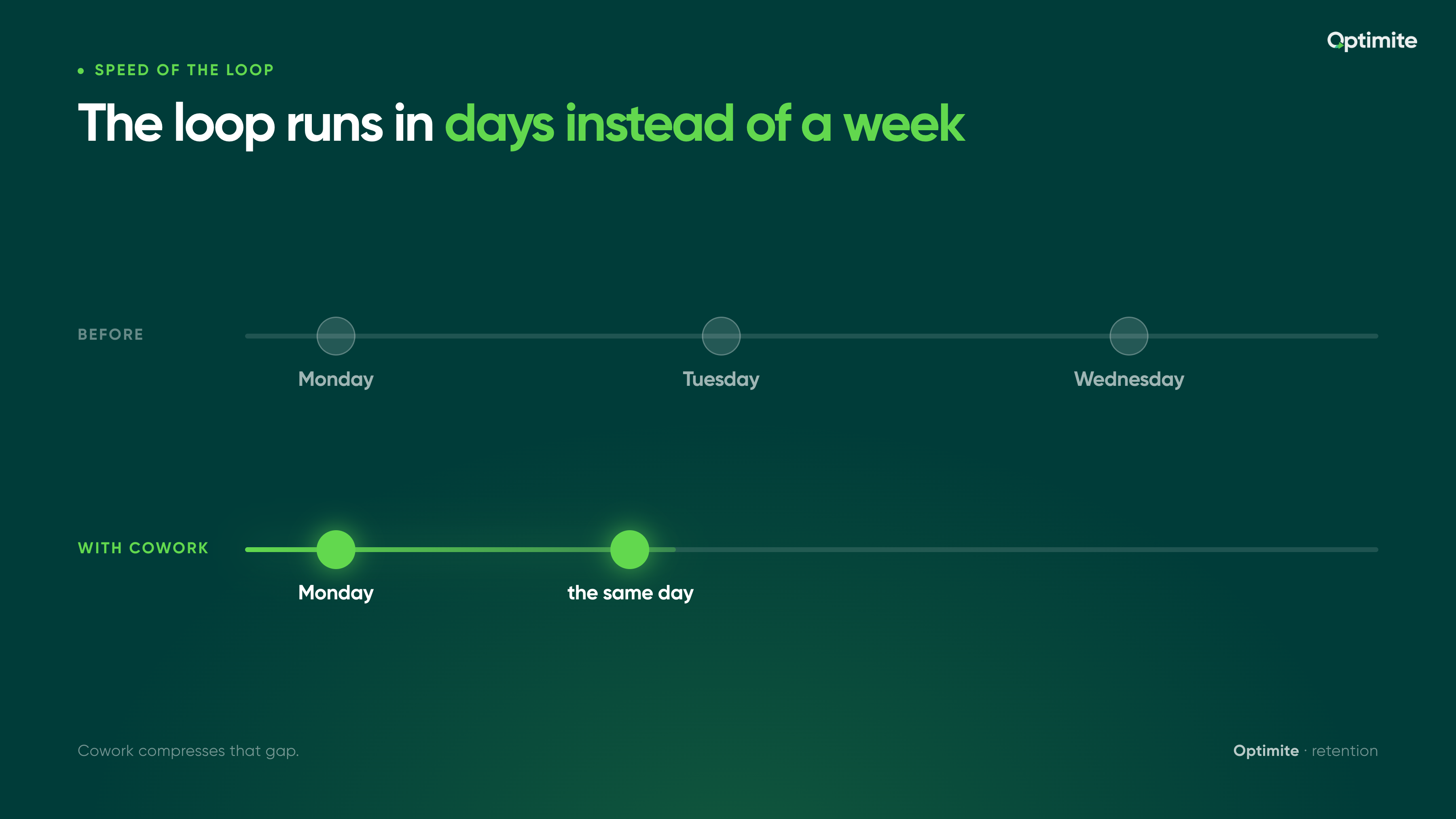
Retention marketing runs on a feedback loop. You send, you observe, you adjust. The faster that loop runs, the more revenue your programme generates.
Most DTC brands already know what needs fixing in their retention programme. They know their welcome flow needs a third email. They know their winback sequence is too generic. They know their post-purchase flow needs segmentation by product category. The gap between knowing what to fix and actually fixing it is time, and time is the one thing a lean team never has enough of.
Cowork compresses that gap. A retention strategist who spent Monday morning pulling last week's numbers, Tuesday briefing a copywriter, and Wednesday reviewing drafts can now walk into Monday with the numbers already pulled, the brief already drafted, and the review ready to happen the same day. The loop runs in days.
The other shift is in how customer data feeds into copy. Most retention teams write flow copy based on what they know about the customer segment broadly. Cowork can synthesise the actual language customers use in surveys, reviews, and support tickets and surface that directly into a brief. The copywriter works from the customer's own words, which shows up in click rates.
Where it connects to your Klaviyo retention programme
For a brand running Klaviyo, the most direct application is in how retention reporting and content work gets done week to week.
A weekly Klaviyo digest covering flow revenue, campaign revenue, and list health can run on a schedule and land in Slack on Monday without anyone pulling it. Post-purchase survey responses synthesised monthly feed directly into the copy updates your flows need. A lapsing cohort identified from export data gets briefed into a re-engagement outline ready for a strategist to review.
The compounding effect builds over time. Every week of automated reporting is a data point. Every synthesised insight makes the next brief more grounded. The feedback loop between what your customers do and what your retention programme does in response gets tighter month on month.
Klaviyo does not have a native Cowork connector yet. Connecting Klaviyo data currently requires an export or an MCP setup. Worth planning for before expecting fully automated retention reporting.
What to watch out for before you start
Cowork still needs a human in the loop. The model it runs on occasionally invents a statistic or gets a source wrong. For anything going to a customer or a client, a human reads it before it goes out.
Two other things worth knowing:
- Shopify and Klaviyo both require a workaround to connect. If those are your primary platforms, factor that into your setup plan.
- Vague instructions produce vague output. The more specific your brief and the richer your brand voice doc, the better everything downstream becomes.
Where to start
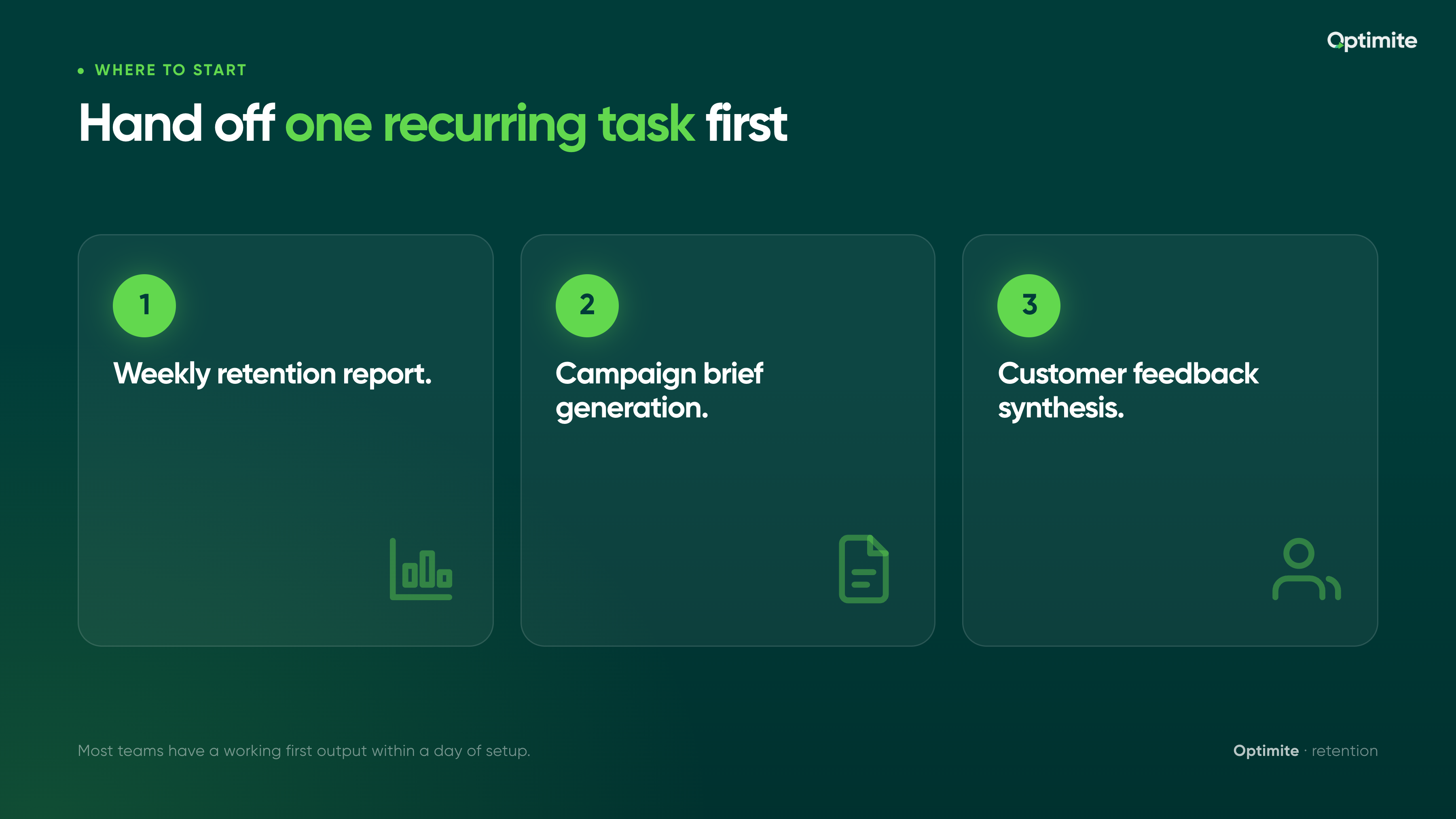
Pick one recurring task that eats two to three hours a week and hand it off first. The three starting points that work most consistently for DTC ecommerce brands:
- Weekly retention report. Connect your data, set a template, schedule it for Monday. Free up the hours your team spent building the same slide every week.
- Campaign brief generation. Give Cowork your brand voice doc and last quarter's top-performing emails. Feed in the campaign angle. Let it draft the structure your copywriter refines.
- Customer feedback synthesis. Export your last 90 days of post-purchase survey responses. Ask it to surface the top themes, the exact language customers use, and any patterns by product category.
Most teams have a working first output within a day of setup. The lift is one folder and one connected data source.
If you want to talk through how this applies to your programme, book a free call with our team.


