

9 SMS Compliance Rules Every Ecommerce Brand Needs to Know
SMS is a high-ROI channel. But it only works if you're compliant. Here are the 9 rules that separate brands from legal trouble.
 Arpit Mehar
You're running SMS campaigns. You're seeing 98% delivery rates and 20-30% click rates. SMS is working. So you send more. You're building flows, blasting urgency offers, pushing inventory alerts.
Then one day you get a cease-and-desist letter. Or your SMS provider shuts down your account. Or you get fined by the FTC.
Compliance sounds boring. It sounds like something lawyers worry about. But SMS compliance is where retention marketing meets regulation. Get it wrong and you lose the channel. You might lose your business.
Most ecommerce brands ignore SMS compliance until it's too late. They don't understand the rules. They don't know what they're risking. They just assume if it worked for everyone else, it's fine.
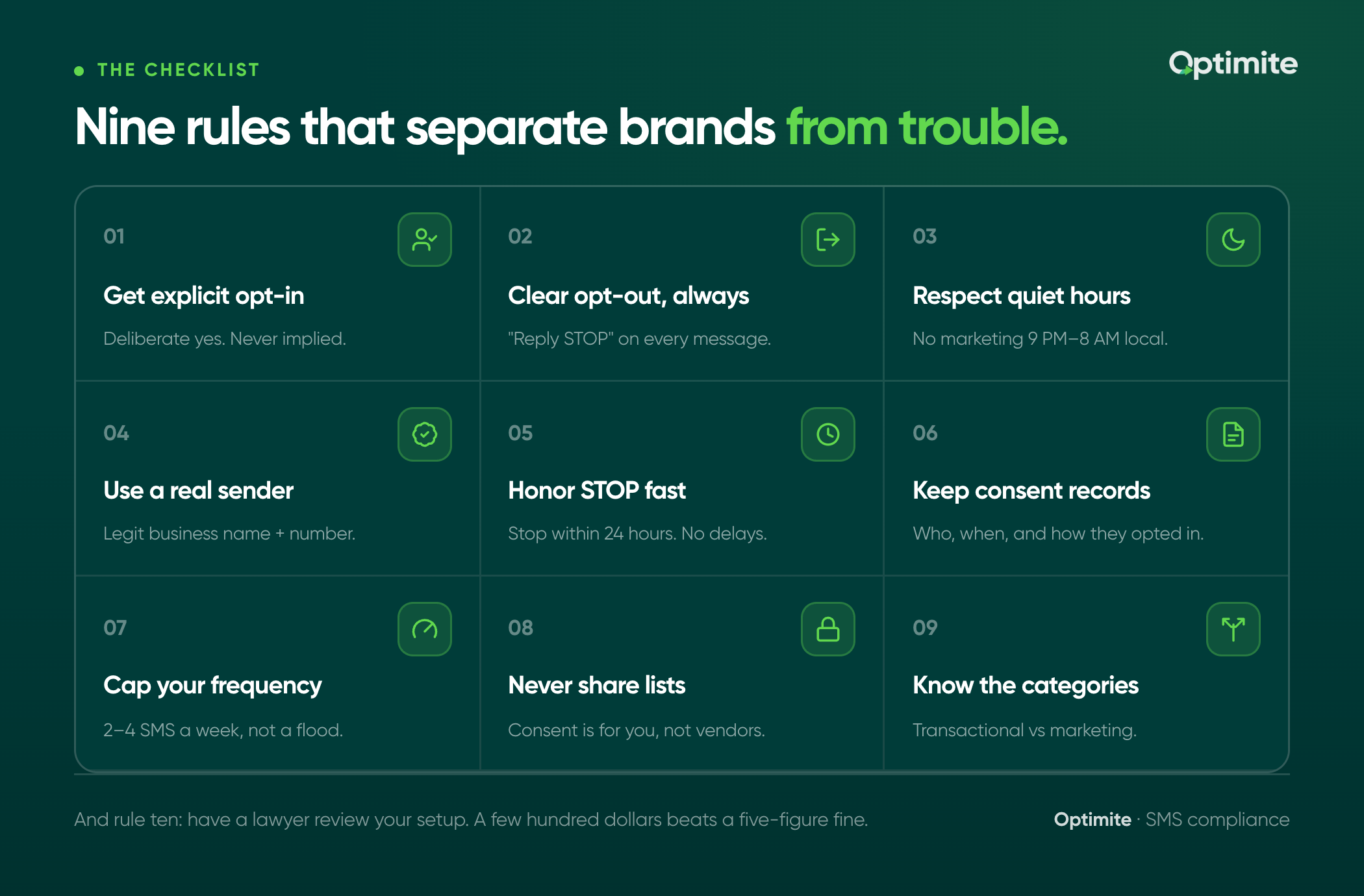
Here are nine SMS compliance rules that separate brands from trouble.
Get explicit opt-in before sending marketing SMS
This is foundational. You cannot send marketing SMS to someone unless they explicitly agreed to receive it. Not implied. Not assumed. Explicit.
A customer buys from your Shopify store. They get their order confirmation via SMS. That's transactional. You don't need explicit opt-in for transactional messages.
But marketing SMS? A promotional offer, a restock alert, an abandoned cart reminder? That's different. They have to opt in first. Deliberately. They have to say yes to receiving SMS marketing from you.
Most brands skip this step. They assume the customer's phone number in their system means consent. That assumption will cost you.
Set up an SMS opt-in checkbox at checkout. Make it clear: "Get exclusive SMS offers and updates." Let them check or uncheck. Document it. Keep records. This is your legal protection.
A food brand we work with was sending SMS to everyone in their database without explicit opt-in. We helped them implement an opt-in flow and asked existing customers to confirm their preference. They lost 40% of their SMS list, but they're now compliant. The 60% who stayed are engaged and legal.
Include clear opt-out instructions on every message
Every SMS you send must include a way for people to stop receiving messages. Not buried. Not hidden. Clear.
Standard language: "Reply STOP to unsubscribe." Some brands add "Reply HELP for support." Both work. The point is you're giving them an easy way to say no.
This is federally mandated. The TCPA (Telephone Consumer Protection Act) requires it. Ignore it and you're breaking the law.
Make opt-out easy and honor it immediately. Someone texts STOP, they should stop receiving messages within 24 hours. No exceptions, no delays.
Don't send marketing SMS between 9 PM and 8 AM
Marketing SMS sent outside business hours (9 AM to 9 PM recipient's local time) is considered harassment. The TCPA has specific rules about this. Transactional SMS (order confirmations, shipping updates) can go anytime. But marketing SMS needs to respect the quiet hours.
This sounds obvious but brands violate it constantly. Someone on the West Coast gets a flash sale alert at 11 PM. That's a violation.
If you're sending SMS to customers across time zones, you need to account for their local time. Your SMS platform should handle this. Set it up correctly from the start.
Use a legitimate business name and phone number
Your SMS needs to come from a real phone number. Not a random code. Not a shared short code you borrowed. A legitimate number associated with your business.
This matters for two reasons: legal compliance and deliverability. If customers can't figure out who's texting them, they report it as spam. That gets your number flagged.
Get a dedicated number for your business. Link it to your legal business name. Use it consistently. Make it easy for customers to know who's texting them.
Honor unsubscribe requests immediately
Someone replies STOP. That's it. They're done. You have 24 hours to make sure no more marketing SMS reaches them. After that, you're violating the law.
This sounds simple but most brands have workflows that don't honor it. Someone unsubscribes and they still get messages from different flows. Nightmare scenario.
Your SMS platform and your email platform need to sync. If someone unsubscribes from SMS in Klaviyo, make sure they're not getting hit by a different flow in another tool. Audit your unsubscribe flow quarterly.
If you get sued for SMS violations, the plaintiff's lawyer will request your unsubscribe records. If you can't prove you honored unsubscribe requests, you lose. Hard stop.
Track and maintain consent records
Keep records of who opted in, when they opted in, and how they opted in. This is your legal protection.
A customer says you never got their consent? You have documentation proving you did. You're protected.
Your SMS platform should have audit trails. It should show consent dates, opt-in methods, and modification history. If your platform doesn't have this, switch platforms. This isn't optional.
A fashion brand was sued for SMS violations. They didn't have consent records. They lost the case and paid 50K in damages. Now they keep meticulous records of every consent action.
Keep your messaging frequency reasonable
You can't spam people. There's no legal definition of "too many," but excessive messaging is a violation. The FTC will look at what's reasonable for your industry and use that as the benchmark.
For most ecommerce, 2-4 SMS per week is reasonable. More than that and you're asking for trouble. People will report you as spam. Your number gets flagged. Your SMS delivery tanks.
Document your message frequency. Be able to explain why you're sending that many messages. If you can't justify it, lower it.
Don't share SMS lists with third parties without consent
You have a customer who opted into your SMS program. That consent is for you. Not for your affiliate partner. Not for your supplier. Not for anyone else.
Sharing their phone number without explicit permission to do so is a compliance violation. They opted into receiving SMS from your brand, not everyone.
This is where vendors become a liability. If your third-party SMS vendor is selling customer lists or sharing data, you're liable.
Use vendors you trust. Read their privacy policy. Make sure they're not sharing data. Document everything.
Know the difference between transactional and marketing SMS
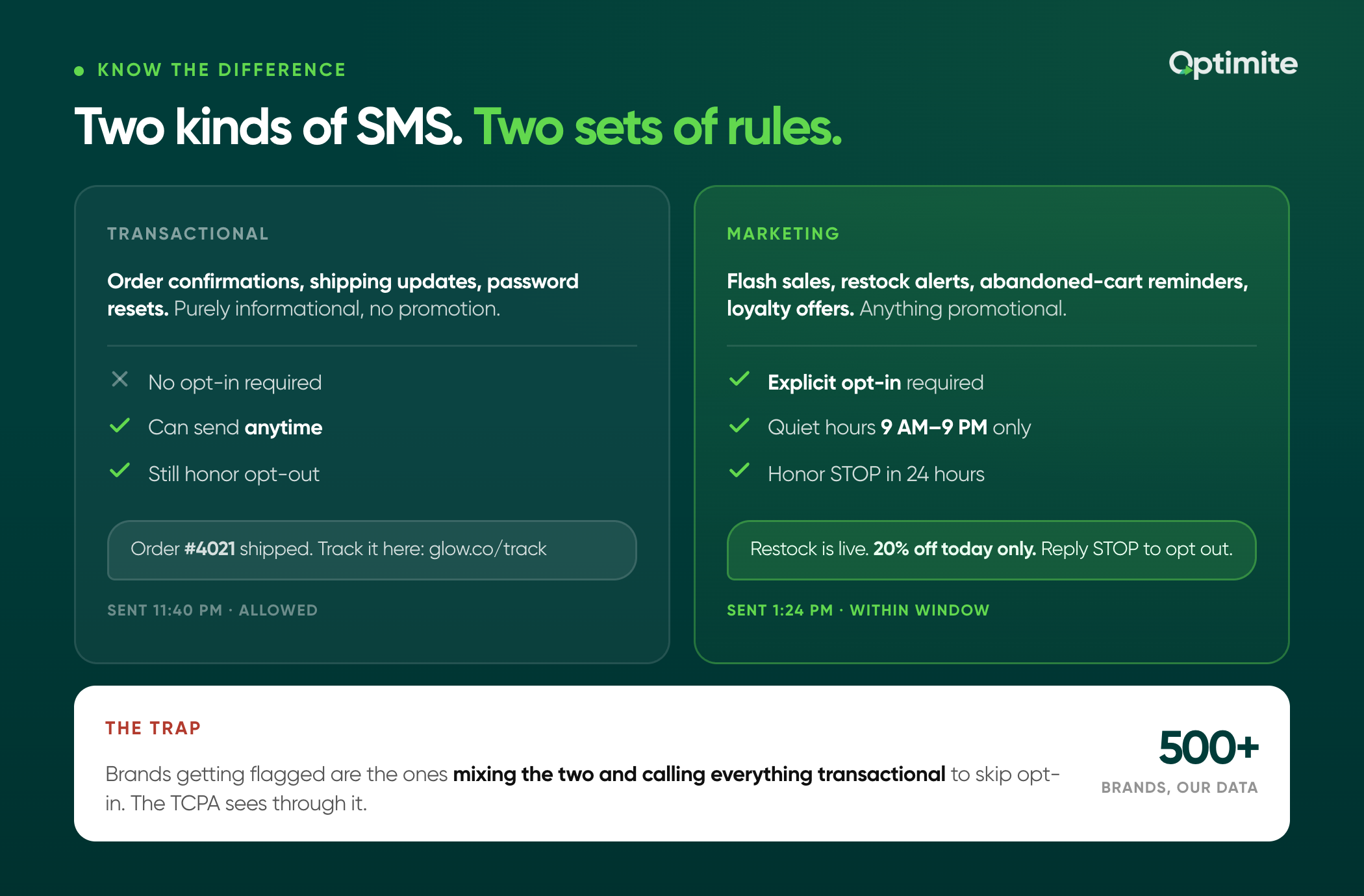
Transactional SMS is order confirmations, shipping updates, password resets. These have no promotional content. They're purely informational.
You don't need opt-in for transactional SMS. But you still need to honor opt-out requests. And you still can't send them between 9 PM and 8 AM in the recipient's time zone. Wait, actually, transactional can go anytime. That's the benefit.
Marketing SMS is promotional. Flash sales, new product alerts, restock reminders, loyalty offers.
The line between these can get blurry. A shipping update with "Shop similar products" in the footer is now partially marketing. The TCPA cares about this distinction.
Build your SMS with clear categories. Know what's transactional and what's marketing. Don't blur the line to avoid compliance rules.
According to our data across 500+ SMS-sending brands, the ones getting flagged for compliance violations are the ones mixing transactional and marketing messages and calling everything transactional to avoid opt-in requirements.
SMS is one of the highest-ROI channels for retention. But it only works if you're doing it legally. Compliance isn't the fun part of SMS. It's the part that keeps you from getting shut down.
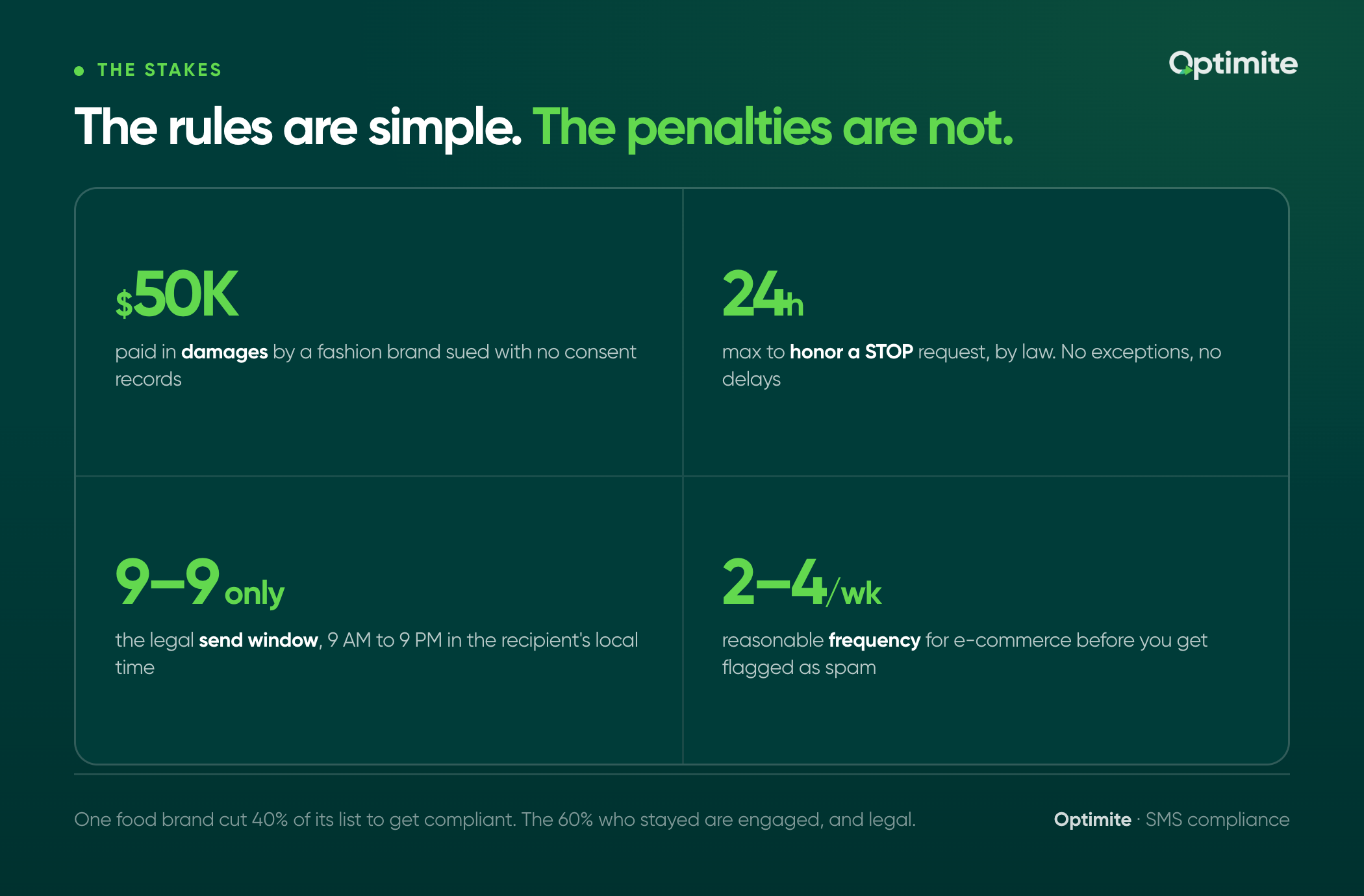
Get opt-in. Track consent. Honor opt-outs. Keep good records. The rules are straightforward. The consequence of breaking them is not.
If you're running SMS and you're not sure you're compliant, that's a red flag. Audit your current setup. Talk to your SMS provider. Better yet, talk to a retention specialist who can walk through your SMS flows and flag compliance gaps. We work with brands across wellness, fashion, food and beverage, and beauty and we've helped dozens of brands rebuild their SMS programs to be both compliant and high-performing.
SMS compliance takes an afternoon to set up right. SMS non-compliance takes weeks and thousands of dollars to fix.
Keep reading.
All posts
Using AI to Personalise SMS Without Burning Your Unsubscribe Rate
Shrestha Ghosal · Jun 24, 2026

Post-Purchase Email Sequence: The 5 Emails Every E-commerce Brand Needs
Shrestha Ghosal · Jun 17, 2026

How to Test Email Subject Lines Without Wasting Your List
Arpit Mehar · Jun 16, 2026