

8 SMS Sending Mistakes That Kill Conversion
Timing, copy, and targeting mistakes cost brands thousands in lost SMS revenue. Most are fixable in a day.
 Arpit Mehar

You're running SMS campaigns. Open rates are solid. Click rates are decent. Revenue is flowing.
Then one day you realize you're leaving money on the table. Half your SMS traffic converts at 2%. Half converts at 8%. Same channel. Same list. Different execution.
The difference isn't luck. It's mistakes.
Most SMS mistakes don't get caught until the damage is done. A campaign runs for a month. Conversion is weak. You assume SMS isn't working for your vertical. So you kill the channel. What you actually did was make eight preventable errors.
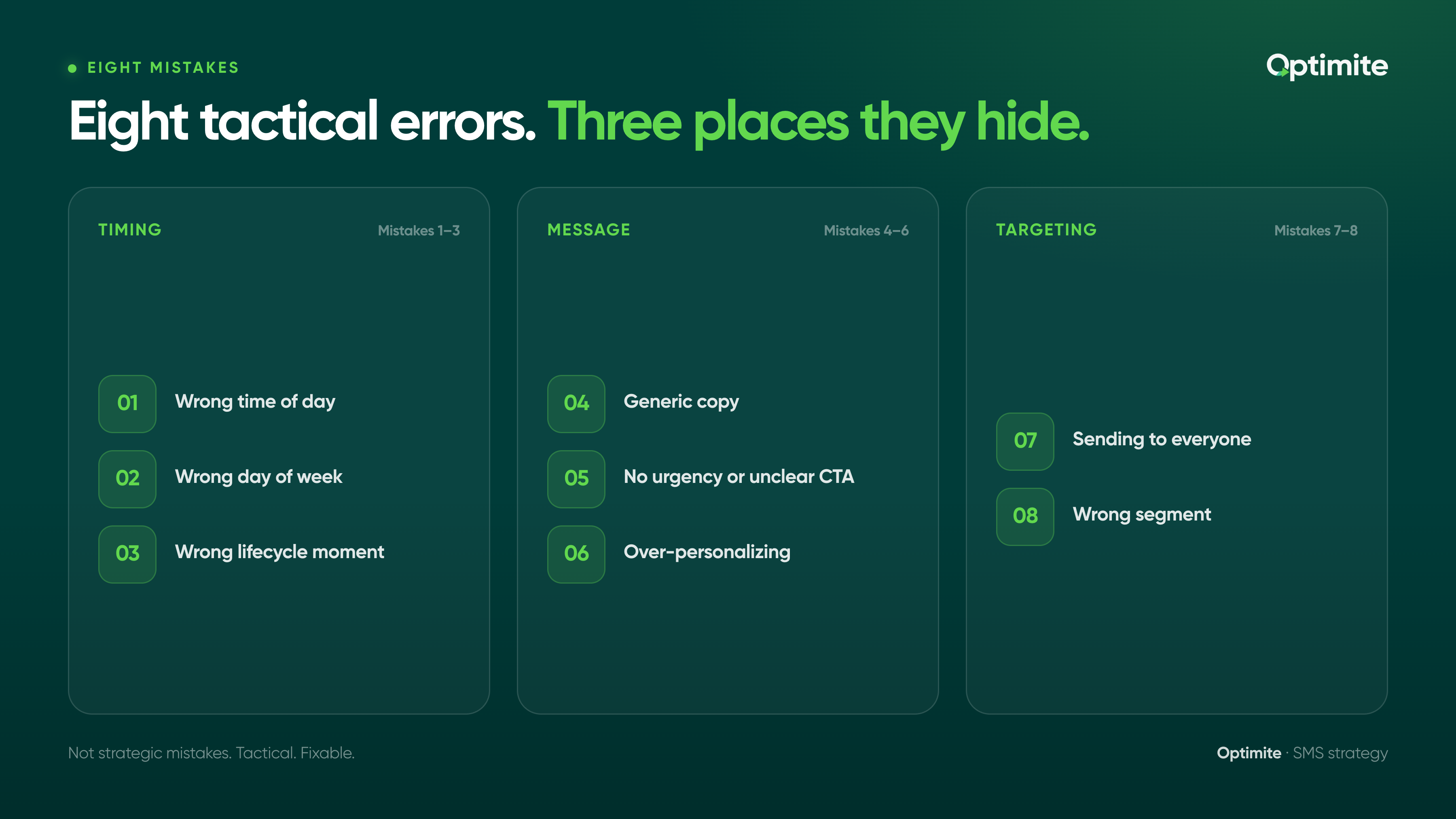
This post walks through the eight SMS sending mistakes that kill conversion. What they look like. How much they cost you. How to fix them.
The real cost
Brands making these mistakes see SMS conversion rates of 2-3%. Brands avoiding them see 8-12%. That's a 300-400% difference on the same channel, same audience, same volume.
For a brand doing $3M in annual revenue with SMS generating 15% of that (typical for retention-focused brands), the difference between 3% and 8% SMS conversion is $75,000 in annual revenue.
Most of that gap comes from eight tactical mistakes. Not strategic mistakes. Tactical. Fixable.
Timing mistakes: The silence killer
Timing destroys SMS before copy even matters. Send at the wrong time and customers don't see the message. They don't engage. Conversion collapses.
Mistake 1: Sending at the wrong time of day.
You send a flash sale SMS at 7 AM. East Coast wakes up, sees it, ignores it. By 9 AM it's buried. West Coast sees it at 4 AM and deletes it. Middle of the country sees it at a dead hour.
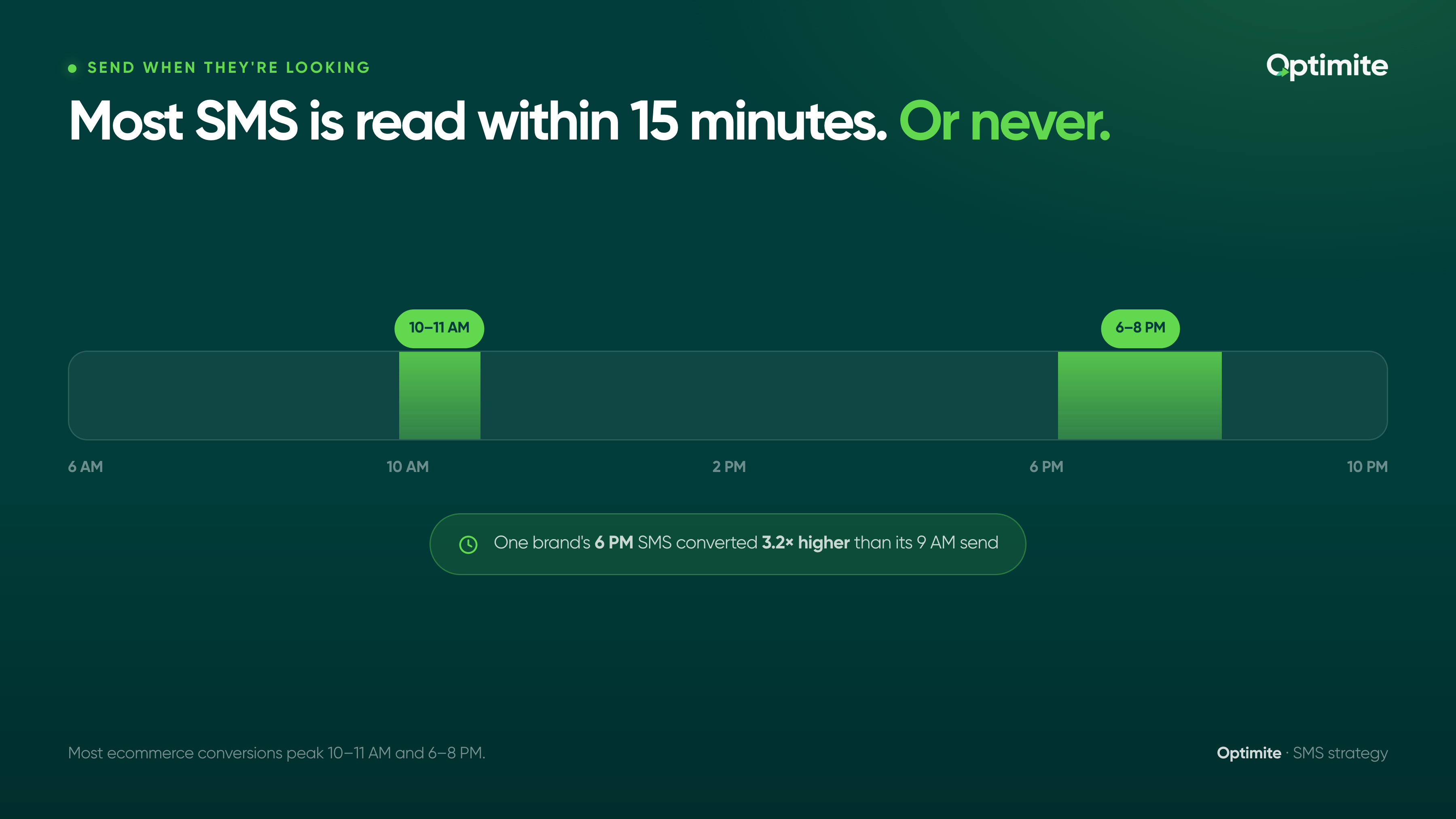
SMS has a short shelf life. Most people read it within 15 minutes or not at all. Timing determines visibility.
The signal: Test different send times for your audience. Most ecommerce conversions peak 10-11 AM and 6-8 PM. Flash sales do better evening. Reminders do better morning. Track by time and optimize.
A food brand tested timing and found their 6 PM SMS had 3.2x higher conversion than their 9 AM SMS. They moved all flash sales to 6 PM. Conversion jumped 40%.
Mistake 2: Wrong day of week.
You send a promotional SMS on Friday evening. Customers are thinking about weekend plans, not shopping. By Monday they've forgotten about the offer.
Different verticals have different peak days. Fashion peaks Tuesday-Thursday. Groceries peak Sunday-Monday. Fitness peaks Monday. You're sending on your schedule, not their buying schedule.
The signal: Test send days. Monday-Thursday generally outperform Friday-Sunday for ecommerce. But test your specific vertical. A beauty brand might find that Tuesday-Wednesday converts 2x higher than Friday.
Mistake 3: Wrong moment in customer lifecycle.
You send a replenishment reminder SMS 3 days after purchase. Too early. Customer is still receiving shipping notifications. Your message gets lost in the noise.
Or you send the same reminder 90 days after purchase. Too late. Customer already bought elsewhere or decided they don't need a reorder.
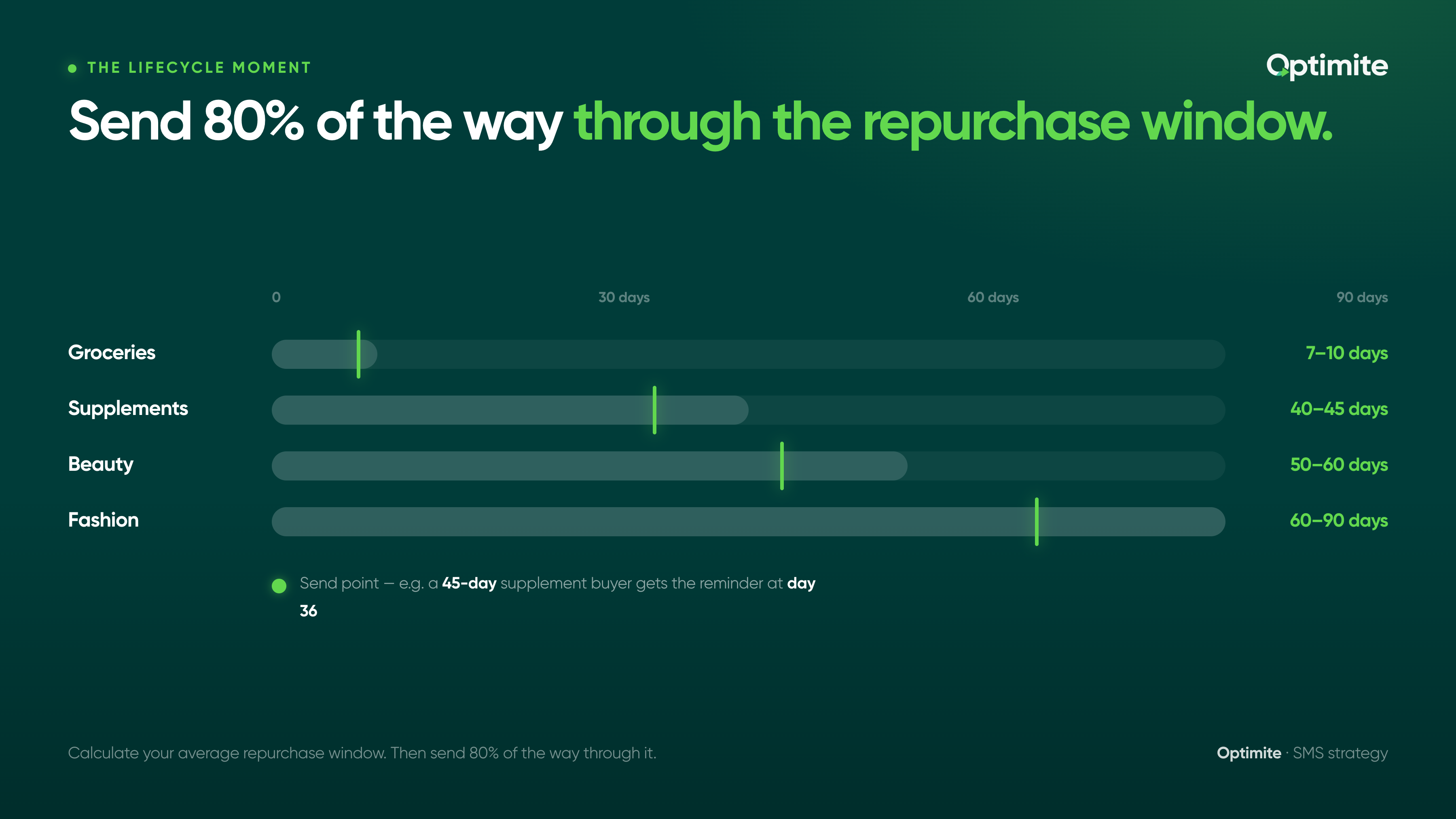
The sweet spot is different for every product. Supplements: 40-45 days. Beauty products: 50-60 days. Fashion: 60-90 days. Groceries: 7-10 days.
The signal: Calculate your average repurchase window. Then send 80% of the way through it. A supplement customer buys every 45 days. Send at day 36.
Timing is 60% of SMS performance. Copy is 40%. Get timing right and weak copy still converts. Get timing wrong and great copy dies.
Message mistakes: The copy killer
Timing is right. Now it's copy's job. Message mistakes kill conversion even when timing is perfect.
Mistake 4: Generic copy that doesn't convert.
You send: "New collection just dropped. Shop now."
Every brand sends this. It's invisible. Customer sees it and feels nothing. They delete it.
Compare to: "We just launched the collection you pre-ordered last month. Your items are ready."
Specific. Personal. Actionable. Same CTA. Totally different conversion.
The signal: Your SMS copy needs a point of view. Not just "shop now." But "this is why now." Product restock? "Back in stock after 6 weeks." Flash sale? "50% off for the next 2 hours." Urgency.
A fashion brand changed from generic SMS to specific, personalized SMS. Conversion jumped from 2.8% to 7.1%. Same audience. Same list. Different copy.
Mistake 5: Missing urgency or unclear CTA.
You send: "Check out our summer collection."
Then? The customer doesn't know. No deadline. No clear action. They read it and think "I'll do that later." Later never comes.
Compare to: "Summer collection. 24 hours only. Shop now."
Clear action. Clear deadline. 3x higher conversion.
The signal: Every SMS needs urgency (time limit, scarcity, exclusivity) and a single clear CTA. Not "shop" or "learn more." But "Shop the sale" or "Reserve yours." The verb + the offer.
Mistake 6: Over-personalizing to the point of creepy.
You send: "Hey, we noticed you looked at the blue running shoes on Thursday at 3
PM, abandoned your cart 6 times, and searched 'running shoes' 23 times last month."Creepy. The customer reads that and thinks "How much are they watching?"
Compare to: "Your size of the blue running shoes is back in stock."
Personal. Helpful. Not invasive.
The signal: Personalize based on data the customer knowingly shared (purchase history, product tags) or behavior you'd expect to use (abandonment). Don't personalize based on surveillance data (browsing timestamps, search frequency, dwell time). It feels invasive.
Over-personalizing kills SMS faster than generic copy. Customers unsubscribe from "we know too much" faster than they unsubscribe from "we don't know you."
Targeting mistakes: The waste killer
Timing is right. Copy is sharp. Now targeting determines if it reaches the right person.
Mistake 7: Sending to everyone.
You send a flash sale SMS to your entire database. 10,000 people. New customers and VIPs get the same message. Same offer. Same urgency.
A new customer sees "30% off" and thinks that's the regular discount. They don't perceive urgency. They don't convert. A VIP customer sees the same offer they get every week. They're annoyed. They unsubscribe.
One message to everyone. Multiple problems.
The signal: Segment by customer type. New customers get different offers than repeat customers. VIPs get exclusive early access. First-time buyers get incentive to reorder. Repeat customers get loyalty. Different segments, different messages.
A supplement brand sent the same SMS to everyone. Conversion: 2.1%. They segmented by customer type (new vs. VIP vs. repeat). New customers got incentive offers. VIP got exclusive access. Repeat got loyalty rewards. Average conversion: 6.8%.
Mistake 8: Sending to the wrong segment.
You have a "restock reminder" SMS for repeat customers. But it goes to everyone who bought once. A one-time buyer gets the message and unsubscribes because the product doesn't apply to them anymore.
Or you send a "VIP early access" SMS to customers who've spent under $50. Not really VIP. They feel like they don't qualify. They get annoyed.
Segmentation is off. Messages go to the wrong people.
The signal: Define your segments clearly. VIP = $500+ lifetime value. Repeat = purchased 3+ times. New = purchased once in last 30 days. Active = opened email in last 30 days. Then build SMS flows to match segments, not send everything to everyone. Want to level up your segmentation? Learn three Klaviyo tricks to build behavioral segments that actually convert.
A beauty brand clarified their segment definitions and rebuilt their SMS flows. Wrong-person SMS dropped from 35% to 8%. Right-person conversion climbed from 4% to 9%.
SMS audit checklist
Before you send another SMS campaign, run through this checklist.
- Timing: Is this the right time of day for my audience? (Test if unsure)
- Day: Is this the right day of week? (Tuesday-Thursday generally win)
- Lifecycle: Am I sending at the right moment in their customer journey? (Early, mid, late)
- Copy: Is my message specific and pointed, or generic and forgettable?
- Urgency: Does my SMS have a deadline or reason to act now?
- CTA: Is there one clear action the customer should take?
- Personalization: Am I personalizing with helpful data or invasive surveillance?
- Segment: Am I sending to the right people or blasting everyone?
Score yourself 1-10 on each. If you're below 8 on any, fix it before sending.
The brands winning at SMS aren't sending more. They're sending smarter. Better timing, better copy, better targeting. Same number of messages. 3-4x higher conversion.
Start with your weakest area from the checklist. Fix that one thing. Measure. Then move to the next.
One week to implement this. One month to measure impact. Most brands see 30-50% conversion lift by fixing these eight mistakes.
Want help auditing your current SMS strategy or building a conversion-optimized SMS system? Let's talk. We work with ecommerce brands across wellness, fashion, food, and beauty to build SMS strategies that actually convert. Browse more guides on email, SMS, and retention.
Keep reading.
All posts
Using AI to Personalise SMS Without Burning Your Unsubscribe Rate
Shrestha Ghosal · Jun 24, 2026

Post-Purchase Email Sequence: The 5 Emails Every E-commerce Brand Needs
Shrestha Ghosal · Jun 17, 2026

How to Test Email Subject Lines Without Wasting Your List
Arpit Mehar · Jun 16, 2026