

7 Purchase Intent Signals AI Can Read in Klaviyo That Email Marketers Used to Miss Entirely
The behavioural signals that were always in your data. Here is what they mean and what to do when AI surfaces them.
 Shrestha Ghosal
The data was always there. Browse behaviour, time-on-site patterns, SMS click timing, product page revisits, and how long someone sat on a checkout page before leaving. Klaviyo has been collecting it for years. The problem was never access to the signals. The problem was that reading them manually, at scale, across a list of 50,000 contacts with 8 SKUs and three acquisition channels, was effectively impossible.
AI changes that. Not by creating new data, but by reading existing data faster and more accurately than any manual segment rule can. The result is a set of purchase intent signals that most email marketers were never able to act on, now surfaced and actionable in near real time.
Here are seven of them.
Repeat product page visits without a purchase
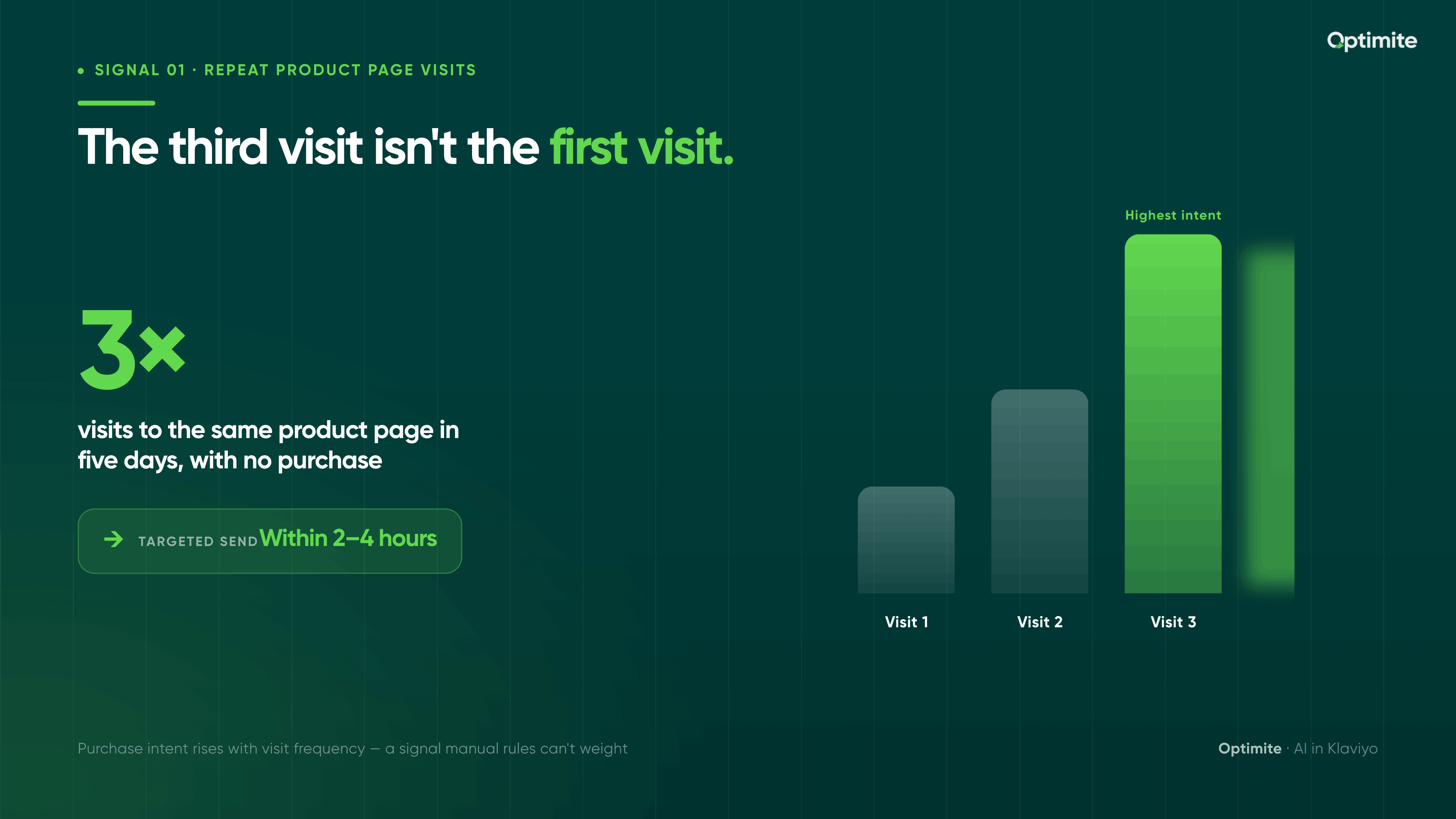
A customer who visits the same product page three times in five days and doesn't buy is telling you something precise. They're interested. Something is stopping them. Manual segmentation can flag a browse abandonment if someone views a product and leaves, but it can't weight the signal of a third visit differently from a first. AI segmentation can.
The third visit to a product page carries significantly higher purchase intent than the first. When AI identifies that pattern, the right response is a targeted send within a short window, typically 2 to 4 hours, that addresses the most common friction points for that product category. For a wellness supplement, that might be a guarantee reminder or a review pull. For a fashion item, it might be a low-inventory signal or a size availability update.
The send that fires after visit one and the send that fires after visit three should be different. Without AI reading visit frequency, they're usually identical.
SMS click followed by email open within 24 hours
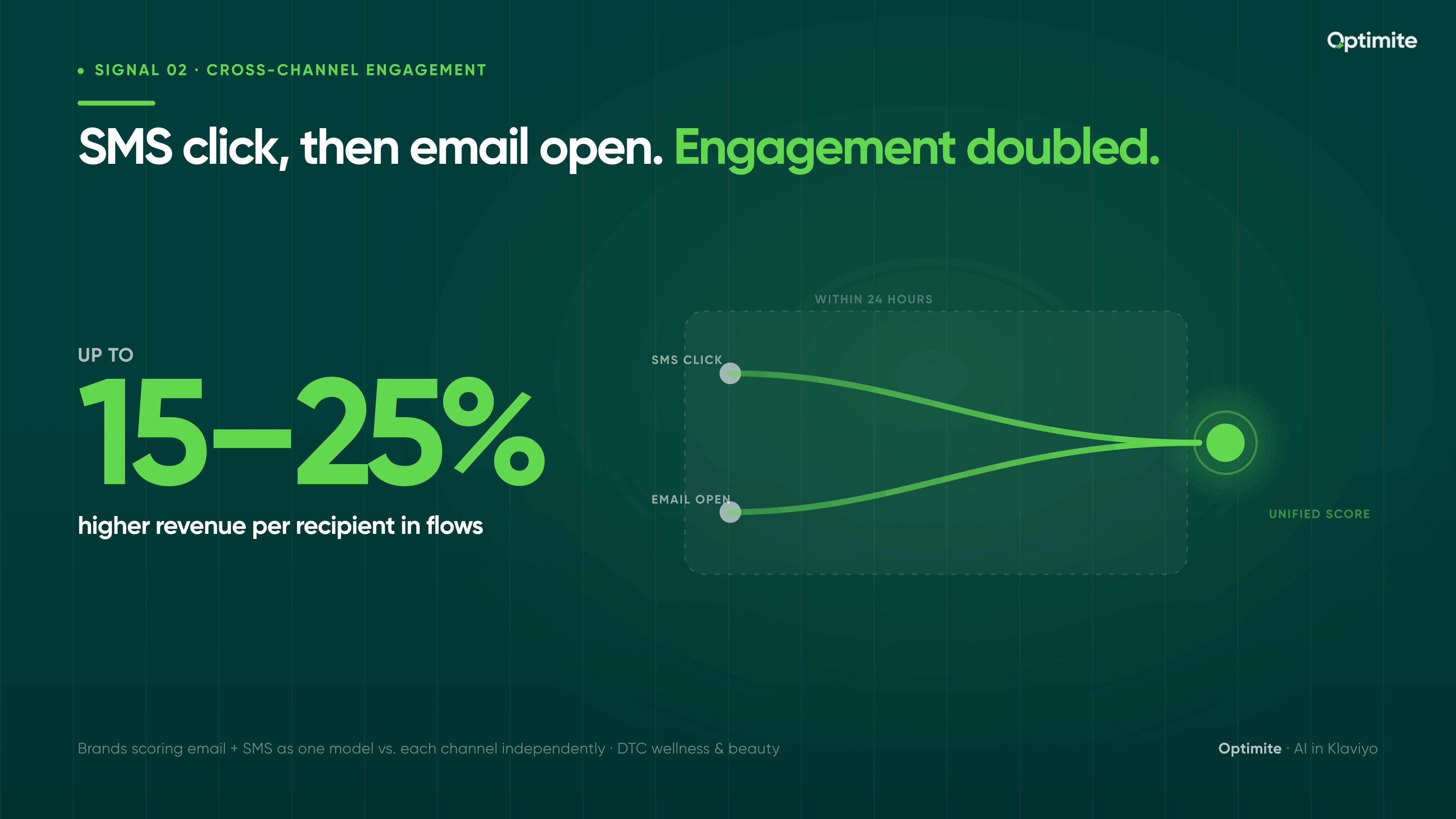
Cross-channel engagement clustering is one of the clearest purchase intent signals available, and one that purely email-focused marketers miss by design. When a customer clicks an SMS and then opens an email within the same 24-hour window, their engagement score has just doubled without any single channel indicating it.
AI reads the combined signal across both channels. A customer doing this is in an active consideration phase. They're seeking information about a purchase decision, not passively receiving your communications.
Brands coordinating email and SMS into a unified engagement scoring model see 15 to 25% higher revenue per recipient in flows compared to brands scoring each channel independently, based on patterns across DTC brands in the wellness and beauty verticals.
The flow response to this combined signal should be different from a response to either signal alone. A high-value personalised send with a clear path to purchase, ideally with social proof or a time-limited incentive, converts this intent window at a higher rate than a standard nurture email.
Cart abandonment with a return visit to the cart
Standard cart abandonment logic treats all abandonment the same. Customer added items, didn't complete checkout, receives the three-email recovery sequence. That sequence is valuable. But a customer who abandoned a cart, came back to look at it again, and still didn't buy is showing a different level of intent than someone who abandoned and never returned.
The return visit to an abandoned cart is a strong purchase intent signal that most abandoned cart flows don't account for. The customer has mentally revisited the purchase decision at least twice. The friction is real, but so is the intent.
AI segmentation can flag this pattern and route that customer into an accelerated recovery path rather than the standard sequence. A more direct message with a specific objection-handling focus, or a one-time offer that wasn't in the standard flow, converts this cohort at a meaningfully higher rate.
Build a separate segment for cart abandoners who return to the cart within 48 hours without purchasing. Even if you're not running AI segmentation yet, this cohort deserves a different message than the standard recovery sequence. The intent is there. The send just needs to match it.
Post-purchase browsing in the same category
A customer who buys a product and then browses other items in the same category within 14 days is showing cross-sell or upsell intent that most post-purchase flows ignore entirely. Standard post-purchase flows focus on the product just purchased: review requests, usage tips, repurchase reminders timed to the consumption window. That's correct logic. But it misses the customer who is already thinking about the next purchase.
For a beauty brand, a customer who buys a moisturiser and then browses serums in the same brand range within a week has a very different post-purchase profile than one who buys and disengages. For a wellness brand, a customer who buys a protein supplement and then visits the pre-workout category is signalling an interest in building a product stack.
AI identifies this browsing pattern and can trigger a cross-sell flow that's separate from the standard post-purchase sequence, timed to when the browsing signal fires rather than to a fixed post-purchase day interval. The timing match alone tends to lift conversion on these sends significantly.
Engagement spike before a seasonal window
Customers who have been low-engagement for 60 to 90 days and then suddenly open two or three emails in quick succession ahead of a known seasonal window, say BFCM, Valentine's Day, or a category-specific peak like the start of summer for fashion, are re-entering an active consideration phase.
Manual segmentation typically treats these customers as part of the broad engaged or unengaged segment, depending on how you've defined your engagement window. AI segmentation picks up the sudden change in engagement velocity and flags it as a re-engagement signal worth acting on ahead of the seasonal peak.
The practical application: a targeted pre-peak send to this cohort, positioned as early access or an exclusive preview, converts better than the general BFCM campaign because the timing matches their re-engagement moment. The customer is back in a buying mindset. The send meets them there.
High time-on-site without a click to Klaviyo
This one requires a joined-up data setup, but for brands with Shopify and Klaviyo connected properly, it's a real signal. A customer who spends significant time on the website, visits multiple pages in a single session, and then receives an email they don't click is not showing disengagement from the product. They may be showing disengagement from the email itself.
AI can identify the pattern where website engagement is high, but email click-through is low for the same customer, and adjust the send strategy accordingly. For these customers, the problem is often email content relevance or CTA clarity. A different email approach, a shorter, more direct message or a different offer framing often resolves the gap.
Without AI reading the contrast between on-site behaviour and email engagement, this cohort gets treated as low-intent and may get suppressed from key sends at exactly the wrong moment.
If your Shopify and Klaviyo data sync is incomplete, AI segmentation will read gaps in the data as disengagement signals. Audit your event tracking before building intent scoring on top of it. A signal model built on incomplete data produces confident-looking predictions that aren't accurate.
Repurchase window compression
Most brands set their repurchase flows on a fixed timer based on the average consumption window for the product category. A supplement brand might set a 30-day post-purchase trigger. A fashion brand might go to 60 to 90 days. That average-based logic works at a population level but misses the customers who are ready to buy again earlier than the average suggests.
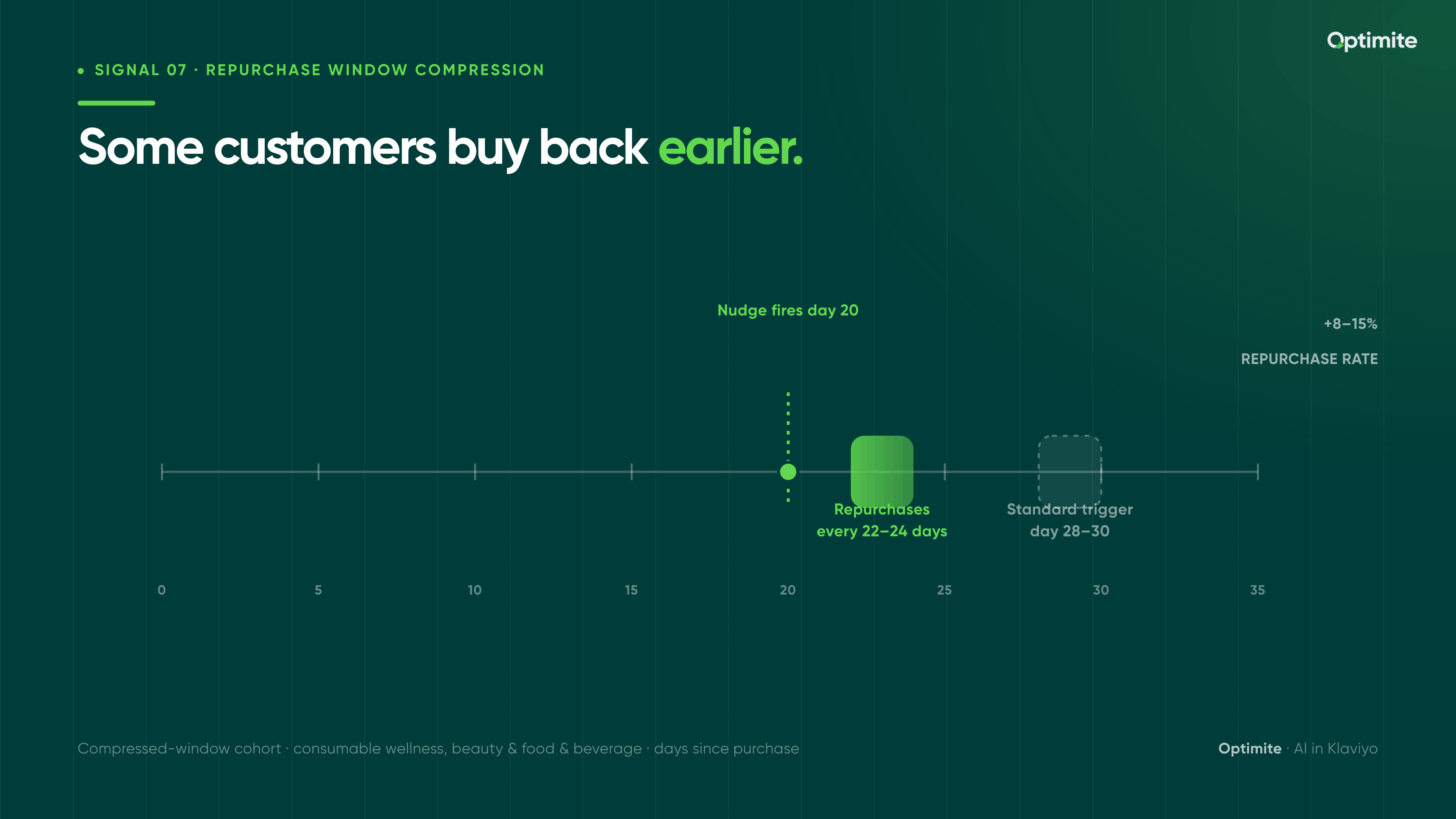
Repurchase window compression is the pattern where a specific customer consistently buys before the average window closes. A customer who repurchases a 30-day supplement every 22 to 24 days is telling you their consumption rate is higher, their household size is larger, or they're stacking the product. That customer should be receiving their repurchase nudge on day 20, not day 28.
AI identifies this pattern from as few as two to three purchase cycles and adjusts the repurchase trigger accordingly. For brands with consumable products in the wellness, beauty, and food and beverage verticals, this single signal shift can move repurchase rates by 8 to 15% for the compressed-window cohort. They're ready. The standard timing was just making them wait.
What to do with these signals
The value of surfacing these signals depends entirely on having the lifecycle flows and segmentation logic in place to act on them. A signal without a corresponding flow is just interesting data. The brands extracting real revenue from AI-assisted segmentation have built the response architecture first and let the AI improve the precision of who gets routed into it.
If your current Klaviyo setup is built on broad segment logic and fixed-interval flows, the first step is getting that foundation right. AI improves what's already there.
If you want to understand which of these signals your current retention programme is missing and what it would take to build the infrastructure to act on them, book a free call with Optimite.
Keep reading.
All posts
Claude Cowork for DTC Brands: What It Does, What Changes, and How to Start
Shrestha Ghosal · Aug 14, 2026

AI Agents in Klaviyo: What DTC Brands Need to Know
Shrestha Ghosal · Jun 24, 2026

Why AI Is Killing the A/B Test
Shrestha Ghosal · Jun 18, 2026