

5 Ways Claude Is Shortening the Gap Between Klaviyo Data and Retention Decisions
 Shrestha Ghosal
Most Klaviyo accounts are not short on data. They have flow performance reports, campaign revenue breakdowns, segment lists, customer profiles, and purchase histories. What they're short on is time to turn all of that into a decision.
A founder running a $5M wellness brand on Shopify does not have three hours a week to export dashboards, build pivot tables, and write a brief about why their post-purchase flow is underperforming. Neither does a lean retention team managing 10+ client accounts. The data sits in Klaviyo. The decisions keep getting delayed.
That gap is the real problem. And Claude is starting to close it.
In May 2026, Klaviyo expanded its integration with Anthropic to bring agentic marketing workflows directly into Claude, including Claude.ai and Claude Cowork. Brands can now connect their Klaviyo account and ask plain-language questions about their data. No exports, no custom dashboards, no waiting for an analyst. As Klaviyo co-founder Andrew Bialecki put it: "Marketing teams are drowning in reporting and repetitive production work."
Here are five specific ways Claude is cutting the time between having Klaviyo data and doing something with it.
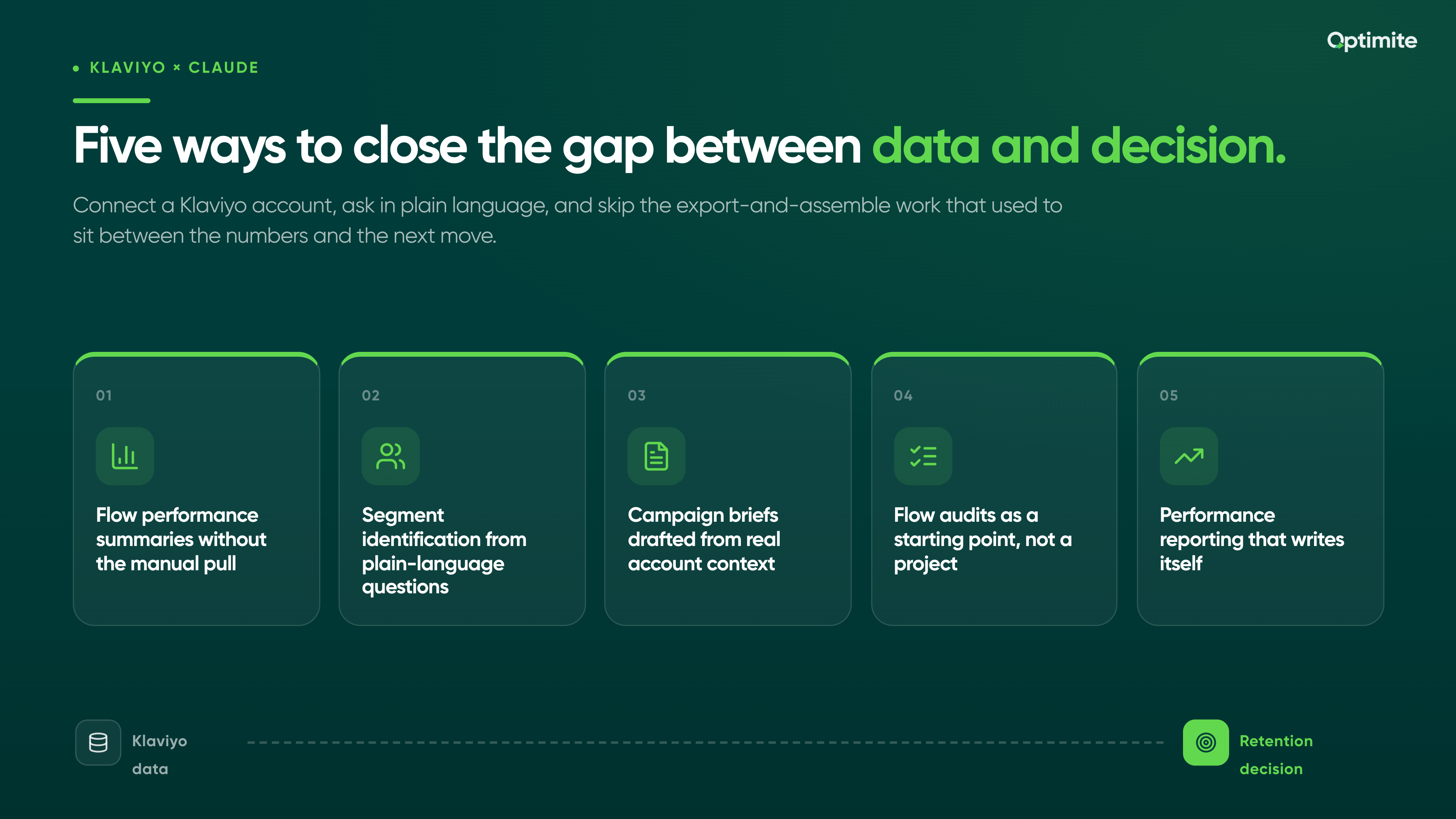
Flow performance summaries without the manual pull
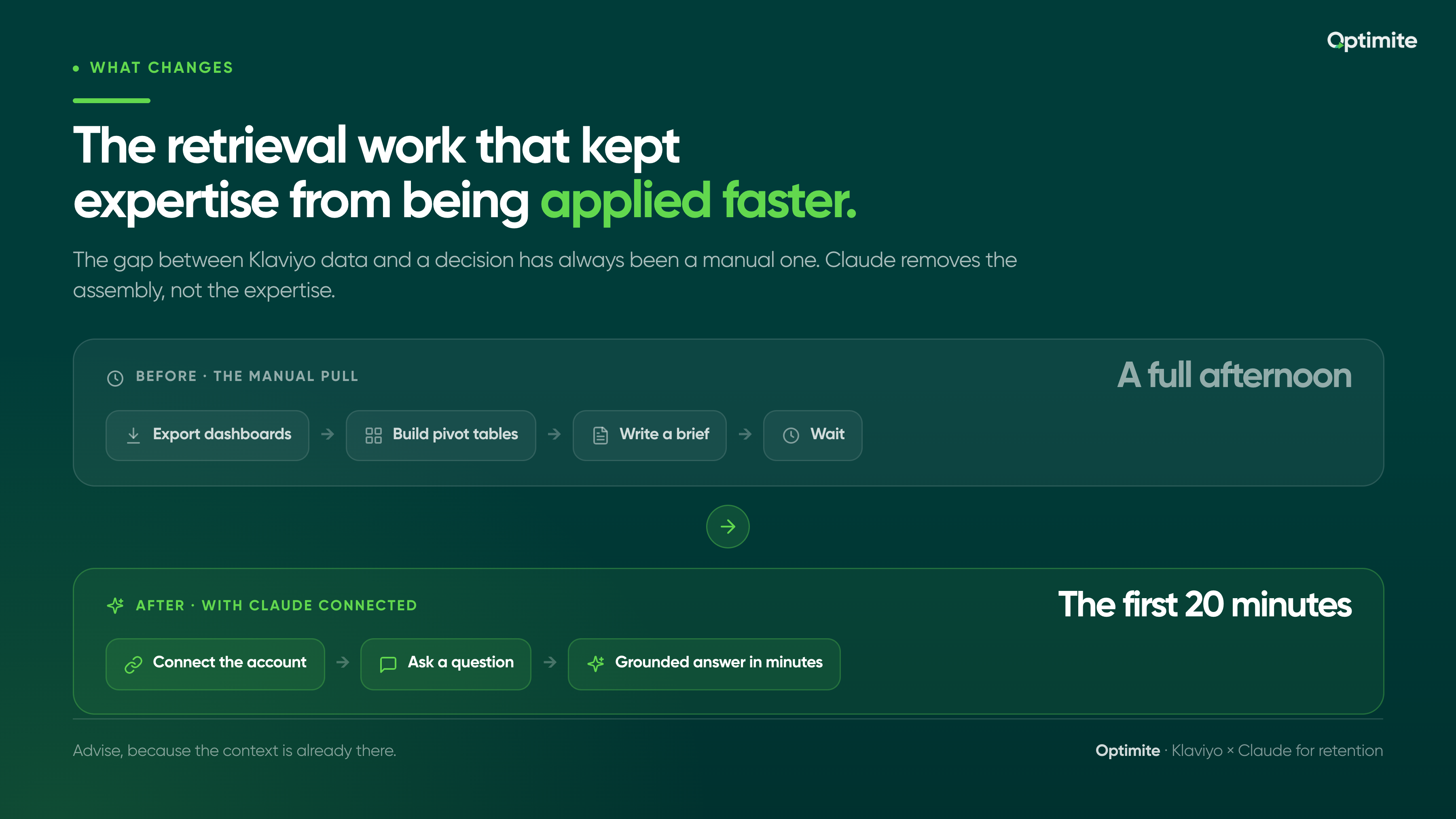
Before this integration, getting a clear picture of how your flows were performing meant going into Klaviyo, pulling each flow report individually, manually comparing open rates and revenue per recipient, and making sense of what was actually worth fixing. For a brand with eight to twelve active flows, that process could take a full afternoon.
Claude can now pull that data directly from Klaviyo through the MCP connector and return a structured summary in minutes. You can ask something like "How is my abandoned cart flow performing compared to last quarter?" and get a direct answer grounded in your actual account data, not a generic benchmark response.
For retention teams managing multiple brands, this compounds fast. Instead of manually reviewing every flow for each client before a strategy call, Claude can surface the performance gaps that matter most and let the team focus on fixing them.
Automated flows account for roughly 37% of all email-generated revenue in e-commerce, despite making up just 2% of total send volume, according to Omnisend's 2026 dataset. If a flow is underperforming, the revenue cost is real and immediate.
The key shift here is not just speed. When the summary is generated from live data, the decisions made from it are more current. A flow that was performing well in February but dropped in April shows up in the question you asked today, not in a report you pulled last month.
Segment identification from plain-language questions
Segmentation is one of those things most brands know they should do more of, and consistently do less of than they intend to. The barrier is almost never strategic. Founders understand why segmenting by purchase frequency or product category matters. The problem is that pulling those segments requires knowing exactly where to look in Klaviyo, building the right filter logic, and then doing something with the list once it exists.
Claude changes the starting point. You can ask: "Find customers who haven't purchased in 90 days but opened emails in the last 30 days." Claude accesses the Klaviyo data and returns the segment without you needing to build the filter logic manually.
This matters for retention decisions in a few specific ways:
- Win-back campaigns can be scoped and briefed faster when the at-risk segment is already defined
- Supplement brands with 30- or 60-day repurchase windows can identify customers approaching the churn threshold before they fall off
- Fashion brands running seasonal flows can see who purchased during the last sale window but hasn't engaged since
Use Claude to identify your "almost lapsed" segment before you build the re-engagement campaign, not after. A customer who opened three emails but hasn't bought in 75 days is a different conversation than one who has gone fully dark. Claude can split those groups from a single question.
The output is not a finished campaign. But it narrows the decision down to a specific group with a specific behaviour, which is exactly where a good retention strategy starts.
Campaign briefs drafted from real account context
This is where Claude does something most reporting tools cannot. Once the data is in context, Claude can move from analysis to draft output in the same conversation. You ask about a segment. Claude tells you what it found. You ask Claude to draft a re-engagement campaign brief for that segment. It does.
What makes this different from a generic brief template is that the brief is anchored in what is actually happening in the account: the segment's last purchase category, their email engagement history, the timeframe since last purchase. A brief for a wellness brand with lapsed customers who previously bought a 30-day protein supply looks different from a brief for a fashion brand chasing customers who clicked but didn't convert on a seasonal campaign.
For a DTC brand without a dedicated retention team, this is significant. The typical path from "we have a lapsed segment" to "we have a campaign live" used to involve a spreadsheet, a brief document, a copywriting briefing call, and a week of back-and-forth. Claude compresses the early part of that workflow.
Claude is a strong brief and analysis layer. It does not replace the human review step before anything goes live. Always have a retention specialist or senior marketer review what comes out before a campaign is sent. The briefs are grounded in real data, but creative judgment and brand voice still need a human sign-off.
At Optimite, we use this kind of workflow to move faster across the brands we manage. The data analysis and brief drafting that used to take the better part of a morning can now be the first 20 minutes of a strategy session, which frees the rest of the time for the decisions that actually require expertise.
Flow audits as a starting point, not a project
Auditing a retention programme properly takes time. You need to look at each flow's trigger logic, timing, content, conversion data, and how it interacts with the rest of the lifecycle. For a new client or a brand that hasn't reviewed their flows in six months, a full audit used to mean a multi-hour work session before a single recommendation could be made.
Claude can now generate an initial flow audit from your Klaviyo data. You describe what you want to audit, Claude pulls the relevant data, and you get a structured summary of what's performing, what's lagging, and where the gaps are.
This does not replace a deep strategic audit. What it does is eliminate the data-gathering phase, which is often the longest part of the job. The decisions about what to fix, in what order, and with what strategy still belong to a retention specialist. But arriving at those decisions with a clear picture of the account already in hand means better conversations and faster action.
A $3M beauty brand reviewing their flows monthly used to spend the first part of every review just pulling numbers together. With Claude connected to Klaviyo, that part is done before the review starts. The conversation moves straight to what to change.
Performance reporting that writes itself
Weekly and monthly reporting is one of the most time-consuming parts of running a retention programme, for in-house teams and agencies alike. Someone has to pull the data, compile it into a format that makes sense to a non-technical reader, add context about what changed and why, and send it somewhere useful.
Claude can generate performance summaries directly from Klaviyo data in natural language. Not a raw data export. A readable summary that explains what happened, what changed, and what to pay attention to. Klaviyo's own announcement of the expanded integration described marketers describing an outcome, like "build weekly reports," stepping away, and coming back to finished work.
For brands managing this in-house, Claude-generated summaries are most useful as a starting layer that a team member reviews and adds context to, not as the final document sent to a founder or board. The data will be accurate. The interpretation benefits from someone who knows the brand.
For ecommerce brands where the founder is still deep in operations, this is genuinely useful. Getting a clear weekly read on how the retention programme is performing without blocking three hours of someone's Thursday is the difference between data being used and data being ignored.
What this means for retention decisions in practice
The gap between Klaviyo data and a retention decision has always been a manual one. Someone had to pull the numbers, interpret them, and build the output that justified the next move. That work was real, it was valuable, and it took time that most lean teams did not have in reserve.
Claude does not eliminate the need for retention expertise. It eliminates the retrieval and assembly work that kept expertise from being applied faster. The specialist's job shifts from "spend four hours gathering context before advising" to "advise, because the context is already there."
For DTC brands running their retention programme with a small team or no dedicated retention resource at all, that shift matters. The decisions that used to require a full afternoon of setup can now start from a question and a live account connection.
If you want to understand how your Klaviyo data stacks up and where the biggest gaps in your retention programme are, book a free call with us. We'll pull your data, map your current lifecycle against benchmarks, and tell you exactly what to fix first.
Keep reading.
All posts
Claude Cowork for DTC Brands: What It Does, What Changes, and How to Start
Shrestha Ghosal · Aug 14, 2026

AI Agents in Klaviyo: What DTC Brands Need to Know
Shrestha Ghosal · Jun 24, 2026

Why AI Is Killing the A/B Test
Shrestha Ghosal · Jun 18, 2026